
The Week That Shaped the World — 9–16 October 2026
The Price of Having Different Plans
Something uncomfortable is happening between governments that are supposed to be working together. They still attend the same meetings, issue reassuring statements and speak warmly of shared interests. Then they return home and pursue rather different objectives.
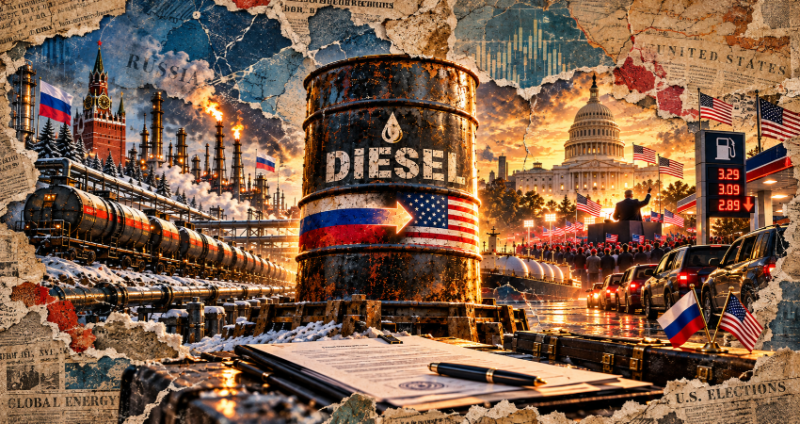
Washington wants Russian diesel back on international markets. Kyiv wants Russian refineries out of action. London and Paris are thinking about the future of European security, while Brussels is struggling to agree on how to finance its ambitions.
Elsewhere, the same difficulty takes different forms.
North and South Korea are exchanging demonstrations of military technology. India's electoral system is confronting accusations that millions of citizens are being pushed out of democratic participation. Yemen is discovering that an unfinished war rarely stays quiet indefinitely.
And the economic picture offers little comfort. Global growth continues, according to the IMF, but inflation is troubling the markets again. Asian technology shares are falling, Indonesia has discovered the extraordinary power of an index provider, and European banking integration is testing national loyalties.
These are not ten versions of the same story. They are ten reminders that political promises eventually encounter money, institutions and the limits of power.
“Governments can agree on the language of cooperation. It is considerably harder to agree on who pays for it, who benefits, and who gets the final say.”
1. Trump's Diesel Deal with Putin: The Price of Breaking Ranks
Europe spent years trying to keep Russian energy out of Western markets. Donald Trump now wants Russian diesel back in them.
On 9 October, after speaking with Vladimir Putin, Trump announced that Russia would supply more than 300,000 tonnes of diesel immediately, another 500,000 in November and further shipments thereafter. Washington issued a temporary sanctions exemption to facilitate the trade.
The explanation is less mysterious than the diplomacy. Diesel moves lorries, powers farms and helps keep industry running. When its price rises, the cost travels down the supply chain until somebody pays it at the till. With congressional elections approaching, Trump has a compelling reason to bring prices down.
Moscow has reasons of its own: export revenue, sanctions relief and an opening to Washington. Whether the extra supply will materially reduce prices remains an open question.
The Refinery Problem
There is one awkward complication. Ukraine has spent months attacking Russian refineries, and Washington has repeatedly asked it to stop.
The two capitals are measuring different costs. Kyiv sees refineries as part of the infrastructure sustaining Russia's war. Washington sees damaged refining capacity as another threat to a strained fuel market. Both calculations have a logic. They cannot easily coexist.
Trump announced an energy ceasefire, but neither warring party publicly accepted its terms. Russian attacks on Ukraine's energy infrastructure continued. On 15 October, Ukraine resumed strikes on Russian refineries, including a facility in Ryazan.
The quarrel is now openly political. Trump has suggested Ukraine needs a new president willing to negotiate. Zelensky has criticised the diesel agreement as a concession to Moscow. It is difficult to conduct a common strategy when the participants disagree on what pressure is supposed to achieve.
London's Longer Game
Kyiv is not without other partners. On 14 October, Zelensky met the British prime minister in Downing Street. Britain reaffirmed military support and discussed accelerating long-range assistance before winter. Further Storm Shadow supplies have also been reported.
Britain's commitment extends beyond missiles. Its 100-year partnership with Ukraine covers defence production, energy, investment and reconstruction. The agreement does not hand Britain Ukrainian assets. It does, however, give London a framework for long-term involvement in a country whose future remains unsettled.
France likewise wants a role in shaping Ukraine's security arrangements. Both governments have reasons to resist a settlement that leaves European interests to be decided principally by Washington and Moscow. That does not establish a plan to prolong the war. It establishes that allies may want different things from peace.
The Bill Comes Later
Trump wants cheaper fuel and a diplomatic opening. Putin wants markets and revenue. Kyiv wants to keep pressure on Russia. London and Paris want a say in the settlement.
The diesel may arrive. The political agreement behind it is another matter.
“Trump wanted cheaper diesel. What he may have purchased instead is an expensive argument with his own allies.”
2. Europe Wants Strategic Independence. Its Budget Has Other Ideas.
Europe has spent years discussing strategic autonomy. This week, somebody finally asked who intends to pay for it.
At a Brussels summit, European Union leaders clashed over the proposed budget for 2028–2034. An Irish compromise put spending at €1.62 trillion, substantially below the European Commission's original proposal. Even that proved difficult to swallow.
Germany and Sweden objected to the burden on national taxpayers. Countries dependent on agricultural and regional development funding warned against cuts. Meanwhile, Brussels insists that Europe must finance defence, industrial competitiveness, energy security and its growing international responsibilities.
Everybody supports ambition. The invoice remains unpopular.
The problem is not simply that European governments disagree about money. They disagree about what the European Union should become.
A more independent Europe requires substantial investment in defence production, infrastructure, technology and energy. Yet national governments remain accountable to voters who are dealing with high living costs, strained public services and limited economic growth.
There is also an uncomfortable contradiction in the argument over sovereignty. European leaders frequently insist that the continent must reduce its dependence on Washington. But achieving that independence would require them to surrender more resources, and perhaps greater financial authority, to Brussels.
National sovereignty, it seems, becomes remarkably precious when the bill arrives.
The budget negotiations have not collapsed permanently. Compromise remains possible, and the European Union has considerable experience of finding agreements after exhausting everybody involved.
But the argument exposes something deeper than another Brussels disagreement.
Europe has legitimate reasons to strengthen its position in a less predictable international environment. The question is whether its governments possess the political willingness to finance what they have promised.
Strategic independence cannot be manufactured from summit declarations. It requires factories, research, energy networks, military equipment and years of sustained expenditure.
Europe knows what it wants to become.
It is still negotiating the price.
“Europe wants the freedom to act independently. Its governments are discovering that independence comes without a discount.”
3. Yemen's War Returns — And Saudi Arabia Is Back in the Firing Line
Yemen's war has a habit of disappearing from international attention without ever properly ending.
This week, it returned rather violently.
Houthi forces struck Saudi Arabia's Riyadh airport earlier in October, killing three people according to Saudi authorities. Saudi-led forces responded with attacks on Houthi positions in Sanaa. On 15 October, missiles struck the presidential palace complex in Aden, killing at least five people and injuring others.
Aden is no ordinary target. It serves as the seat of Yemen's internationally recognised government, which was driven from Sanaa when the Houthis seized the capital in 2014.
The attack was therefore more than another exchange of missiles. It demonstrated the ability of the Houthis to threaten the institutions of the government they have spent years fighting.
Saudi Arabia faces an increasingly difficult calculation.
A prolonged military campaign is expensive and carries serious risks for the kingdom's infrastructure and international reputation. But withdrawing without reliable security arrangements could leave an armed adversary capable of striking airports, energy facilities and shipping routes.
For the Houthis, military pressure provides bargaining power. They control substantial territory and remain capable of disrupting regional security. Their demands include access to oil revenues, control over ports and compensation for war damage.
Yet military leverage does not automatically produce political legitimacy or economic stability.
Yemen remains one of the world's most vulnerable societies. Years of fighting have damaged healthcare, public services, agriculture and transport. Another escalation threatens people who have already endured more than enough.
There are wider consequences. Saudi Arabia is central to global energy markets, while nearby maritime routes carry international commerce through an increasingly unstable region.
A missile fired in Yemen can become a security problem in Riyadh and an insurance cost for shipping thousands of miles away.
The tragedy is that the conflict's central questions remain largely unresolved.
Who governs Yemen? Who controls its resources? And who guarantees that any ceasefire will survive the next political disagreement?
Until those questions receive credible answers, temporary calm will remain exactly that.
“A ceasefire can silence the weapons. It cannot settle the argument over who owns the country when the shooting stops.”
4. North Korea's Missiles Are Sending a Message Beyond Seoul
North Korea launched multiple ballistic missiles into waters east of the Korean Peninsula on 12 October, shortly after South Korea successfully tested a hypersonic weapon.
At least one North Korean missile travelled more than 900 kilometres. Japan reported that one launch appeared to involve hypersonic technology, although the precise characteristics remained under assessment.
Both sides described their actions in familiar terms: defence, deterrence and national security.
The difficulty is that weapons intended to demonstrate security can make everybody else feel considerably less secure.
South Korea's military development reflects genuine concern about the North's expanding missile and nuclear capabilities. Pyongyang, meanwhile, presents its own weapons programme as essential protection against military pressure from Seoul and Washington.
Each government therefore regards its actions as defensive and its neighbour's as provocative.
It is a particularly dangerous arrangement when the weapons involved travel at extraordinary speeds.
Hypersonic systems promise greater manoeuvrability and shorter response times. They also place additional pressure on early-warning systems and military commanders, who may have only minutes to distinguish a demonstration from an attack.
That does not make war inevitable. It makes mistakes more expensive.
Japan has already strengthened its defensive posture, while South Korea continues working closely with the United States. North Korea's relationship with China and Russia further complicates the regional balance.
There is also a diplomatic problem.
Washington has repeatedly explored the possibility of renewed engagement with Kim Jong Un, but negotiations remain stalled. Military development continues in the absence of meaningful political progress.
Missile tests are not necessarily preparations for immediate conflict. They can be signals intended to strengthen negotiating positions, demonstrate technological progress and reassure domestic audiences.
Unfortunately, signals are only useful when the intended recipient understands them.
In Northeast Asia, several governments are investing heavily in the ability to respond faster than their neighbours. What receives less attention is how they might prevent a confrontation from beginning.
The region does not lack weapons.
It lacks confidence that everybody knows when not to use them.
“Deterrence works when both sides understand the warning. The danger begins when each mistakes the other's warning for the first move.”
5. India's Electoral Crisis: When Democracy Loses Its Voters
India calls itself the world's largest democracy. The title is impressive, although it comes with a rather basic obligation: making sure eligible citizens can actually vote.
That obligation is now at the centre of a serious political confrontation.
A sweeping revision of electoral registers has removed approximately 130 million entries, according to figures circulating in the dispute. The authorities say the exercise is necessary to eliminate duplicate registrations, deceased voters and inaccurate records.
Opposition politicians and civil rights organisations argue that legitimate voters have also been removed, with poorer communities and religious minorities particularly vulnerable.
Protests have spread, including demonstrations in Delhi against the country's election authorities.
The central issue is not whether electoral registers should be accurate. Of course they should. A democracy cannot function properly if its voter lists are unreliable.
The question is how accuracy is achieved, and who bears the consequences when the process goes wrong.
For a comfortable middle-class voter with stable housing and complete documentation, correcting a registration error may be an inconvenience.
For a migrant worker, an elderly citizen or somebody living without reliable paperwork, proving eligibility can become considerably more difficult.
India's enormous population makes the administrative challenge substantial. It also makes mistakes potentially consequential on a remarkable scale.
The government maintains that the revision protects electoral integrity. Its critics suspect that the process could change the composition of the electorate in ways that benefit the ruling party. Those allegations require independent examination, not automatic acceptance.
But the burden of transparency lies heavily on the institutions managing the register.
How many legitimate voters were removed? How quickly can errors be corrected? Are appeals accessible? And can the public inspect the process without having to trust political assurances?
These are administrative questions with constitutional consequences.
Democracy is not protected merely by holding elections on schedule. It depends on the credibility of the machinery that determines who is allowed to participate.
A government can win an election and still leave serious doubts about the system administering it.
India has the institutional capacity to address those doubts.
Whether it restores public confidence will depend less on speeches than on verifiable corrections.
“A democracy does not begin when the votes are counted. It begins when every eligible citizen has a fair chance to cast one.”
6. The World Economy Is Growing. That Does Not Mean It Is Healthy.
The International Monetary Fund expects the world economy to grow by 3.1% in 2026.
Under ordinary circumstances, that might sound reassuring. The world is still producing, trading and investing despite an extraordinary collection of political and economic shocks.
Unfortunately, averages have a talent for concealing uncomfortable differences.
The IMF's October assessment describes two opposing forces shaping the global economy. Higher energy and commodity prices are weakening activity and increasing costs. At the same time, investment in artificial intelligence is supporting production, trade and industrial demand.
One part of the economy is pressing the accelerator while another is searching for the brake.
The contrast is particularly visible in Asia. Countries manufacturing semiconductors, servers and advanced electronic equipment are benefiting from enormous demand for AI infrastructure. Other economies, dependent on imported energy or struggling with expensive borrowing, have considerably less reason to celebrate.
The IMF expects global growth to recover to 3.4% in 2027. But forecasts are not guarantees, particularly when so much depends on unpredictable energy markets and continued technology investment.
There is a second problem.
Economic growth does not automatically translate into rising living standards. An economy may expand while households face higher food prices, businesses struggle with financing costs and governments devote increasing amounts of revenue to servicing debt.
The distribution of growth matters as much as its headline rate.
Artificial intelligence complicates the picture further. Investment in computing infrastructure creates immediate demand for factories, construction, electricity and advanced machinery. The longer-term productivity gains remain harder to measure.
If those gains disappoint, some of today's enormous capital commitments could become tomorrow's financial difficulties.
That does not mean the technology boom is imaginary. It means the economic benefits and the investment risks operate on different schedules.
The IMF is describing a world that has proved more resilient than many expected.
But resilience is not the same as strength.
An economy can continue moving forward while becoming increasingly vulnerable to the next shock.
“The world economy is still growing. The more interesting question is who is getting richer, who is paying more, and how long the difference can be sustained.”
7. America's Inflation Problem Has Become Asia's Market Problem
The latest American inflation figures arrived in Washington.
The financial consequences appeared thousands of miles away.
US consumer prices rose 3.7% in September, above market expectations of 3.6%. Investors responded by reconsidering the prospect of further Federal Reserve interest-rate increases.
By 15 October, technology stocks across Asia were falling sharply. Japan's Nikkei lost almost 5%, South Korea's market suffered heavy losses, and Taiwan's Taiex dropped 3.41% in a single session.
For Taiwan, that meant a decline of 1,655.96 points.
The connection is straightforward, although the markets occasionally behave as though it comes as a surprise.
Higher American inflation increases pressure on the Federal Reserve to keep borrowing costs elevated or raise them further. More expensive money makes future corporate profits less valuable in today's calculations, particularly when investors have paid high prices for companies promising rapid growth.
Technology shares are especially sensitive.
And Asia manufactures much of the equipment powering the global artificial intelligence boom.
Taiwanese semiconductor companies, Korean memory-chip manufacturers and Japanese technology suppliers sit at the centre of an industrial expansion requiring extraordinary quantities of capital.
Their businesses may remain successful even when their share prices fall. That distinction matters.
A company can possess excellent technology, growing orders and strong long-term prospects while still being too expensive at the price investors previously accepted.
There is another contradiction worth noticing.
AI investment has helped sustain industrial production and international trade. Yet the same investment boom has pushed market valuations higher, leaving technology shares exposed when financing conditions tighten.
The technology is becoming more important.
Its financial foundations are becoming more sensitive.
For Asian economies, decisions taken by the American central bank therefore carry consequences extending far beyond currency markets. They affect investment plans, company valuations and the cost of building the infrastructure on which future growth may depend.
Washington does not set interest rates for Taiwan or South Korea.
But its decisions can certainly change what investors are willing to pay for their businesses.
“Silicon may be manufactured in Asia, but its market valuation still takes a remarkably close interest in the price of money in Washington.”
8. Indonesia's Market Collapse: When an Index Provider Becomes a Judge
Indonesia's stock market suffered its worst daily fall since 1998 after an institution most ordinary investors rarely think about questioned the country's place in global financial markets.
On 16 October, the Jakarta Composite plunged more than 11%. The rupiah weakened as investors absorbed a warning from MSCI that Indonesia could lose its emerging-market classification and be moved into a standalone category.
The distinction sounds technical.
Its financial consequences are anything but.
MSCI constructs the indexes used by investment funds around the world. When a country belongs to a major emerging-market index, it attracts money from funds required to follow that benchmark.
Remove the country, and some of those funds may have to sell its shares regardless of whether individual companies remain profitable.
Estimates suggest that a downgrade could threaten billions of dollars in investment flows.
It is an extraordinary amount of influence for an organisation that does not govern Indonesia, collect taxes or answer to Indonesian voters.
Yet that influence exists for a reason.
International investors need confidence that markets are transparent, accessible and properly regulated. When those standards are questioned, index providers must decide whether a market still satisfies their criteria.
MSCI's warning therefore cannot be dismissed simply as external interference.
Indonesia must address the underlying concerns.
But the episode reveals an uncomfortable reality about financial sovereignty. Governments can set domestic economic policy, encourage investment and celebrate the growth of their stock markets.
They cannot compel international investors to remain.
Nor can they force global benchmark providers to maintain a classification.
For Indonesia, the immediate task is to demonstrate credible improvements in market transparency and regulation. Reassuring statements alone will not reverse the structural questions behind the warning.
The wider lesson extends well beyond Jakarta.
Financial globalisation gives countries access to capital on a scale that domestic savings alone may never provide. It also makes them vulnerable to decisions taken by institutions operating far outside their political systems.
Indonesia has not yet been formally expelled from the indexes.
But its market has already discovered what the possibility can cost.
“A government may control its stock exchange. It does not necessarily control the rules determining who is allowed to invest in it.”
9. Europe's Banking Union Is Becoming Real — Whether Berlin Likes It or Not
For years, European leaders have argued that the continent needs larger, stronger banks capable of competing internationally.
Now an Italian bank is attempting to create one, and the politics have become considerably less enthusiastic.
On 15 October, the European Central Bank authorised UniCredit to increase its ownership of Germany's Commerzbank beyond 30%, without imposing an upper limit.
Further regulatory procedures remain, and the acquisition is not yet complete. UniCredit expects to obtain control once the outstanding conditions are satisfied.
The decision is significant because it brings a long-discussed European ambition into contact with national political interests.
Europe has a single currency and a common banking supervisor, but much of its banking industry remains organised around national borders.
Governments encourage financial integration in principle. In practice, major banks are closely connected to domestic businesses, household lending, employment and political influence.
Commerzbank is especially important to Germany's Mittelstand, the network of medium-sized companies that forms a central part of the country's industrial economy.
That helps explain why ownership matters politically, even when banking supervisors see no fundamental objection to cross-border consolidation.
UniCredit sees opportunities to combine operations, improve efficiency and build a larger European competitor. Critics worry about employment, lending decisions and whether an institution serving German companies might become less responsive to domestic priorities.
Neither concern should be dismissed automatically.
Larger banks can possess stronger capital resources and greater technological capacity. They can also become more complex, harder to supervise and more consequential when something goes wrong.
The European Central Bank's approval addresses regulatory suitability. It does not settle the political debate.
And there lies the familiar contradiction.
Europe wants capital markets capable of supporting its industrial ambitions, but financial integration requires accepting that important institutions may no longer remain under familiar national ownership.
Germany is discovering that European integration becomes more complicated when a significant German asset is involved.
The question is whether Europe's governments are prepared to accept the practical consequences of the economic union they have spent decades promoting.
“Europe has spent years demanding bigger European banks. The argument becomes rather less comfortable when the bigger bank turns out to be Italian.”
10. G7 Is Preparing for an AI Attack on the Financial System
Artificial intelligence has become one of the financial industry's favourite promises.
Faster transactions. Better fraud detection. More efficient customer service. Smarter risk management.
This week, the world's leading industrialised economies began preparing for the possibility that the same technology could be used against the financial system itself.
G7 finance officials agreed to develop exercises simulating AI-assisted cyberattacks on banks and critical financial infrastructure. The discussions followed warnings about increasingly sophisticated threats to the institutions on which international payments and financial confidence depend.
These will be exercises rather than actual attacks, but their purpose is serious.
Modern banking depends on an intricate network of digital systems. Payments, trading, customer accounts, settlement operations and communications are connected across institutions and national borders.
Disrupt one important component and the consequences may spread rapidly.
Artificial intelligence adds a new dimension because it can help attackers identify vulnerabilities, automate malicious activity and generate convincing fraudulent communications at considerable scale.
Defenders use similar technology to detect threats.
An increasingly sophisticated contest is developing between systems designed to attack and systems designed to recognise the attack before damage occurs.
The danger is not limited to money being stolen.
Financial stability depends heavily on trust. If businesses cannot reliably make payments, if banks lose access to essential systems or if customers begin doubting the safety of their deposits, technical disruption can become an economic problem.
And unlike a traditional banking crisis, a major cyberattack does not necessarily begin with reckless lending or falling asset prices.
It may begin with a compromised piece of software.
The G7's challenge is therefore both technological and institutional. Financial regulators, governments and private companies need procedures for responding when several systems are affected simultaneously.
That requires cooperation between institutions that normally compete and governments that do not always trust one another.
It is also a reminder that digital efficiency often brings digital dependency.
Artificial intelligence may help make finance faster and more productive.
But financial systems are not judged only by how quickly they operate when everything works.
They are judged by what survives when something fails.
“The financial system has spent decades teaching computers to move money faster. It must now learn how to survive when computers become part of the threat.”