
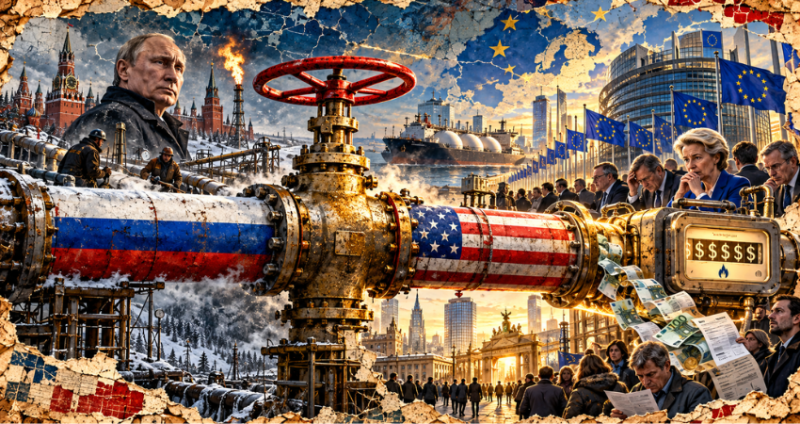
The Week That Shaped the World — 2–9 October 2026
Power Is Changing Hands — And Someone Will Always Pay the Bill
There are weeks when the world appears chaotic because too many things are happening at once. Look closer, and sometimes the opposite is true.
The events are connected by something remarkably simple: leverage.
Europe may again receive Russian gas, but perhaps through an American financial gate. Britain and Germany are building security structures outside the comfortable assumptions of yesterday. Washington is discovering that even the timing of war can collide with an election calendar. In Africa, an unfinished peace is beginning to unravel. In France, angry teenagers are forcing an ageing political system to confront problems it would rather explain away.
Then comes the invoice.
Oil above $100 changes inflation. Inflation changes borrowing costs. Borrowing costs discipline governments. Artificial intelligence keeps world trade moving while simultaneously demanding such absurd quantities of capital that investors are beginning to ask whether every AI promise deserves a blank cheque.
Different countries. Different crises.
The same question keeps returning.
Who still possesses leverage — and who merely thought they did?
“Power rarely disappears. It changes owners, changes instruments, and eventually sends somebody the bill.”
1. US and Russia Discuss Reviving Nord Stream Gas Supplies to Europe
Europe spent four years learning how not to buy Russian gas.
Washington and Moscow may now be discussing how to sell it back.
Senior US and Russian officials have discussed bringing an American investor into the Nord Stream pipelines and potentially restoring Russian gas flows to Europe after the war. No agreement exists, sanctions remain a formidable obstacle, and Germany, Poland and other European governments may strongly resist any revival of the network.
Those qualifications matter.
But so does the extraordinary shape of the conversation.
Nord Stream once represented precisely the dependence Europe was told it had to escape: Russian molecules travelling through Russian-controlled infrastructure into the industrial heart of Germany. Europe subsequently cut Russian pipeline imports, absorbed an enormous energy shock and turned increasingly towards liquefied natural gas. American LNG alone accounted for a dominant share of EU LNG imports by 2025.
Now imagine the next act.
The gas is Russian.
The customer is European.
The pipeline is the same.
But somewhere between producer and buyer appears an American shareholder.
The molecule has not acquired democratic values on its journey through the Baltic. The ownership structure has simply become more politically acceptable.
That is where this story becomes larger than energy.
Prime Economist cannot establish that the events of the past four years were designed to produce this outcome. We should not pretend otherwise. But after examining the incentives, the redistribution of energy dependence and the emerging US-Russian commercial discussions, our assessment is that a broader post-war rearrangement of influence deserves serious consideration.
Europe may not have escaped dependence.
It may have exchanged one dependency for another — only to discover that the two can eventually be combined.
There is an historical irony here that Brussels should remember.
Long before the Ukraine war, European leaders were already talking confidently about “strategic autonomy”. Emmanuel Macron called for a “real European army” capable of defending Europe without relying solely on the United States. European leaders increasingly discussed reducing military dependence on Washington, while Trump repeatedly complained that Europe was not paying enough for its own defence.
There was nothing inherently foolish about wanting Europe to defend itself.
The problem was more basic.
Europe announced strategic autonomy before it had built strategic independence.
It did not possess sufficient common military capacity to replace the American security umbrella. It had not created an energy system insulated from geopolitical shocks. Nor had it resolved the industrial consequences of more expensive energy.
For a brief period, some European rhetoric carried a distinctly Napoleonic confidence: Europe would stand taller, Washington would become less indispensable, and sovereignty would finally acquire a continental address.
History proved less impressed by the speech.
War increased European defence expenditure and reinforced the importance of American military capability. Cutting Russian pipeline gas increased Europe's reliance on alternative suppliers, including the United States.
Now comes the potentially exquisite geopolitical irony.
If American capital eventually acquires a position in Nord Stream, Washington could find itself exercising influence on both sides of Europe's strategic vulnerability: security through NATO and energy through participation in the infrastructure carrying Russian gas.
Russia, meanwhile, would recover access to an enormously valuable market.
America could acquire leverage and profit.
Europe would receive the gas.
This does not prove a grand bargain between Washington and Moscow. The negotiations may collapse. European opposition may stop them. Sanctions may remain in place.
But the incentives are difficult to ignore.
Peace arrangements between great powers are rarely built from sentiment. They are built from assets, markets, territory, security guarantees and things that can be invoiced.
Perhaps Nord Stream is simply one prospective business deal.
Perhaps it is something more: an early glimpse of a post-war settlement in which Russia retains resources, America inserts itself into the transaction, and Europe discovers that the architecture built to free it from dependence has produced a more expensive version of dependence instead.
Years ago, Europe complained that American security came with too high a price.
It may now be learning what security costs when the protector decides that dependence should pay commercial rates.
“Europe wanted strategic autonomy before it had built strategic independence. The difference may now be arriving as an invoice.”
2. Britain and Germany Are Quietly Building a New Security Axis
Britain and Germany have launched a new partnership against sabotage, cyberattacks and other hybrid threats, while London has also opened the door to possible German participation in the Global Combat Air Programme — the next-generation fighter project currently being developed by Britain, Italy and Japan.
Taken separately, these are defence announcements.
Taken together, they look more interesting.
European security is becoming increasingly networked. NATO remains the central military alliance, but governments are building additional structures underneath it: bilateral intelligence links, industrial partnerships, cyber-defence arrangements and weapons programmes capable of surviving political changes elsewhere.
Britain has particular reasons to welcome Germany closer. GCAP is enormously expensive. Germany has money, industry and an increasingly serious defence budget. Berlin, meanwhile, has its own reasons to diversify defence-industrial partnerships.
That does not yet constitute a new Anglo-German bloc.
But the machinery is beginning to appear.
There is also something distinctly British about the opportunity. Brexit removed Britain from the political institutions of the European Union, but geography never resigned. Britain remains one of Europe’s principal military powers, Germany its largest economy. Security has a habit of rebuilding bridges that politics has spent years dismantling.
And perhaps Europe is rediscovering an old truth.
Strategic autonomy is easier to discuss in speeches than to manufacture in factories.
Aircraft, software, intelligence, ammunition and cyber-defence require partners who can actually build things.
London and Berlin appear to have noticed.
“Europe may argue endlessly about political architecture. Threats have the irritating habit of demanding engineering instead.”
3. Trump Has Put an Election Date Into the Iran War
Donald Trump said this week that the United States would not attack Iran before the November midterm elections, while describing current discussions with Tehran as productive.
That sentence deserves more attention than it received.
Presidents have always considered domestic politics when making military decisions. Pretending otherwise would require a heroic misunderstanding of democracy.
But saying it aloud changes the picture.
If military action is unnecessary today, why might it become necessary after an election? If it is strategically necessary, why should ballots determine the timetable?
Perhaps the answer is perfectly rational. Washington may believe negotiations still have a chance. A pause could reduce the danger of escalation around the Strait of Hormuz, through which roughly one fifth of global oil and fuel shipments travelled before the current crisis.
But electoral calendars create their own incentives.
War before an election brings petrol prices, body bags and uncertainty. War afterwards brings precisely the same things, except the votes have already been counted.
Markets understood the distinction immediately. Oil prices moved lower because traders were not evaluating philosophy. They were evaluating the probability that missiles might interrupt supply.
There is something uncomfortable in that.
Modern warfare is presented in the language of national security, deterrence and moral necessity. Yet democratic politics continues ticking underneath it: polling dates, congressional seats, petrol prices and consumer confidence.
None of this means the president is planning a war after November.
It means he has publicly introduced November into the calculation.
That alone matters.
“When an election date enters the timetable of a war, strategy has acquired a second clock.”
4. Ethiopia and Eritrea Are Walking Back Toward a War They Already Know
Ethiopia and Eritrea have severed diplomatic relations. Embassies have closed, diplomats have been expelled and fighting in northern Ethiopia has intensified, raising fears that a conflict supposedly contained by the 2022 peace settlement is widening again.
The region knows what comes next because it has already lived through it.
The Ethiopian civil war between 2020 and 2022 killed hundreds of thousands of people. Eritrea then fought alongside Ethiopia’s federal forces against the Tigray People’s Liberation Front.
The alliances have since shifted.
Addis Ababa now accuses Eritrea, Sudan and Egypt of supporting an opposition coalition led by the TPLF. All three deny the accusation. Ethiopia’s search for secure access to the Red Sea has added another source of tension with Eritrea.
This is what makes incomplete peace agreements dangerous.
They stop the shooting before they settle the geography, ambitions and fears that caused people to shoot in the first place.
For several years that can look remarkably like peace.
Then the unresolved questions return.
Embassies closing do not cause wars. They remove one of the mechanisms through which governments can prevent misunderstandings from becoming wars. Diplomatic relations are most valuable precisely when two countries dislike one another.
The wider danger is regional. Egypt, Sudan, Red Sea access and the future of Tigray are now touching the same strategic fault line.
The Horn of Africa does not need another grand war.
Unfortunately, geography has never shown much concern for what regions need.
“Peace becomes fragile when governments sign the end of the fighting but leave the reasons for fighting untouched.”
5. France’s School Revolt — Blaming the Fire Is Easier Than Repairing the Building
France’s school protests did not begin with geopolitics.
They began with classrooms.
Students have protested teacher shortages, overcrowding, deteriorating buildings, unequal educational opportunities and an admissions system many regard as opaque and unfair. Hundreds of schools have been disrupted. Demonstrations have grown dramatically, violence has followed, thousands have been arrested and both students and police officers have been injured.
Those facts are inconvenient because they describe a domestic problem.
France spends heavily as a state, yet its education system is visibly struggling. Pensions consume an enormous share of public expenditure while schools face staffing shortages and decaying infrastructure. Wealthier families increasingly retreat into private education, leaving inequality to reproduce itself inside what is supposed to be a republican institution.
Then violence entered the movement.
Political accusations followed. Some French politicians have begun pointing towards foreign interference, including Russia, while others have blamed domestic radical groups for exploiting the unrest.
Perhaps outside actors are amplifying anger. Russia certainly possesses both the capability and incentive to exploit divisions inside Europe.
But amplification is not creation.
Moscow did not fail to hire a French maths teacher.
Moscow did not leave ceilings crumbling.
And Moscow did not design France’s public finances.
Foreign interference should be investigated where evidence exists. It should not become an intellectual fire extinguisher sprayed over every uncomfortable domestic failure.
A government can condemn an adversary.
A broken school has to be fixed.
“Foreign interference may amplify a fire. It does not explain who left the building full of dry timber.”
6. Hormuz Has Become the World’s Inflation Valve
Brent crude remains above $100 a barrel. The G7 has discussed releasing large volumes of diesel and crude from strategic reserves, while the Strait of Hormuz remains threatened by the Middle East conflict.
The world’s inflation problem is once again passing through a narrow stretch of water.
Before the crisis, Hormuz carried oil and fuel volumes equivalent to roughly one fifth of global shipments. Interrupt that flow and the consequences do not remain in the Gulf.
They arrive at petrol stations.
Then trucking companies.
Then supermarkets.
Then inflation statistics.
Then central banks.
This is why strategic oil reserves are political instruments as much as energy reserves. Governments release them not because petroleum has suddenly become scarce in geological terms, but because prices transmit geopolitical panic extraordinarily efficiently.
There is an irony here.
Western economies spent years raising interest rates to suppress inflation generated partly by earlier energy shocks. Higher rates then increased government borrowing costs and weakened investment.
Now another energy shock threatens to reopen the same argument.
Central bankers can reduce demand.
They cannot escort a tanker through Hormuz.
Nor can governments permanently solve a structural supply problem by opening emergency storage tanks. Reserves buy time. They do not manufacture stability.
If negotiations reduce the danger around the Strait, oil could fall quickly.
If they fail, the world may rediscover how rapidly an apparently distant war becomes an electricity bill, a delivery charge and eventually a mortgage decision.
“Hormuz is only a few dozen kilometres wide. Economically, it runs through almost every household in the industrial world.”
7. France Is Discovering That the Bond Market Also Votes
France’s ten-year government bond yield has approached levels not seen for decades, as investors worry about a budget deficit above 5% of GDP, political instability and the government’s ability to repair the public finances.
Unfortunately for Paris, this is happening while the streets are demanding more money.
Schools need investment. Teachers need replacing. Energy prices are hurting households. Defence spending is rising. Political pressure is intensifying.
Normally French governments have possessed a familiar response to social unrest.
Spend.
That instrument is becoming expensive.
This is the part of modern democracy politicians rarely place on campaign posters. A government may possess a parliamentary mandate to borrow. It does not possess the authority to dictate the interest rate at which somebody must lend.
That distinction becomes painful when debt is already large.
The school protests therefore belong in the same story as French bond yields. One is political pressure demanding additional resources. The other is financial pressure warning that those resources now carry a higher price.
Neither side is imaginary.
Students cannot be told that leaking buildings are a bond-market abstraction. Investors cannot be told that debt servicing disappears because public anger is genuine.
France is being squeezed between social expectations built during decades of relatively generous government and capital markets that have rediscovered the concept of risk.
There may be compromises.
There will not be magic.
Arithmetic is notoriously poor at respecting revolutionary tradition.
“A government can lose a vote and survive. Losing the confidence of the people financing its debt is a different sort of election.”
8. America’s Labour Market Has Frozen Without Breaking
America entered October with unemployment at 4.2%, a figure that ordinarily suggests something close to full employment.
Yet the labour market feels weaker than that number implies.
Hiring has slowed sharply. Workers are changing jobs less frequently. Manufacturing employment has failed to deliver the renaissance repeatedly promised by Washington. At the same time, companies are still reluctant to dismiss existing workers in large numbers.
Nobody hires.
Nobody fires.
Economists have more elegant vocabulary for this. Workers generally do not.
The result is a peculiar form of stability.
If you already possess a job, conditions may appear reasonably secure. If you are looking for one, the economy can feel considerably colder than an unemployment rate of 4.2% suggests.
That matters politically because voters experience labour markets through movement, not statistics.
Can I get another job?
Can I negotiate higher pay?
Can my child find work after university?
Can I leave an employer I dislike?
During the post-pandemic boom, workers possessed unusual bargaining power because businesses were desperate for labour. That period has ended. Immigration restrictions and demographic pressures have also reduced labour-force growth, leaving fewer workers without necessarily creating stronger demand for each worker.
This is not yet a classic recessionary labour market.
It may be something stranger: an economy holding its breath.
Companies have enough confidence not to fire.
They do not have enough confidence to hire.
For somebody sending the fiftieth CV, the distinction is considerably more than statistical.
“Full employment looks rather different when everybody has a chair but nobody is allowed to change seats.”
9. AI Is Now Holding Up World Trade
The World Trade Organization has sharply raised its forecast for merchandise trade growth in 2026.
One of the principal reasons is artificial intelligence.
Trade in AI-enabling products — including semiconductors, servers and related equipment — has surged. These goods now account for a substantial share of global merchandise trade growth.
That is a remarkable development.
AI has spent several years being discussed as software: chatbots, models, algorithms and clever demonstrations on laptop screens.
The physical economy has now caught up.
Intelligence, it turns out, needs factories.
It needs chips, cooling systems, electrical equipment, data centres, cables and enormous quantities of power. The supposedly weightless digital revolution has become one of the largest industrial construction programmes on Earth.
This is helping global trade withstand extraordinary disruption elsewhere. Middle Eastern energy exports have been affected, transport routes have been rerouted and energy prices have risen. Yet supply chains have adapted faster than expected, while AI infrastructure continues pulling goods across borders.
That changes the economic meaning of the AI boom.
It is no longer merely a contest between technology companies.
Countries producing semiconductors, electrical systems, cooling equipment and data-centre infrastructure increasingly occupy strategic positions inside a new industrial supply chain.
The cloud has acquired factories.
And factories have borders.
“Artificial intelligence was supposed to make the economy less physical. Instead, it is teaching us how much steel, silicon and electricity intelligence requires.”
10. The AI Boom Has Finally Met an Investor Who Said No
For several years, attaching the letters AI to an investment proposal seemed almost sufficient to open the capital markets.
This week, somebody closed the door.
Australian data-centre company Firmus abandoned a planned multibillion-dollar IPO after investors resisted a valuation above $30 billion. The proposed valuation had risen dramatically in a short period, while questions were growing about debt, execution risk and the company’s ability to deliver its enormous expansion plans.
This does not mean the AI boom is ending.
Quite the opposite.
The previous story in this digest explains why. AI infrastructure is already reshaping global trade. Demand for computing power remains immense.
But transformative technology does not make every valuation sensible.
Railways transformed nineteenth-century economies. Railway investors still managed to lose fortunes.
The internet transformed civilisation. That did not make every dot-com company worth what somebody paid for it in 1999.
AI can be revolutionary and overpriced simultaneously.
Investors are beginning to rediscover that distinction because building frontier infrastructure requires staggering quantities of capital. Data centres must actually be completed. Power must be secured. Customers must pay enough to justify the construction. Debt eventually requires servicing.
Narratives can postpone those questions.
They cannot abolish them.
Firmus may raise money privately and return to public markets later. Its underlying business may ultimately prosper.
The important signal is psychological.
Fear of missing out has finally met another ancient market instinct.
Fear of paying too much.
That is not the death of a boom.
It may be the moment the boom starts growing up.
“A revolution can change the world and still be a terrible investment at the wrong price.”