US Limits UK Access to New OpenAI and Anthropic AI Models
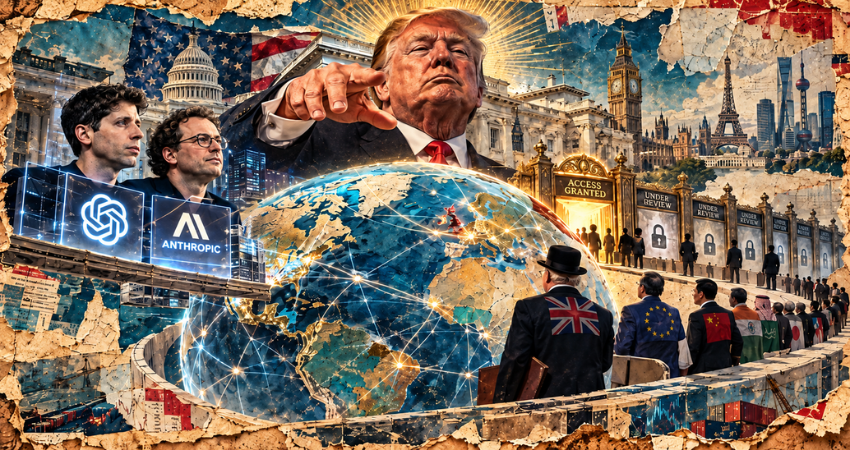
The Week That Shaped the World — 18–25 September 2026
Allies, Markets, Machines and Money — This Week the World Started Redefining Access
For thirty years, globalisation was sold as a world of access.
Capital could move. Goods could move. Knowledge could move. Technology could move. And allies, at least in theory, shared.
This week offered a more complicated picture.
Washington reportedly asked American AI companies to delay giving Britain access to their newest models. Brussels told London that privileged access to European industrial markets may require greater alignment with European trade policy. China reminded Washington that technological power still depends on minerals dug from the ground. Canada discovered again how expensive dependence on a single neighbour can become.
Meanwhile, Europe wants technological sovereignty but is beginning to calculate the electricity and water required to build it.
Money tells the same story.
War reaches Britain through borrowing costs. China competes inside industries Europe once considered its own. Artificial intelligence has reached the bond market. Stablecoins designed to sit outside traditional finance are beginning to alter the structure of traditional banking.
The world is not deglobalising. Something subtler is happening. Doors remain open.
But governments are increasingly deciding who enters first, on what terms — and at what price.
“The new struggle for power may not be about closing borders. It may be about deciding who still has the key.”
1. US Limits UK Access to New OpenAI and Anthropic AI Models
Something unusual happened between two countries that usually describe themselves as unusually close.
The White House has asked OpenAI and Anthropic to hold their newest artificial-intelligence models back from British government testers until American officials have reviewed them first, Reuters reported on 24 September, citing Politico.
According to the report, Washington wants to ensure American systems are secure before the models are shared with partners. OpenAI, Anthropic and the White House had not publicly commented when Reuters published its report.
That qualification matters. This is not evidence that America has stopped trusting Britain.
But the timing deserves attention.
The British and American AI-security institutes have formally cooperated since 2024, including on model evaluation and research. Britain’s AI Security Institute has publicly praised OpenAI and Anthropic for providing detailed access to models and described that collaboration as demonstrating the value of the UK-US partnership.
And only days before this latest report, Britain announced another AI defence partnership with the United States.
So what changed? Perhaps nothing fundamental.
Frontier models are becoming more capable, security risks are increasing, and Washington may simply want American agencies to inspect American technology first.
That is a reasonable explanation.
But Britain should still notice the order of the queue.
Because strategic relationships are defined not only by treaties and speeches.
They are also defined by privileges. Who receives intelligence first? Who gets the technology?
Who is consulted before a decision?
Who needs permission where previously there was assumption?
There have been other recent points of friction. Donald Trump has publicly criticised British policy, while the future of Diego Garcia has produced a genuine disagreement between Washington and London. Prime Minister Andy Burnham nevertheless said this week that he and Trump had established a “good connection,” underlining that the relationship remains substantial.
None of these events proves a deliberate American strategy to downgrade Britain.
We do not know whether such a strategy exists. But there is a hypothesis worth considering.
As the international system becomes more competitive, Washington may increasingly be sorting relationships by function: military allies, intelligence partners, industrial partners, technology partners — each receiving different levels of access.
Britain may remain one of America’s closest allies while discovering that closeness no longer automatically provides first access to everything America considers strategic.
That possibility concerns me more than one delayed AI model.
Countries often discover that their place in the world has changed only after the privileges attached to that place begin quietly disappearing.
“The most dangerous moment for an ally is not when it is abandoned. It is when it remains an ally, but no longer knows where it stands in the hierarchy.”
2. Europe Tells Britain: Market Access Comes With European Conditions
Britain has spent much of the past decade debating sovereignty.
Europe is beginning to answer with access.
Brussels has told Prime Minister Andy Burnham that Britain would need to raise tariffs on Chinese cars and align more closely with European trade policy if London wants to avoid disadvantages under the EU’s emerging industrial regime, according to a Financial Times report cited by Reuters.
The immediate argument concerns Made in Europe.
The EU’s proposed Industrial Accelerator Act would favour European production in strategic sectors including electric vehicles, renewable energy and other industrial technologies. Britain, having left the EU, is not automatically inside that definition.
That matters.
British factories remain heavily integrated into European supply chains. A car assembled in Britain can contain components crossing several borders before the finished vehicle returns to continental Europe.
Brussels is therefore discussing something much more significant than another tariff.
It is defining what counts as European economic production.
And Britain is asking to be included.
The European answer appears increasingly straightforward: inclusion may require alignment.
Reuters reported this week that one obvious mechanism discussed is a customs union. The broader EU proposal could also require high levels of locally produced components for products receiving public support.
This is the post-Brexit problem in its purest form.
Britain possesses the sovereign right to set its own tariffs on Chinese vehicles.
The European Union possesses the sovereign right to decide which products qualify for European industrial preferences.
Both statements can be true simultaneously.
That does not prove Brexit was wise or unwise.
It demonstrates something more fundamental about sovereignty.
Leaving an institution increases your freedom over your own rules.
It does not increase your authority over somebody else’s.
And in a world where governments are rebuilding industrial policy around subsidies, procurement and strategic supply chains, market access is becoming less neutral.
Membership has a value.
Alignment has a value.
Distance has a price.
Britain wanted the freedom to stand outside European structures.
It may increasingly find itself negotiating the cost of standing close enough to continue using them.
“Sovereignty gives Britain the right to choose its rules. It does not give Britain the right to choose everybody else’s.”
3. Trump and Xi: Rivals Who Cannot Afford Not to Talk
Donald Trump welcomed Xi Jinping to Washington this week.
There was ceremony. There were negotiations.
There was another extension of the uneasy economic truce between the world's two largest economies.
What there was not was a grand settlement.
Trade disputes remain. Taiwan remains. Technology competition remains. Iran remains. Artificial intelligence has now joined the agenda.
Reuters' assessment of the summit was therefore less dramatic than the images surrounding it: the United States gained an extension of the existing trade truce, but fundamental disagreements remained unresolved.
Perhaps that is precisely what makes the meeting important.
America and China have spent years trying to reduce their vulnerability to one another.
Washington restricts technology. Beijing controls strategic exports. America builds semiconductor supply chains.
China invests in technological self-sufficiency.
Both governments use tariffs, subsidies and regulation to create distance.
And then their presidents sit down together. Because rivalry does not eliminate dependence.
Sometimes it makes diplomacy more necessary.
China controls enormous portions of global rare-earth mining, refining and magnet production. American technology and defence industries still depend on materials connected to those supply chains. China, meanwhile, remains deeply connected to Western markets and technology.
This produces one of the defining contradictions of our age.
The two powers are preparing for a world in which they need each other less.
They must manage the present world in which they still need each other enormously.
That also creates an interesting contrast with Britain's experience this week.
A close ally can discover that access to an American technology is delayed.
A strategic competitor can still command hours of presidential diplomacy.
There is no contradiction.
Foreign policy is not organised according to friendship alone.
Importance matters. Dependency matters. Risk matters. Leverage matters.
Great powers do not necessarily spend the most time talking to those they trust most.
They often spend it talking to those they cannot afford to misunderstand.
“Diplomacy is not proof of friendship. Sometimes it is simply what happens when two rivals become too important to ignore.”
4. Canada Wanted Another Door. Washington Has Just Explained Why
Last week Canada was looking toward Europe.
This week we received part of the explanation.
Bank of Canada Governor Tiff Macklem warned that new American tariffs could roughly halve Canada's expected economic growth during the fourth quarter, taking it below 1% compared with an earlier projection of around 1.5%.
Investment and hiring could also suffer as uncertainty rises.
This is not an argument that Canada can somehow detach itself from the United States.
It cannot.
Geography has an inconvenient habit of surviving elections.
The United States remains Canada's dominant economic neighbour, and the two economies are interconnected through energy, manufacturing, investment, defence and supply chains.
But concentration creates leverage.
If one customer buys most of your exports, that customer matters.
If one market dominates your investment calculations, policy changes in that market travel rapidly across the border.
Canada's recent search for deeper European relationships therefore looks less like diplomatic theatre and more like risk management.
The same principle applies to companies.
A manufacturer dependent on one supplier searches for another.
An investor diversifies a portfolio. A country can attempt something similar. Not separation. Optionality.
This is becoming increasingly important because the traditional distinction between economics and national strategy is disappearing.
Tariffs are no longer merely instruments for collecting revenue.
Industrial policy is no longer merely about jobs. Supply chains are no longer merely logistical questions.
Each can become a mechanism of influence. Canada cannot change its map.
But it can try to create enough alternative relationships that geography does not become destiny.
That strategy will have limits.
Europe cannot replace the enormous American market sitting directly across Canada's border.
But diversification does not need to replace the primary relationship to change the negotiating balance.
Sometimes the existence of another door matters even when you continue using the first one every day.
“Canada cannot move away from America. It can try to make dependence on America less capable of moving Canada.”
5. Europe Wants AI Sovereignty. Then It Discovered AI Needs Power Stations
Artificial intelligence is often described as though it lives somewhere above us.
In the cloud.
Europe is discovering that the cloud consumes electricity.
And water. And land. And grid capacity.
The European Commission this week proposed requiring data centres to disclose how efficiently they use energy and water as Brussels attempts simultaneously to expand Europe's computing capacity and control its environmental and infrastructure costs.
This is not simply environmental regulation.
It is technological geopolitics becoming physical.
Europe wants to reduce its dependence on American technology companies.
It wants more computing infrastructure.
More AI development. More data centres. More strategic autonomy.
All of that sounds digital until somebody asks where the electricity comes from.
AI models require chips. Chips require data centres.
Data centres require enormous electrical connections, cooling systems, construction and capital.
Suddenly technological sovereignty starts looking remarkably similar to twentieth-century industrial policy.
Power stations matter. Transmission lines matter. Planning permission matters. Water availability matters.
This is why Europe's AI ambitions cannot be separated from Europe's energy policy.
A continent can write sophisticated rules governing artificial intelligence.
It can create safety institutes. It can fund start-ups. It can demand data sovereignty.
But if the most powerful models are trained and operated on infrastructure controlled elsewhere, sovereignty remains incomplete.
The debate around AI is therefore entering a new stage.
The first stage concerned software. The second concerned regulation.
The third will increasingly concern infrastructure. And infrastructure is where ambitions meet engineering.
That may eventually become one of Europe's largest strategic tests. The continent does not merely need better algorithms. It needs enough physical capacity to run them.
The future may be digital. Its electricity bill will not be.
“Artificial intelligence may live in the cloud. Technological sovereignty still requires a power station.”
6. Britain’s Budget Is Being Written Partly in the Middle East
Britain borrowed £18.3 billion in August.
The Office for Budget Responsibility had expected £15.5 billion.
During the first five months of the financial year, cumulative borrowing reached £77.3 billion — £8.1 billion above the OBR forecast.
Those are Treasury numbers.
Their causes extend considerably beyond the Treasury.
Higher government-bond yields have increased borrowing costs. Inflation linked partly to global energy prices has added pressure. Estimates cited by Reuters suggest the government's fiscal headroom has fallen sharply ahead of the October budget.
This is how geopolitics enters domestic economics.
Not dramatically. Administratively. War affects oil. Oil affects inflation.
Inflation affects interest-rate expectations.
Interest-rate expectations move bond yields.
Bond yields determine how much a government pays to borrow.
And eventually a conflict thousands of miles away appears inside a spreadsheet in Whitehall.
Last week we looked at how geopolitical shocks travel into mortgages.
The same mechanism is now operating one floor higher.
Government itself receives the bill.
This matters because higher debt-service costs do not remain abstract.
Money spent servicing government debt cannot simultaneously finance hospitals, transport, defence, housing or tax reductions.
Every additional pound of interest therefore competes with another political priority.
Governments like to divide policy into departments. Markets do not.
The Treasury cannot tell the oil market that Middle Eastern security belongs to the Foreign Office.
Nor can a Chancellor ask bond investors to ignore inflation because its original cause occurred abroad.
Modern economies are too interconnected for geographical distance to provide financial insulation.
A missile does not need to reach London.
An oil tanker does. A bond trader does. An inflation forecast does. Then the Budget changes.
“A war does not need to cross Britain’s borders to enter Britain’s accounts.”
7. China Is Entering the Industries Europe Thought It Owned
For years Europe's Chinese problem could be summarised with one word.
Cheap. Cheap electronics. Cheap consumer goods. Cheap solar panels. Cheap manufacturing.
That description is becoming obsolete.
An analysis highlighted by the European Central Bank this week finds that China's industrial rise is increasingly challenging European producers in high-value, technology-intensive sectors — particularly machinery and transport equipment.
Germany is especially exposed because its export structure overlaps more closely with China's than those of many other European economies.
This is a much more serious competitive problem.
Germany's traditional economic model depended partly upon selling sophisticated machinery, vehicles and industrial equipment to a global economy in which China was both customer and manufacturing partner.
China increasingly wants to produce those things itself.
And then export them.
The transformation is visible in sectors from electric vehicles to industrial equipment.
At the same time, China's rising domestic capabilities reduce its need to import some European products.
Europe therefore faces pressure from two directions.
A customer buys less. A competitor sells more.
None of this means European manufacturing is disappearing.
Germany retains enormous industrial capability, engineering expertise and globally recognised companies.
But the direction of competition has changed.
The old argument was that Europe should not attempt to compete with Chinese labour costs.
The new question is what happens when China competes in engineering, automation, batteries, machinery and technologically sophisticated manufacturing.
That challenge cannot be answered simply with tariffs.
Protection may give industries time.
It does not automatically create competitiveness.
Europe will still need cheaper energy, investment, research, skilled workers and companies capable of converting innovation into production at scale.
China spent decades learning how to manufacture Europe's products.
Europe may now have to learn how to compete with China's version of industrial modernity.
“Europe spent twenty years worrying that China could make things cheaper. The harder question begins when China can make the things Europe thought only Europe could make.”
8. America Wants Independence from China. Its Industries Still Need Chinese Minerals
Aerospace engineers are looking backwards.
Some are examining turbine-coating technologies from the 1970s and 1980s.
Not because aviation has suddenly developed nostalgia.
Because China controls materials required by modern alternatives.
Reuters reported this week that rare-earth shortages are pushing aerospace suppliers to reconsider older coatings as manufacturers search for ways to reduce dependence on Chinese critical minerals.
China has dominant positions in rare earths and other strategically important materials used in jet engines, semiconductors and defence equipment. Industry experts say replacing that dependence will take years rather than months.
That is an extraordinary illustration of the difference between political ambition and industrial reality.
Washington wants strategic independence.
American companies want secure domestic supply chains.
Defence planners want fewer vulnerabilities.
All reasonable objectives.
But supply chains are accumulated over decades.
They cannot be rewritten by executive order.
China controls up to 70% of global rare-earth mining and an even larger share of refining and magnet production, according to figures cited by Reuters. That gives Beijing leverage well beyond the nominal economic value of the materials themselves.
A tiny quantity of specialised material can stop production of a very expensive machine.
That is power.
This also helps explain the tone of current US-China diplomacy.
Washington can threaten tariffs or technology restrictions.
Beijing can influence access to inputs American manufacturers still require.
Each side possesses tools capable of hurting the other.
So engineers experiment with substitutes.
Governments finance mines. Companies recycle materials. Supply chains gradually diversify.
But “gradually” is the important word. Strategic independence is a political objective.
Industrial independence is a construction project. The first can be announced at a podium.
The second may take a decade.
“Strategic independence sounds easy until somebody asks where the magnets come from.”
9. AI Has Reached the Bond Market
Artificial intelligence has finally met one of capitalism's less glamorous inventions.
The bond investor.
For several years the AI boom was dominated by models, chips, venture capital and extraordinary equity valuations.
Now it requires something more ordinary.
Debt. Companies building data centres, computing infrastructure and semiconductor capacity are borrowing enormous amounts of money to finance the physical architecture of artificial intelligence.
And bond investors are becoming selective.
Reuters reported this week that spreads on debt from AI-related issuers have widened relative to the broader investment-grade market, even though many of the companies involved possess exceptionally strong balance sheets.
The concern is not primarily default.
It is supply. Goldman Sachs estimates gross debt issuance from hyperscalers could reach a record $420 billion next year, around 60% above estimated 2026 levels.
Investors can absorb enormous quantities of debt.
They cannot absorb infinite quantities at the same price.
So a subtle change is occurring.
AI companies are beginning to pay a premium for the privilege of financing AI.
That matters because markets are beginning to ask a different question.
For years investors asked: How large will artificial intelligence become?
Now fixed-income investors increasingly ask: How much capital will it consume before the returns arrive?
That is a healthier question. Every technological revolution eventually acquires factories.
Railways needed steel. Telecommunications needed cables. The internet needed server farms.
Artificial intelligence needs data centres, chips and electricity on a scale that makes software look surprisingly industrial.
The AI boom therefore has not left the digital world.
It has simply reached the part where somebody must finance the concrete.
And the bond market is wonderfully indifferent to excitement.
It cares about duration. Cash flow. Supply. Return on invested capital. The revolution can continue.
But increasingly it will have an interest rate attached.
“Every technological revolution eventually reaches the bond market. That is where excitement learns the price of money.”
10. Stablecoins Wanted to Escape the Banking System. Now They May Be Changing It
Stablecoins were supposed to make money more digital.
Europe is discovering that they may also make bank deposits less stable.
The European Central Bank and the EU's national central banks this week recommended changing part of the bloc's MiCA crypto rules.
Under the existing regime, stablecoin issuers must hold 30% of their reserves in bank deposits — rising to 60% for major issuers.
The logic appears sensible.
If a token promises to maintain a stable value, regulators want liquid reserves behind it.
But central banks now see an unintended consequence.
Large stablecoin issuers could replace relatively sticky household deposits with much more mobile institutional deposits. In a crisis, stablecoin reserves might move rapidly, exposing banks to greater funding volatility.
The ECB therefore wants the minimum-deposit requirement replaced with rules requiring part of the reserves to sit in assets capable of maturing within one to five working days.
It is a wonderfully circular story.
Crypto was created partly because its advocates distrusted traditional banking.
Regulators then connected stablecoins to traditional banks in order to make crypto safer.
Now regulators worry that connecting stablecoins to banks could make parts of banking less stable.
Welcome to financial engineering. The important lesson is not that MiCA failed.
Regulation is supposed to evolve when evidence changes.
The more interesting lesson is that financial systems respond to rules.
Every regulation changes incentives. Every changed incentive changes behaviour.
And at sufficient scale, behaviour changes the structure regulators were trying to protect.
Stablecoins remain small compared with the global banking system.
But they are becoming large enough that central banks no longer regard them as a technological curiosity.
They are becoming part of monetary plumbing.
And plumbing deserves attention precisely because most people notice it only when something stops flowing.
“Finance rarely defeats regulation by refusing to obey it. Sometimes it simply obeys at a scale the regulator did not expect.”