
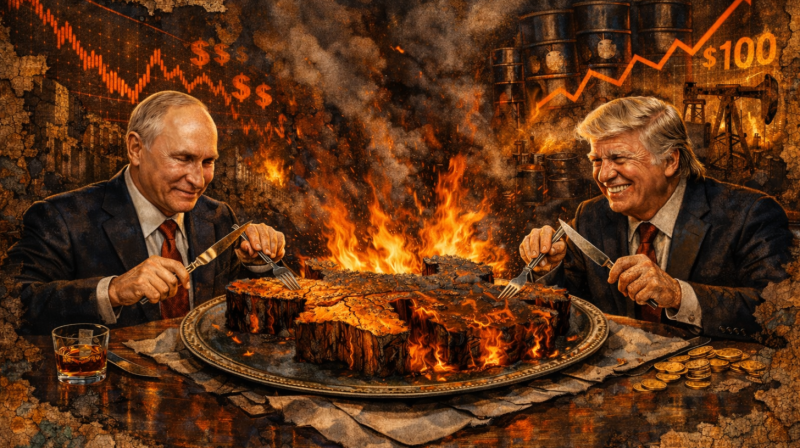
As the Israel–US war with Iran threatens to ignite a wider Middle East conflict and disrupt global oil markets, a deeper question emerges: who ultimately benefits from the geopolitical and financial shockwaves?
There are moments in geopolitics when the official explanation feels too neat. Too rehearsed. The cameras show smoke. The headlines shout escalation. The experts speak of deterrence and red lines.
And yet — beneath the theatre — the choreography suggests something colder.
At Prime Economist, we are not inclined to treat the unfolding Middle Eastern inferno as a sequence of unfortunate accidents. We see something else emerging: not a spontaneous spiral, but what may become one of the most consequential strategic pivots of the decade.
This is not a claim of hidden documents or secret signatures. It is a reading of incentives.
And incentives rarely lie.
Ukraine Fatigue and the Search for an Exit
The Western project in Ukraine has reached what can only be described as strategic exhaustion. Billions spent. Political capital drained. A battlefield locked in attritional stalemate. Prestige at stake.
For Washington, the real question was never whether to support Kyiv — it was how to disengage without looking defeated.
Reports of high-level contact between Donald Trump and Vladimir Putin in Anchorage — however opaque — hint at something larger: a recalibration of global priorities. If the centre of gravity shifts from the Dnieper to the Persian Gulf, the political optics change overnight.
A new theatre absorbs attention. Resources pivot. Media cycles reset.
In such a scenario, Ukraine becomes background noise rather than headline urgency.
That is not proof of coordination. It is recognition of strategic convenience.
Israel: Asset, Liability — or Leverage?
For decades, Israel has been described as America’s immovable ally in the Middle East. That assumption may now deserve scrutiny.
In power politics, alliances are not sentimental bonds; they are instruments. And instruments are evaluated on cost.
If a prolonged, multi-front conflict weakens regional competitors, fractures Arab financial autonomy, and redraws energy routes — then Israel’s role transforms from shield to catalyst.
We are not suggesting abandonment. We are suggesting utility.
It is entirely plausible that escalation serves broader financial objectives. A destabilised Middle East exerts pressure on oil flows, sovereign funds, and regional banking systems. In that chaos, capital searches for safety.
And safety, more often than not, speaks with an American accent.
The Psychology of Timing
The recent strikes — including the killing of Iran’s Supreme Leader, Ayatollah Ali Khamenei, along with members of his family, reportedly confirmed by Iranian officials, and a devastating attack on a school that left 180 girls dead — were not merely tactical. They carried immense symbolic weight, unfolding at the charged intersection of Ramadan and Shabbat.
Symbolism in geopolitics is never accidental.
Strikes that target identity, not merely infrastructure, reduce diplomatic flexibility.
They narrow the path back to negotiation and push leadership into predictable cycles of retaliation.
When religious emotion replaces rational calculation, escalation becomes almost mechanical.
Was this outcome desired? We cannot assert that. But we can observe that the psychological consequences were foreseeable.
And in strategy, foreseeable consequences are rarely overlooked.
Oil, Eurasia and the Financial Squeeze
The economic dimension is where this analysis sharpens.
Should Iran attempt to disrupt the Strait of Hormuz — even temporarily — the global oil market convulses.
Energy prices surge. Supply chains strain.
The consequences would not be evenly distributed.
Europe and China would face renewed industrial pressure. High energy costs erode competitiveness. Growth slows. Political fractures widen.
Russia, paradoxically, benefits from elevated oil prices. Budget inflows strengthen. Strategic patience increases.
The United States becomes the gravitational centre of capital flight. In times of global uncertainty, funds retreat to the dollar, US Treasuries and American equity markets.
Chaos abroad can consolidate stability at home.
It is an uncomfortable pattern. But it is a pattern.
A Thin and Clever Settlement?
Let us entertain a possibility — not as fact, but as trajectory.
A Middle Eastern conflagration diverts attention from Ukraine.
Russia consolidates incremental gains under reduced Western focus. Energy markets reward Moscow financially. Washington absorbs capital inflows and strengthens domestic political optics.
Meanwhile, Europe shoulders refugee pressure and economic strain. China recalculates supply vulnerabilities.
In such a world, reconstruction — whether in Ukraine or elsewhere — becomes a business opportunity shared by those still standing.
We are not arguing for a grand conspiracy. We are observing a convergence of interests.
Sometimes the most powerful alignments are never formally signed.
The Editorial View
Is this scenario inevitable? No.
Is it implausible? Hardly.
Power does not operate on morality; it operates on leverage. States pursue advantage. Crises are tools as much as tragedies.
The Middle East may indeed be burning because of irreconcilable grievances. But it is equally possible that the fire serves as a strategic solvent — dissolving old stalemates and redistributing capital flows in ways that benefit those positioned to absorb the shock.
History will decide whether this moment marks diplomatic failure or strategic design.
For now, one thing is clear: when global capital moves and military theatres shift simultaneously, coincidence becomes a fragile explanation.
And in geopolitics, fragility rarely survives long.
“Morality fills the speeches. Interests write the contracts.”