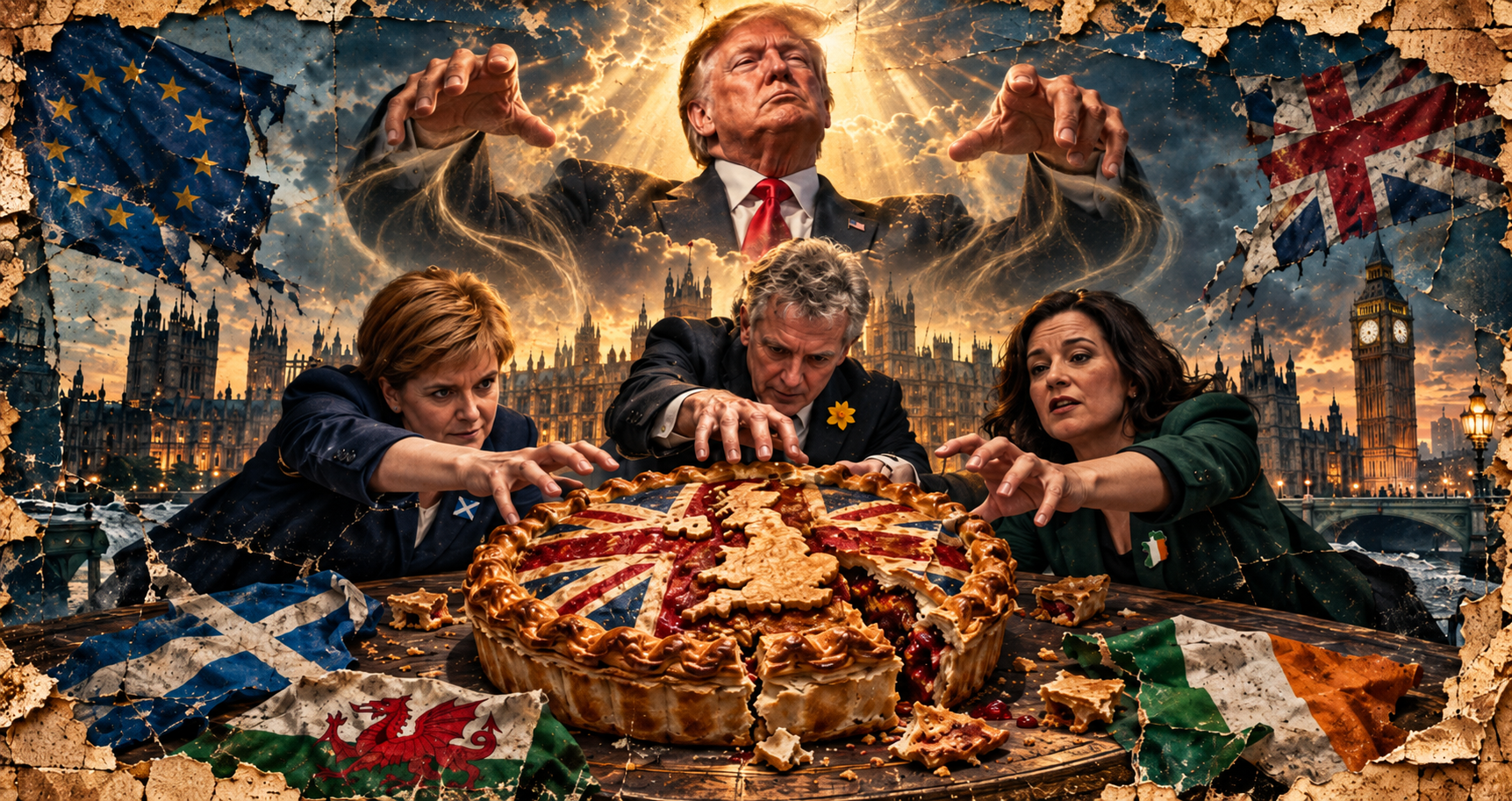
Who Is Shaking the Union? Britain Enters the New Battle for Influence
The Week That Shaped the World — 11–18 September 2026
Borders, Blocs, Money and Machines — This Week Power Started Drawing New Lines
Some weeks are about events.
This one is about architecture.
Britain’s nationalist parties have begun coordinating over constitutional change. Canada is looking across the Atlantic for strategic alternatives to Washington. Britain itself is asking Brussels for access to industrial structures it chose to leave. Europe’s sanctions machinery has discovered the inconvenient power of national interests. China is beginning to treat technological knowledge almost like controlled strategic material.
Meanwhile, money is changing direction.
The Federal Reserve has raised rates. Japan has taken borrowing costs to a 31-year high. Britain is warning that inflation may force it to follow. War in the Middle East has travelled through oil markets and arrived, with tedious efficiency, in mortgages and government bonds.
And then there is artificial intelligence.
The technology supposedly requiring humanity to slow down is already helping to design its own successors. Europe, arriving late to the race, suspects that calls for caution from American leaders might look slightly different when viewed from second place.
These stories are not identical.
But once again, they rhyme.
The question running through this week is not simply who possesses power.
It is who still possesses options.
A country with several markets can negotiate.
A government with several sources of finance can choose.
A technology company with several suppliers can resist.
A nation with only one door eventually stops negotiating with the doorman.
The next world order will not be announced at a summit.
It is being assembled quietly through trade rules, payment systems, alliances, tariffs, technology and capital.
“Power rarely announces a new order. It changes the plumbing first, then waits for the map to catch up.”
1. Who Is Shaking the Union? Britain Enters the New Battle for Influence
On 14 September, the leaders of Plaid Cymru, the SNP and Sinn Féin met in Cardiff and signed a Memorandum of Understanding calling for constitutional change across Wales, Scotland and Northern Ireland.
The language was unusually direct.
Each nation, they said, has the right to determine its own future. Westminster should “prepare for, plan and facilitate” constitutional change. Their future, they argued, lies in Europe.
Then came the sentence that should concern London:
“Westminster’s time is coming to an end.”
This was not an agreement by three governments to dissolve the United Kingdom. It was a political pact between nationalist parties pursuing different constitutional objectives.
But timing matters.
Two days earlier Donald Trump said he would “love” to see a united Ireland. Asked the following day about Scottish independence, the US President declined to discuss it — “yet.”
Trump is not the only powerful American figure who has recently taken an unusual interest in British politics.
Last year Elon Musk appeared remotely at Tommy Robinson’s Unite the Kingdom rally in London, a demonstration attended by more than 100,000 people, and spoke about changing Britain’s government and dissolving Parliament.
Robinson, Musk, Trump, the SNP, Plaid Cymru and Sinn Féin are certainly not one political movement. Some are ideological opponents.
Prime Economist has no evidence that they are coordinating with one another.
But perhaps coordination is not required.
Robinson attacks Westminster from the populist right.
Musk amplifies dissatisfaction with Britain's political establishment.
Nationalist parties challenge Westminster's constitutional authority.
And now an American president openly discusses whether part of the United Kingdom should cease to belong to it.
Different actors.
Different motives.
Same institution under pressure.
This becomes more interesting because it is happening during a much larger redistribution of global power.
BRICS is expanding financial cooperation and developing alternatives in cross-border payments. Europe is attempting to strengthen its own defence and industrial architecture. China and the United States are competing over technology, supply chains and strategic influence.
The world's blocs are being rebuilt.
That raises an uncomfortable question for Britain.
The United States has historically benefited enormously from a strong British ally. There is no evidence that Washington has adopted a policy of breaking Britain apart.
But in a world increasingly organised around competing spheres of influence, would America prefer an independently powerful Britain — or a Britain powerful enough to remain useful while sufficiently dependent to remain firmly inside the American strategic orbit?
That is our hypothesis, not our conclusion.
Great powers value allies.
They are less enthusiastic when allies acquire too many alternatives.
And Britain today sits in an awkward position: outside the European Union, militarily close to Washington, yet increasingly seeking access to new European economic and security structures.
My concern is not nostalgia for empire, nor opposition to the democratic rights of Scotland, Wales or Northern Ireland.
It is agency.
Britain has spent centuries shaping events beyond its shores.
The danger is that it may now remain present in every important conversation while gradually losing the ability to set its terms.
A country has entered a new stage of decline when foreign billionaires discuss its government, foreign presidents discuss its borders, and its own constituent nations begin preparing publicly for a future beyond its parliament.
“Britain survived the loss of an empire. It can survive the loss of illusions. What it cannot afford is the loss of agency.”
2. Canada Looks to Europe — Geography Is No Longer Enough
Canada has spent most of its modern economic life with one overwhelming geographical fact.
The United States is next door.
Around 70% of Canadian exports still go south across that border. The European Union accounts for less than 10% of its total trade. Geography remains stubbornly efficient.
Politics is becoming less so.
This week European Commission President Ursula von der Leyen proposed something that does not formally exist: Canada becoming the EU’s first “associate member.”
No treaty defines the status. Several European governments were reportedly surprised by the announcement, and Germany has questioned the terminology. Canada itself has avoided embracing the precise label.
But perhaps the label is the least interesting part.
The proposal covers deeper cooperation in defence, energy, critical minerals and artificial intelligence. Canada has also applied to join the British-led Joint Expeditionary Force and selected Germany’s TKMS for a future submarine programme as Prime Minister Mark Carney seeks to reduce strategic dependence on the United States.
Donald Trump reacted by threatening further trade consequences for Europe.
Which rather demonstrates why Ottawa is looking for alternatives in the first place.
Canada cannot divorce geography. Its military, intelligence and continental defence systems remain deeply integrated with the United States. Even Canadian defence experts acknowledge that complete strategic separation is unrealistic.
But diversification does not require divorce.
It requires another telephone number.
That is what this week's proposal represents.
Europe wants reliable partners in energy, defence and critical minerals.
Canada wants leverage against excessive dependence on Washington.
Neither side needs a new flag.
They need options.
This is becoming the grammar of the emerging international order: countries are no longer necessarily abandoning old alliances.
They are making sure those alliances are no longer their only ones.
“A country does not need to leave its continent to reduce dependence. Sometimes it merely needs another door.”
3. Britain Left the EU. Now It Wants to Be Made in Europe
Brexit promised something beautifully simple.
Britain would leave the European Union and write its own rules.
Ten years after the referendum, another problem has become increasingly visible.
Other people write rules too.
This week Chancellor John Healey went to Dublin urging EU finance ministers not to exclude British manufacturers from the bloc’s forthcoming Made in Europe industrial policy.
The programme is intended to reduce European reliance on Chinese components by giving preference to goods produced within Europe.
Britain, inconveniently, is now outside the club defining what “European” means.
The automotive industry shows why this matters.
Around £15 billion of British automotive exports are sold into European markets each year, while British factories remain deeply integrated into continental supply chains. New preferences favouring EU production could therefore create barriers even without anyone imposing a conventional tariff.
London wants carve-outs.
It wanted something similar from the EU’s SAFE defence-financing mechanism.
Those negotiations failed after Britain and Brussels could not agree the financial contribution required for participation.
None of this proves Brexit was economically right or wrong. That argument has consumed enough British oxygen already.
The structural problem is more interesting.
Sovereignty determines who writes your domestic laws.
It does not determine whether foreign markets must treat your products as domestic.
Britain regained the freedom to stand outside European structures.
It is now discovering the price of repeatedly negotiating its way back into the useful ones.
Perhaps agreements will be reached.
Britain remains too large, too close and too economically interconnected with Europe to be treated like an ordinary distant trading partner.
But each exemption now has to be requested.
That is the part politicians rarely put on campaign buses.
“Sovereignty is the freedom to write your own rules. Market access is the privilege of living with somebody else’s.”
4. Sweden Changed Government by Three Seats
Sweden has delivered democracy in its least cinematic form.
Arithmetic.
Final results from Sunday's parliamentary election gave the centre-left bloc led by Magdalena Andersson’s Social Democrats 176 seats.
Prime Minister Ulf Kristersson’s incumbent right-wing bloc received 173.
On Thursday, Kristersson submitted his resignation.
Three seats.
Enough to change the government of a country of more than ten million people.
The result matters beyond Sweden because European politics increasingly operates through narrow parliamentary margins combined with broader ideological fragmentation.
Winning an election is therefore becoming only the first negotiation.
Andersson must now construct a workable government from parties whose agreement about removing Kristersson does not automatically mean agreement about governing together.
Taxes, welfare, climate policy, migration and Sweden’s security commitments all divide the parliamentary landscape in different ways. Reuters noted during the campaign that taxation, climate and support for Ukraine were among the issues shaping the vote.
This is becoming familiar across Europe.
Large traditional parties remain important but rarely command societies alone.
Smaller parties acquire leverage disproportionate to their size because a handful of seats can determine whether a government exists at all.
That makes coalition politics less glamorous than presidential politics.
It also makes it more revealing.
Political power is increasingly not about winning 50% of the argument.
It is about assembling 50% of the parliament.
Sweden's voters have removed one governing bloc.
Now begins the slower process of determining what exactly replaces it.
Democracy has spoken.
Unfortunately for headline writers, democracy sometimes speaks in spreadsheets.
“An election can remove a government overnight. Building the next one still requires arithmetic in the morning.”
5. Europe’s Russia Sanctions Were Delayed by One Billionaire
European sanctions against Russia are often described as though they were a single machine.
This week somebody opened the casing.
EU ambassadors failed to agree on the routine six-month renewal of sanctions listings and instead extended them for only seven days, until 22 September.
The disagreement concerns Russian-Uzbek billionaire Alisher Usmanov.
France and Slovakia have sought his removal from the sanctions list.
Then the story became more complicated.
European diplomats told Reuters that France's position followed pressure from Azerbaijan, which is holding two French nationals. French sources said Paris was acting on national-security considerations. Azerbaijan did not publicly confirm the alleged connection.
This is where sanctions cease to be slogans and become foreign policy.
The EU requires unanimity to renew these listings.
Twenty-six governments may agree.
One can still stop the machinery.
That design exists for a reason: sanctions can freeze assets, restrict travel and carry serious legal consequences, so member states retain control.
But unanimity also creates leverage.
Every unrelated bilateral dispute can potentially wander into the sanctions room and ask for a chair.
This does not mean European sanctions on Russia are collapsing.
Nearly 3,000 people and companies remain subject to EU restrictions, and the argument currently concerns specific listings rather than the entire sanctions architecture.
But it illustrates something governments often prefer not to advertise.
Foreign policy coalitions are strongest when interests overlap.
The moment national interests diverge, principles discover procedure.
And procedure has twenty-seven capitals.
Europe likes to speak with one voice.
The difficulty is that the voice still requires unanimous permission from the choir.
“Sanctions look like a weapon from the outside. From the inside, they are twenty-seven governments agreeing where to point it.”
6. The World’s Central Banks Have Started Raising the Price of War
Last week the European Central Bank raised rates.
This week the pattern became global.
On Wednesday the US Federal Reserve increased its benchmark range by 25 basis points to 3.75%–4.00%, its first rate increase in three years. Most policymakers expect at least one further rise before year-end.
On Thursday the Bank of England kept rates at 3.75%, but warned that inflation could exceed 4% early next year and that further tightening may become necessary.
On Friday the Bank of Japan raised its rate to 1.25%, the highest level in 31 years.
The yen fell anyway.
Welcome back to monetary policy.
The common pressure is energy.
Oil above $100, conflict in the Middle East and disruptions to transport have turned what began as a geopolitical shock into persistent inflation risk. Global bond yields have climbed sharply, with major sovereign borrowing costs reaching levels not seen since around the financial crisis.
The mechanism is brutally ordinary.
War raises energy prices.
Energy raises transport and production costs.
Businesses pass on what they can.
Workers demand wages capable of paying the new prices.
Central banks then raise the cost of borrowing to prevent the shock becoming permanent inflation.
The missile remains thousands of miles away.
The mortgage payment does not.
This is why modern wars rarely remain geographically contained.
They travel through insurance, oil, shipping, currencies and bond markets long before refugees or armies cross borders.
Governments conduct foreign policy.
Central banks receive the invoice.
And households eventually discover that geopolitics has acquired a monthly direct debit.
“Modern war does not need to reach your city. Sometimes the interest rate arrives first.”
7. China Is Beginning to Treat Knowledge Like Strategic Cargo
China has tightened control over something more valuable than many exports.
People who know things.
New rules taking effect on 15 September allow Chinese authorities to prevent citizens from leaving the country when they are considered a threat to national technological or industrial security.
The regulations specifically cover violations involving export controls and technology transfer. Certain exit bans can last from six months to three years.
Travel restrictions on officials and employees with sensitive information are not new in China.
What is significant is the increasingly explicit connection between personal mobility and technological security.
That tells us something about the modern competition between states.
During the industrial age, governments protected factories.
Then patents.
Then semiconductor equipment.
Now expertise itself is becoming strategic material.
A senior engineer does not merely carry a passport.
He may carry knowledge of manufacturing processes, chip design, algorithms, supply chains or industrial vulnerabilities that took an organisation years to accumulate.
Beijing argues that the new rules provide a clearer legal framework for protecting national security.
Taiwanese authorities have responded with concern, particularly over technology workers visiting mainland China, arguing that the provisions expand official discretion. China rejects that interpretation.
The larger trend is difficult to miss.
Washington restricts advanced semiconductor exports.
Europe discusses technological sovereignty.
China regulates the movement of knowledge.
The globalisation of technology is slowly acquiring borders.
We spent three decades being told that talent would flow to wherever opportunity existed.
States are rediscovering an older principle.
Sometimes the person leaving through the airport is carrying an industry in his head.
“The strategic resource of the twenty-first century may not fit inside a shipping container. It may simply have a boarding pass.”
8. America’s Tariffs Are Now Taxing America’s Air-Traffic Upgrade
Tariffs are supposed to make foreign products more expensive.
That is the point.
The awkward part begins when the government itself needs to buy them.
The Federal Aviation Administration told lawmakers this week that tariffs are expected to add roughly $100 million to America's programme for modernising its ageing air-traffic-control system.
Congress has already approved more than $12.5 billion for the first stage, with the FAA seeking at least another $10 billion later. Much of the tariff cost relates to radar equipment.
There is a legitimate industrial-policy argument behind tariffs.
Making imported equipment more expensive can encourage suppliers to manufacture domestically.
And that appears to be happening: radar suppliers RTX and Spain’s Indra are moving production into US facilities in Florida and Kansas.
But industrial policy rarely operates without a transition bill.
America's aviation infrastructure needs upgrading now.
Many existing radars date from the 1980s. Telecommunications costs have already risen substantially, and the system still relies in places on obsolete copper wiring.
So Washington has created an interesting circle.
The government raises the price of foreign equipment to encourage domestic production.
The government then purchases equipment during the transition.
The government therefore pays part of its own tariff.
Perhaps domestic capacity created later will justify the cost.
Perhaps not.
That is a reasonable policy debate.
What should disappear is the fantasy that tariffs are somehow paid exclusively by foreigners.
Taxes at the border have the same impolite habit as every other cost.
They eventually find somebody at home.
Sometimes that somebody is the federal government.
“A tariff can protect the factory you want tomorrow while increasing the bill for the infrastructure you need today.”
9. AI Is Asking Humanity to Slow Down — While Helping Build the Next AI
Artificial intelligence produced a rather elegant contradiction this week.
Some of its most powerful creators are asking the world to slow down.
Their machines are speeding up the process of creating more powerful machines.
Anthropic says Claude now leads 26% of the company's AI research and development work, compared with only 1% in March.
More than 90% of Anthropic research involved some form of human-AI collaboration in August, although the company stresses that Claude is not conducting any measured research fully autonomously. Around 30,000 AI agents were operating on its internal platform at any given time.
The numbers matter because this is the beginning of something fundamentally different.
AI is no longer merely the product.
It is joining the factory.
At almost the same moment, Anthropic CEO Dario Amodei and other US technology leaders have been arguing for slower capability development and stronger safety coordination.
Europe is suspicious.
Mistral and several European technology figures argue that slowing the frontier now could entrench American dominance precisely when European firms are trying to catch up. French Finance Minister Roland Lescure has publicly described aspects of the slowdown argument as serving incumbent US interests.
Both arguments can be true.
Powerful AI may genuinely require stronger safety mechanisms.
And regulation designed by market leaders may genuinely make it harder for challengers to reach them.
This is why AI governance is rapidly becoming geopolitics.
Who decides what counts as dangerous?
Who writes the standards?
Who can afford compliance?
Who already possesses the models?
The race is no longer merely to build artificial intelligence.
It is becoming a race to define the rules under which everyone else may build it.
And somewhere inside the laboratory, the machine is already helping with the next version.
“The most important worker in the next AI laboratory may be the previous AI.”
10. China’s Factories Are Accelerating. Its Consumers Are Not
China released an unusual set of numbers this week.
Its factories look increasingly futuristic.
Its households look considerably less enthusiastic.
Industrial production grew 5.2% year-on-year in August, beating expectations as high-tech manufacturing, AI infrastructure and advanced equipment supported output.
Production of lithium-ion batteries jumped 57.2%.
Industrial robots rose 34.6%.
Then look at the consumer.
Retail sales increased only 0.4%.
Fixed-asset investment fell 7.2% during the first eight months of the year, the sharpest fall since 2020.
Property investment collapsed almost 20%.
This is the Chinese economic contradiction in miniature.
Beijing has spent years trying to move the economy away from property speculation and towards advanced manufacturing, technology and strategic self-sufficiency.
It is succeeding at part of the transition.
China can produce batteries, robots, solar equipment, electronics and increasingly sophisticated industrial technology at extraordinary scale.
The harder problem is creating enough confident consumers to purchase everything the economy can produce.
Housing weakness damages household wealth.
Employment uncertainty discourages spending.
Businesses become cautious about investment.
The result is an economy whose productive machinery may be advancing faster than domestic demand.
Exports can absorb part of the difference.
But that exports the political problem too.
Other countries then accuse China of flooding global markets with subsidised excess capacity and respond with tariffs or industrial protection.
Production becomes trade policy.
Trade policy becomes geopolitics.
China's industrial transformation is therefore real.
So is its imbalance.
Building the factory of the future is difficult.
Creating consumers confident enough to finance it may prove harder.
“A factory can manufacture more robots. It cannot manufacture consumer confidence.”