Britain Is Looking Back to Europe — But the Real Question May Be Britain Itself
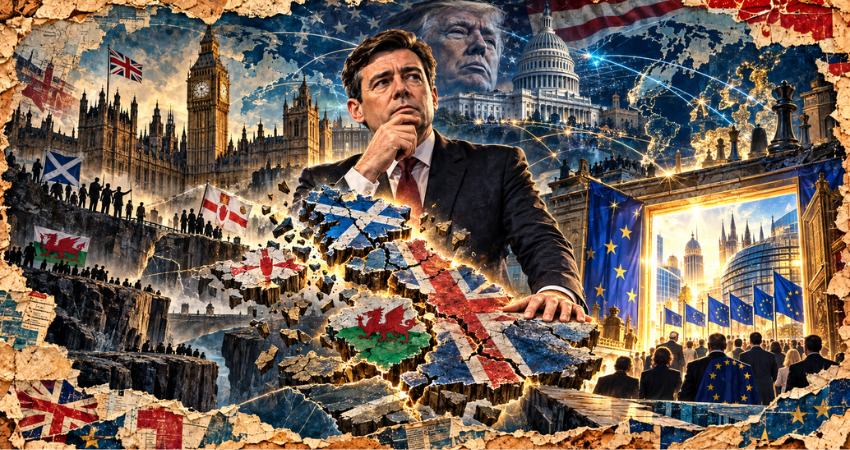
The Week That Shaped the World — 25 September–2 October 2026
Borders, Deterrence, Debt and AI — This Week the Old Assumptions Started Moving Again
There are weeks when governments change policy. More important are the weeks when they begin questioning assumptions that were supposed to be permanent.
Britain is talking seriously about Europe again. Switzerland has rejected a version of neutrality that would have pushed it further from NATO. Germany has reopened direct diplomatic contact with Russia.
Moscow is drawing an explicit nuclear line around Kaliningrad while the Baltic region quietly prepares for a security environment few Europeans wanted to imagine.
Across the Atlantic, the United States and China have begun discussing artificial intelligence almost as nuclear powers once discussed strategic weapons: not because they trust one another, but because the technology has become too important to leave unmanaged.
Money is delivering the same message. Government borrowing costs are returning to levels not seen for decades. Europe is discovering that AI ambition is easier to announce than to finance.
Even payment systems are becoming instruments of sovereignty.
Old certainties are not collapsing at once.
They are becoming negotiable.
“History rarely announces that the rules have changed. Usually, it simply begins charging a different price for believing the old ones.”
1. Britain Is Talking About Europe Again — But This May Be About Britain Itself
For nearly a decade, British politics treated Brexit as a finished argument. Britain had left, and the question was no longer whether to leave, but how to make leaving work.
This week Prime Minister Andy Burnham quietly reopened the door.
He said Britain should consider the full range of future relationships with the European Union — including a customs union, the single market and, eventually, rejoining the EU itself. Burnham also said Brexit had brought more harm than benefit, while stressing that another referendum was not imminent.
That alone would constitute a major political shift. But I suspect the European question may now be about something considerably larger than Europe.
It may also be about Britain.
Brexit altered the constitutional argument inside the United Kingdom. Scotland voted strongly to remain in the EU in 2016, and Scottish nationalists subsequently acquired an additional argument: independence could provide a route back into European institutions. Earlier this year, pro-independence parties strengthened their positions across Scotland, Wales and Northern Ireland. Reuters noted that three of Britain's four nations were set to be governed by parties favouring some form of independence, although voters were motivated by many issues beyond the constitutional question.
Then came another signal. In September, Donald Trump publicly said he would “love” to see a united Ireland and, when asked about Scottish independence, declined to discuss it — “yet”. His comments surprised officials and irritated some British unionists.
None of this establishes an American strategy to weaken the United Kingdom.
But serious geopolitics requires a distinction between intentions and interests.
Intentions may remain private. Interests are usually easier to observe.
A United Kingdom of nearly 70 million people, with nuclear weapons, a permanent UN Security Council seat, major financial markets, extensive intelligence capabilities and significant diplomatic reach represents one kind of strategic partner. Several smaller states would represent another.
Washington does not need actively to desire Britain's fragmentation for such an outcome to redistribute geopolitical weight.
And this is where Burnham's European opening becomes more interesting.
Perhaps it is simply economic correction. Perhaps London has concluded that Brexit created too much friction in trade, investment and strategic cooperation.
But there is another possibility.
A credible British path back towards Europe could weaken one of the strongest additional arguments available to separatist movements. If Scottish nationalists can say leave Britain and return to Europe, Westminster may eventually be able to answer: you may not need to leave Britain to return to Europe.
That does not remove arguments about identity, taxation, constitutional authority or self-government. Nor does it mean independence movements disappear.
It changes the calculation.
Governments facing centrifugal political pressure rarely need to defeat every argument simultaneously.
Sometimes reducing the attractiveness of one important argument is enough to buy time.
This is Prime Economist's editorial hypothesis, not a claim about a secret Downing Street plan.
But timing matters. Britain is reconsidering Europe at precisely the moment when questions about Britain's own constitutional future have become harder to dismiss as theoretical.
History may eventually judge Brexit principally as an economic decision.
I am no longer certain that will be its most consequential legacy.
Brexit may have changed the internal strategic balance of the United Kingdom itself. And if Westminster is now thinking several moves ahead, Europe's greatest value to Britain may no longer be merely access to a market.
It may be helping preserve Britain.
“Brexit turned Europe into an argument for leaving Britain. Returning towards Europe may become Westminster’s quietest argument for keeping Britain together.”
2. Switzerland Rejects Isolation — Neutrality Is Being Redefined
Switzerland has spent more than two centuries perfecting one of Europe's most recognisable political brands.
Neutrality.
On Sunday, Swiss voters were asked whether to make that neutrality substantially stricter.
The proposal would have constrained Switzerland's ability to impose sanctions and restricted peacetime military cooperation with NATO. Roughly 70% of voters rejected it.
The result should not be interpreted as Switzerland abandoning neutrality.
It did something more interesting.
Switzerland rejected the idea that neutrality must mean strategic isolation.
That distinction matters because the European security environment has changed profoundly since Russia's invasion of Ukraine. Switzerland joined EU sanctions against Moscow while remaining outside NATO and the European Union. Critics argued that such measures compromised traditional neutrality; supporters countered that neutrality should not prevent Switzerland from responding politically or economically to violations of international law.
The voters have now broadly preserved that flexibility.
This says something larger about the meaning of neutrality in a fragmented world.
During relatively stable periods, neutrality can mean remaining outside competing blocs. During periods of systemic confrontation, however, almost every supposedly neutral choice acquires strategic consequences. Refusing sanctions has consequences. Imposing them has consequences. Training with NATO has consequences. Refusing to train with NATO has consequences.
Neutrality therefore becomes less about standing outside politics and more about deciding which forms of participation still remain compatible with independence.
Switzerland is not applying to join NATO. It is not abandoning the diplomatic tradition that has made Geneva one of the world's negotiating centres.
But Swiss voters appear unwilling to freeze their country's foreign policy inside a nineteenth-century definition of neutrality while twenty-first-century security structures change around them.
Sometimes neutrality protects sovereignty.
Sometimes excessive rigidity simply removes options.
The Swiss appear to have chosen options.
“Neutrality does not mean having no position. It means preserving enough freedom to decide which positions remain your own.”
3. Germany and Russia Talk Again — Diplomacy Returns Before Trust Does
Germany and Russia have spoken directly at foreign-minister level for the first time since 2022.
German Foreign Minister Johann Wadephul met Sergei Lavrov on the sidelines of the United Nations General Assembly in New York. According to both sides, the discussion covered Ukraine, European security and bilateral relations. Wadephul later said concerns about Russia and European security motivated his decision to meet.
Nobody should confuse this with reconciliation.
Germany remains one of Ukraine's major supporters. Relations with Moscow remain deeply hostile. Lavrov and Wadephul publicly disagreed after the meeting, and nothing resembling a diplomatic breakthrough emerged.
That is precisely why the meeting matters.
Diplomacy is often misunderstood as a reward for good behaviour.
It is not.
Sometimes governments talk because relations have improved. Sometimes they talk because relations have become dangerous enough that silence itself creates additional risk.
Europe spent the first years of the Ukraine war progressively reducing political contact with Moscow.
There were understandable reasons for doing so: sanctions, military support for Kyiv and the desire to demonstrate political isolation of Russia.
But wars do not end simply because communication becomes morally uncomfortable.
At some point, European governments must calculate whether denying Russia diplomatic legitimacy remains more valuable than maintaining channels through which escalation, miscalculation and eventual negotiation might be managed.
Germany appears to be testing that boundary.
This does not mean Berlin is preparing to abandon Ukraine. Nor does it indicate an imminent European settlement with Moscow.
It indicates something more modest and potentially more important: a recognition that strategic adversaries sometimes need functioning communication precisely because they remain adversaries.
The Cold War contained long periods of intense confrontation.
It also produced hotlines, arms-control talks and permanent diplomatic machinery.
Trust was not the prerequisite.
Danger was.
Europe may gradually be rediscovering that distinction.
“Diplomacy does not begin when enemies trust each other. Often it begins when they finally understand how dangerous misunderstanding has become.”
4. Kaliningrad May Be the Next Map Europe Needs to Understand
Russia has now drawn one of its clearest red lines around Kaliningrad.
In a diplomatic note Moscow warned NATO that an attempt to isolate the Russian exclave could trigger the use of nuclear weapons. The document referred explicitly to possible strikes against decision-making centres in NATO states. NATO Secretary General Mark Rutte responded that the alliance remains defensive and said he did not consider a Russian nuclear attack on the Baltics an immediate threat.
Kaliningrad is geographically peculiar and strategically dangerous: a heavily militarised Russian territory of roughly one million people wedged between NATO members Poland and Lithuania. Russia uses it for air-defence, missile and naval capabilities; NATO planners see the same geography as a vulnerability separating parts of the Baltic security space.
Prime Economist has examined the sequence of developments around Ukraine, Moldova and the Baltic region. What follows is scenario analysis, not a claim that a formal Western escalation plan has been established.
So far, Western governments have sought to impose substantial military and economic costs on Russia while avoiding direct NATO-Russia war. Ukraine has carried the overwhelming burden of the battlefield confrontation.
If Ukraine's military position were eventually to deteriorate severely, the geopolitical confrontation itself would not necessarily disappear.
It could migrate.
Moldova and Transnistria represent one potential pressure point. The Baltic represents another. Kaliningrad is particularly dangerous because Russia has now attached an explicit nuclear threshold to its isolation.
Meanwhile, the regional security architecture is already changing. Lithuania has begun removing its constitutional prohibition on hosting nuclear weapons and foreign bases, while stressing there are no immediate deployment plans. Latvia has entered discussions about participation in France's wider nuclear-deterrence initiative.
Latvian media also reported President Edgars Rinkēvičs saying Latvia has no legal obstacle to hosting nuclear weapons if NATO ever considered it necessary, while emphasising that no such negotiations are currently under way.
These developments do not prove that war in the Baltic is planned.
They demonstrate that governments are preparing for possibilities that recently appeared remote.
Our assessment is that readers should therefore resist viewing Ukraine, Transnistria and Kaliningrad as completely unrelated maps. They belong to the same broader confrontation over Russia's place in the European security order.
Western strategy has so far attempted to pressure Russia without crossing deliberately into direct war between nuclear blocs. That is rational.
The danger begins when each side believes it can increase pressure one additional step while the other side will continue exercising restraint.
“The greatest danger in Europe is not that someone has already chosen the next battlefield. It is that too many potential battlefields are being prepared at once.”
5. America and China Have Started Talking About AI Like Strategic Powers
The United States and China have agreed to launch a formal dialogue on artificial intelligence.
The agreement followed Xi Jinping's visit to Washington and accompanied reciprocal tariff reductions covering roughly $30 billion of trade. The two governments said the AI discussions would address benefits, risks and communication channels for AI-related incidents.
This deserves more attention than another tariff agreement.
Artificial intelligence has entered diplomacy.
For years, governments discussed AI primarily as industrial policy: chips, subsidies, investment, export controls and competition between companies.
Now the language is beginning to resemble strategic-risk management.
Two rival powers want channels through which they can discuss what happens if advanced AI systems create consequences neither side intended.
That is significant.
Washington and Beijing do not need to agree about AI governance to recognise that uncontrolled misunderstanding could become dangerous. Cyber incidents already demonstrate how difficult attribution can be.
Advanced autonomous systems could make that problem considerably worse.
The historical parallel is not perfect, but the logic resembles early nuclear diplomacy.
The United States and Soviet Union did not establish hotlines because ideological conflict had ended.
They established them because conflict had become capable of moving faster than political leaders could comfortably control.
AI may eventually create similar requirements.
Last week, Britain discovered that even close allies do not automatically receive immediate access to America's most advanced models.
This week, America's principal strategic competitor receives something different:
a negotiating channel.
There is no contradiction.
Access and diplomacy serve different purposes.
One is about controlling technology.
The other is about controlling risk.
The important shift is that AI is no longer simply something governments regulate or businesses sell.
It is becoming something great powers negotiate over directly.
That tells us where the technology is moving in the hierarchy of state interests.
“A technology becomes geopolitical when rivals stop asking only who will build it first and begin asking how to prevent it from becoming a misunderstanding neither can reverse.”
6. The Bond Market Is Putting Governments Back in Their Place
For more than a decade, governments became accustomed to borrowing extraordinarily cheaply.
That era now looks increasingly distant.
Britain's 30-year gilt yield climbed above 6% this week, reaching its highest level since 1998. Ten-year borrowing costs rose to their highest since 2007. The move followed a global bond selloff driven by persistent inflation, higher US Treasury yields and expectations that central banks may keep monetary policy tighter for longer.
America is experiencing the same pressure. The benchmark US 10-year Treasury yield touched a 24-year high before easing slightly, while bond markets across Europe and Japan have also endured sharp losses.
This is not merely a technical story for traders.
Bond markets determine the price governments pay for promises.
A politician can announce new infrastructure, defence spending, tax reductions or social programmes.
Eventually somebody has to finance them.
When interest rates were near zero, debt created comparatively little immediate political pain. When thirty-year borrowing costs exceed 6%, arithmetic becomes considerably less forgiving.
Britain is especially exposed because inflation remains elevated, energy costs are sensitive to the Middle East conflict and the government faces pressure to increase spending in several areas simultaneously.
Higher yields also travel beyond Westminster.
Mortgages become more expensive.
Corporate financing becomes more expensive.
Investment decisions change.
Asset valuations change.
The bond market therefore acts as an unelected but unavoidable constraint on political ambition.
That does not mean markets should determine public policy.
It means governments cannot indefinitely determine the price at which markets finance it.
For years politics behaved as though cheap capital were part of the natural environment.
It was not.
It was a historical condition.
And historical conditions change.
“Governments can choose what they promise. The bond market quietly decides how expensive those promises become.”
7. The Federal Reserve Is Discovering That Inflation May Not Be Finished
The Federal Reserve raised rates last month.
Some policymakers already think that was only the beginning.
Dallas Fed President Lorie Logan said this week that US interest rates may need to rise by another 50 basis points or more to make monetary policy sufficiently restrictive and return inflation toward the Federal Reserve's 2% target. The current policy range is 3.75%–4.00%.
But the Fed is not united on timing.
New York Fed President John Williams and Vice Chair Philip Jefferson signalled a preference for waiting for more data before another increase, while Minneapolis Fed President Neel Kashkari said additional hikes were probably necessary but questioned whether the next one must come immediately.
That disagreement is revealing.
The important question is no longer simply whether inflation is falling.
It is whether it is falling far enough.
US inflation has remained stubbornly above target despite years of restrictive policy. At the same time, economic activity and employment have proved stronger than many policymakers expected.
Central bankers therefore face an uncomfortable problem.
Raise rates too slowly, and inflation may become embedded.
Raise them too aggressively, and higher borrowing costs could damage housing, investment and employment just as earlier tightening finally begins to bite.
Markets once spent years asking when central banks would return to cheap money.
Perhaps they were asking the wrong question.
The more important possibility is that the neutral cost of capital itself has moved higher.
If that is true, the post-financial-crisis era of permanently cheap money may not be coming back.
Businesses, governments and households would then need to adapt to something earlier generations considered perfectly normal:
money that has a meaningful price.
“The hardest inflation to defeat is not the inflation that suddenly rises. It is the inflation that falls just enough to persuade everyone the battle is almost over.”
8. Europe Wants AI — But Its Companies Are Financing It From Their Own Pockets
Europe talks constantly about closing the artificial-intelligence gap with the United States.
The financing data suggests why that may prove difficult.
An ECB analysis published this week found that around 72% of euro-area companies planning AI investment expect to finance it primarily from internal cash, while only 16% intend to use bank loans. Around 6% expect equity or venture-capital financing and just 1% plan to issue debt securities. More than 80% expect to rely mainly on a single source of finance.
That is a structural problem disguised as a funding statistic.
AI investment is unusual because much of its value lies in intangible assets: software, intellectual property, data and human expertise.
Banks traditionally prefer collateral they can value and recover.
A factory can be mortgaged.
A building can be sold.
An algorithm is considerably harder to repossess.
American capital markets are far more accustomed to financing businesses whose value may exist primarily in future growth rather than physical assets. European companies remain more dependent on bank finance, which helps explain why so many are falling back on retained earnings.
That creates an obvious ceiling.
A company can invest only as aggressively as its cash flow allows.
Meanwhile, American technology companies are issuing enormous amounts of debt and equity to finance data centres, chips and power infrastructure.
Europe therefore may not primarily have an AI-talent problem.
It may have a capital-allocation problem.
Regulation receives enormous political attention because governments can write it.
Deep capital markets are harder.
They require risk tolerance, scale, institutional investors and financial structures capable of funding companies before their investments become predictable.
Europe can announce AI sovereignty.
But sovereignty financed exclusively from yesterday's profits may struggle against competitors borrowing against tomorrow.
“Europe may possess the engineers to compete in AI. The harder question is whether its financial system possesses the imagination to finance them.”
9. Europe Is Building a Payment System Because Money Has Become Geopolitical
Europeans use American payment infrastructure so routinely that it barely feels American.
Visa.
Mastercard.
For most consumers they simply work.
That apparent neutrality is precisely what European policymakers are beginning to question.
Payment groups including Spain's Bizum, Italy's Bancomat, Brussels-based Wero, Portugal's SIBS-MB WAY and Vipps MobilePay have agreed to create the European Network for Payments, linking systems serving around 130 million users across 13 countries. Together they cover more than 70% of the population of the EU and Norway.
The objective is explicitly strategic.
Europe wants to reduce dependence on US-controlled payment infrastructure.
The network will initially connect person-to-person payments before expanding into e-commerce and physical retail. It could eventually complement the ECB's planned digital euro.
This is another example of geopolitical fragmentation reaching infrastructure most people rarely think about.
Payments are not merely convenient technology.
They are arteries of economic activity.
If access to those arteries depends heavily on companies headquartered outside Europe, then European policymakers must consider what happens during sanctions disputes, regulatory confrontation or a more serious deterioration in transatlantic relations.
Nobody is suggesting Visa or Mastercard are about to disappear from Europe.
The point is optionality.
A resilient system has alternatives.
Europe has begun applying that principle to energy, defence, semiconductors and cloud computing.
Payments are the logical next step.
The most consequential forms of strategic dependence are often the least visible because they function perfectly — until the moment politics gives somebody a reason to ask who actually controls them.
Money may increasingly become digital.
Control over the infrastructure carrying it remains profoundly political.
“The safest dependency is the one nobody notices. That is why governments usually notice it only after they begin imagining what would happen if it stopped working.”
10. Anthropic’s IPO Shows How Expensive the AI Revolution Is Becoming
Anthropic wants investors to believe artificial intelligence could transform the economy more profoundly than industrialisation or electricity.
Its IPO prospectus also reveals what that ambition costs.
Documents reviewed by Reuters show rapidly expanding expenditure as Anthropic attempts to compete at the frontier of AI development. The company is simultaneously warning prospective investors that advanced AI could create catastrophic or even existential risks while asking capital markets to finance the enormous computing infrastructure necessary to make those systems more powerful.
The contradiction is striking but not necessarily irrational.
Anthropic's argument is essentially that AI may become extraordinarily valuable and extraordinarily dangerous at the same time.
Investors are being asked to price both propositions.
This tells us something about the stage the AI industry has reached.
The first generation of the AI boom was dominated by excitement over capability.
The second is becoming dominated by scale.
More chips.
More power.
More data centres.
More engineers.
More capital.
And scale changes the economic character of technology.
Software was once attractive partly because an additional customer could be served at almost zero marginal cost.
Frontier AI increasingly resembles heavy industry.
Before another token can be generated cheaply, somebody may need to spend billions building the system capable of generating it.
This creates a fascinating question for investors.
If AI truly becomes one of history's transformative technologies, current expenditure may eventually look modest.
If capability improvements slow, competition compresses prices or regulation limits deployment, today's investment race could create one of the largest episodes of overcapacity ever financed.
Nobody yet knows which world we are entering.
That uncertainty is exactly what capital markets are now being asked to value.
Artificial intelligence has spent several years convincing humanity that intelligence itself might become cheap.
Building it is proving remarkably expensive.
“AI promises to make intelligence abundant. The race to create that abundance may become one of the most capital-intensive experiments in economic history.”