
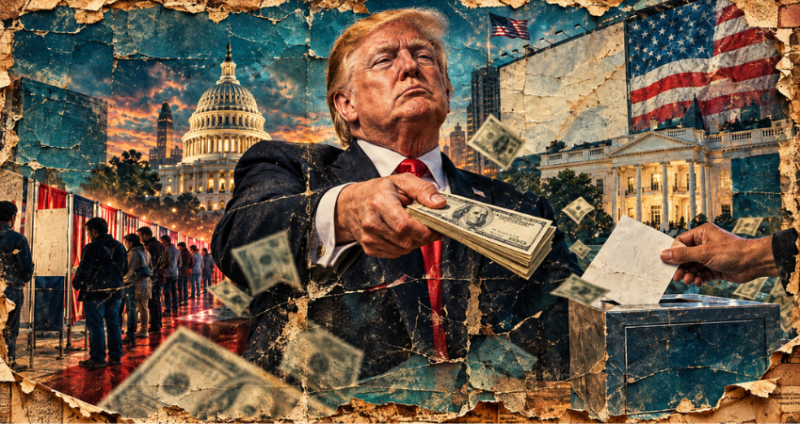
The Week That Shaped the World — 5–11 September 2026
Votes, Death, War and Debt — This Week Politics Started Naming the Price
Some weeks are held together by events.
This one is held together by invoices.
Donald Trump has offered American adults $5,000 if Republicans retain Congress. Britain is debating whether terminally ill people should be allowed medical assistance to die — while the official impact assessment, quite properly and quite chillingly, calculates what care, pensions and benefits would no longer be paid after an earlier death. Europe is discovering that a war thousands of miles away can arrive through an interest-rate decision. France is spending more on servicing yesterday’s debt. BRICS, meanwhile, is asking why tomorrow’s financial architecture should still be designed almost entirely in institutions built by yesterday’s powers.
None of these stories are identical.
But they rhyme.
Politics has always been about values. Increasingly, it is also becoming unusually explicit about price.
A vote has a number attached. A barrel of oil has become foreign policy. Debt has become a department of government. And somewhere inside Whitehall, even the final months of human life can be rendered into a spreadsheet.
Perhaps this is simply modern government becoming more transparent.
Or perhaps we are learning something less comfortable.
“Civilisation becomes interesting when it stops asking what something is worth — and starts asking what it costs.”
1. Trump Promises Americans $5,000 if Republicans Win Congress
Donald Trump has discovered an unusually efficient way of explaining electoral politics.
Put a number on it.
At the Republican convention in Dallas, the President promised what he called a $5,000 “Trump Dividend” for every adult American citizen if Republicans retain control of both the House and Senate in November’s midterm elections. Roughly 240 million adults could qualify. The potential cost is around $1.2 trillion. Congress would have to approve the spending, and tariff revenues currently come nowhere close to covering the bill.
Legally, this is not buying a vote.
No citizen is required to prove how they voted. No envelope is exchanged outside the polling station. There is no receipt marked Republican.
Modern politics has learnt some manners.
Politically, however, the distinction becomes more interesting.
The proposition is remarkably clean: deliver the President the congressional result he wants, and a rather large cheque may follow.
We normally talk about corruption in democracy as though temptation travels in one direction. Politicians sell promises; the noble voter judges them.
That may be too flattering to everyone involved.
A market exists because there are two sides to the transaction. One offers something. The other considers the price.
For generations politicians sold prosperity, national greatness, justice, lower taxes, better schools and, when absolutely necessary, beautifully packaged nonsense. Trump has removed much of the poetry.
Five thousand dollars is easier to understand.
The economic arithmetic is rather less convenient. America is already running a large fiscal deficit. A programme of this scale would almost certainly require substantial borrowing unless matched by taxes or spending cuts elsewhere. Similar pandemic-era transfers supported demand but also became part of the later argument over inflation.
Perhaps Trump has not invented a new politics at all.
Perhaps he has merely put a public price on an old human instinct.
“When citizens begin choosing not between ideas but between sums, politics is no longer corrupting democracy. It is simply servicing demand.”
2. Who Benefits from the Right to Die?
Britain is again debating assisted dying.
The Terminally Ill Adults (End of Life) Bill returned to the Commons on 11 September. It would permit mentally competent adults in England and Wales, aged over 18 and reasonably expected to die within six months, to request medical assistance to end their lives under a defined system of safeguards. The government remains formally neutral.
The moral argument for it is formidable.
A person is dying. Medicine cannot save them. Pain, indignity or physical decline may be overwhelming. Why should the state insist that they remain alive until biology finishes the job?
British media have carried deeply affecting accounts from terminally ill people and bereaved families arguing precisely that. Campaigners including Dignity in Dying have deliberately put human faces before Parliament.
Fair enough.
But Prime Economist has an unfortunate habit when politics speaks entirely in the language of compassion.
We look for the spreadsheet.
The government's own impact assessment models the financial consequences. Under its high-uptake scenario, as much as £84.76 million of healthcare expenditure could be “not required” in year ten if assisted deaths mean four fewer months of end-of-life care. It also estimates up to £30.24 million in state-pension payments no longer required under an illustrative high scenario, though Treasury methodology correctly classifies those pension payments as economic transfers rather than societal savings. The document also warns that unused healthcare capacity may simply be taken up by other patients rather than producing a cash saving.
None of this proves that Britain is legalising assisted dying to cut costs.
We make no such allegation.
Our concern is about the mechanism being created.
The bill establishes a Voluntary Assisted Dying Commissioner appointed by the Prime Minister, supported by review panels comprising legal, psychiatric and social-work members. These bodies would decide whether applicants satisfy the statutory criteria.
Today the boundary is six months.
Who sets that boundary?
Parliament.
Who could move it later?
Parliament.
Britain is ageing. Pensions are expensive. NHS care is expensive. Social care is expensive.
We therefore regard this law as carrying the risk of becoming, in some future fiscal crisis, a rehearsal for managed optimisation of state expenditure through the regulation of the end of life.
Not because that is its declared purpose today.
Because once the machinery exists, future governments inherit it.
The dangerous question is not whether today's MPs intend abuse.
It is whether tomorrow's state may discover an incentive that today's Parliament never intended to create.
“The state may safely be entrusted to protect life. The more dangerous moment comes when we discover that we have also entrusted it to calculate how long that life should remain affordable.”
3. America Is Fighting Over the Map Before It Counts the Votes
There is more than one way to win an election.
The traditional method is to persuade voters.
The more sophisticated method is to decide which voters belong together before persuasion begins.
On 10 September, the US Supreme Court blocked Missouri from using a Republican-backed congressional map for November’s midterm elections, leaving the state to return to its 2022 districts. The disputed map would have broken up the Kansas City-based district represented by Democrat Emanuel Cleaver and potentially given Republicans another congressional seat.
The legal dispute became unusually messy.
Missouri Republicans had adopted new boundaries with encouragement from Trump as both parties searched for every possible House seat in what could be an extremely tight election. Opponents mounted a referendum effort, Missouri courts intervened, federal proceedings followed, and election officials were briefly left trying to work out which map actually governed an election already approaching.
This is gerrymandering’s peculiar achievement.
Democracy still occurs.
People still queue. Ballots are still printed. Candidates still shake hands in diners and discover sudden affection for local manufacturing.
But before any of that, mathematics enters the room.
Move this suburb there. Divide that city here. Add enough reliable voters to one district, remove enough from another, and representative government begins to look suspiciously like cartography with career incentives.
Republicans argue that legislatures possess legitimate authority over redistricting and that Democrats use the same tools where they hold power.
They are correct about the second part.
That does not make the system prettier.
The Missouri case matters because the struggle for Congress is now so tight that the geometry of a district may be worth more than thousands of campaign speeches.
America will spend the next two months talking solemnly about the will of the people.
It might first decide which people belong in which box.
“In modern democracy, the voter chooses the politician — after the politicians have had a surprisingly enthusiastic attempt at choosing the voters.”
4. Britain Finally Puts a Price on Israeli Settlements
Britain has criticised Israeli settlements in the occupied West Bank for years.
Diplomacy is rich in verbs such as urge, condemn, deplore and reiterate.
They are terribly useful because none requires a customs officer.
This week that began to change.
On 8 September, Britain joined France, Canada and other governments in announcing further measures against trade connected to Israeli settlements. The UK, France and Canada said they would bring forward national measures to ban trade in settlement goods, arguing that settlement expansion and settler violence are undermining the possibility of a two-state solution.
Israel responded sharply.
Foreign Minister Gideon Saar announced the closure of the British consulate in East Jerusalem and accused London of hostile interference. Britain maintains that the settlements are illegal under international law and says the trade restrictions are aimed at the settlements, not Israel itself.
That distinction matters.
So does the timing.
For decades Western governments managed an increasingly strange arrangement: settlements could be described as unlawful while normal economic and diplomatic relations continued around them. Legal objection and commercial reality occupied separate rooms and politely avoided each other.
Britain is now attempting to connect them.
There are reasonable objections. Trade with settlements is small. Economic sanctions may achieve more symbolism than behavioural change. Israel argues that external pressure hardens positions rather than advancing peace.
Perhaps.
But symbols become policy precisely when governments decide words have stopped working.
The interesting development is therefore not the likely immediate economic damage.
It is precedent.
Once a government concludes that economic relationships can be differentiated according to where goods are produced and under what territorial status, a diplomatic position acquires machinery.
Customs codes do something communiqués cannot.
They stop being opinions at the border.
“For years Britain said the settlements were illegal. This week it began the more difficult business of deciding whether the adjective should have economic consequences.”
5. Trump Promised to End the Forever Wars. Iran Has Entered the Election Calendar
Donald Trump returned to office presenting himself as the man who understood one lesson Washington repeatedly forgot.
Wars are easier to start than to finish.
America is learning the lesson again.
On 11 September, Trump said he did not regret the decision to go to war with Iran, despite the political damage the conflict may inflict on Republicans in November. He has suggested the war could end after the midterms, effectively placing military strategy inside the electoral calendar.
The campaign began with US-Israeli strikes on Iran in February. Months later the conflict is no longer confined to aircraft, missiles and military briefings.
It has reached the petrol station.
Disruption around the Gulf, attacks on shipping and energy infrastructure, and fears over the Strait of Hormuz have pushed Brent crude back above $100 a barrel. US diesel prices have climbed above $6 a gallon, a record.
That creates a distinctly Trumpian contradiction.
The President who built much of his appeal on cheap energy, domestic prosperity and hostility to open-ended foreign entanglements now faces an open-ended foreign entanglement raising energy costs at home.
Supporters argue that Iran’s nuclear and military capabilities had to be confronted and that delaying action would have produced a greater danger later.
Critics see something painfully familiar: Washington entering a conflict with impressive destructive capability and a less impressive description of the political end-state.
Both arguments deserve examination.
What cannot be debated away is the bill.
Wars are sold in strategy and paid for in mundane places: shipping insurance, diesel, food distribution, mortgages and government borrowing.
For voters, geopolitics eventually becomes household arithmetic.
The war may be occurring in the Middle East.
Its polling station is in America.
“A forever war does not become temporary because a president puts Election Day on the calendar.”
6. American Inflation Is Heating Up Just as Trump Promises a $1.2 Trillion Cheque
The American voter has been offered $5,000.
The Federal Reserve may soon respond by making money more expensive.
There is a certain elegance to modern economic policy.
Official data released on 11 September showed US consumer prices rising 0.4% in August, up sharply from July’s 0.1% monthly increase. Annual inflation remained at 3.4%. Core inflation, excluding food and energy, rose 0.3% during the month and eased slightly to 2.4% year-on-year. Gasoline was an important part of the acceleration.
The figures arrived one day after producer-price data showed a 0.4% monthly increase in final demand and a 5.4% annual rise, with diesel fuel prices jumping particularly sharply.
Markets responded by assigning roughly a 70% probability to a Federal Reserve rate increase at its 15–16 September meeting.
Now return to politics.
Trump's proposed dividend would cost roughly $1.2 trillion if paid to all adult citizens. Unless financed through equivalent taxation or spending cuts, much of that money would have to come from additional borrowing. Tariff receipts are nowhere near sufficient to finance the entire promise.
That does not mean a $5,000 payment automatically produces another inflationary spiral.
Economics rarely grants us such convenient certainty.
But adding enormous fiscal demand while the central bank is considering tighter monetary policy is, at minimum, an unusual form of teamwork.
Washington may therefore find itself pressing the accelerator and the brake simultaneously.
The political temptation is obvious. Households dislike inflation because prices are visible. They like cash because cash is also visible.
The connection between the two arrives later, usually accompanied by an economist explaining why everybody should have read the footnotes.
America's election may yet be fought over affordability.
That makes a trillion-dollar cash promise wonderfully simple politics.
And rather complicated economics.
“Government can print the cheque before the election. Inflation has the discourtesy to send its invoice afterwards.”
7. Britain Grows Faster Than Expected — and AI May Be Hiding Inside the Number
Britain produced something this week that Westminster has almost forgotten how to handle.
Good economic news.
GDP grew 0.4% in July, following 0.3% growth in June. Compared with July 2025, the economy was 1.6% larger, the strongest annual monthly comparison in roughly 18 months. Services rose 0.4%, while production and construction also recorded modest monthly gains.
Look underneath the headline and something interesting appears.
Computer programming, consultancy and related activities grew 3.5% in July. The Office for National Statistics says many of the businesses reporting the strongest turnover in programming and information services were involved in artificial intelligence and cloud computing — while carefully warning that it cannot yet quantify precisely how much of the growth came from AI.
That caution deserves to survive contact with the headlines.
Britain has spent years discussing the AI revolution in the future tense. If these figures endure, parts of it may already be appearing quietly in national output.
There is, naturally, another ledger.
Consumer-facing services actually fell in July. Construction was down over the three-month period. Oil above $100 is threatening another inflation shock. Government borrowing costs have risen sharply, and markets are again contemplating higher Bank of England rates.
So Britain has arrived at one of its favourite economic contradictions.
Growth is improving.
The price of financing it is becoming less friendly.
The encouraging possibility is that productivity-enhancing sectors such as software, cloud infrastructure and AI are beginning to lift output sufficiently to matter at national scale.
The less encouraging possibility is that Britain has found another promising growth engine precisely as energy and capital become expensive enough to restrain it.
We have seen this film before.
The machinery improves.
Then somebody brings the electricity bill.
“Britain may finally have found some growth. The question is whether the cost of money will allow us to keep it.”
8. The ECB Raises Rates — and the Middle East Arrives in the European Mortgage
The European Central Bank does not command aircraft carriers.
It does, however, possess interest rates.
On 10 September the ECB raised all three of its key rates by 25 basis points, taking the deposit facility rate to 2.50%, the main refinancing rate to 2.65% and the marginal lending rate to 2.90%, effective from 16 September.
The explanation was unusually direct.
The conflict in the Middle East continues to generate inflationary pressure.
The ECB now forecasts headline inflation averaging 3.0% in 2026, 2.5% in 2027 and 2.1% in 2028. Its projections for 2027 and 2028 were revised higher.
This is how distant wars migrate.
First a tanker becomes difficult to insure.
Then oil rises.
Then transport becomes more expensive.
Then manufacturers pass on costs.
Then households discover that the central bank has noticed.
The missile never reaches Frankfurt.
The mortgage does.
There is a political problem buried inside this mechanism.
European governments possess limited control over the geopolitical shock, yet their citizens experience the response domestically. A German homeowner does not distinguish elegantly between inflation originating in the Gulf and inflation originating in Berlin when the monthly payment changes.
The ECB has little choice but to concentrate on its mandate.
If inflation remains persistently above its 2% target, doing nothing carries its own costs: expectations can become embedded, wages and prices adjust, and restoring stability later may require even harsher tightening.
But monetary policy remains a blunt instrument.
It cannot reopen the Strait of Hormuz.
It cannot repair an oil terminal.
It cannot negotiate a ceasefire.
It can only reduce demand elsewhere until the economy stops generating additional pressure of its own.
Central banking often looks technocratic from a distance.
Up close, it is the art of making one part of society cooler because another part of the world has caught fire.
“A missile does not need the range to reach Europe. Its interest rate can make the journey for it.”
9. France’s Largest Spending Item Is Becoming the Cost of Yesterday
France has reached a fiscal milestone no government puts on a campaign poster.
Debt service is becoming its largest single expenditure.
On 11 September, Finance Minister Roland Lescure cut the government’s 2026 growth forecast from 0.7% to 0.5% and acknowledged that France would miss its target of reducing the budget deficit to 5% of GDP. Borrowing costs have risen, and debt servicing is now expected to reach roughly €65 billion, around €4.5 billion more than budgeted.
That figure deserves to sit quietly on the page for a moment.
Sixty-five billion euros.
Not to build a railway.
Not to hire teachers.
Not to modernise hospitals.
Not to buy weapons.
To finance previous borrowing.
Debt is useful. Sometimes essential.
States borrow to survive crises, build infrastructure, smooth recessions and spread the cost of long-lived investments across generations that will benefit from them.
The problem begins when servicing accumulated debt consumes enough revenue to restrict today's choices.
France is approaching that problem while political fragmentation makes both tax rises and serious spending restraint difficult. Investors demand a greater premium for holding French debt. Higher yields then increase future interest costs.
The snake begins examining its tail.
Paris still possesses enormous economic strengths, a deep tax base and access to one of the world's major capital markets. France is not on the verge of some melodramatic sovereign collapse.
The more subtle danger is stagnation by obligation.
Every euro committed to debt service is a euro unavailable for whichever crisis the next government insists is absolutely unprecedented.
Climate adaptation. Defence. Healthcare. Ageing. Industry.
All will want money.
Yesterday already has a reservation.
Governments like debt because it allows today's electorate to consume tomorrow's taxation without having to meet tomorrow's voter.
Eventually they are introduced.
“A state loses fiscal freedom gradually: first it borrows to fund its priorities, then servicing the borrowing becomes one of them.”
10. BRICS Is Not Killing the Dollar. It Is Learning How to Live With Less of It
The death of the dollar is announced with remarkable regularity.
The dollar, displaying poor manners, continues turning up for work.
BRICS finance ministers and central-bank governors nevertheless took another incremental step this week towards building alternatives around the existing Western-dominated financial system.
In a statement released ahead of the leaders’ summit in New Delhi, BRICS officials called for reforms to institutions including the IMF and World Bank, arguing that governance should better reflect the growing economic weight of emerging economies. They also instructed work to continue on cheaper, faster and more interoperable cross-border payment systems.
India is separately pushing discussion of connecting or making member states' central-bank digital currencies more interoperable for international payments. The summit itself takes place on 12–13 September, outside this digest’s reporting window, and major technical and political obstacles remain.
Those obstacles are not trivial.
India and China distrust one another.
Iran and Gulf states bring their own geopolitical tensions.
Trade imbalances make settlement difficult.
National central banks do not casually surrender control over payment architecture because somebody has printed an attractive summit logo.
So no, BRICS is not about to replace the dollar with a shiny new currency next Tuesday.
That misses the more important story.
Financial power is not only about which currency dominates reserves.
It is about infrastructure.
Who clears the payment?
Which banks must be used?
Which sanctions can stop it?
Which institution sets conditions when a country needs emergency finance?
For decades the Western-led system possessed not merely prestige but plumbing.
BRICS is beginning to experiment with its own pipes.
They may leak. They may never connect properly.
But the strategic intention is visible.
The bloc does not yet need to overthrow the financial order.
It merely needs, transaction by transaction, to make dependence on it less compulsory.
“The dollar does not have to die for American financial power to weaken. The world merely has to learn that there are other doors out of the room.”