Saudi Arabia, Turkey and Pakistan Create a New Mutual-Defence Bloc
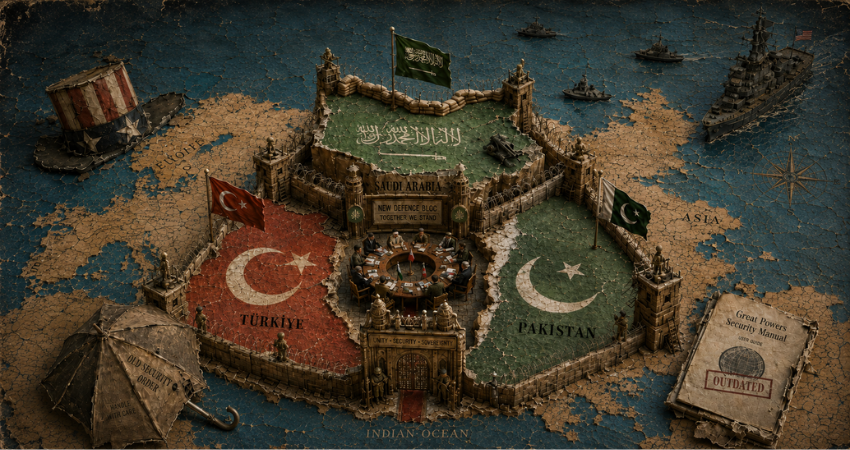
The Week That Shaped the World — 31 July–7 August 2026
A New Defence Bloc Emerges. Britain Discovers the Price of Rebuilding — and Other Major Stories of the Week
The international order has spent decades organising power through institutions designed after earlier crises. This week, several countries began making alternative arrangements.
Saudi Arabia, Turkey and Pakistan created a mutual-defence pact outside the traditional architecture built around Washington. North Korea moved closer to becoming an operational participant in Russia’s war in Ukraine. One of Ukraine’s most prominent former commanders publicly questioned whether NATO membership remains a realistic destination at all.
In Asia, Taiwan rehearsed a war whose possibility everybody officially wishes to minimise while Japan and China argued increasingly openly about who is preparing for it. In Germany, investigators treated an explosive drone incident at a military logistics hub not merely as a crime but as a potential attack on national security.
Economics offered a similar lesson.
Britain’s new government promised a different model and immediately encountered the same arithmetic. Ministers were told there was no new money, while the Treasury simultaneously examined how existing fiscal rules might permit more borrowing for investment. British construction remained in contraction while the country continued insisting that its housing shortage would be solved by building.
China, meanwhile, demonstrated that trade restrictions have not prevented its export machine from finding a new growth engine in artificial intelligence. Global food prices climbed again, while American factories recorded their strongest expansion in years even as managers complained that the supply environment increasingly resembles something they had hoped never to see again.
Governments continue to possess choices.
The difficulty is that increasingly, every choice appears to have been pre-financed by the consequences of the previous one.
”The new global order is not being designed. It is being improvised by governments discovering that the old one no longer provides everything they need.”
1. Saudi Arabia, Turkey and Pakistan Create a New Mutual-Defence Bloc
Saudi Arabia, Turkey and Pakistan signed the Mecca Joint Defence Agreement on August 7, establishing that an attack on one participant would be treated as an attack on all.
That sentence resembles NATO’s central principle sufficiently to make the comparison unavoidable.
The three countries bring very different assets. Turkey has NATO’s second-largest military. Pakistan possesses nuclear weapons and one of the region’s largest armed forces. Saudi Arabia possesses money, energy infrastructure and a geographic position that allows many regional crises to become Saudi problems shortly after they begin.
The agreement excludes nuclear cooperation, according to Reuters, and its participants describe it as defensive. Its political meaning is nevertheless larger than its legal wording.
For decades, Saudi security depended heavily on the United States. Turkey’s security remains formally embedded in NATO. Pakistan has alternated between partnership and tension with Washington.
All three are now creating an additional insurance policy.
That does not mean they are abandoning America. It means they have noticed that being an American ally and possessing sufficient independent protection are no longer necessarily the same thing.
Regional instability accelerated the arrangement. Saudi Arabia has faced threats from Iranian-aligned groups to its north and south, while wars involving Iran, Israel and their respective partners have made reliance on external protection progressively less comfortable.
The remarkable development is therefore not that three states agreed to cooperate.
It is that three states already protected by existing alliances decided another alliance was still necessary.
“The Middle East spent decades asking how much security America would provide. It has begun asking how much security it should provide for itself.”
2. North Korea Moves From Supplying Russia’s War to Operating Its Own Missile Unit
North Korea’s involvement in Russia’s war against Ukraine is becoming considerably harder to describe as assistance.
Ukrainian intelligence says a North Korean missile unit is deploying to Russia’s Voronezh region with roughly 90 personnel, up to six launchers and potentially 120 ballistic missiles. At least 40 missiles had reportedly already arrived.
Pyongyang had already supplied Russia with artillery shells, missiles and troops. Reuters estimates North Korean ammunition has become extraordinarily important to Russian frontline supply, while thousands of North Korean soldiers have served alongside Russian forces.
A dedicated missile formation represents another step.
North Korea is no longer merely selling Russia the material required to fight a European war. It is moving towards operating part of that war itself.
This matters well beyond Ukraine.
Russia and North Korea signed a mutual assistance treaty in 2024. What initially appeared to be a diplomatic alignment has evolved into a mechanism through which an isolated Asian nuclear state acquires combat experience, Russian technology and battlefield knowledge while Moscow receives manpower and weapons.
Europe therefore faces an unusual consequence of its own industrial weakness.
Western governments spent years debating how rapidly they could manufacture ammunition for Ukraine. North Korea solved Russia’s corresponding problem considerably faster.
The war was once described as a conflict between Russia and Ukraine supported by competing international coalitions.
The coalitions are gradually acquiring uniforms.
“North Korea began by supplying Russia’s war. It is increasingly learning how to fight one.”
3. Ukraine’s Former Commander Says NATO Membership May No Longer Be a Realistic Destination
For years, Ukraine’s long-term security strategy could be summarised in one word: NATO.
Valery Zaluzhnyi has now publicly questioned whether that destination remains realistic.
Ukraine’s former commander-in-chief, now ambassador to Britain and one of the country’s most influential public figures, said he sees no realistic prospect of Ukrainian membership in the alliance. He argued that Ukraine’s armed forces remain incompatible with important NATO capabilities and doctrine, including missile defence and space-based systems.
The significance lies partly in who said it.
Zaluzhnyi commanded Ukraine’s military during some of the most important phases of the Russian invasion and remains a figure with substantial political credibility. His statement does not alter Ukraine’s constitutional aspiration to join NATO, nor does it formally change government policy.
It does, however, expose the increasing distance between aspiration and strategic reality.
Russia has always demanded that Ukraine remain outside NATO. Ukraine has always insisted that Moscow should not possess a veto over its alliances.
Between those positions sits a less philosophical obstacle: NATO members themselves have never reached unanimous agreement on admitting a country already fighting Russia.
The West has therefore spent years promising that Ukraine’s future lies inside the alliance without establishing when that future begins.
Zaluzhnyi has supplied the uncomfortable possibility that it may not.
If so, Europe will eventually require another security architecture for Ukraine.
It may discover that postponing that design was easier than designing it.
“Ukraine was promised an open door to NATO. The unresolved question is whether the corridor behind it was ever built.”
4. Taiwan Rehearses War While China and Japan Argue About Who Is Preparing for It
Taiwan began its annual Han Kuang exercises this week with more realism and considerably less reassurance.
More than 20,000 reservists are participating in drills that include disrupted communications, rapid command decisions, arsenal relocation and mobilisation of civilian infrastructure. Taiwan is even deliberately slowing mobile internet to simulate wartime conditions.
Its defence minister also said cooperation with the United States Pacific Command is closer than many people imagine.
The statement is notable because American policy towards Taiwan continues to depend on strategic ambiguity.
Officially, Washington avoids specifying exactly how it would respond to a Chinese attack. Operationally, Taiwan is describing a relationship that appears increasingly specific.
Japan is moving in the same direction.
Tokyo’s latest defence white paper warned that the military balance around Taiwan is shifting rapidly towards China. Prime Minister Sanae Takaichi has already suggested circumstances in which a Chinese attack could require Japanese Self-Defense Forces to act.
Beijing responded by accusing Japan of exaggerating the Chinese threat and reviving militarism.
Everyone therefore agrees that a war must be prevented.
They are simply buying weapons, changing doctrine, conducting increasingly realistic exercises and reorganising alliances in case prevention fails.
Strategic ambiguity once meant that nobody knew exactly what America would do.
The growing problem is that everybody is preparing increasingly detailed plans for what happens afterwards.
“Peace around Taiwan increasingly consists of several governments preparing very seriously for a war they insist is not inevitable.”
5. Germany Investigates an Explosive Drone at a Military Logistics Hub
Germany’s federal prosecutor has taken over an investigation into a suspected drone attack near a major freight and military airport in the country’s east.
That bureaucratic detail is what makes the story important.
Federal prosecutors said the incident may represent a serious attack on German transport and logistics infrastructure with implications for both domestic and external security.
The facility is not simply another airport. It forms part of the logistics network supporting German and allied military operations and therefore belongs to the physical infrastructure on which NATO deterrence depends.
Europe has spent several years preparing intellectually for hybrid warfare.
Undersea cables have been damaged. Cyberattacks have targeted infrastructure. Intelligence agencies have warned about sabotage, espionage and covert Russian operations across the continent.
The difficulty begins when an ambiguous incident moves from theoretical risk to an object containing explosives.
Investigators have not publicly established responsibility. It would therefore be premature to attribute the incident to Russia or any other state.
The strategic point does not require attribution.
Modern European deterrence rests on ports, airports, railways, warehouses, telecommunications networks and power supplies that were largely built as civilian infrastructure. A hostile actor does not necessarily need to attack a NATO military base if disrupting the logistics feeding it produces sufficient effect.
Article 5 was written for armed attack.
Europe is increasingly discovering a category of hostile action carefully designed to make governments argue about whether an attack has happened at all.
“Hybrid warfare succeeds when the damage is obvious but the decision about what to call it is not.”
6. Burnham Wants to Rebuild Britain. The Treasury Says There Is No New Money
Andy Burnham entered Downing Street promising a different economic model.
Less than two weeks later, every cabinet department received a more traditional message from the Treasury: there is no new money.
Finance minister John Healey told departments that programmes involving technical education, regional devolution and cost-of-living support would need to be funded from existing budgets. New commitments must be matched by reprioritisation.
Healey also said Britain’s rising welfare bill must be controlled and declined to rule out tax increases in his first budget, scheduled for October 28.
The problem is not ideological. It is arithmetic.
Burnham wants higher investment, improved social care, increased defence spending and greater economic power for British regions while retaining existing fiscal rules. Those rules require day-to-day spending eventually to be covered by tax revenues.
Markets have already noticed the contradiction. Gilt yields rose after Burnham took office as investors assessed the possibility of higher borrowing and spending.
Then another development appeared.
This week the Treasury was reported to be examining how flexibility created by previous fiscal reforms could permit additional borrowing for infrastructure, housing and business investment. Institutions such as the National Wealth Fund, British Business Bank and National Housing Bank could become vehicles for that expansion.
Britain is therefore considering borrowing more for investment while simultaneously telling ministers to spend less.
Both policies can be economically rational.
The challenge is persuading bond investors that they belong to the same definition of discipline.
“Britain has elected a government promising to escape austerity without escaping arithmetic.”
7. Britain Needs More Homes While Its Construction Industry Is Still Shrinking
Britain has a housing shortage.
Its construction industry is contracting.
The two facts have coexisted for long enough to become a model of British economic policy.
The S&P Global construction PMI rose sharply in July from 38.4 to 44.7. That was much better than economists expected and suggests the brutal downturn of the second quarter is easing.
Unfortunately, anything below 50 still means contraction.
Commercial construction and housebuilding both remained weak.
At the same time, Lloyds reported that UK house prices were essentially flat in July as higher mortgage costs continued to damage affordability.
This creates an economic trap.
High house prices make ownership inaccessible for many households. High borrowing costs reduce demand. Weak demand discourages construction. Weak construction preserves the shortage that helped make housing expensive in the first place.
Government can attempt to break the cycle by accelerating public housing and infrastructure.
That requires construction capacity.
It can lower planning barriers.
That does not guarantee developers will build projects whose financing no longer works.
Britain’s housing crisis is often discussed as if the central problem were the number of planning permissions issued by local authorities. Planning is important. So are labour, financing, materials, infrastructure, land values and the profitability expected by private developers.
The country wants a building boom at precisely the moment the building industry is emerging from one of its sharpest recent contractions.
Britain does not lack plans for more homes.
It currently lacks an economy making those plans sufficiently easy to build.
“Britain’s housing shortage is caused partly by not building enough homes. Its current solution depends on an industry that is still building fewer things.”
8. China’s Export Machine Finds a New Engine in the Global AI Boom
American technology restrictions were designed partly to prevent China from dominating the next generation of advanced technology.
The global AI boom is nevertheless providing Chinese industry with an extraordinary new export market.
China’s exports rose 23.9% year-on-year in July. Semiconductor exports almost doubled, while high-tech exports increased 40.7%.
The numbers reveal two different Chinese economies.
Domestically, consumption remains weak, property continues to weigh on confidence and investment has disappointed.
Externally, the world is ordering enormous quantities of technology.
AI infrastructure requires far more than the most advanced American graphics processors. It requires electronics, electrical equipment, networking components, memory-related products, industrial machinery and enormous supporting supply chains.
China manufactures many of them.
This creates an awkward feature of the technological confrontation between Washington and Beijing.
The United States can restrict China’s access to certain frontier technologies while American and global investment simultaneously expands demand for the broader industrial ecosystem China already dominates.
Beijing has responded by leaning harder into exports rather than launching the vast consumer stimulus many economists have demanded.
For the moment, the strategy works.
It also exports some of China’s economic imbalance to everybody else.
China’s factories need foreign buyers because Chinese households are not consuming enough. Foreign governments then complain that Chinese factories are selling too much.
The trade conflict may therefore intensify precisely because China’s export strategy is succeeding.
“The West is trying to contain China’s role in the AI economy while simultaneously ordering much of the equipment required to build it.”
9. World Food Prices Rise Again as Climate and War Share the Same Supply Chain
Global food prices climbed in July to their highest level in more than three years, according to the United Nations Food and Agriculture Organization.
The causes are inconveniently diverse.
Conflict is disrupting agricultural production and shipping in several important regions. Extreme weather is damaging crops elsewhere. Energy costs influence fertiliser, transport and refrigeration. Supply chains then convert all of these problems into one familiar outcome at the supermarket.
Higher prices.
The FAO has warned that the world faces another period of food inflation as geopolitical and climatic shocks occur simultaneously.
This matters because food inflation behaves differently from many other forms of inflation.
Consumers can postpone buying furniture. They can reduce discretionary travel. They cannot stop eating until monetary policy improves.
Food prices therefore hit lower-income households most severely and create political effects disproportionate to their share of advanced economies.
Central banks face another difficulty.
Interest-rate increases can suppress demand. They cannot increase rainfall, reopen damaged ports or manufacture a missing harvest.
Yet policymakers remain responsible for stopping temporary food shocks from spreading into wages and broader inflation expectations.
The world has spent several years moving from pandemic shortages to energy shocks, wars and climate disruption.
Each event was initially described as temporary.
Consumers have now experienced enough temporary events to understand that another one will eventually arrive.
The most persistent feature of modern inflation may therefore be the frequency with which supposedly exceptional causes occur.
“Food inflation is temporary in much the same way that bad weather is temporary: each event ends before the next one begins.”
10. American Manufacturing Surges — and Factory Managers Say the Supply Chain Feels Worse
American manufacturing activity rose in July to its highest level in more than four years.
The Institute for Supply Management’s manufacturing index reached 55.6. Factory employment expanded for the first time in 33 months. New orders strengthened. Backlogs grew.
That would ordinarily constitute an uncomplicated economic success.
The people running the factories sounded considerably less celebratory.
Almost two-thirds of negative comments collected by the ISM referred to pricing volatility. Manufacturers complained about expensive transport, shortages of electronics and critical minerals, longer delivery times and disruption linked to conflict and tariffs.
One respondent told the survey that the current metals environment made the chaos of the pandemic appear more manageable.
AI investment is part of the reason.
Demand for computers, electrical systems and electronic components is helping support manufacturing while simultaneously competing for scarce semiconductors and other inputs.
Tariffs add another layer.
They are intended to strengthen domestic manufacturing by making foreign production less attractive. In the short term, they can also increase the price of imported materials American manufacturers still require.
The result is a manufacturing boom occurring inside a supply system behaving as though it were under stress.
Factories are receiving more orders.
Suppliers are taking longer.
Input prices remain high.
The American industrial revival may therefore be real.
Its first achievement may be demonstrating that producing more domestically does not immediately make producing things domestically simple.
“American factories are booming again. Their supply chains appear not to have received the same announcement.”