US-Iran Dispute Over Strait of Hormuz Control Comes With a $600 Million Hit for Hapag-Lloyd
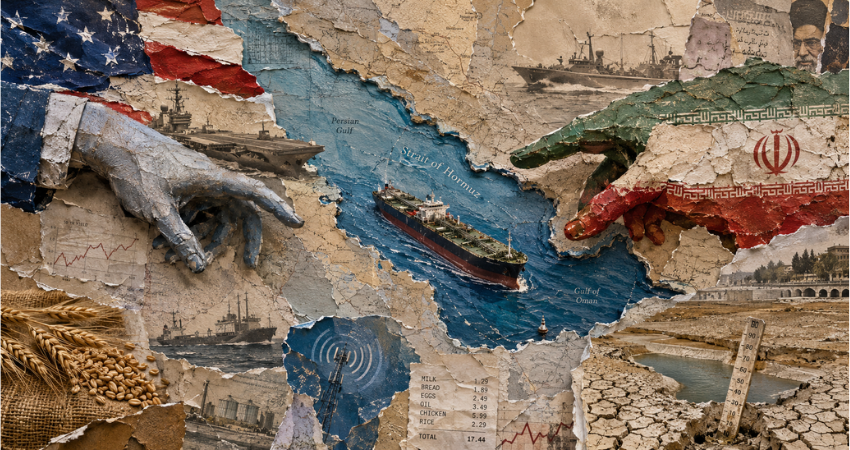
The Week That Shaped the World — 7–14 August 2026
The world spent this week arguing about control.
Washington and Tehran both claimed authority over the Strait of Hormuz while the economic price of the confrontation became harder to ignore. Hapag-Lloyd said the Middle East crisis cost the shipping group about $600 million in the second quarter alone — a reminder that geopolitical arguments eventually arrive on somebody’s balance sheet.
Ukraine proposed a halt to attacks on civilian shipping in the Black Sea as maritime warfare continued to weigh on grain exports. Taiwan deliberately slowed its own mobile internet while rehearsing how the island might function during a Chinese attack. In Gaza and southern Lebanon, diplomacy remained trapped by the same problem: every side knows what it wants the other to do first.
Economics offered a similar lesson.
Britain grew faster than expected, only for stronger activity to reinforce the case for higher interest rates. Artificial intelligence began appearing not merely in valuations but in British output and investment. Supermarkets absorbed part of the food-price shock themselves, while drought turned water from background infrastructure into an increasingly visible economic constraint.
Across the Atlantic, American equities remained close to record levels while the government paid unusually high yields to borrow for ten years.
The systems still work.
The increasingly interesting question is what keeping them working now costs.
“Power is easiest to claim in a speech. The bill usually arrives somewhere less theatrical — in a shipping account, a mortgage payment, a supermarket margin or an empty reservoir.”
1.US-Iran Dispute Over Strait of Hormuz Control Comes With a $600 Million Hit for Hapag-Lloyd
Washington and Tehran spent this week arguing over who controls the Strait of Hormuz.
The shipping industry has begun answering a more practical question:
What is that argument costing?
On Thursday, Iran’s newly appointed Basij chief Hossein Taeb said the Strait was under Tehran’s “control and management”. A day earlier, President Donald Trump had claimed that the United States had “total control” of the waterway. Iran’s joint military command went further, saying no vessel could transit Hormuz without Tehran’s permission.
The dispute itself is not new.
The price attached to it is becoming much clearer.
Hapag-Lloyd, one of the world’s largest container shipping companies, said this week that the Middle East conflict and the closure of Hormuz cost the group about $600 million in the second quarter, weighing heavily on its earnings.
That does not mean Hapag-Lloyd posted a $600 million loss.
The company remained profitable. Strong exports from Asia and improved demand in the United States partly offset the damage, leaving net profit at $83 million, down from $306 million a year earlier.
In other words, $600 million is Hapag-Lloyd’s estimate of the financial hit from the crisis — not its final quarterly loss.
And Hapag-Lloyd is only one company.
Before the war, roughly a fifth of the world’s oil and liquefied natural gas moved through Hormuz. Traffic remains severely curtailed: before the conflict, around 125 to 140 vessels crossed the Strait each day; this week, crossings excluding container ships fell to just five in a single day.
Energy producers are already adapting.
ADNOC has introduced shuttle shipments across the Strait, expanded ship-to-ship transfers outside Hormuz and is enlarging its shipping fleet. Reuters notes that if these changes outlast the war, they could reshape Gulf oil marketing and trade flows to Asia.
That is what makes this week’s story different.
The struggle over Hormuz has been running for months.
Now the economic consequences are becoming measurable — and potentially structural.
Hapag-Lloyd’s $600 million hit is only one visible entry on a much larger bill. It covers one company, over one quarter, in a crisis that is still unfolding.
The wider cost is dispersed across disrupted energy flows, shipping risk, altered routes, delayed cargo and the capital now being spent to make trade less dependent on the Strait. The precise global total cannot yet be calculated with confidence, but companies and governments are already spending money to adapt.
If one shipping company can take a $600 million hit in a single quarter, it is uncomfortable to imagine what prolonged disruption of one of the world’s most important trade arteries could eventually cost the global economy.
Washington can point to its naval blockade and enormous military presence.
Tehran can point to its continuing ability to restrict passage.
Global trade is beginning to count the cost of both.
“Washington and Tehran are still debating who controls Hormuz. The global economy may eventually discover that the more important question was how much the argument cost.”
2. Ukraine Offers a Black Sea Truce After Maritime War Hits Grain Exports
Wars eventually discover logistics.
Then logistics begins negotiating back.
Ukraine has proposed a mutual halt to attacks on civilian vessels in the Black Sea, using a third party to transmit the offer to Russia. Moscow said it had not formally received such a proposal. Turkey has also supported the idea of restoring safer maritime trade.
The timing is instructive.
Ukraine’s grain exports have fallen sharply as Russian attacks on ports and shipping infrastructure around Odesa have increased the risks to commercial traffic. But Kyiv has also been attacking Russian maritime infrastructure, including the port of Novorossiysk and vessels linked to Russian trade.
The difference is no longer whether trade has become part of the war.
It has.
The question is how far both sides can push that weapon before the economic consequences begin travelling beyond the battlefield.
Russia and Ukraine are major agricultural exporters. Grain prices in Cairo, North Africa or the Middle East do not distinguish elegantly between a military target and a damaged transport corridor.
That is why the Black Sea is strategically unusual.
A port can finance a war.
A ship can carry food.
An attack can therefore hurt an opponent and a distant customer at the same time.
The proposed truce does not prove that either side has suddenly rediscovered maritime pacifism.
It suggests something more practical.
The weapon is beginning to send part of the bill back to the people using it.
“War discovered that grain ships make useful pressure points. The grain market has now begun applying pressure of its own.”
3. Taiwan Slows Its Own Internet to Practise Surviving a Chinese Attack
Taiwan did something unusual this week.
It deliberately made itself work worse.
During the annual Han Kuang exercises, authorities throttled mobile internet for 30 minutes in northern Taiwan to simulate communications pressure during an emergency. Air-raid drills emptied streets, civilians moved into shelters, and President Lai Ching-te inspected an underground hospital facility and emergency supply arrangements.
At sea, the navy and coast guard conducted their first joint anti-blockade exercise, escorting a simulated merchant vessel while a minesweeper cleared a route into port.
This is a more serious form of deterrence than another photograph of missiles.
Taiwan has traditionally asked whether its armed forces could stop or delay a Chinese invasion.
The newer question is broader:
Can the island continue functioning while somebody tries?
A blockade would not need to destroy every military installation.
It could attack insurance, telecommunications, fuel, food deliveries, ports and public confidence.
That brings rather ordinary objects into national defence.
A mobile network.
A supermarket.
A hospital car park.
A merchant ship.
A communications backup plan.
Modern resilience is less cinematic than modern warfare.
That may be precisely why it matters.
Taiwan is increasingly treating the civilian economy not as something the military protects after the battle begins, but as part of the defensive system itself.
“Taiwan is no longer rehearsing only how to fight a war. It is rehearsing how to remain a country while one is happening.”
4. Trump Has a Gaza Peace Plan. Israel and Hamas Still Disagree About Who Moves First
Donald Trump’s Gaza roadmap contains most of the ingredients diplomats usually request.
Disarmament.
Israeli withdrawal.
An international stabilisation force.
A technocratic Palestinian administration.
The difficult part is sequence.
Israel says it will not withdraw until Hamas has been disarmed. Hamas says Israeli withdrawal and an end to attacks must begin before its weapons are handed over under the proposed framework. Prime Minister Benjamin Netanyahu has publicly rejected the current 15-point document, while Washington continues trying to keep negotiations alive.
That disagreement sounds procedural.
It is actually the agreement.
Israel fears withdrawing before the security threat has been removed.
Hamas fears surrendering its principal leverage before Israel has left.
Each side’s position contains internal logic.
Together they produce paralysis.
Two Palestinians were killed in Israeli strikes on Thursday, the first reported fatalities in Gaza for more than a week, underlining how thin the space between reduced military activity and resumed violence remains.
The proposed international stabilisation force could eventually provide part of the missing mechanism.
But peacekeeping forces are most useful after political trust has become sufficient to allow them in.
Here, trust is precisely what is absent.
The plan therefore has a destination.
What it still lacks is an agreed order of departure.
“The Gaza roadmap has a destination. What it lacks is a passenger willing to leave the station first.”
5. Israel and Hezbollah Turn Southern Lebanon Into a Perfect Diplomatic Deadlock
Israel says it will leave southern Lebanon when Hezbollah disarms.
Hezbollah says it will discuss disarmament when Israel leaves.
Diplomacy occasionally achieves perfect symmetry.
Israeli Defence Minister Israel Katz clarified on Thursday that Israeli troops would remain in the security zone until Hezbollah had been disarmed and the threat it poses removed. That followed U.S. criticism of earlier remarks suggesting Israel might remain indefinitely.
The U.S.-backed framework is supposed to connect several moving parts: verified disarmament of non-state armed groups, deployment of the Lebanese army and progressive Israeli withdrawal.
Hezbollah is not a party to the agreement and rejects discussion of its weapons before Israel withdraws.
Even the verification mechanism remains unsettled.
A Lebanese official this week denied that Beirut had agreed with Israel on a shortlist of countries that might help verify Hezbollah’s disarmament, saying talks with Washington were still continuing.
This matters because verification is supposed to solve the trust problem.
Instead, the parties are now also negotiating who verifies the verification.
Meanwhile, hundreds of thousands of Lebanese were displaced during the fighting, and Israeli communities in the north remain focused on the danger of renewed attack.
Everyone therefore has a condition.
What remains scarce is movement.
“When both sides make the other’s first move a condition of their own, a ceasefire becomes less a bridge than a very well-documented traffic jam.”
6. Britain Grows Faster Than Expected — and the Bank of England Sees a Reason to Raise Rates
Britain received good economic news.
Naturally, it may make borrowing more expensive.
The economy expanded by 0.4% in the second quarter, following 0.6% growth in the first. June alone produced an unexpected 0.3% rise, helped by services, World Cup activity, warm weather and temporary relief from the energy shock caused by the Iran conflict. Britain recorded the fastest growth among G7 economies for a second consecutive quarter.
Then Bank of England Chief Economist Huw Pill looked at the same numbers and argued that they strengthened the case for higher interest rates.
His reasoning is not absurd.
A resilient economy gives the central bank more room to attack inflation without causing a severe downturn. Pill has repeatedly warned that inflation has remained above target for most of his time on the Monetary Policy Committee.
There is therefore no contradiction in the economics.
Only in the household experience of it.
Stronger activity may sustain inflation.
Persistent inflation encourages tighter monetary policy.
Higher rates increase borrowing costs.
So the country can become economically healthier while the monthly mortgage payment becomes more unpleasant.
Britain spent years demanding growth.
It is now rediscovering that central banks occasionally charge admission.
“Britain wanted growth badly enough to complain about its absence. The Bank of England may now charge interest on its return.”
7. Artificial Intelligence Is Finally Beginning to Appear in Britain’s GDP
For several years, artificial intelligence appeared everywhere except the national accounts.
That is changing.
Britain’s information and communications sector contributed almost half of the economy’s second-quarter expansion. Output in computer programming, consultancy and related activities rose 3.7% quarter-on-quarter, following another strong increase in the previous quarter.
Investment points in the same direction.
Spending on plant and machinery rose to £22.1 billion, close to a record, with the Office for National Statistics identifying computer hardware and ICT equipment as major contributors. British output of computing, electronic and optical products grew 10.7% year-on-year.
This is more important than another technology stock rally.
The AI boom is becoming physical.
Models require servers.
Servers require buildings.
Buildings require power.
Computing infrastructure requires capital, chips and skilled labour.
Eventually those things stop being a narrative and become GDP.
The political question now becomes ownership.
Prime Minister Andy Burnham’s government has signalled a stronger emphasis on British technological sovereignty and protection for workers disrupted by AI.
That ambition will confront a familiar constraint: much of the capital, cloud infrastructure and advanced hardware still comes from global technology giants.
Britain may succeed in building an AI economy.
The next argument will be about who owns the important parts of it.
“AI has finally entered Britain’s GDP. The next question is whether Britain enters the ownership structure.”
8. Britain’s Food Inflation Fell Because Supermarkets Quietly Took Part of the Hit
Earlier this year, Britain’s food industry warned that the Middle East energy shock could push food inflation towards 10% by Christmas.
Instead, food and non-alcoholic beverage inflation fell to 1.7% in June, its lowest rate since August 2024.
That does not mean the costs disappeared.
Part of them moved.
Competition between Tesco, Sainsbury’s, Aldi, Lidl and other grocers has made retailers reluctant to pass every increase directly to shoppers. Suppliers are better hedged against energy and commodity shocks than they were after Russia’s invasion of Ukraine, while supermarkets have been cutting costs through automation, supply-chain efficiencies and AI-assisted markdowns.
The shelf price therefore tells only half the story.
Households are paying less than feared.
Retailers and suppliers are surrendering part of their margin.
That can work for a while.
It cannot necessarily work forever.
Tesco and Sainsbury’s have both issued unusually wide profit guidance, and the lower ends imply earnings pressure. Britain’s drought is also creating another potential food-price risk for next year.
Inflation has not vanished.
For the moment, some of it has simply been moved behind the till.
“Britain’s food prices did not escape inflation. The supermarkets merely agreed to pay part of the bill before handing us the receipt.”
9. Britain’s Drought Turns Water Into Economic Infrastructure
Rain is usually treated as weather.
Until there is not enough of it.
Almost three-quarters of England is now in drought as Britain experiences its fifth heatwave of the year. The National Drought Group has warned of growing pressure on agriculture, public water supplies, navigation and the environment.
The economic consequences are already visible.
Farmers are using winter forage earlier because grass growth is poor. Water restrictions are spreading. At the same time, Ofwat has allowed five water companies to raise customer bills in order to finance infrastructure and environmental improvements.
That creates an awkward political equation.
Consumers are being asked to use less water.
They are also being asked to pay more for the system that supplies it.
The deeper issue is not simply climate.
Whether drought becomes national disruption also depends on reservoirs, leakage, recycling, agricultural water management and decades of infrastructure investment.
Water is easy to ignore economically because it arrives through a pipe.
Until it does not.
The UK already thinks of electricity grids, railways, data centres and broadband as productive infrastructure.
Reservoirs and water systems belong in the same category.
They always did.
We merely notice them later.
“Water becomes economic infrastructure at precisely the moment a country discovers it has treated it as scenery.”
10. Wall Street Remains Near Records While America Pays Almost 20-Year High Yields to Borrow
Corporate America and sovereign America are currently receiving rather different reviews from investors.
Wall Street remained near record levels this week as AI-related companies such as CoreWeave and Super Micro helped support equities and softer inflation data reduced fears of an immediate Federal Reserve rate increase.
At almost the same moment, the U.S. Treasury sold 10-year government debt at the highest auction yield in nearly 20 years.
That does not mean investors are abandoning American government debt.
The auction was not a funding crisis.
But the price is informative.
Equity investors continue to pay premium valuations for claims on America’s most successful companies.
Bond investors are simultaneously demanding substantial compensation to finance the state.
Persistent inflation is part of the explanation.
Large borrowing requirements are another.
The important point is not that one market must be wrong.
Both can be right.
The United States can possess extraordinarily profitable companies while the government pays more to finance debt.
That is not collapse.
It is divergence.
One America is being priced for technological abundance.
The other is being charged for fiscal weight.
“Wall Street is pricing America’s future as a premium asset. The bond market is charging the government more for borrowing against it.”