
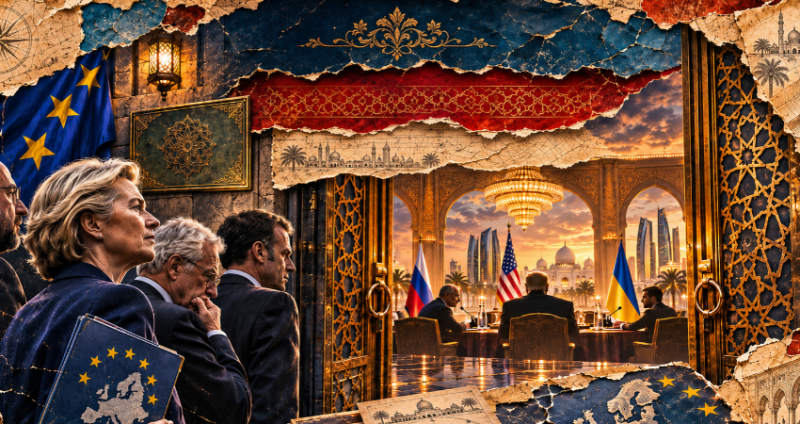
The Week That Shaped the World — 6–13 November 2026
This Week's Perspective
There is something increasingly uncomfortable about Europe's position in world affairs. Its governments spend enormous sums supporting Ukraine and strengthening their own defences, yet when the major powers sit down in Abu Dhabi to discuss the continent's security, Europe finds itself outside the main negotiations.
An awkward situation. And perhaps a revealing one.
At home, the picture is hardly reassuring. Spain witnesses its first general strike in 14 years, driven largely by a housing crisis that leaves working people struggling to afford somewhere to live. Britain reports stronger economic growth, although the Bank of England's latest interest-rate increase hardly feels like good news to anyone approaching a mortgage renewal.
Then there is the Baltic, where another reported military strike brings the conflict uncomfortably close to NATO territory. Across the Atlantic, Washington's incoming Democratic majority prepares to challenge Donald Trump's economic and foreign policies.
Wall Street has its own drama. Nvidia loses Jensen Huang, the man who helped make it an artificial intelligence powerhouse. Almost simultaneously, investors queue for shares in Anthropic at a proposed valuation approaching $1.4 trillion.
Oil production is recovering, climate negotiators are searching for the money behind their promises, and Britain and the EU are discovering that economic geography is rather more stubborn than political ambition.
What connects these developments?
Money, certainly. But also the widening distance between political ambitions and the resources required to sustain them.
And that is where this week's story really begins.
“Every government has a vision of the future. The difficult part is explaining to people why their present must become more expensive to pay for it.”
1. Abu Dhabi Peace Talks: Why Was Europe Shut Out?
Abu Dhabi was supposed to bring Russia and Ukraine closer to peace. Instead, the talks exposed another question: who gets to decide Europe's security?
On 10–11 November, Russian negotiator Vladimir Medinsky sat down with Ukrainian representatives under US mediation led by Steve Witkoff and Jared Kushner. Officials from the EU, Britain, France and Germany were also in Abu Dhabi.
But Moscow refused direct talks with them.
Europe was present. It was not an equal participant in the central negotiations.
The distinction matters.
After meeting Vladimir Putin in Moscow on 12 November, Witkoff announced that Europeans would join the next round. Yet the Kremlin declined to confirm an unconditional invitation. On 13 November, it said Europe must first show willingness to contribute to peace.
EU foreign policy chief Kaja Kallas rejected the idea that Russia could decide who should represent Europe. She also insists that a ceasefire and peace agreement must precede any redesign of the continent's security architecture.
Moscow wants the sequence reversed, putting broader security arrangements at the centre of negotiations.
This is not merely a dispute over seating.
For Russia, controlling the format creates leverage over governments supplying Ukraine with weapons and financial support. For Washington, keeping the initial discussions narrow may make a difficult settlement more manageable.
Neither calculation establishes that Europe's exclusion was a deliberate humiliation.
But both invite a harder question.
Why is a continent financing much of Ukraine's resistance having to negotiate the terms of its own participation?
The answer may lie partly within Europe itself.
In Spain, a nationwide housing strike reflects the growing frustration of working people priced out of ordinary accommodation. In France, parliamentary divisions complicate efforts to address public debt through the 2027 budget. In Germany, industrial demand remains weak despite signs of recovery elsewhere in the economy.
Different economies. Different problems.
One underlying contradiction.
Political leaders speak of strategic autonomy while households confront rent, energy bills and insecure purchasing power.
Official growth figures cannot, on their own, describe whether a working family can afford a home.
And when governments are asked to finance public services, defence, energy security and Ukraine simultaneously, the choices become more divisive.
None of this means the European Union is collapsing. European governments still possess immense economic resources, and many share a strong commitment to Ukraine.
But shared commitments are not always the same as a common negotiating position. EU leaders have yet to settle who should represent the continent in a broader process.
The danger is not simply that Europe may be left outside one meeting.
It is that mounting economic pressures and political disagreements could gradually weaken its ability to act when the next invitation arrives.
An end to the war could reshape Europe's security for decades.
So who will shape the agreement — and who will pay for its consequences?
“Europe has financed its place in the conflict. Whether it can secure a place in the peace may depend on something money cannot purchase: the ability to speak with one voice.”
2. Spain's Housing Crisis: When Having a Job Is No Longer Enough to Afford a Home
Something is going badly wrong with Spain's housing market. And on 11 November, millions of workers decide they have had enough.
The country's first general strike in 14 years disrupts transport, manufacturing and commercial activity. In Madrid, protesters march through heavy rain. Barcelona sees clashes with riot police, and at least 115 people are arrested nationwide, according to Reuters.
Trade unions say more than three million people participate. Estimates of the demonstrations themselves vary considerably, but the anger behind the strike is not difficult to understand.
People cannot afford somewhere to live.
Spain faces an estimated shortage of 750,000 homes. Rents have risen sharply, especially in major cities and tourist regions. For some young workers, an ordinary rental property can consume almost their entire monthly salary.
Think about that for a moment. A job, a salary, an ordinary working life — and still no realistic prospect of independent housing.
There are documented cases of employed families resorting to motorhomes, not for the pleasure of travelling, but because conventional accommodation has become financially inaccessible.
Tourism brings money into Spain. Property investment brings money too. Neither necessarily provides affordable homes for the people working in the restaurants, shops and businesses that keep those places running.
Here lies the uncomfortable contradiction.
Spain's economy continues to grow. Yet economic expansion offers little consolation to someone whose wages cannot cover the rent.
On 12 November, parliament's Standing Council narrowly approves emergency housing measures by 35 votes to 34, extending protections against eviction. A separate proposal to strengthen tenants' rights fails to secure enough support.
The political consequences are already visible. A general election approaches on 29 November, and the parties disagree sharply over rent controls, construction and the rights of landlords.
There are no effortless solutions. Build more homes, certainly — but where, how quickly and at whose expense? Restrict rents, and landlords warn that supply may shrink.
For people already struggling, these arguments can sound painfully remote.
Spain's protesters are not simply demanding a better standard of living. Many are asking how a modern European economy reaches the point where employment no longer guarantees access to a home.
“A country can attract investors, tourists and international capital. But if the people who keep it running cannot afford to live there, one has to ask who the prosperity is really for.”
3. Russian Warship Reportedly Hit in the Baltic: How Close Is the Conflict Getting to NATO Territory?
A Russian missile corvette is reportedly struck in the Gulf of Finland on 11 November. Finnish defence authorities detect the incident. Ukraine subsequently claims responsibility.
The vessel is identified by Ukraine's Security Service as the Naro-Fominsk, a Buyan-M-class warship capable of carrying Kalibr cruise missiles.
Kyiv provides no independently verifiable evidence of the damage. Finnish officials confirm that they are monitoring developments but decline to disclose the exact location of the incident. They also emphasise that there is no immediate military threat to Finland.
That reassurance matters. So does the geography.
The Gulf of Finland is a narrow maritime passage between Finland and Estonia, leading towards St Petersburg. Russian naval facilities, commercial ports, energy shipments and NATO territory exist within a relatively confined area.
A glance at the map explains why an incident here attracts attention beyond the countries directly involved in the war.
Ukraine is extending the reach of its operations against Russian military and logistical assets. The reported naval strike coincides with attacks against infrastructure around Ust-Luga, one of Russia's important Baltic export ports.
For Moscow, the security of this region is both a military and commercial concern.
For neighbouring NATO countries, the problem is rather different.
A Ukrainian strike against a Russian ship does not automatically threaten Finland or Estonia. Nor does every military incident indicate that a wider confrontation is approaching.
But the margin for error is uncomfortable.
Weapons can malfunction. Drones can cross borders unintentionally. Governments sometimes have to respond to incomplete information, particularly when events unfold close to sensitive military installations.
And then there is the commercial question.
Shipping companies and insurers do not wait for an official declaration of war before reassessing risk. Greater uncertainty around a maritime corridor can mean more expensive insurance, difficult routing decisions and additional costs for businesses using the region.
The Baltic remains commercially active, and Finland describes the security situation as stable.
Still, a war that increasingly reaches into the approaches to St Petersburg presents Europe's northern neighbours with another problem they would rather not have.
“The Baltic is not another battlefield. At least, not yet. Keeping it that way may depend as much on avoiding mistakes as on demonstrating military strength.”
4. Democrats Prepare to Challenge Trump's Economic Agenda — But Can They Deliver?
The Democrats are preparing to take control of Congress. They have a long list of promises, an impatient electorate and a president who is unlikely to make their work particularly easy.
Following their sweeping midterm election gains, Democratic leaders outline the legislation they want to pursue when the new Congress convenes in January 2027.
Healthcare comes first for many. So do the cost of living, Donald Trump's tariffs and the war with Iran.
The party wants to reverse cuts to Medicaid, restore enhanced health-insurance subsidies and restrict stock trading by members of Congress. Proposals concerning wages, housing and consumer prices are also taking shape.
There is an obvious political calculation here.
Americans have delivered a substantial electoral setback to the Republicans. But dissatisfaction with the cost of living does not necessarily mean voters agree on how to fix it.
Democrats themselves are divided over how far their mandate extends.
Some want an aggressive confrontation with the White House. Others are more concerned about convincing moderate voters that their party can govern effectively.
Then there is the Senate.
Democrats are projected to hold around 55 seats, but most ordinary legislation requires 60 votes to overcome procedural obstacles. Trump also retains the presidential veto.
A congressional majority, in other words, is not a blank cheque.
Consider tariffs. Removing them could reduce costs for importers and consumers, although manufacturers benefiting from protection might see matters differently.
Healthcare creates another difficult calculation. Restoring public support requires funding, while reducing expenditure can mean cutting programmes on which millions depend.
And ending the Iran war involves more than deciding that America has spent enough. Military commitments, regional relationships and diplomatic arrangements cannot simply be cancelled like an unwanted subscription.
Businesses face uncertainty over trade rules, taxation and future government spending. Some may delay investment until Washington provides greater clarity.
The election changes the political balance.
It does not resolve the disagreements that produced it.
For Americans expecting immediate financial relief, that distinction may soon become painfully familiar.
“Voters can remove politicians who disappoint them. Unfortunately, changing the politicians is often considerably easier than changing the policies — particularly when the bills have already arrived.”
5. Britain Seeks a New Deal With Europe as Brexit's Economic Reality Becomes Harder to Ignore
Britain is preparing for another meeting with its European neighbours. This time, the conversation is less about sovereignty and more about the price of doing business.
Prime Minister Andy Burnham meets European Commission President Ursula von der Leyen in Dublin on 12 November, ahead of the UK–EU summit scheduled for 20 November in Brussels.
The government wants fewer barriers to food exports, closer cooperation on emissions trading and a new arrangement allowing young people to live, work and study across borders.
Nothing revolutionary, perhaps. But the details reveal how complicated Britain's relationship with Europe has become.
Take food.
British producers continue to face certification requirements, border procedures and administrative costs when selling into the European market. Simplifying those arrangements could improve competitiveness and reduce expenses.
Consumers might benefit too, although nobody can promise that every saving made by a business will appear on a supermarket shelf.
Burnham argues that the existing Brexit settlement has damaged Britain's economy. Former prime minister David Cameron disputes the extent to which Brexit explains the country's wider economic difficulties.
The political argument is familiar.
The financial calculations are more interesting.
Brussels wants European students attending British universities to receive more favourable tuition-fee arrangements. Britain, meanwhile, is seeking access to European industrial opportunities, including the proposed Made in Europe framework.
One reported compromise could cost the British government up to £450 million annually in support for universities.
That is a substantial concession when public finances are already under pressure.
There are disagreements over youth mobility numbers, immigration conditions and the extent to which Britain should align with European regulations.
And here is the curious part.
Both sides are negotiating ways to remove obstacles that followed their separation, while carefully avoiding any suggestion that the original political decision is being reversed.
Perhaps that is simply how diplomacy works.
The EU wants a dependable trading and security partner. Britain wants easier access to its largest neighbouring market without abandoning the independence Brexit was supposed to deliver.
Both have economic reasons to compromise.
Whether they can agree on the price is another matter.
“Britain left the European Union, not the European continent. Geography remains stubbornly indifferent to political slogans — and businesses are still paying to navigate the difference.”
6. Nvidia CEO Jensen Huang Resigns as $500 Billion Market Shock Hits the AI Industry
For more than three decades, Jensen Huang has been the face of Nvidia. He helps turn a graphics-chip manufacturer into one of the most valuable companies on Earth, becoming something of a celebrity along the way.
Now he is gone. And the circumstances are extraordinary.
On 12 November, Nvidia announces the departure of its founder and chief executive following revelations about his extramarital relationships, including one involving a businesswoman suspected by American officials of connections to Chinese intelligence.
The suspected espionage links remain unproven. But the affair raises difficult questions about corporate governance, sensitive technology and Nvidia's business relationships with China.
Chief Financial Officer Colette Kress takes over as interim CEO while the board searches for a permanent successor.
Wall Street reacts immediately.
Nvidia shares fall sharply during Thursday's trading, at one point losing around 14%, before recovering to close 4.3% lower. The session erases approximately $180 billion in market capitalisation. Across the week, the decline approaches $500 billion.
An extraordinary amount of shareholder value to disappear while the company's underlying technology remains largely unchanged.
And that is precisely what makes this case interesting.
Nvidia's processors still power much of the artificial intelligence industry. Its customers still require enormous computing capacity. Demand for advanced chips does not simply vanish because the chief executive resigns.
What changes is confidence.
Huang is not merely a manager. Investors have associated him personally with Nvidia's strategy, technological ambitions and relationships with governments and customers.
There is no guarantee that another executive can reproduce that influence.
The scandal also arrives at an awkward moment for the wider industry. Investors are already questioning the enormous sums being committed to AI infrastructure, particularly projects whose future revenues remain uncertain.
Nvidia is more than a chip supplier. It also helps finance parts of the ecosystem that purchases its products. Any retreat from that strategy could affect companies far beyond its own balance sheet.
Its quarterly results are due on 17 November. Investors will be watching the numbers, certainly, but also whether the company can explain what comes next.
For now, an industry that promises to reduce human limitations is being reminded of its dependence on a single human being.
“Nvidia has spent years persuading investors that machines will shape the future. It takes a very human scandal to remind them who still controls the present.”
7. UK Economy Grows 0.7% — But Andrew Bailey Faces an Uncomfortable Interest Rate Dilemma
Britain's economy grows by 0.7% in the third quarter, according to figures released on 12 November. That is exactly what economists expect, and a respectable performance considering the international uncertainty surrounding energy markets.
The Bank of England, however, has a problem.
Only a week earlier, Governor Andrew Bailey and his colleagues raise interest rates to 4%, attempting to contain another surge in inflation.
Now the economy is demonstrating enough resilience to complicate the argument over what happens next.
The figures reveal an uneven recovery. Services expand by 0.9%, supported particularly by business-facing activity, while production manages just 0.1%. Construction actually contracts by 0.7%.
Not exactly a broad-based boom.
Inflation reaches 3.5% in September, and the Bank expects it to approach 5% by the middle of next year, largely because of higher energy costs.
Bailey faces a difficult choice.
Keep rates elevated, perhaps raise them again, and mortgage borrowers and businesses pay more for credit. Move too cautiously, and expensive energy risks feeding into broader prices and wage demands.
There is an additional frustration here.
The Bank of England can influence the cost of borrowing in Britain. It cannot reopen the Strait of Hormuz or make imported energy cheaper.
Yet it must respond to the economic consequences.
For homeowners approaching the end of a fixed-rate mortgage, the distinction is hardly academic. Stronger GDP offers little immediate comfort if refinancing means finding hundreds of pounds more each month.
Businesses face their own calculations. Should they invest in new equipment, expand their workforce or preserve cash until borrowing becomes cheaper?
Even the Bank's policymakers disagree about how aggressively to act. Eight support November's quarter-point increase; Catherine Mann favours a larger rise.
The next interest-rate decision comes on 17 December.
Much depends on energy markets, over which Threadneedle Street has very little control.
Britain is growing. That is encouraging. But stronger growth also gives the Bank greater room to keep monetary policy restrictive.
A rather uncomfortable kind of success.
“Andrew Bailey can make borrowing more expensive to control inflation. What he cannot do is manufacture cheaper energy. Unfortunately, British mortgage holders may end up paying for both problems.”
8. Anthropic's $1.4 Trillion IPO: Has Wall Street Found Its Next AI Obsession?
Wall Street has an extraordinary ability to lose confidence in one technology giant while preparing to invest billions in another.
Consider this week's contrast.
Nvidia is struggling with Jensen Huang's sudden departure. Investors are questioning the risks surrounding its leadership and its role in financing the AI industry.
Meanwhile, Anthropic — the company behind Claude — is preparing one of the largest stock-market flotations ever attempted.
The proposed fully diluted valuation reaches approximately $1.4 trillion. Anthropic and some existing shareholders are offering 825 million shares at between $70 and $78 each, potentially raising $64.4 billion.
Trading is expected to begin on Nasdaq on 19 November.
Demand is already remarkable. Bloomberg reports that orders are roughly six times greater than the shares available, although allocations and final pricing remain subject to change.
Apparently, enthusiasm for artificial intelligence is far from exhausted.
But look a little closer.
Anthropic's disclosed commitments for computing infrastructure approach $900 billion. These are contractual obligations spread over future periods, some subject to conditions, rather than money that must all be spent immediately.
Still, the scale is difficult to comprehend.
AI developers need enormous computing capacity to train and operate increasingly sophisticated systems. That infrastructure requires financing, reliable electricity and customers willing to pay for the resulting services.
Anthropic's revenue is growing rapidly, but substantial losses remain.
Perhaps investors are becoming more selective rather than abandoning artificial intelligence altogether.
Nvidia supplies much of the hardware. Anthropic develops systems intended to turn that computing power into commercially useful products.
Different businesses. Different financial exposures.
Neither escapes the underlying cost of computation.
And competition is hardly standing still. Google, Microsoft, OpenAI and other developers are investing heavily in capabilities that may challenge one another for the same customers.
The question is no longer simply whether artificial intelligence is useful. It plainly is.
The harder question concerns profitability, competitive advantage and how much customers will ultimately pay.
Anthropic's flotation will provide an unusually expensive test of those expectations.
“Wall Street may be questioning the price of the AI revolution. Judging by Anthropic's order book, it has not yet lost its appetite for financing one.”
9. OPEC+ Restores Oil Production — But the Strait of Hormuz Remains the Real Problem
Oil producers have some encouraging news. They are pumping almost as much crude as they did before the war with Iran began.
Getting it to customers is another matter.
OPEC's latest report, published on 11 November, shows output across the OPEC+ alliance reaching 41.23 million barrels a day in October, an increase of approximately two million barrels from September.
That brings production back to around 97% of February's level.
Saudi Arabia accounts for much of the recovery. Its reported production rises to approximately 10.56 million barrels daily, more than two million above September's figure.
On paper, the improvement looks impressive.
But oil markets are not governed by production figures alone.
The Strait of Hormuz remains affected by the conflict with Iran. Producers are using alternative shipping arrangements, including ship-to-ship transfers, to maintain exports.
These arrangements help move crude. They also introduce additional expenses and operational risks.
And this is where the apparent recovery becomes less reassuring.
An oilfield may be operating normally while a tanker operator still faces uncertain delivery schedules or exceptionally expensive insurance.
The buyer is interested in the oil arriving, not simply in the number of barrels produced.
There are nevertheless signs of genuine improvement. The International Energy Agency reports that global oil supply rises sharply in October, while benchmark crude prices fall considerably from their early-October peak.
Yet shipping costs remain elevated, and diesel prices in Europe are still far above pre-war levels.
That matters more to businesses than a reassuring production headline.
A transport company buying diesel does not care whether an OPEC report looks encouraging. It cares about the price on its fuel invoice.
There is also a question of political leverage.
Saudi Arabia's production recovery strengthens its position as a major supplier. Iran's influence over maritime security around Hormuz remains a separate source of uncertainty.
Both factors affect international negotiations.
Perhaps the market is adapting faster than expected.
But adaptation should not be mistaken for normality.
“The oil industry is learning to work around the war. That is an impressive commercial achievement, although a rather expensive substitute for ending it.”
10. COP31 Climate Finance: Governments Promise Trillions. Who Is Actually Paying?
There is no shortage of ambitious numbers at the COP31 climate conference in Antalya.
The international community has agreed to work towards mobilising $1.3 trillion a year in climate finance for developing countries by 2035. Wealthier nations are expected to lead efforts to provide at least $300 billion annually.
An impressive commitment.
Now comes the awkward part: finding the money.
An assessment of the international financing roadmap warns that, under current trends, external climate finance could reach only around $461 billion annually by 2035.
That leaves a gap of approximately $840 billion.
And there is another troubling development.
According to an analysis published by Carbon Brief on 11 November, new multi-year public climate-finance pledges have fallen by more than 70% in 2026.
This does not mean all existing financing has disappeared. It means governments are making substantially fewer new commitments just as expectations are increasing.
It is tempting to see this as another dispute between wealthy countries and poorer nations demanding support. The reality is more complicated.
Many governments promising climate assistance are also confronting expensive borrowing, defence commitments and growing pressure to improve living standards at home.
For a finance minister, those competing demands are not theoretical.
Every additional commitment requires funding, a change in spending priorities or additional borrowing.
And private investors are not charitable institutions.
They need projects capable of delivering returns at acceptable levels of risk.
This creates a difficult problem for vulnerable countries. A solar installation may attract investment if electricity demand is predictable and customers can pay. Flood defences protecting a poor coastal community offer less obvious commercial returns, despite their enormous social value.
Borrowing costs make matters worse. Some developing countries must pay far more for capital than the wealthy governments asking them to accelerate their climate commitments.
There is practical progress.
On 12 November, the Asian Infrastructure Investment Bank announces a $1.6 billion climate-financing agreement with Turkey to support environmental and institutional reforms.
Such commitments are more tangible than another declaration of ambition.
But they also illustrate the scale of the challenge. Individual agreements are measured in billions while the overall objective is measured in trillions.
Perhaps the most important question at COP31 is not how much money governments promise.
It is whether they can build financial arrangements that make those promises deliverable.
“Climate conferences are remarkably good at agreeing how much money the world needs. The difficult negotiations begin when someone asks where that money is supposed to come from.”