
The Week That Shaped the World — 13–20 November 2026
This Week's Perspective
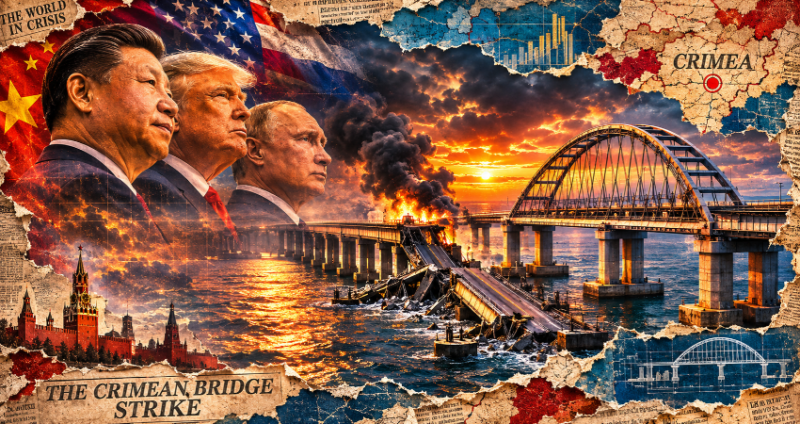
There is something rather unsettling about the way the world is moving this week. Three of the most powerful leaders meet in China to discuss global security, while thousands of miles away, another attack on the Crimean Bridge brings the war in Ukraine into sharper focus. Diplomacy continues. So does the destruction.
Elsewhere, the International Court of Justice delivers a landmark judgment on Myanmar, while Syria receives an unusually encouraging signal from the United Nations. In Turkey, climate negotiators struggle to agree on their commitments, even as billions of dollars flow towards renewable energy projects.
Britain has its own contradictions. London is negotiating closer economic ties with Europe while rising inflation and expensive government borrowing leave little room for financial optimism.
And then there is technology. Anthropic makes an extraordinary Wall Street debut, China tightens its grip on drone components, and Southeast Asia takes another step towards a common digital market.
Different stories, certainly. But look a little closer.
Governments are negotiating power, businesses are competing for the future, and taxpayers are increasingly being asked to finance both.
Perhaps the most interesting question this week is not who makes the decisions, but who ultimately pays for them.
“The people shaping tomorrow rarely struggle to explain their ambitions. It is those paying for today's decisions who might reasonably ask to see the figures first.”
1. Ukraine Strikes Crimean Bridge as Trump, Xi and Putin Meet in China
Three presidents meet in China to discuss global stability. Thousands of miles away, part of the Crimean Bridge lies in the Kerch Strait. An uncomfortable contrast. Between 16 and 19 November, Ukrainian forces repeatedly strike the bridge connecting Russia with occupied Crimea, destroying part of its roadway and disrupting railway traffic.
Kyiv calls it retaliation for Russian attacks on Ukrainian infrastructure. Moscow promises a severe response. The bridge carries enormous symbolic significance for Russia, although much of its military supply traffic now travels through occupied southern Ukraine. Damaging it creates logistical difficulties, certainly.
But what about the diplomatic consequences?
On 19 November, Donald Trump, Xi Jinping and Vladimir Putin meet in Shenzhen. Their joint declaration focuses on nuclear risks and international stability.
Curiously, Ukraine is not mentioned. The war is discussed separately, but no agreement emerges on how to end it. Instead, Putin announces that Russia will no longer consider a proposed moratorium on strikes against energy infrastructure and shipping in the Black Sea. On 20 November, Russian missiles hit three bridges in Kyiv. Eight people are reported killed across Ukraine.
Meanwhile, an interesting disagreement is developing among Ukraine's allies. Senior Pentagon official Elbridge Colby questions the effectiveness of certain Ukrainian long-range strikes. Britain and Germany reject his assessment, arguing that such operations weaken Russia's military capabilities. So even among countries supporting Ukraine, there are different views about which military tactics might bring an eventual settlement closer.
And there is a financial dimension. On 18 November, London announces another £260 million military assistance package, including more than 1,000 long-range drones. According to the British government, over 80% of that money will be spent in Britain, supporting domestic defence manufacturers and jobs. Military assistance, it seems, also serves an industrial purpose. This does not imply British involvement in the bridge attacks, but it illustrates how security policy and economic interests increasingly intersect.
For Kyiv, military pressure remains essential. London continues strengthening Ukraine's capabilities, Washington questions certain tactics, and Moscow threatens retaliation. Different priorities, one continuing conflict. Do the countries financing, fighting and negotiating this war necessarily share the same vision of how it should end?
While three nuclear powers discuss preventing a global catastrophe, the war in Europe continues to produce new reasons for escalation. Perhaps agreeing on what must never happen is considerably easier than agreeing on what should happen next.
“The world's most powerful leaders can agree that a nuclear war must never be fought. But until those fighting, financing and negotiating this one agree on what peace should look like, the bridges will keep falling — and the bills will keep arriving.”
2. Myanmar Found Responsible for Rohingya Genocide: But Who Will Enforce Justice?
A court in The Hague delivers a judgment that hundreds of thousands of people have been waiting almost a decade to hear. On 19 November, the International Court of Justice finds Myanmar responsible for genocide against the Rohingya minority during military operations in 2017.
The case was brought by The Gambia in 2019, with support from the Organisation of Islamic Cooperation. It follows years of allegations involving mass killings, sexual violence and the destruction of villages in Myanmar's Rakhine State. Hundreds of thousands of Rohingya fled across the border into Bangladesh, where many remain in refugee camps.
Myanmar's authorities have consistently rejected accusations of genocide, maintaining that military operations were directed against armed militants.
The Court reaches a different conclusion. Its judgment establishes state responsibility under the Genocide Convention, giving the victims an important measure of international legal recognition.
But recognition creates another question. What happens when a government refuses to accept the judgment?
The International Court of Justice can determine whether a state has violated international law. It cannot send police officers to arrest those responsible or force a government to comply. Enforcement depends heavily on political pressure and the actions of other states.
And the situation in Myanmar is hardly improving. The country remains engulfed in civil conflict, while continuing violence in Rakhine State makes the safe return of Rohingya refugees extremely difficult.
There is something deeply troubling about the distance between a courtroom in Europe and a refugee camp in Bangladesh. A legal decision may establish what happened. For the families who lost their homes, however, the more immediate question is whether they will ever be able to return.
International justice has delivered its verdict. Turning that verdict into meaningful change is now a political challenge.
“Justice can establish responsibility with extraordinary precision. Unfortunately, the distance between a judgment in The Hague and a family's return home is measured in something considerably more difficult than legal arguments.”
3. COP31 in Turkey: $26 Billion in Deals, but Where Is the Climate Agreement?
There is an interesting contradiction emerging from the COP31 climate conference in Antalya.
Turkey is preparing to leave the summit with billions of dollars in investment commitments, while negotiations over a stronger international climate agreement are struggling to reach a conclusion.
As the conference enters its scheduled final day on 20 November, the host government reports investment deals and plans worth more than $26 billion.
They include a preliminary $15 billion renewable-energy agreement with China and $5.1 billion in financing arrangements with development banks.
An impressive commercial achievement. The diplomatic picture is rather less encouraging.
The latest draft of the conference agreement does not explicitly mention fossil fuels, provoking criticism from countries and environmental organisations demanding stronger commitments. Panama threatens to oppose the final text unless important concerns over climate finance and emissions are addressed.
Why is the wording so difficult?
Because fossil fuels are not merely an environmental issue. They remain a source of government revenue, industrial activity and energy security for many countries. Reducing dependence on them requires expensive changes to electricity generation, transport and manufacturing. The costs are immediate, while many of the benefits arrive years later.
Developing economies face an additional problem. They are being asked to invest in cleaner technologies and climate protection while frequently paying much more to borrow money than richer countries.
The international ambition to mobilise $1.3 trillion annually in climate finance by 2035 remains enormous. But setting a target is considerably easier than producing the investment arrangements needed to achieve it.
Turkey's investment announcements demonstrate that climate-related projects can attract substantial capital. Yet a renewable-energy agreement benefiting one country does not automatically solve the financing difficulties facing poorer economies elsewhere.
As negotiations continue, governments are once again discovering the difference between agreeing on the scale of a problem and agreeing on who should pay to solve it.
“A climate summit can produce billions in business deals and still struggle to produce a common policy. Perhaps the real challenge is not persuading governments that the future must change, but agreeing who can afford to change it first.”
4. Syria Wins Unusual UN Consensus: Is the International Community Ready to Trust Damascus?
For years, United Nations discussions about Syria have been dominated by condemnation, political disagreement and arguments over responsibility for human rights abuses.
This week offers a different development.
On 18 November, the UN General Assembly's Third Committee approves a draft resolution on human rights in Syria by consensus. According to Syrian diplomats, it is the first time in approximately 15 years that such a resolution has received unanimous procedural support without a vote.
The document acknowledges steps towards rebuilding state institutions, developing transitional justice mechanisms and addressing the legacy of the country's prolonged conflict.
It also welcomes efforts concerning the rights of minorities, missing persons and the conditions required for refugees to return safely.
A notable change in diplomatic language.
But an important distinction is necessary. The resolution has been approved by a General Assembly committee and still requires consideration by the full Assembly.
It is not a declaration that Syria's political transition is complete or that its human rights problems have disappeared.
Indeed, rebuilding the country's institutions may prove easier to announce than to accomplish.
Years of war have damaged housing, hospitals, electricity networks and commercial infrastructure. Millions of Syrians have experienced displacement, while businesses face the challenge of operating in an economy that needs enormous investment.
Political recognition can help create the conditions for reconstruction. It cannot, by itself, rebuild a power station or provide employment.
There is also the difficult question of justice. A country emerging from prolonged violence must establish accountability while attempting to restore functioning institutions and social stability. Those objectives are both necessary, but they are not always easy to reconcile.
For international donors, the changing diplomatic atmosphere could open opportunities for cooperation. Yet substantial investment requires legal certainty, security and confidence that funds will be used effectively.
The UN's changing language may represent an important beginning.
Whether ordinary Syrians experience a corresponding change in their daily lives remains the more demanding test.
“Diplomatic recognition can open the door to a country's recovery. But rebuilding international confidence is rather like rebuilding a city: the foundations matter considerably more than the speeches delivered at the opening ceremony.”
5. Britain and the EU Move Closer: Brexit's Economic Geography Returns to the Negotiating Table
Britain is moving towards a closer economic relationship with the European Union. Not by reversing Brexit, but by negotiating ways to remove some of the obstacles that followed it.
On 20 November, Prime Minister Andy Burnham meets European Commission President Ursula von der Leyen and European Council President António Costa in Brussels. The two sides announce political agreement on food and agricultural trade, emissions trading and a new youth mobility arrangement.
For British exporters, the proposed food agreement could be particularly important. Businesses selling agricultural products to the EU face certification requirements, border procedures and additional administrative expenses. Reducing those obstacles could make trade easier and less costly.
The British government estimates that such an agreement could eventually contribute up to £5.1 billion annually to the economy. That remains a projection rather than guaranteed growth.
There is also an agreement in principle allowing up to 100,000 young adults from each side to live and work across the border for periods of up to three years.
Yet the wider package is not fully settled.
Brussels wants more favourable tuition fees for European students attending British universities. London is reluctant to accept arrangements that could reduce university income or require additional financial support. Negotiators now have six months to resolve the disagreement.
And here is the curious part.
Both sides want closer economic cooperation while remaining determined to defend the political principles established after Britain's departure from the EU.
For London, easier access to European markets offers commercial advantages. For Brussels, closer cooperation with Britain strengthens a relationship important to trade, security and regional stability.
Neither side is negotiating out of generosity.
The challenge is deciding which compromises are economically worthwhile and politically acceptable. Businesses, meanwhile, would probably prefer fewer forms to complete and more certainty about the rules.
Perhaps the most revealing feature of the summit is how practical the conversation has become.
The argument over whether Britain should have left the European Union continues. But governments are increasingly occupied with calculating the cost of the arrangements that replaced membership.
“Britain left the European Union, but its businesses did not acquire the ability to move their customers elsewhere. Geography remains remarkably indifferent to political decisions — and sooner or later, governments have to negotiate with it.”
6. Anthropic's $81 Billion IPO: How Much Is Wall Street Prepared to Pay for the AI Revolution?
Wall Street has just witnessed the largest stock-market flotation in history. And, rather unusually, the company behind it is still facing enormous questions about the cost of running its business.
On 19 November, Anthropic, the developer of the Claude artificial intelligence models, begins trading on Nasdaq after raising approximately $81.3 billion.
The offering values the company at around $1.5 trillion, with shares priced at $83.
Investors initially push the price above $115. By the closing bell, however, it has fallen back to $97.17. Still a gain of approximately 17% on the offering price, leaving Anthropic valued at around $1.77 trillion on a fully diluted basis.
An extraordinary sum.
But consider the business behind the valuation.
Anthropic reports an annualised revenue run rate of approximately $81 billion by the end of October, reflecting rapidly growing demand for its models, particularly among software developers and corporate customers.
That is impressive growth. It is not the same as profitability.
During the first six months of 2026, Anthropic spends almost $9 billion on computing capacity and infrastructure, nearly four times the amount spent during the comparable period a year earlier.
Artificial intelligence requires enormous quantities of processing power, electricity and specialised infrastructure. Developing sophisticated models is expensive. Operating them for millions of customers creates additional costs.
And the competition is hardly standing still.
Google, Microsoft, OpenAI and other developers are investing heavily in systems competing for many of the same customers. Technological advantages can be difficult to maintain when rivals possess substantial financial resources.
There is another interesting contrast. Anthropic's historic flotation arrives only days after Nvidia's leadership crisis unsettles technology investors.
The market appears willing to question one AI giant while assigning an extraordinary valuation to another.
Perhaps investors are becoming more selective rather than losing confidence in artificial intelligence.
But Anthropic now faces a demanding test. It must demonstrate that rapidly expanding commercial use can eventually generate returns sufficient to justify its enormous infrastructure commitments.
“Wall Street has demonstrated that investors are prepared to spend extraordinary sums on the future of artificial intelligence. The more difficult question is whether the technology will eventually earn enough money to justify their enthusiasm.”
7. China Tightens Drone Export Controls: When Small Components Become Big Political Instruments
A drone may weigh only a few kilograms. Its components, however, can carry considerable geopolitical significance.
On 18 November, China introduces revised export controls covering selected unmanned aircraft, engines, flight-control systems and related technologies.
Exporters of specified products must obtain government licences before shipping them overseas.
Beijing describes the measures as necessary to protect national security and fulfil international obligations concerning technologies with both civilian and military applications.
There is an obvious difficulty.
The same electronic controllers, motors and communications equipment used in civilian drones can also appear in military systems.
A drone inspecting agricultural land and a drone operating over a battlefield may rely on remarkably similar technology.
And China occupies an important position in the international supply chains supporting both.
The revised rules do not represent a complete prohibition on Chinese drone exports. Licences remain available, and Beijing has also introduced adjustments intended to facilitate legitimate trade.
Nevertheless, the measures give Chinese authorities greater control over the international movement of selected technologies.
For manufacturers outside China, this introduces another commercial consideration.
Price and performance are no longer the only factors when selecting components. Businesses must also consider licensing requirements, political relationships and the possibility of future supply interruptions.
That matters to companies developing agricultural equipment, inspection systems, logistics technologies and other civilian applications.
It also matters to countries attempting to expand their domestic drone industries.
Can manufacturers build reliable long-term production systems when access to important components depends partly on decisions made by foreign governments?
The broader lesson extends well beyond drones.
International manufacturing has spent decades organising production around efficiency and cost. Increasingly, governments are introducing national security into those calculations.
A small electronic component can suddenly become strategically important, not because its design has changed, but because the world around it has.
“A country does not need to manufacture every machine to influence how those machines are used. Sometimes controlling a few essential components is enough to remind everyone who holds an important part of the supply chain.”
8. Southeast Asia Signs a Digital Economy Pact: A New Opportunity for Global Technology Companies?
While the world's attention is concentrated on diplomatic meetings in China, another development in Asia could have considerable long-term economic consequences.
On 14 November, all 11 members of the Association of Southeast Asian Nations sign the ASEAN Digital Economy Framework Agreement in Manila.
The agreement aims to make cross-border digital trade easier by establishing common approaches to electronic documentation, digital payments, data transfers and online business.
It may sound like another technical trade arrangement.
But imagine running a small software company in Singapore and trying to expand into Indonesia, Vietnam, Thailand and the Philippines.
Each market has its own regulations, administrative requirements and payment systems. Managing those differences requires time, employees and money.
Larger international corporations can afford specialised legal and compliance teams. Smaller businesses often cannot.
ASEAN's proposed framework seeks to reduce such barriers and make operating across the region more straightforward.
The potential commercial implications extend beyond e-commerce. Financial technology, logistics, business software and digital services could all benefit from greater regulatory compatibility.
But signing an agreement is not the same as establishing a fully integrated market.
Southeast Asia contains economies with very different levels of technological development, infrastructure and purchasing power. Governments must also balance easier data transfers with concerns about privacy, cybersecurity and national sovereignty.
Implementation will therefore be critical.
Still, the direction is interesting.
For years, international technology companies have approached Southeast Asia as a collection of separate national markets. A more coordinated regulatory framework could gradually make regional expansion easier.
And this creates opportunities not only for global technology giants, but also for smaller companies capable of offering useful products without enormous local operations.
The question is whether regional governments can translate diplomatic agreement into practical commercial simplicity.
If they succeed, the biggest beneficiaries may be businesses that previously considered international expansion too complicated or expensive.
“The internet has connected Southeast Asia for years. What the region is now attempting is something rather more difficult: making it easier for businesses to operate across borders as if those connections actually meant something.”
9. Global Patent Applications Reach 3.9 Million: Is Innovation Moving East?
The world is producing inventions at a remarkable pace. But perhaps the most interesting development is where those inventions are being registered.
On 18 November, the World Intellectual Property Organization publishes figures showing that global patent applications reached a record 3.9 million in 2025, an increase of 6% from the previous year.
It is the fastest annual growth in nearly a decade.
Asia accounts for approximately 71.2% of worldwide patent filings, compared with 61.9% ten years earlier. China remains the dominant contributor, while India passes 100,000 annual applications for the first time.
A significant geographical shift.
But what do these figures actually tell us?
Patent applications are an indicator of inventive activity, not a direct measurement of commercial success. An invention may receive legal protection without becoming a profitable product, and the number of applications does not necessarily reflect their technological importance.
Nevertheless, the trend reveals where businesses, researchers and institutions are increasingly concentrating their development efforts.
Computer technology remains a major field of patenting, alongside innovations in energy systems, electronic components and industrial processes.
For Western economies, this creates a challenge extending beyond scientific research.
Europe and the United States continue to possess major universities, research institutions and innovative companies. Yet developing an invention is only the beginning.
Turning an idea into a successful commercial product requires investment, manufacturing capacity, skilled workers and access to customers.
And those resources do not always remain in the country where the original research takes place.
This raises an uncomfortable question for governments spending billions supporting innovation.
Are they building industries capable of commercialising new technologies, or simply financing discoveries that other economies will eventually manufacture?
The patent figures cannot answer that question by themselves.
But they provide another indication that technological competition increasingly concerns entire industrial ecosystems rather than individual inventions.
“A patent protects an idea. It does not guarantee that the idea will create prosperity. The real economic contest begins when someone works out how to manufacture it, sell it and persuade the world to buy it.”
10. Britain's Inflation Rises to 3.6% — and Government Debt Is Becoming More Expensive
Britain receives two sets of economic figures this week. Neither is particularly reassuring for households hoping that living costs and borrowing expenses might finally begin to ease.
On 18 November, the Office for National Statistics reports that annual consumer price inflation rises to 3.6% in October, up from 3.5% in September.
Transport costs are a major contributor, with motor fuels pushing prices higher. Transport inflation reaches 7.5%, while housing and household services continue placing pressure on family budgets.
And that creates a familiar problem for the Bank of England.
Earlier this month, policymakers raised the Bank Rate to 4%, attempting to prevent expensive energy from feeding into wider inflation.
Higher borrowing costs may help reduce demand. They cannot produce cheaper oil or eliminate international supply disruptions.
For mortgage holders, the distinction offers little comfort.
A household approaching the end of a fixed-rate mortgage may face substantially higher monthly payments, even if its wages have barely changed.
Businesses face similar decisions. Should they invest, recruit staff or preserve cash until financing becomes less expensive?
The government has another problem.
Figures released on 20 November show that Britain borrowed £17 billion in October, slightly less than economists expected. That appears encouraging until the cost of servicing existing debt is examined.
Interest payments reach £11.2 billion for the month, the highest October figure on record and £2.8 billion more than a year earlier.
That is money needed to service government borrowing rather than directly finance new public services or infrastructure.
And here lies the uncomfortable contradiction.
Britain needs investment to strengthen economic growth. Yet higher interest rates make investment more expensive for businesses, households and the government itself.
Reducing inflation remains necessary. But prolonged borrowing costs can also restrain the growth required to improve public finances.
The Bank of England's next interest-rate decision arrives in December.
For now, Britain's economic challenge is not simply controlling prices. It is finding a way to do so without making the broader economy pay an increasingly heavy price.
“Governments can borrow money to buy time, and central banks can raise interest rates to fight inflation. Unfortunately, neither can guarantee that time will become cheaper — or that the bill will arrive when people can afford to pay it.”