
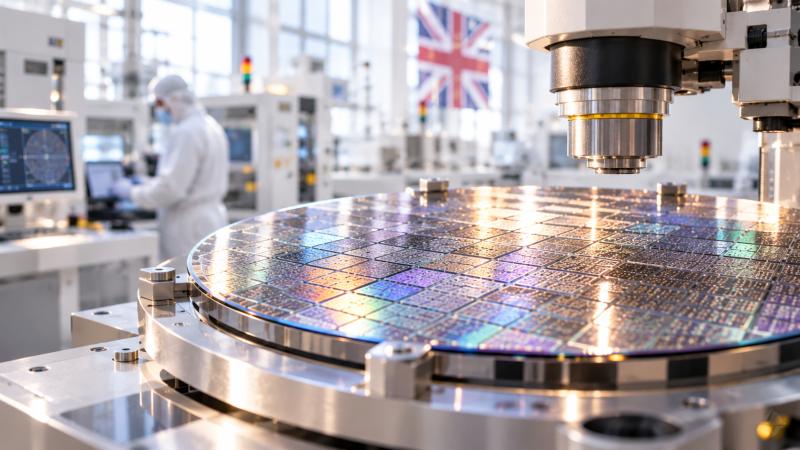
British semiconductor startup Fractile secures $720 million (approximately £542 million) in investment to develop specialised artificial intelligence hardware. With a valuation of $7 billion (£5.27 billion) and backing from British public investment institutions, the company positions itself as a potential challenger in the AI computing market. But can Britain turn advanced chip design into a commercially successful industry?
Britain plays a substantial role in the development of modern computing. Its universities, engineering expertise and semiconductor design businesses contribute to technologies used around the world. Yet the country faces a persistent challenge: turning technological expertise into globally competitive hardware companies.
The latest investment in Fractile brings that challenge into focus.
According to the company's announcement dated 11 November 2026, the London and Bristol based AI hardware developer secures a Series C funding round worth $720 million (approximately £542 million).
Reuters places the company's valuation at approximately $7 billion (£5.27 billion), making Fractile one of Britain's most highly valued technology startups.
The financing includes major American venture capital firms, the British Business Bank and the UK Government's Sovereign AI investment programme.
The investment provides substantial resources for technology development and commercial preparation. However, the company's ability to generate sustainable revenue and operating profit depends on engineering performance, manufacturing arrangements and customer adoption.
What Is Fractile, and Why Does It Attract £542 Million?
Fractile dates its founding to 2022. Its founder, Walter Goodwin, comes from a doctoral research background at the University of Oxford.
The company develops processors specifically for artificial intelligence workloads. Its principal focus is AI inference, the process through which a trained model responds to new requests. AI training and inference have different computing requirements. Training involves processing large datasets to develop a model's capabilities. Inference begins when a model operates in a commercial application and generates responses to users. Every request submitted to an AI assistant, coding application or automated business system requires computational resources. As AI services reach more users, the economics of inference become increasingly relevant to the companies operating them. Providers pay for hardware, electricity, cooling, networking and maintenance. They also need systems capable of responding quickly enough to meet customer expectations.
Fractile develops an alternative processing architecture that aims to address some of these costs. Its £542 million funding round provides capital for technology development and commercial deployment preparations. The company targets a market in which the cost of operating AI models directly affects the profitability of an expanding range of digital services.
How Do Fractile's AI Chips Work?
One of the constraints affecting AI computing is the movement of data between memory and processing components.
A processor performs calculations, but it also requires rapid access to model parameters and other information necessary for each operation. Moving data consumes energy and creates delays. For certain AI inference workloads, memory bandwidth and data movement restrict the performance of otherwise powerful computing systems.
Fractile's architecture aims to reduce these limitations by bringing memory and computation closer together. The company develops specialised processors alongside the software and computing systems required to operate them. Its objective is to improve the speed and energy efficiency of AI inference.
However, promising architectural characteristics do not automatically translate into reliable commercial performance. A chip needs to function consistently, operate within practical power limits and integrate into the infrastructure customers already use. Manufacturing costs and production yields also influence the economics of the finished product. According to Data Center Dynamics, Fractile targets 2027 for its first chip and system shipments.
Until these products reach customers, projected performance improvements remain claims requiring commercial validation.
Can Fractile Compete With Nvidia?
Nvidia occupies an established position in the AI computing market.
Its competitive advantage extends beyond its processors. Customers depend on its software frameworks, development tools, infrastructure compatibility and technical support. Replacing an existing hardware supplier therefore involves considerably more than purchasing a faster or cheaper processor. A new competitor needs to demonstrate that its technology delivers measurable economic benefits without introducing unacceptable operational costs.
Fractile approaches the market through specialised inference hardware rather than attempting to reproduce every capability of Nvidia's broader computing platform.
This strategy offers potential opportunities among companies operating large AI services, particularly where inference costs account for a substantial proportion of operating expenditure.
Consider a business providing AI-powered software to thousands of customers. Its financial performance depends partly on the cost of processing each request. A more efficient processor can reduce infrastructure expenditure, but the benefit needs to outweigh additional integration, software adaptation and maintenance costs. A reduction in electricity consumption does not necessarily produce an equivalent improvement in profitability.
The relevant measure is the total cost of delivering a reliable AI service.
Fractile therefore faces a commercial requirement: its technology needs to demonstrate sufficient economic advantages to justify adoption. Its funding gives the company an opportunity to compete. It does not establish superiority over Nvidia.
How Much Does the British Government Invest in Fractile?
The distinction between total fundraising and public investment is central to understanding the transaction. In its official announcement dated 11 November 2026, the UK Government identifies the Sovereign AI programme and the British Business Bank as participants in a funding round worth more than £500 million.
Reuters places the same Series C round at $720 million, equivalent to approximately £542 million at the exchange rate on the announcement date.
These figures describe one financing event. The round's lead investors include Thrive Capital, Founders Fund, Lightspeed and Redpoint. Other institutional investors also participate.
The government announcement does not disclose the separate amounts committed by Sovereign AI and the British Business Bank. Consequently, the total £542 million cannot be described as government spending. The financing combines private venture capital with public investment participation.
This distinction matters because equity investment differs from a government grant.
Public equity investors acquire a financial interest in a company. They accept investment risk in exchange for the possibility of future returns. The industrial-policy rationale extends beyond financial performance. Supporting strategically relevant technology businesses can contribute to domestic engineering employment, research capabilities and economic activity.
Whether those benefits materialise depends on the company's subsequent commercial development.
Britain's AI Hardware Strategy Extends Beyond Fractile
The investment forms part of a wider government effort to strengthen Britain's AI computing capabilities. The UK AI Hardware Plan, dated June 2026, outlines measures to support hardware innovation, computing infrastructure and specialist engineering skills.
The programme includes support for emerging British hardware companies and investment intended to attract additional private capital.
One initiative involves a deep-technology hardware venture fund led by Playground Global, with up to £150 million of backing from the British Business Bank. The wider Sovereign AI Fund has a stated value of £500 million and prioritises computing capabilities. Neither figure represents an additional contribution to Fractile's £542 million Series C round.
The industrial rationale reflects the economics of semiconductor development. Chip design requires substantial capital long before a product generates meaningful revenue.
Specialist engineering teams, fabrication arrangements and testing programmes create expenses that many smaller technology businesses cannot finance through ordinary operating income.
Public investment can help address some financing constraints, although it also exposes public capital to the commercial risks associated with hardware development. The eventual return depends on whether companies develop products that customers need and are prepared to purchase.
Does British Chip Design Mean British Manufacturing?
Britain possesses considerable expertise in semiconductor architecture and related technologies.
However, semiconductor design and semiconductor manufacturing represent distinct economic activities. Designing an advanced processor involves specialist engineering, modelling, software and intellectual property.
Producing that processor requires sophisticated fabrication facilities, manufacturing equipment, materials and testing infrastructure. Advanced semiconductor fabrication plants demand substantial capital expenditure.
For many chip designers, contracting manufacturing to specialist international suppliers offers a more realistic commercial model than constructing domestic fabrication facilities.
That arrangement can still support substantial economic activity in Britain.
Engineering employment, software development, research and intellectual property can remain concentrated in the UK even when physical production takes place overseas. However, reliance on external manufacturing introduces dependencies involving production capacity, trade restrictions and supply-chain access.
It also complicates the meaning of technological sovereignty. A British-designed processor is not necessarily a British-manufactured processor. Similarly, the location of a company's headquarters does not automatically determine where its profits arise or where its intellectual property resides.
Understanding a business's economic contribution requires examining its operations rather than relying solely on its national identity.
Who Captures the Economic Value?
Fractile's financing raises a question that extends beyond semiconductor technology.
Who ultimately benefits when a British company creates valuable intellectual property using international investment?
The involvement of American venture capital is economically significant, but foreign investment does not automatically mean that a British business loses control over its technology.
International investors provide access to capital, commercial relationships and overseas markets that domestic funding alone may struggle to support. Those advantages can accelerate growth.
At the same time, successive investment rounds change ownership structures. Founders and earlier shareholders may experience dilution, while new investors may negotiate governance rights affecting important corporate decisions.
The outcome depends on the terms of each transaction. A company can maintain substantial engineering operations in Britain while attracting overseas capital and customers. Alternatively, acquisitions, restructuring or changes in commercial strategy can shift economic activity elsewhere. Neither outcome follows automatically from the nationality of investors.
For Britain, the question concerns whether successful technology businesses create lasting domestic capabilities and generate sufficient economic returns to justify the resources invested in them. Fractile's valuation of $7 billion (approximately £5.27 billion) signals substantial investor expectations.
It does not represent £5.27 billion in revenue, profit or economic value already realised by the UK.
That distinction remains central to any assessment of the investment.
The Real Test Begins When Fractile's Chips Reach Customers
A successful fundraising round demonstrates investor confidence in a company's future prospects. It does not establish commercial success.
Fractile still needs to deliver working systems, validate performance claims and persuade customers to adopt its technology. Semiconductor development involves substantial execution risk.
Manufacturing delays, technical difficulties and higher-than-expected integration costs can affect the economics of promising designs. The company's target of first shipments in 2027 therefore represents an important milestone.
Evidence of customer adoption, operating performance and revenue generation provides a more reliable basis for evaluating its prospects than valuation alone. Fractile's £542 million investment gives it an opportunity to challenge established suppliers in AI inference computing. Its approximately £5.27 billion valuation reflects expectations that the technology can eventually support a much larger business.
For Britain, the broader economic question concerns the country's ability to convert semiconductor design expertise into companies capable of maintaining skilled employment, creating commercially valuable intellectual property and competing internationally. The financing provides the resources for that ambition. The commercial outcome remains uncertain.
Currency Converter UK. Historical USD/GBP exchange rates, 11 November 2026. Currency note: US dollar amounts use an approximate conversion rate of £0.7532 per $1, based on 11 November 2026. GBP equivalents are rounded for readability and do not represent separate financial disclosures.