
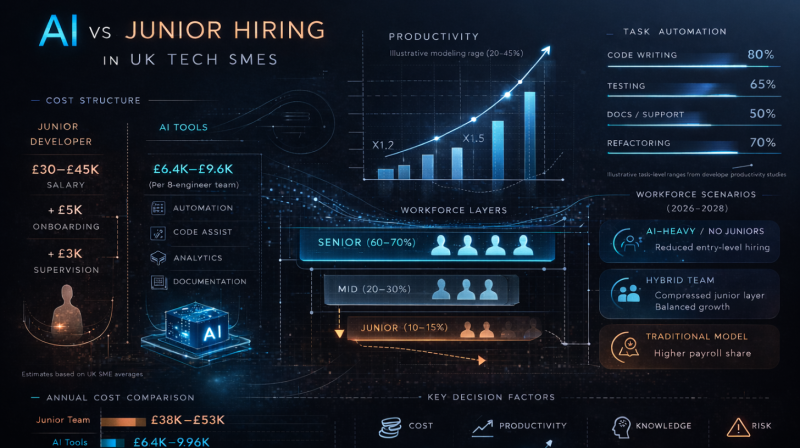
Cost Logic, Productivity Metrics and the Structural Question Emerging Across SMEs
Across UK tech SMEs (10–500 employees), hiring discussions are changing tone.
The question is no longer simply:
“Can we afford to hire?”
It is increasingly:
“Does hiring juniors still make economic sense in an AI-accelerated environment?”
This is not a moral debate.
It is a modelling problem.
UK Context: Why This Question Is Emerging Now
The hiring question is appearing in a specific macroeconomic setting.
According to recent data from the UK Office for National Statistics (ONS, Labour Market Overview – latest release), vacancy growth has moderated compared to post-pandemic peaks, while business confidence indicators across SMEs have fluctuated amid tighter capital conditions.
At the same time:
Venture funding cycles have become more selective.
Runway sensitivity has increased.
Cost-per-hire scrutiny has intensified.
AI adoption across engineering teams is accelerating.
The economic environment amplifies productivity pressure.
Which makes workforce structure an economic variable — not just an HR one.
The Cost Comparison — What Does “£1,000 AI Stack” Actually Mean?
In recent discussions, AI tooling is often described as “cheap compared to hiring.”
But what does that realistically include?
A typical AI productivity stack per engineer in a UK SME may include:
GitHub Copilot Business (~£190–£240 per year)
AI code review tool (£200–£400 annually depending on seat pricing)
LLM API credits for internal tooling (often £200–£600 per developer annually depending on usage)
Security proxy or governance layer (~£100–£300 per seat equivalent)
A moderate-usage environment can realistically fall within a £800–£1,200 annual per-engineer tooling cost range.
By contrast, a junior developer in the UK typically costs:
£35,000–£45,000 salary
+ Employer National Insurance
+ Pension contributions
+ Equipment and onboarding overhead
+ Managerial bandwidth cost
The economic delta is substantial.
However, the comparison is incomplete.
AI replaces tasks.
Hiring builds organisational layers.
Case Example A — 18-Person SaaS Startup (London)
Scenario:
Planned 2 junior hires. Funding pressure increased. AI tools adopted across 5 engineers.
6-month outcome:
Feature velocity increased.
Minor bug backlog reduced.
Hiring postponed.
~£80k annualised salary spend deferred.
Observed trade-offs:
Two senior engineers became critical knowledge nodes.
Documentation remained informal.
No mentoring structure existed for future hires.
Code review became time-compressed.
Short-term efficiency improved.
Long-term structural depth reduced.
Case Example B — 70-Person FinTech (Manchester)
Scenario:
Maintained junior hiring but redefined role.
Junior responsibilities:
Validate AI-generated outputs.
Maintain automated testing suites.
Monitor defect patterns.
Structure documentation repositories.
Assist in AI governance enforcement.
Outcome:
Productivity gains maintained.
Defect rate stable.
Knowledge diffusion improved.
Hiring pipeline preserved.
AI acted as leverage — not replacement.
These case examples reflect aggregated observations from SME interviews and are presented for
analytical illustration.
Workforce Architecture Variables Framework
Before modelling potential outcomes, it is useful to define core structural variables influencing workforce design in AI-accelerated SMEs:
Productivity Gain Ratio (PGR)
Estimated percentage increase in engineering task-level output attributable to AI tooling.
Junior Substitution Index (JSI)
Proportion of traditionally junior-level tasks now absorbed by AI or redistributed to senior engineers.
Senior Dependency Concentration (SDC)
Degree to which system knowledge and decision authority are concentrated among a limited number of engineers.
Governance Maturity Level (GML)
Presence of AI review processes, testing layers, documentation standards, and oversight mechanisms.
Succession Horizon Risk (SHR)
Probability of mid-level capacity gaps emerging within a 24–36 month window due to suppressed entry-level hiring.
These variables interact differently depending on workforce configuration.
Workforce Architecture Scenario Model (2026–2028)
| Dimension | Scenario A — AI-Heavy / No Juniors | Scenario B — Hybrid Layered Team | Scenario C — Traditional Model |
| Engineering Structure | 8 mid–senior engineers | 6 mid–senior + 2 juniors | 5 mid–senior + 3 juniors |
| AI Tooling Penetration | Full-stack across seats | Full-stack across seats | Limited integration |
| Annual Tooling Cost (Est.) | £8k–£9.6k | £8k–£9.6k | £1k–£2k |
| Payroll Exposure | Payroll-light | Payroll-heavy | Payroll-heavy |
| Short-Term Output Velocity | High | High | Moderate |
| Knowledge Distribution | Concentrated | Distributed | Layered |
| Succession Pipeline | Limited | Preserved | Preserved |
| Governance Load | Senior-heavy | Shared | Shared |
| Key-Person Dependency | Elevated | Moderate | Lower |
| 24–36 Month Structural Risk | Talent bottleneck risk | Moderate structural risk | Productivity gap risk |
The following simplified modelling illustration considers a 30-employee SaaS company with 8 engineers.
Scenario A — AI-Heavy / No Junior Hiring
Configuration:
8 mid-to-senior engineers
Full AI productivity stack
No entry-level hires
Estimated Annual Tooling Cost:
~£8,000–£9,600 (8 seats × £1,000–£1,200)
Short-Term Effect (0–12 months):
Increased individual throughput
Deferred hiring expense
Reduced onboarding overhead
Medium-Term Structural Exposure (12–36 months):
Increased knowledge concentration
Limited internal promotion pipeline
Higher key-person dependency
Scenario B — Hybrid Layered Team
Configuration:
6 mid-to-senior engineers
2 junior developers
AI tooling across entire team
Cost Profile:
Additional payroll exposure
Tooling cost maintained across seats
Operational Effect:
AI handles repetitive workload
Juniors validate outputs and support governance
Knowledge diffusion maintained
Structural Profile:
Lower dependency concentration
Defined succession pathway
Layered organisational depth
Scenario C — Traditional Hiring Model (Minimal AI Integration)
Configuration:
5 mid-level engineers
3 juniors
Limited AI tooling
Cost Profile:
Higher relative payroll allocation
Minimal tooling spend
Operational Effect:
Conventional development layering
Slower automation of repetitive processes
Structural Profile:
Stable hierarchy
Reduced exposure to AI-driven productivity variance
Potential competitiveness pressure if output acceleration differs from peers
The Missing Link: Hiring Metrics vs Engineering Productivity
CIPD Resourcing & Talent Planning reports emphasise:
Cost-per-hire
Time-to-hire
Engineering teams track (DORA metrics):
Deployment frequency
Lead time for changes
Change failure rate
The structural question rarely asked:
Are hiring models dynamically linked to productivity metrics?
If AI increases task-level productivity by 20–45% (as suggested in various developer productivity studies), should hiring logic recalibrate proportionally?
Or is workforce layering structurally independent of output acceleration?
The UK SME market does not yet have longitudinal modelling connecting these metrics.
The Structural Uncertainty
If UK SMEs broadly compress junior hiring for 24–36 months:
Possible second-order effects may include:
Mid-level talent gaps
Increased senior salary pressure
Recruitment fee inflation
Reduced internal succession
Greater key-person dependency
Alternatively:
If AI-driven productivity sustainably offsets capacity requirements, hiring models may permanently recalibrate toward leaner structures.
Both scenarios remain plausible.
Neither has been comprehensively modelled within the SME segment.
The Open Questions
- At what productivity threshold does junior hiring lose marginal ROI?
- How should cost-per-hire adjust in AI-accelerated teams?
- What governance maturity is required to prevent technical debt expansion?
- How should recruitment agencies adapt to AI-leveraged engineering teams?
- Is the current shift cyclical — or structural?
These are economic questions, not emotional ones.
Ongoing Research
Prime Economist is currently gathering structured input from:
Founders
CTOs
Engineering leads
Recruitment agencies
HR technology providers
AI developer tool vendors
The objective is not to advocate a preferred workforce configuration, but to examine variable interaction under real SME conditions.
The UK tech hiring model may be entering a structural redesign phase.
Before strong narratives form, it is worth examining the economics carefully.
Editorial Note
As UK tech SMEs reassess workforce economics under AI acceleration, the absence of structured modelling becomes increasingly visible.
We invite founders, CTOs and recruitment leaders to contribute data, perspective and counter-arguments to this ongoing study.
Structural transitions are best examined before assumptions harden.