
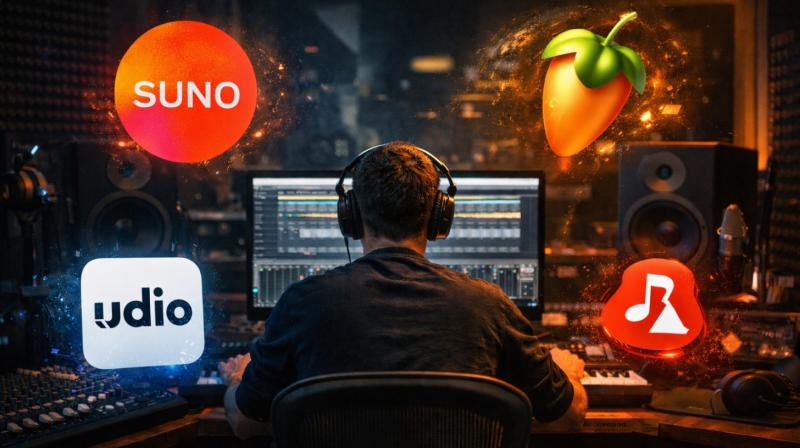
The Sovereign Producer — Orchestrating the AI Revolution in Music and the New Era of Creative Autonomy
I didn’t expect to be fooled by a voice.
It was late evening — the kind of quiet that only happens in small studios after a long day of work.
My friend, a veteran producer, didn’t say much when I arrived. He just nodded, turned back to the monitor, and pressed play.
The vocal that came out of the speakers felt disarming in a way I didn’t anticipate. It wasn’t “polished-perfect”.
It trembled in places. A line caught slightly, like somebody remembering an old wound. It sounded lived-in. Personal. Human.
When the track ended, I asked the only sensible question:
“Who’s the singer?”
He didn’t look away from the screen.
“By design — it’s me,” he said.
“A version of my voice, assembled and shaped through the machine.”
I’ve written about AI for years. I know the terminology, the policy debates, the marketing language. But this wasn’t a demo of technology. It was a confession delivered by software — with a human intention behind it.
So I asked another question.
“And what are you going to do with… this vocalist?”
He paused for a second and then answered calmly — as if the idea had long since stopped surprising him.
“Now I can create my own virtual artists and produce them the same way labels develop real acts — but with continuity, control and creative coherence.
Some of the big labels are already experimenting with this.I prefer staying in the background — the one who builds the world and directs the voice.”
At that moment, I realised I wasn’t listening to a novelty trick. I was sitting with a representative of a new class of professionals — the sovereign producers. Not people who oppose AI, nor those who surrender to it — but those who direct it.
And their influence on the future of music will be profound.
Why Virtual Artists Exist — and Why They Make Sense Now
Virtual artists are easy to misunderstand.
We tend to imagine empty, synthetic mascots built for cheap virality. That phenomenon exists — but it is not what serious producers are doing.
For my friend, a virtual artist is not a replacement for a human singer. It is a creative container — a long-form narrative identity, a voice with continuity, a character capable of evolving without breaking under the unpredictability of real-world logistics.
Real artists live real lives — families, health, fatigue, time, contracts, hesitation, change. That is human — and beautiful — but it also makes some artistic trajectories fragile.
“A virtual artist doesn’t erase humanity,” he told me.
“It preserves the direction of the idea. The decisions — the meaning — are still human.”
The question is not whether a voice is biological.
The question is where authorship lives.
And in this emerging world, authorship sits with the person who writes the words, shapes the emotion, builds the sound architecture — and takes responsibility for the result.
From Dependency to Autonomy — The End of the Old Production Gauntlet
For decades, the songwriter stood at the mercy of a fragile production chain.
You could hear the track clearly in your head — the character of the vocal, the weight of the bass, the moment where the strings should break like light through cloud.
But to bring that internal record into the world, you had to survive a process defined by risk:
- The vocalist equation — availability, mood, schedules, price, compromise.
- The arranger’s filter — your idea passing through someone else’s taste.
- The studio lottery — sessions, engineering, revision cycles, delay, cost.
“Every song used to be a bet that a dozen people would somehow hear the same dream,” he said.
“Most of the time — they didn’t.”
AI, in competent hands, doesn’t “replace” these people.
It reduces the dependency.
It returns the centre of gravity to the author.
Suno — A Creative Engine, When Guided by Human Intent
The casual image of tools like Suno is that they produce disposable, template-like songs. That happens — but it happens when they are treated as generators rather than collaborators.
The sovereign producer begins not with the prompt — but with the demo.
A simple performance: guitar or piano, a clean recording space, a vocal sung honestly — even if imperfect.
Before sending it anywhere, he stabilises the performance: light intonation correction, gentle rhythm tightening, just enough to show the melodic line as it was intended.
Only after that does the track enter Suno — not as text, but as guided material.
His prompts are not commands but textures, emotional directions, references to timbre and energy. The model interprets the structure and timing from his demo, and produces a refined vocal and arrangement that follows his intention rather than replacing it.
The result is not a finished song.
It is raw creative material with potential.
BandLab — Cleaning, Separating, Preparing the Canvas
From Suno, the project moves to BandLab — not for shortcuts, but for discipline.
Here, he works in stems, not stereo lumps: isolating elements, cleaning artefacts, removing unwanted digital residue, ensuring that vocals, drums and harmonic layers sit in controllable spaces.
Cloud mastering is used not as an aesthetic finish, but as a neutral reality check — a way to see whether the song still carries emotion after the gloss has been stripped away.
If it does — the track is worth investing in.
If it doesn’t — the idea wasn’t ready.
FL Studio — Where the Track Stops Being “AI” and Becomes a Record
Once inside FL Studio, the work truly begins.
Low-end timing is aligned. Transients are shaped. Bass and kick are allowed to breathe rather than collide. Compression and side-chaining serve movement, not loudness. Harmonic saturation adds character rather than distortion. Reverb is unified into a single believable space rather than scattered ambience.
The goal is simple:
The track should stop sounding like an AI system approximating music, and start sounding like a human record performed through a technologically-extended voice.
You may question the aesthetics. You may question the ethics. But you cannot honestly call the result trivial.
Udio — A Parallel Tool for Exploration and Long-Form Thinking
When I asked him why he sometimes chose Udio instead of Suno, he smiled.
Different tools serve different stages of imagination.
Where Suno excels at directive, reference-anchored work, Udio often becomes his space for longer, exploratory structures — extended sections, evolving harmonic movement, unexpected turns that spark new ideas.
Neither tool replaces him.
Both extend him.
The sovereign producer does not pledge allegiance to platforms — he treats them as instruments within a larger architecture of authorship.
This Is Not About Replacing Musicians — It Is About Raising the Bar
Walk through any platform today and you will find oceans of AI-generated tracks that sound competent and empty at the same time.
Polished. Loud. Forgettable.
My friend’s reaction to this was unexpected:
“It helps me,” he said.
“The faster the world fills with generic noise, the sooner people will crave music with intention.Those who master AI don’t lose their humanity — they remove their limits.”
The dividing line is not technology.
It is taste, responsibility and discipline.
Where casual users regenerate endlessly, the sovereign producer chooses. Where others finish at the point of generation, he begins.
AI does not erase authorship.
It exposes whether authorship was ever there in the first place.
Authorship, Process and Evidence
The legal frameworks around AI music will change — perhaps many times. But one principle already matters:
Document your process.
He keeps his demos, session files, versions, stems, edit decisions — the entire creative trail from first sketch to final master. Not as legal theatre — but as proof of intention.
The machine does not author the work.
It participates in a process directed by a human mind.
And that difference is not semantic — it is philosophical.
Where This Leaves the Industry
For labels, this new class of producers is both opportunity and disruption. They can build projects faster, iterate cheaper, and maintain artistic continuity without the weak points of the old production chain.
For independent artists, it is something else entirely:
A way back to agency.
The sovereign producer is not the antagonist of musicians.
He is the return of authorship — amplified by tools that finally match the speed of his ideas.
Final Reflection — Steven Jones
“I walked into that studio thinking I understood what technology does to music.
I left with a different lesson.The machine can extend a voice, multiply a style, even build a performer who never walks on stage — but meaning still comes from the person who decides what the song is about.
What I saw wasn’t the triumph of algorithms.
It was the quiet return of authorship — to the hands of those who are willing to take responsibility for their own sound.”
EDITOR’S BOX — The Sovereign Producer: One-Page Field Checklist
For musicians and producers working with AI-assisted production
1) Begin with a human core.
A song must stand on voice and idea — before any technology touches it.
2) Prepare the demo before scaling it.
Clean pitch and stable rhythm at the input save problems at the output.
3) AI = source material, not a master.
Generation is raw material. Decisions belong in the DAW.
4) Work in stems, keep control.
Separate tracks mean control over phase, dynamics and space.
5) Fix the foundation first.
Kick + bass alignment, low-end clarity, frequency conflicts — this is the basis of a professional mix.
6) Add character, not gloss.
A unified space, subtle harmonic texture and sonic identity matter more than loudness.
7) One narrative per track.
The arrangement should serve the idea — not a collection of “cool fragments”.
8) Leave a trace.
Save projects, versions and source files — the process is as important as the result.
9) Taste is the real instrument.
AI offers options. The author decides what has the right to stay.
10) Release with responsibility.
If you can’t honestly defend why the track sounds the way it does — it isn’t ready for the listener.