
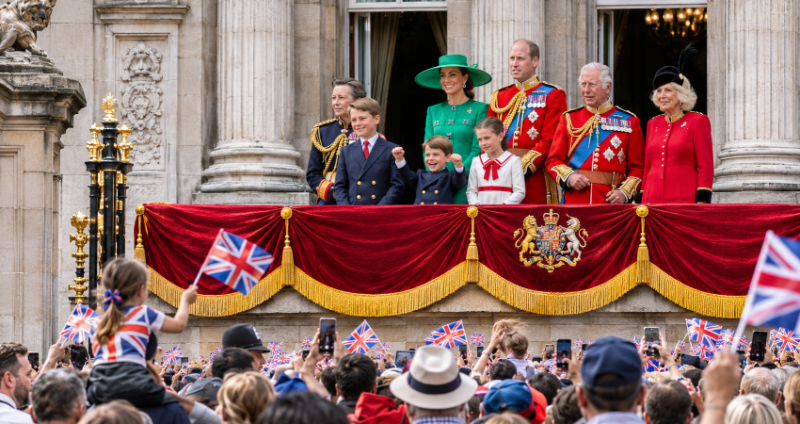
National identity, inherited privilege and the changing expectations of a nation — can the Crown preserve its place in modern Britain?
There is something remarkable about the British monarchy. Governments change, political parties rise and fall, economic crises come and go — yet the Crown remains.
For generations, it has offered Britain a sense of continuity, a connection to its history and a symbol of national identity beyond the divisions of everyday politics.
But a symbol of unity is not necessarily evidence of a united society.
In 2026, Britain faces difficult questions about living standards, housing, inherited wealth and trust in public institutions. These pressures are not caused by the monarchy, but they form the society in which the monarchy must continue to earn public confidence.
The evidence reveals a complex picture. Most Britons still prefer retaining the monarchy, according to recent polling, while younger generations are markedly less attached to the institution.
The question is no longer simply whether the Crown represents Britain's past.
It is whether the monarchy can continue to represent the aspirations of Britain's future.
How Did the Monarchy Become Part of British National Identity?
To understand the monarchy's place in modern Britain, we must begin long before Buckingham Palace became one of the world's most recognisable royal residences.
The British monarchy developed through centuries of conquest, conflict, constitutional change and political compromise. Its historical roots extend into the Anglo-Saxon period, while the Norman Conquest of 1066 fundamentally reshaped the relationship between land, aristocracy and royal authority in England.
William the Conqueror's victory at Hastings was not merely a change of ruler. It transformed the country's landed elite.
According to The National Archives, land previously held by approximately 2,000 Anglo-Saxon landowners had largely passed into the hands of around 200 Norman barons by the time of the Domesday survey in 1086.
The new ruling elite held land within a system of obligations to the Crown, including military service, while agricultural communities provided much of the economic foundation of medieval society.
That history matters because land was more than property. It represented wealth, political influence and social status.
Yet the monarchy itself changed profoundly over the centuries that followed.
Magna Carta in 1215, the development of Parliament, the constitutional conflicts of the seventeenth century and the eventual establishment of parliamentary government progressively limited royal authority.
The institution survived by changing its relationship with power.
Under Queen Elizabeth II, the monarchy became closely associated with public service, ceremonial continuity and Britain's international identity. Her long reign helped shape how generations understood the Crown.
But the circumstances facing King Charles III are different.
And this raises a historical question: could the institution's greatest strength lie not in its ability to preserve the past unchanged, but in its willingness to adapt?
What Does the British Monarchy Actually Do Today?
The distinction between reigning and governing is essential to understanding modern Britain.
The King is the country's head of state, but elected politicians exercise political power. The monarch formally appoints the Prime Minister, opens Parliament, grants Royal Assent to legislation and performs constitutional and representative duties.
These functions are governed by law and constitutional conventions.
As the UCL Constitution Unit explains, the monarch's formal powers do not amount to a general authority to direct government policy or remove an elected administration at will.
The dissolution of Parliament, for example, takes place within a constitutional framework and ordinarily follows the Prime Minister's request.
The distinction matters particularly when political disagreements become intense. Public calls for royal intervention do not automatically give the King constitutional freedom to intervene.
The monarchy's influence is therefore largely different from the power exercised by government.
It provides national representation, institutional continuity, diplomatic functions and public recognition of voluntary service, charitable work and national achievement.
Its constitutional position also offers something that elected governments cannot provide in quite the same way: an enduring head of state who does not compete for party-political office.
For supporters, this is a fundamental advantage.
For critics, the hereditary nature of the office remains difficult to reconcile with democratic equality.
Both arguments form part of Britain's continuing constitutional debate.
From the Norman Conquest to Modern Britain: Who Owns the Nation's Wealth?
The Norman Conquest may seem distant from the daily concerns of modern British families. But its legacy raises a question that remains surprisingly relevant.
How much of Britain's prosperity is earned today — and how much is inherited from yesterday?
Large hereditary estates remain a visible feature of Britain's economic landscape.
The Grosvenor family, for example, traces its ancestry back nearly a thousand years. Its London property interests began in 1677, when land entered the family following the marriage of Sir Thomas Grosvenor to Mary Davies.
Over subsequent centuries, the development of Mayfair and Belgravia helped establish one of Britain's most prominent property enterprises.
The history is documented by Grosvenor itself.
Such estates are not evidence of wrongdoing. Their ownership has evolved through successive generations and operates within modern property law.
Nor should the wealth of aristocratic families be confused with the private property of the Royal Family.
Nevertheless, these histories illustrate the extraordinary persistence of accumulated wealth.
Britain's system of land ownership also retains distinctive legal traditions. In England and Wales, the Crown's ultimate title to land forms part of the legal framework, but this does not mean the monarch personally owns every house.
Freehold and leasehold interests provide legally recognised property rights. Compulsory purchase for qualifying public projects is a separate statutory power, subject to safeguards and compensation.
The larger issue is therefore not whether ordinary homeowners possess genuine legal rights. They do.
It is whether inherited wealth and modern economic opportunities are distributed in ways that maintain public confidence in the wider system.
That question becomes more immediate when we consider Britain's housing market.
A Nation of Homeowners — or a Nation of Renters?
Home ownership has long represented security, independence and the possibility of passing something valuable to the next generation.
But for millions of households, that aspiration remains distant.
The English Housing Survey 2024–25 recorded 4.7 million households in private rented accommodation and another 4.1 million in social housing.
Together, rented households accounted for 35% of all households in England.
More revealing still is what renters expect from the future.
Only 58% of private renting households and 23% of social renting households said they expected to buy a property eventually, according to the government's research on future housing expectations.
Housing costs remain a particularly significant pressure in London.
According to the Office for National Statistics, an average-priced private rental property in London represented 41.6% of the median gross income of private renting households in 2024.
These figures do not mean that every renter feels deprived or that home ownership is everyone's preferred choice.
But they demonstrate why economic security and opportunity have become important elements of the national conversation.
And they create an uncomfortable contrast.
Britain celebrates centuries of continuity in its historic institutions, while many households struggle to establish the financial security that earlier generations associated with owning a home.
The monarchy is not responsible for planning policy, mortgage markets or the supply of social housing. Those are matters for elected governments and public authorities.
Yet the Crown remains a symbol of the nation as a whole.
Can any institution continue to represent national unity without remaining attentive to the changing circumstances of the people it symbolises?
Does the Royal Family Still Unite Britain?
Public opinion provides a more precise answer than either royal celebrations or protest slogans.
In research published in June 2026, Ipsos reported that 55% of Britons preferred retaining the monarchy, while 27% preferred a republic and 18% were undecided.
The survey was conducted between 5 and 11 March 2026.
The same research revealed a sharp generational difference: 33% of respondents aged 18–34 preferred the monarchy, compared with 74% of those aged 55 and over.
But the picture is not one of straightforward institutional collapse.
A YouGov survey conducted on 22–23 October 2026, involving 2,116 adults in Great Britain, found that 64% favoured retaining the monarchy, compared with 25% who preferred an elected head of state.
In the same survey, 58% expressed a positive opinion of King Charles III, while the Prince and Princess of Wales received favourable ratings of 72–74%.
The differences between the Ipsos and YouGov figures should not be treated as a sudden change in public opinion: the organisations use different survey designs, samples and question wording.
Nevertheless, the evidence consistently shows an institution that retains majority support while facing substantial differences between generations.
And it suggests a distinction often lost in public debate.
People may question inherited privilege without rejecting the monarchy. Equally, they may respect individual royals without supporting a hereditary head of state.
Understanding those differences is essential to any serious assessment of the Crown's future.
Is Support for the Monarchy Declining?
The longer historical picture is more challenging.
The National Centre for Social Research has tracked public attitudes through the British Social Attitudes survey since 1983.
That year, 86% of respondents said continuing to have a monarchy was very or quite important for Britain.
By 2024, the proportion had fallen to 51%.
Support has not declined in a perfectly straight line. Major royal occasions have coincided with periods of renewed public attachment, including the wedding of Prince William and Catherine in 2011 and events surrounding Elizabeth II's jubilees.
Nevertheless, the long-term change is substantial.
The 2024 British Social Attitudes survey also asked respondents whether Britain should retain the monarchy or replace it with an elected head of state. On that question, 58% preferred retaining the Crown and 38% supported an elected alternative.
These figures measure different attitudes and should not be combined into a single trend.
The important distinction is between considering the monarchy *important* and actively choosing it over a different constitutional arrangement.
One question measures attachment. The other tests preference.
For a historic institution, the difference could prove significant.
A society may become less emotionally attached to its institutions without necessarily wishing to abolish them.
The monarchy's future may therefore depend not only on preserving support, but on understanding how the meaning of that support is changing.
One Kingdom, Different Identities
The United Kingdom is not a single, culturally uniform society.
England, Scotland, Wales and Northern Ireland have distinct histories, identities and political traditions. Attitudes towards the monarchy cannot be accurately described through an exclusively English perspective.
The 2024 British Social Attitudes analysis found substantial differences between respondents identifying primarily as British or English and those identifying as Scottish or Welsh.
In that survey, majorities of respondents identifying as Scottish or Welsh favoured an elected head of state.
These are findings about respondents' declared national identities, not direct measures of every resident of Scotland or Wales. They should be interpreted accordingly.
Northern Ireland presents additional historical and constitutional complexities, with attitudes to the Crown closely connected to different traditions of national belonging. Reliable conclusions require research specific to its population.
Such differences need not prevent the monarchy from serving a national role.
But they complicate any assumption that a single ceremonial tradition carries precisely the same meaning throughout the United Kingdom.
A modern monarchy must represent a country whose citizens do not necessarily interpret its history in the same way.
When Trust Is Tested: The Andrew Controversy
The monarchy's public standing is shaped not only by constitutional principles, but also by the conduct of individuals associated with it.
The controversy surrounding Andrew Mountbatten-Windsor has been a particularly serious reputational challenge.
His documented association with Jeffrey Epstein and the allegations surrounding his conduct have attracted extensive scrutiny. Allegations, evidence of association and findings of criminal wrongdoing must, however, be clearly distinguished.
The Royal Family's response also has an important chronology.
On 17 October 2025, Andrew announced that he would cease using certain titles and honours, following discussions with King Charles III.
On 30 October, Buckingham Palace announced that the King had initiated a formal process to remove Andrew's royal styles, titles and honours. The Palace also announced arrangements concerning his departure from Royal Lodge.
Following Andrew's arrest in February 2026 on suspicion of misconduct in public office, the King issued a public statement supporting the legal process.
Andrew has denied wrongdoing. The existence of an investigation does not establish criminal guilt.
The episode raises an important institutional question.
In a modern constitutional monarchy, how should personal loyalty be balanced with public accountability?
The King's actions demonstrate that the Royal Household is prepared to take significant formal steps when serious reputational concerns arise.
Whether these decisions strengthen long-term confidence cannot be established from the announcements alone.
But they illustrate the expectations under which the contemporary Crown operates: public service, institutional responsibility and respect for the rule of law.
Protest, Political Division and the Meaning of British Unity
Beyond the Royal Household, Britain is experiencing a broader debate about national identity.
Large demonstrations organised under Tommy Robinson's Unite the Kingdom banner have emphasised immigration, freedom of speech and cultural identity. Counter-demonstrations have advanced contrasting ideas about inclusion and national belonging.
Prominent international figures, including Elon Musk, have also entered debates about British politics through public statements and digital platforms.
These developments illustrate the growing influence of competing political narratives. They do not, however, establish that the demonstrations are primarily republican or directed against the monarchy.
Indeed, national traditions and royal symbols can remain important to people who strongly oppose the government of the day.
The distinction is fundamental.
A constitutional monarchy is intended to stand apart from party-political competition. Its representative role does not depend on endorsing one side of an increasingly polarised debate.
That separation may become more valuable as political disagreement intensifies.
But it also becomes more difficult to sustain public identification with a single national symbol when citizens hold sharply different ideas about what the nation represents.
Perhaps the greatest challenge is not opposition to the Crown itself, but disagreement over the meaning of the country the Crown represents.
Monarchy or Republic: What Would Britain Actually Change?
Republican arguments generally centre on democratic accountability and the principle that a head of state should be chosen rather than inherit office.
Supporters of constitutional monarchy emphasise continuity, political neutrality and the separation between the symbolic head of state and elected government.
Replacing the monarchy would not automatically create a presidential political system similar to that of the United States.
Countries such as Ireland and Germany have parliamentary systems with presidents whose functions differ substantially from those of an executive president.
As the UCL Constitution Unit explains, replacing the British monarchy would require decisions about how a new head of state was chosen, which powers that office would possess and how existing constitutional conventions would be adapted.
There would also be questions about ceremonial functions, international representation and the relationship between the state and the Commonwealth realms.
The choice therefore extends beyond sentiment towards individual members of the Royal Family.
It concerns the institutional design of the British state.
And opinion polls suggest that a clear majority still favour retaining the current constitutional model, even as doubts about certain aspects of royal life persist.
Can Britain's Monarchy Adapt to a New Generation?
History offers an important perspective.
The monarchies of Sweden, Norway, Denmark, the Netherlands, Belgium and Spain have each adapted their ceremonial and constitutional roles to changing democratic societies.
The British monarchy is not alone in facing the tension between tradition and modern expectations.
Its international profile and historic continuity are distinctive, but its future challenges are familiar: public accountability, financial transparency, generational change and the need to remain relevant without becoming politically partisan.
For King Charles III, adaptation may involve continuing the emphasis on service, environmental responsibility, community engagement and constitutional restraint.
For Prince William and the next generation, a different set of expectations may emerge.
Younger citizens are accustomed to questioning institutions, asking for transparency and assessing public figures against standards that extend beyond historical status.
Yet adaptation need not mean abandoning tradition.
The most enduring institutions are often those capable of retaining their essential purpose while reconsidering how that purpose is expressed.
For the Crown, the challenge is to preserve its value as an impartial national institution without appearing detached from the everyday experiences of the people it represents.
The monarchy cannot resolve Britain's housing crisis or eliminate economic inequality. But it can influence how convincingly the idea of national service is embodied at the highest level of the state.
Is the Monarchy Still Central to British Identity?
The evidence does not support a simple declaration that the British monarchy has lost the confidence of the nation.
Majorities in recent opinion polls still favour its continuation. King Charles III retains substantial public approval, and the Prince and Princess of Wales remain widely popular.
Nor does the evidence support an unqualified claim that the monarchy unites all Britons in the same way.
The generational divide is clear. National identities differ. Economic pressures and changing expectations are reshaping the relationship between citizens and longstanding institutions.
The Crown occupies a unique position within that transformation.
It represents history in a society increasingly concerned with its future. It embodies continuity in an age of uncertainty. And it carries the responsibility of remaining above political divisions while serving people whose expectations are far from uniform.
Perhaps the most important question is therefore not whether Britain can preserve its monarchy exactly as it once was.
It is whether the monarchy can continue evolving while preserving the qualities that have sustained its public role for centuries.
The future of the British Crown may depend less on the power it inherited than on the confidence it continues to earn.