
Europe at Breaking Point: Why the Global Security Order Is Failing
Why growing unrest across Europe reveals a deeper crisis in the international order — and why the answers may lie in decisions made long before today's generation was born.
The Streets Are Speaking. But Are We Listening?
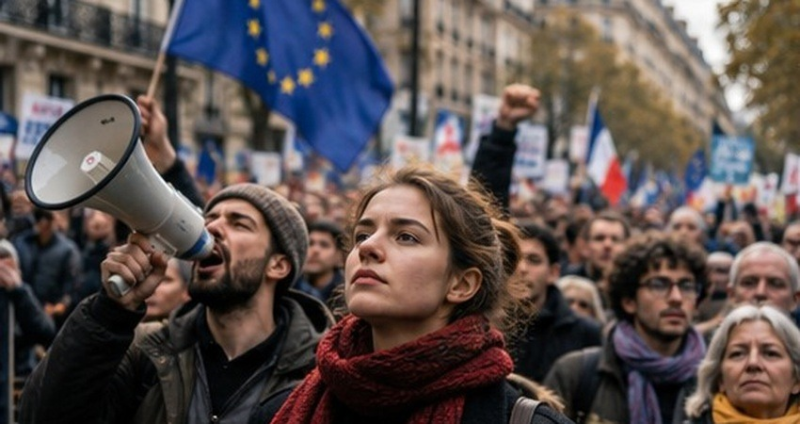
Europe is protesting. Again.
In Paris, demonstrators demand higher wages, better schools and stronger public services. In Berlin, young people question government priorities, rising military expenditure and their own economic prospects. In Lisbon, protesters pitch tents in public squares, demanding something increasingly difficult to obtain: an affordable place to live.
The images are familiar. Crowded streets. Raised banners. Police lines. Frustrated citizens asking their governments to listen.
On 5 November 2026, France witnesses another major day of national mobilisation. The Interior Ministry counts 575,000 participants across 193 demonstrations, including 65,000 in Paris. The CGT trade union estimates considerably higher participation, at around 1.57 million nationwide.
In Berlin, a demonstration organised by the youth initiative Gen Z regelt brings thousands to the Brandenburg Gate on 31 October. Its demands include investment in education, affordable living costs and opposition to compulsory military service.
In Lisbon, protesters challenge proposed changes to rental legislation against the backdrop of a housing crisis that has placed enormous pressure on younger generations.
Different cities. Different political circumstances. Different demands.
Yet something familiar connects them: a growing anxiety about the future.
The immediate explanations are not difficult to find. Rising prices, unaffordable housing, pressure on public services, uncertain employment prospects and frustration with political leadership.
These problems are real. Their human consequences are equally real.
But I want to ask a different question.
What if the issues bringing people onto Europe's streets are not the beginning of the story, but the latest chapter of one that began decades ago?
What if the tensions confronting Europe in 2026 cannot be understood by examining only the decisions of today's governments?
And what if some of the economic pressures experienced by ordinary citizens are connected to weaknesses in the international security system developed long before many of those citizens were born?
This does not mean that every protest shares a single cause. Nor does it excuse national governments for failures in housing, taxation, education or economic management.
It means that we need to look at two levels of responsibility simultaneously: the decisions made within individual countries and the international structures that influence the conditions under which those decisions are made.
To understand Europe's present, we must examine its past.
We must follow the political decisions, trace their economic consequences, identify who benefits and who bears the costs, and question the institutions that are supposed to preserve international stability.
Not to discover a convenient villain.
To understand the system.
“The headline tells us what happened. History helps explain why. Economics reveals who pays the price.”
1990: The Promise of a Different Europe
The fall of the Berlin Wall in November 1989 represents one of the great turning points in modern European history.
For millions of people, the moment symbolises freedom, reunification and the possibility of ending decades of confrontation between East and West.
In November 1990, leaders gather in Paris to sign the Charter of Paris for a New Europe.
Its ambition is extraordinary.
The signatories envision a continent in which political cooperation, democracy, human rights and international security replace the logic of permanent ideological confrontation.
The Cold War appears to be ending. The possibility of a fundamentally different international order seems within reach.
A year later, in December 1991, the Soviet Union ceases to exist.
The geopolitical landscape changes almost overnight.
But the institutions governing international security do not undergo an equally comprehensive transformation.
NATO survives and subsequently expands. European integration accelerates. Countries that had lived under Soviet domination pursue new alliances, political freedoms and economic opportunities.
Russia, meanwhile, faces the economic and political upheaval of the post-Soviet period and seeks to redefine its position in the international system.
The result is not a single shared vision of European security.
It is a collection of competing visions.
For Poland, Estonia, Latvia, Lithuania and other countries, NATO membership offers protection against the possible return of Russian domination.
For successive Russian governments, NATO's eastward expansion becomes a major strategic grievance.
Western governments generally regard enlargement as a legitimate choice by sovereign states and a means of strengthening European stability.
These perspectives are not interchangeable, and recognising them does not require accepting every claim made by their advocates.
Sovereign countries have the right to determine their own security arrangements. A neighbouring power's sense of insecurity does not create a right to invade them.
Nevertheless, the competing perceptions reveal a fundamental problem.
The Cold War ends without the emergence of a universally accepted security settlement capable of reconciling the interests and sovereignty of Europe's states.
The Charter of Paris expresses the aspiration of a peaceful, cooperative Europe. But translating that aspiration into an enduring security order proves far more difficult.
The institutions inherited from the previous era continue to evolve, yet the underlying disagreements remain.
“Europe dismantles the visible symbols of its division, but never fully resolves the competing visions of security that survive beneath them.”
This is where our investigation begins.
Not with the assumption that one decision inevitably causes everything that follows, but with a question.
Does Europe construct a genuinely new security architecture after the Cold War, or does it largely adapt and expand institutions developed for an earlier confrontation?
And how effectively can those institutions function when the international balance of power changes?
The Warnings: From Munich to Ukraine
History rarely announces the arrival of a crisis in a single dramatic moment.
More often, tensions accumulate.
The wars in the former Yugoslavia demonstrate that the end of the Cold War does not eliminate violent nationalism or political fragmentation.
NATO expands in 1999 and again in 2004. Its new members regard accession as protection for their independence. Russia increasingly portrays expansion as a threat to its security interests.
In February 2007, Russian President Vladimir Putin delivers a speech at the Munich Security Conference.
He openly challenges the US-dominated international order and criticises NATO enlargement.
The speech is important not because it makes future conflict inevitable, but because it exposes the depth of strategic disagreement that has developed.
The years that follow are increasingly confrontational.
Russia's war with Georgia in 2008, its annexation of Crimea in 2014 and the conflict in eastern Ukraine damage the foundations of European security.
Then, on 24 February 2022, Russia launches its full-scale invasion of Ukraine.
The war represents a fundamental violation of Ukraine's sovereignty and the international prohibition on aggressive war.
The distinction between explaining a conflict and justifying it is essential.
Examining the historical failures of European security does not reduce Russia's responsibility for its decision to invade.
Nor does criticism of Western diplomatic strategy imply that Russia's actions are legitimate responses to those policies.
A serious investigation must be capable of considering several conclusions simultaneously.
Russia is responsible for its invasion. The European security environment had become increasingly unstable long before February 2022. International institutions and diplomatic mechanisms failed to prevent that instability from escalating into a devastating war.
These statements do not contradict one another.
They describe different dimensions of the same historical process.
And they lead us to a difficult question.
If the international security system is designed to prevent catastrophic conflict, what does its inability to prevent this one reveal about its effectiveness?
We must also be careful not to mistake hindsight for certainty.
A different diplomatic approach might have changed some incentives or reduced certain risks. But no credible historical analysis can demonstrate that an alternative policy would necessarily have prevented the invasion.
What we can establish is that the international security environment deteriorated over many years, while the mechanisms intended to manage the resulting tensions proved insufficient.
The consequences extend far beyond the battlefield.
They reach Europe's energy markets, government budgets, industries and households.
When Geopolitics Reaches the Kitchen Table
For decades, Europe's economic model depends in part on international trade, industrial competitiveness and access to relatively affordable energy.
Germany provides one of the clearest examples.
Its industrial economy benefits from extensive trade relationships and supplies of Russian pipeline gas.
Economic interdependence is widely regarded as a source of mutual benefit. Some policymakers also hope that commercial cooperation will help reduce the risk of political confrontation.
The logic appears attractive.
Russia exports energy and receives revenue. European industries obtain fuel. Consumers benefit from economic activity supported by comparatively competitive energy costs.
Yet economic interdependence is not automatically the same as security.
When political relationships deteriorate, concentrated dependence can become a strategic vulnerability.
In 2021, Russia accounts for approximately 45% of EU gas imports.
Following the invasion of Ukraine and the subsequent transformation of European energy policy, that share falls to approximately 12% in 2025, according to European Commission figures.
Europe diversifies its suppliers, increases investment in infrastructure and accelerates efforts to reduce dependence on Russian energy.
These changes address a genuine security risk.
But restructuring energy systems is neither immediate nor free.
Businesses must adapt. New infrastructure requires investment. Suppliers and trade routes change. Exposure to internationally traded liquefied natural gas introduces different vulnerabilities.
The economic costs are not evenly distributed.
Some companies secure new contracts and markets. Others face higher operating costs or lose access to established supply arrangements.
Governments introduce support measures, while businesses and households adjust to changing prices.
And energy is only one part of the story.
The international security environment remains unstable in 2026, with renewed conflict in the Middle East adding further pressure to global energy markets.
Eurostat's preliminary estimate for October 2026 puts annual inflation in the euro area at 4.0%, up from 3.8% in September.
Energy prices show an annual increase of 20.8%.
These figures are not evidence that every price increase is caused by the war in Ukraine, or by the international security architecture alone.
They reflect economic conditions influenced by multiple factors, including energy markets, monetary policy, domestic demand and new geopolitical disruptions.
But they illustrate how rapidly external instability can become an internal economic problem.
When energy prices rise, the consequences can spread through transport, manufacturing, agriculture and food distribution.
Businesses face difficult choices. They can absorb higher costs, increase prices, reduce investment or reorganise their operations.
Workers encounter the results through wages, employment opportunities and purchasing power.
Governments face pressure to intervene, often at considerable fiscal expense.
And families experience the consequences when paying for heating, electricity, food and transport.
“A geopolitical decision may be made thousands of miles away. Its consequences can still arrive in the electricity bill of a family that had no voice in making it.”
But there is an important point here.
Not every economic hardship begins abroad.
A family struggling with rent may be affected primarily by housing supply, planning restrictions, local taxation, weak wage growth or an inadequate transport network.
These are often domestic policy questions.
Global instability can intensify them, but it does not create automatic immunity from responsibility for national leaders.
The distinction matters because identifying a structural problem should help us understand accountability, not dissolve it.
Follow the Money: The Economics of Insecurity
Whenever international tensions rise, I find myself returning to a simple question.
Who benefits?
It is a legitimate economic question, provided we ask it carefully.
The existence of a beneficiary does not establish the existence of a conspiracy.
A company may profit from a crisis without having caused it. A government may gain strategic influence from events it did not initiate. An industry may expand because states respond to genuine security threats.
But none of this makes the financial consequences irrelevant.
On the contrary, understanding how costs and benefits are distributed is essential to understanding the political economy of international security.
Consider the scale of military spending.
According to the Stockholm International Peace Research Institute, global military expenditure reaches $2.887 trillion in 2025, an increase of 2.9% in real terms.
European military expenditure rises by 14% in real terms to $864 billion.
This European figure uses SIPRI's geographical definition, including Russia and Ukraine. It must not be confused with the military expenditure of the European Union alone.
Over the decade from 2016 to 2025, European military spending approximately doubles in real terms.
The increase reflects growing security concerns, particularly the Russia–Ukraine war and uncertainty surrounding future international defence commitments.
Military budgets support personnel, training, maintenance, infrastructure and procurement.
They also generate substantial commercial demand.
SIPRI's most recent available ranking of the world's 100 largest arms-producing and military-services companies shows combined arms revenues of $679 billion in 2024.
US-based companies account for $334 billion.
The 26 European companies included in the ranking generate $151 billion, an increase of 13% in real terms compared with the previous year.
These figures represent arms-related revenues, not corporate profits.
They demonstrate the commercial scale of defence procurement, but they do not prove that manufacturers caused the conflicts driving demand.
Companies such as Lockheed Martin, RTX, BAE Systems and Rheinmetall operate in an industry shaped by government decisions, national security requirements and long-term procurement contracts.
Their role is complex.
They produce equipment that governments consider necessary for defence and deterrence. Their operations support employment, engineering and technological development.
At the same time, the growth of military expenditure creates powerful commercial interests in future procurement and long-term defence programmes.
This makes transparency and accountability essential.
Who receives contracts? How are they awarded? What are their long-term costs? What safeguards exist against conflicts of interest or wasteful spending?
These are questions of public finance, not conspiracy.
The same analytical method applies to energy.
The reorganisation of Europe's energy supply creates opportunities for LNG exporters, infrastructure operators, equipment manufacturers and other businesses.
Some benefit from new demand. Others lose established markets. Consumers may face higher costs even as energy security improves.
The important task is to identify the documented flows of money and the incentives they create.
And then investigate whether those interests influence policy decisions.
We should not assume influence simply because a financial interest exists.
We should establish it through evidence.
“Every crisis creates losses. Some crises also create extraordinary commercial opportunities. The responsibility of journalism is to document both — without confusing opportunity with authorship.”
The central lesson is straightforward.
International security is not only a diplomatic or military issue.
It is also an enormous economic system, one in which decisions about threats, alliances and procurement shape the distribution of public resources and private opportunities.
And the larger that system becomes, the more carefully its economic consequences deserve to be examined.
The New Defence Commitments — and Their Price
In June 2025, NATO members agree at The Hague summit to a new defence investment commitment.
By 2035, allies undertake to invest 5% of GDP annually in defence and security-related requirements.
The commitment contains two categories.
At least 3.5% of GDP is intended for core defence requirements, while up to 1.5% covers wider security-related areas, including critical infrastructure, resilience, networks, innovation and defence-industrial capacity.
This is a long-term commitment, not an immediate requirement to increase conventional military spending to 5% overnight.
Nor is every pound or euro in the wider category necessarily spent on weapons.
Nevertheless, the financial implications are considerable.
Supporters argue that greater investment is necessary to deter aggression, improve readiness and reduce dependence on external security guarantees.
The argument deserves serious consideration.
An inadequately defended country can face consequences far more expensive than the investments required to protect it.
But another question is equally legitimate.
How will governments finance these commitments while maintaining education, healthcare, infrastructure and social welfare?
The answer cannot be reduced to a simple claim that every increase in defence spending automatically produces a corresponding reduction in public services.
Public budgets are more complicated.
Governments can increase taxation, borrow, encourage growth, reallocate spending or pursue combinations of these approaches.
Some security expenditure also benefits civilian infrastructure and domestic industry.
Yet resources remain limited.
Money, skilled workers, materials and industrial capacity cannot be allocated without choices.
And those choices have consequences.
The responsibility for making them belongs to national governments.
No international agreement automatically determines how a country designs its tax system, manages its public debt, reforms its planning laws or distributes the costs of its policies.
These decisions remain political choices for which elected leaders must answer.
A government cannot credibly attribute every failure of domestic administration to global instability.
If housing construction is obstructed by ineffective planning policy, that failure requires a domestic explanation.
If infrastructure investment is poorly managed, international tensions do not eliminate the need for scrutiny.
If taxation is inefficient or public services are badly administered, responsibility does not disappear because the international environment is difficult.
Global pressures help explain the constraints. National governments remain accountable for the choices they make within them.
Understanding both levels is essential.
Without the international context, we risk misunderstanding the pressures governments face.
Without domestic accountability, we risk turning structural analysis into an excuse for political failure.
The United Nations: A System Designed for Another Century
We now arrive at the institution that lies at the centre of the international security architecture.
The United Nations is established in 1945 following the devastation of the Second World War.
Its creation represents an extraordinary attempt to prevent future global conflict through international law, diplomacy and collective security.
The UN Security Council receives primary responsibility for maintaining international peace and security.
Yet its structure reflects the distribution of power at the end of the Second World War.
Five countries — the United States, the United Kingdom, France, China and Russia, which succeeded the Soviet Union in its UN seat — hold permanent membership and veto powers over substantive resolutions.
The arrangement is intended to ensure that the major powers remain involved in decisions affecting international peace.
But it creates an enduring contradiction.
An institution responsible for upholding international security can be prevented from taking certain binding actions when one of its permanent members objects.
This becomes especially problematic when a permanent member is itself involved in the conflict under consideration.
Russia's invasion of Ukraine illustrates the difficulty.
On 2 March 2022, the UN General Assembly adopts a resolution demanding an end to Russia's aggression and the withdrawal of its forces.
The resolution receives the support of 141 countries.
The vote demonstrates broad international opposition to the invasion.
Yet the General Assembly does not possess the same binding enforcement powers as the Security Council.
The international community can establish that an action violates fundamental principles without necessarily possessing an effective collective mechanism to stop it.
This is not evidence that international law is meaningless.
It is evidence that international law and the mechanisms available to enforce it are not the same thing.
The problem also extends beyond Russia.
Permanent members possess institutional advantages that other countries do not.
Their veto powers can restrict collective action even when international opinion strongly favours a different course.
Moreover, the Security Council's permanent membership does not fully reflect the economic, demographic and political realities of the twenty-first century.
Africa has no permanent seat. Neither do India, Brazil, Japan or Germany.
Proposals for reform have circulated for decades.
Yet changing the UN Charter requires an exceptionally demanding process, including ratification by all five permanent members.
Those with the greatest institutional privileges therefore retain substantial influence over attempts to alter them.
No secret arrangement is required to explain this difficulty.
It is built into the rules.
“An international system cannot rely indefinitely on yesterday's balance of power while claiming to govern tomorrow's conflicts.”
Reform, however, is not as simple as removing the veto.
The original justification for giving major powers special responsibilities remains relevant: a security institution that excludes the cooperation of powerful states may struggle to function at all.
A redesigned system must confront the difficult balance between legitimacy and effectiveness.
How can international rules be applied more consistently without making cooperation between major powers impossible?
How can smaller states gain meaningful representation without creating institutions incapable of making decisions?
And how can the international community respond to aggression when those responsible possess the power to obstruct collective action?
These are not abstract constitutional questions.
They concern the ability of the international system to prevent the wars that eventually disrupt economies, displace populations and place enormous pressure on public resources.
Europe Cannot Separate Security From Prosperity
For much of the post-war period, Western Europe develops within a security environment in which the United States plays a central role.
This arrangement supports European reconstruction, economic integration and the development of extensive social welfare systems.
Over time, Europe becomes one of the world's most important economic regions.
But economic integration does not produce an equally unified European defence and foreign policy.
European countries retain different strategic interests, defence capabilities and relationships with powers beyond the continent.
Today, these differences complicate the search for a common response to international instability.
Europe faces several challenges simultaneously.
It must strengthen its ability to defend itself, preserve economic competitiveness, reduce vulnerabilities in energy and supply chains, and maintain the confidence of its citizens.
The relationship between security and prosperity is unavoidable.
Security protects economic activity.
Economic productivity finances security.
A country that cannot generate sufficient wealth will eventually struggle to support ambitious defence commitments.
Equally, a wealthy country that cannot protect its institutions, infrastructure and territory faces serious risks to future prosperity.
The two objectives are therefore not natural enemies.
The challenge lies in achieving a sustainable balance.
And this balance requires more than military budgets.
It requires innovation, reliable energy, education, infrastructure, effective administration and public trust.
It also requires governments to recognise that national resilience is not measured solely by the number of weapons they possess.
A society with deteriorating public services, declining confidence and limited economic opportunity may become politically vulnerable even while its military capabilities improve.
This does not mean that social dissatisfaction is always caused by security spending.
It means that national security must be understood more broadly.
A country's capacity to defend itself ultimately rests upon the strength and legitimacy of the society behind that defence.
A Crisis of Architecture — Not a Single Cause for Every Problem
At this point, we can return to the hypothesis at the centre of our investigation.
Is the architecture of international security becoming increasingly inadequate for the world it is expected to govern?
The evidence identifies several substantial weaknesses.
The post-Cold War period fails to produce a durable settlement of competing security concerns.
International institutions struggle to prevent major powers from violating fundamental rules.
Military spending increases as governments respond to threats and uncertainty.
Economic interdependence creates prosperity but also introduces strategic vulnerabilities.
Geopolitical shocks transmit costs across borders, affecting businesses, public finances and households.
These developments are connected.
But connection does not mean that every problem shares one cause.
Europe's housing crises are not simply consequences of NATO enlargement.
Low productivity cannot be explained solely by the structure of the UN Security Council.
Ageing populations, domestic taxation, planning restrictions, education policy and industrial investment have their own distinct histories.
A comprehensive explanation must therefore distinguish direct causes from contributing pressures.
The international security architecture is best understood as a framework that shapes the broader environment in which national economies operate.
When that framework fails to manage conflict effectively, the resulting instability can intensify existing domestic weaknesses.
Consider one possible sequence.
Unresolved security disputes increase geopolitical tensions.
Those tensions develop into confrontation, military escalation or prolonged uncertainty.
Conflict and uncertainty disrupt energy supplies, trade routes, investment decisions and public spending priorities.
These disruptions place pressure on government budgets, businesses and households.
Where national policies are already ineffective, the additional pressure can magnify social dissatisfaction.
But the sequence is not inevitable.
Governments have opportunities to intervene at every stage.
Diplomacy can reduce tensions. Energy diversification can limit exposure. Sound economic policies can protect public finances. Effective housing and labour-market policies can help households withstand shocks.
This is precisely why responsibility must remain central to our analysis.
An international system may create difficult conditions, but governments are not passive observers of those conditions.
Their decisions influence whether external pressures become manageable challenges or deep domestic crises.
The failures of international architecture and the failures of national governance can reinforce one another.
Recognising this interaction is more useful than assigning every problem to one convenient explanation.
Who Has an Interest in Preserving the Existing System?
Every institutional arrangement creates patterns of influence, authority and economic advantage.
The international security system is no exception.
Permanent members of the UN Security Council possess privileges that other states do not.
Military alliances provide security guarantees while also creating strategic commitments and dependencies.
Defence industries operate within procurement systems heavily influenced by government policy.
Energy suppliers and infrastructure businesses respond to political decisions that can create or eliminate entire markets.
These relationships do not establish that the system exists solely to benefit a particular group.
But they help explain why fundamental changes can encounter resistance.
Reform may require powerful actors to accept constraints they do not currently face.
It may redistribute influence.
It may alter investment priorities, procurement arrangements or long-established diplomatic relationships.
Some actors may support reform because it improves stability or representation. Others may fear that changes will undermine their security or reduce their influence.
Those interests deserve investigation.
But we must be careful with the word beneficiary.
A country may benefit from an alliance without supporting every decision taken within it.
A defence company may benefit from higher procurement without welcoming the conflict that created the demand.
An energy producer may gain a market because another supply relationship collapses, without having played any role in that collapse.
Financial incentives can influence political behaviour, but their existence alone does not prove causation.
This is where independent journalism must be especially disciplined.
We need contracts, public records, documented lobbying, budget data and evidence of actual decision-making.
Not assumptions.
“Following the money is not about finding someone to blame. It is about understanding whose interests are represented, whose costs are overlooked and how power operates when decisions are made.”
The broader question is whether the international security architecture creates sufficient incentives for preventing conflict — or whether some of its institutional arrangements make peaceful adaptation unnecessarily difficult.
That is a question worth asking openly.
And answering with evidence.
What Would a New Security Architecture Require?
If the existing international order is struggling to meet contemporary challenges, what might a more effective system look like?
There is no single reform capable of eliminating geopolitical competition.
Countries will continue to have different interests. International law will continue to face enforcement difficulties. Economic interdependence will always involve some degree of vulnerability.
But several areas of reform deserve serious examination.
The first is the structure and effectiveness of international institutions.
The UN Security Council needs a debate about representation, accountability and the use of veto powers that moves beyond repeated declarations of principle.
Greater participation by underrepresented regions could improve legitimacy, although it would not by itself guarantee more effective decisions.
The second is conflict prevention.
Diplomacy, communication between rival powers, arms-control mechanisms and verifiable agreements remain indispensable.
Military deterrence can discourage aggression, but deterrence alone cannot resolve every political disagreement.
The third is economic resilience.
Governments should treat energy security, critical infrastructure, industrial capacity and supply-chain diversification as integral parts of national security.
But resilience must not become a justification for abandoning the benefits of international cooperation.
The fourth is democratic accountability.
Citizens deserve clear explanations of major security commitments, their financial consequences and the alternatives considered.
Public scrutiny of procurement, borrowing, taxation and long-term strategic investment is essential.
Finally, the international system must recognise that lasting stability depends on more than preventing military defeat.
It also depends on creating conditions in which societies can develop economically, maintain functioning institutions and preserve public confidence.
None of these reforms guarantees a peaceful world.
But their effectiveness can be tested.
Do they reduce the likelihood of confrontation?
Do they make international rules more consistently enforceable?
Do they protect sovereignty?
Do they reduce economic vulnerability?
Do they make the costs and benefits of security decisions more transparent?
These questions provide a practical basis for evaluating change.
They also shift the debate away from the false choice between defending the existing order exactly as it stands and dismantling it without a credible alternative.
The objective should be to improve the capacity of international institutions to perform the functions for which they were created.
The View From Above: Understanding the Whole Picture
Let us return to Europe's streets.
A student in Paris demands better education.
A young demonstrator in Berlin challenges the priorities of political leaders.
A worker in Lisbon wonders whether they will ever be able to afford a home.
Their demands are immediate and personal.
They are not necessarily thinking about the Charter of Paris, the Munich Security Conference, the UN Security Council or the economics of military procurement.
And they should not be required to understand every aspect of international relations before their concerns are taken seriously.
Yet their lives are influenced by systems much larger than the cities in which they live.
Some of those systems are national.
Housing regulations, taxation, public investment, education and labour-market policies are shaped substantially by domestic governments.
Others are international.
Energy markets, security alliances, military confrontation, trade and global financial conditions reach across borders.
A full explanation of Europe's difficulties must examine how these systems interact.
Imagine looking at a city from street level.
We see individual buildings, vehicles, people and intersections.
From above, we begin to understand the wider network.
We see how roads connect, where congestion develops and how apparently separate areas form part of a larger structure.
Historical and economic analysis can provide a similar perspective.
What appears to be a collection of isolated political emergencies may reveal deeper relationships when examined over a longer period.
But a wider perspective is valuable only if it remains faithful to the details.
Not every traffic jam has the same cause.
And not every protest originates in the same political failure.
The task is to understand both the larger system and the individual circumstances within it.
This is also why critical thinking requires us to question our preferred explanations.
If we believe international institutions are outdated, we must test that proposition against the evidence.
If we suspect economic interests influence political decisions, we must establish how that influence operates.
If we argue that historical choices have long-term consequences, we must demonstrate the connections rather than assume them.
An explanation becomes persuasive through the strength of its evidence, not the confidence with which it is expressed.
The Question Europe Can No Longer Avoid
The protests of 2026 provide a warning about public confidence, living standards and the expectations of a new generation.
But they also invite us to examine a larger historical problem.
The world changes profoundly after 1945 and again after 1991.
New powers emerge. Economies become deeply interconnected. Technology transforms warfare, communication and finance.
Yet important parts of the international security system remain tied to institutions and arrangements developed for earlier geopolitical realities.
Those institutions still perform essential functions.
But they also reveal significant limitations when confronted with the strategic challenges of the twenty-first century.
Our investigation points towards a central conclusion.
The international security architecture is not the sole cause of Europe's economic and political difficulties. But its inability to prevent or contain major conflicts can amplify existing problems and make them substantially harder to resolve.
It is also clear that responsibility cannot be transferred entirely from national governments to international institutions.
Governments remain accountable for the domestic choices they make — whether those concern housing, taxation, public services, industrial policy or the distribution of security costs.
The failures of the international system do not excuse failures of national governance.
Equally, concentrating exclusively on domestic political mistakes risks overlooking the international environment in which those mistakes occur.
The two levels are inseparable.
A more stable international order cannot guarantee prosperity.
But persistent international instability can undermine the conditions required to achieve it.
This is why the question of security reform deserves attention far beyond military and diplomatic circles.
It affects economic development, investment, public finances and the everyday prospects of millions of people.
And it raises a difficult issue for the world's most influential states.
Are they prepared to reconsider institutional arrangements that preserve their privileges if those arrangements increasingly struggle to fulfil their stated purpose?
Meaningful reform may require changes in representation, decision-making and the relationship between national sovereignty and collective responsibility.
It may also require governments to accept greater transparency about the economic consequences of their strategic decisions.
None of this will be easy.
History offers few examples of powerful institutions voluntarily surrendering advantages without substantial political pressure or changing circumstances.
But the difficulty of reform does not make the question irrelevant.
It makes the quality of the debate more important.
“A crisis does not begin when people finally take to the streets. By then, its causes may have been accumulating for decades. The real question is whether we have the courage to examine the system that allowed them to accumulate.”
The demonstrations eventually end.
Crowds disperse. Streets reopen. The news cycle moves to another crisis.
But the structural problems do not disappear when the cameras leave.
They remain embedded in institutions, economic relationships, strategic commitments and political choices.
Understanding them requires us to look beyond today's headlines.
To examine the decisions made years or decades earlier.
To follow the money without inventing conspiracies.
To question power without abandoning evidence.
And to recognise that a world designed around the political realities of the twentieth century cannot automatically meet every challenge of the twenty-first.
The future of Europe depends on what its governments do at home.
But it also depends on whether the international system in which they operate can adapt to a changing world.
The question is no longer simply how Europe responds to the protests of 2026.
It is whether the world is prepared to rethink the architecture that shapes the crises of the twenty-first century.