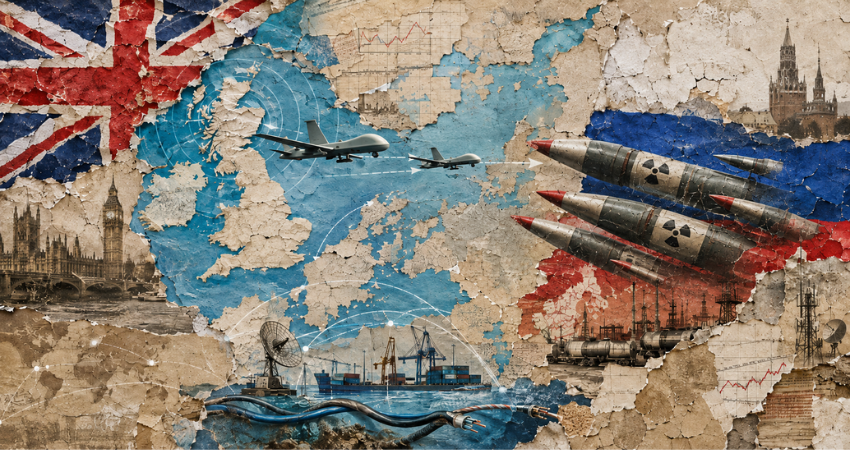
Russia Threatens British Targets Worldwide Over Long-Range Drones Supplied to Ukraine
The Week That Shaped the World — 14–21 August 2026
This was the week when escalation started sending invoices.
Britain pushed deeper into Ukraine’s long-range war as British-made drones struck targets inside Russia, prompting Moscow to warn that London may eventually pay a price of its own.
In the Strait of Hormuz, Iran and Washington continued arguing over who controls one of the world’s most important shipping routes while oil moved towards $90–94 a barrel. Gaza produced another diplomatic effort without a settlement. And one of Russia’s heaviest recent attacks on Kyiv brought the familiar geopolitical vocabulary — deterrence, escalation, leverage — back to where it eventually ends.
People.
Economics offered little refuge.
America’s national debt crossed $40 trillion just as investors demanded more money to lend to governments for decades. China slowed again, then sentenced the founder of Evergrande to life imprisonment — an impressively decisive punishment for one man, though somewhat less useful for repairing an entire property model.
Artificial intelligence continued consuming billions in chips, memory and infrastructure while markets began asking the question that eventually visits every technological revolution:
When does all this become profit?
There was a common thread.
Governments are testing how far wars can expand without becoming larger wars. Governments are testing how much debt markets will finance without complaint. Technology companies are testing how much capital investors will provide before demanding proof.
Everyone is testing limits.
Limits have an irritating habit of answering back.
“Power enjoys discussing red lines. Markets, wars and arithmetic have the less theatrical habit of eventually drawing them.”
1. Russia Threatens British Targets Worldwide Over Long-Range Drones Supplied to Ukraine
Britain’s increasingly direct role in Ukraine’s long-range strike campaign has triggered one of Moscow’s sharpest warnings yet towards London.
British-made drones are now being used to strike targets inside Russia, including industrial facilities, energy infrastructure and logistics hubs far from the Ukrainian border.
Among them were Wildberries distribution facilities.
There is something grimly modern about that sentence.
A European war that began with tanks crossing a border now reaches warehouses belonging to Russia’s largest online retailer through remotely operated aircraft manufactured in Britain.
London’s position is straightforward: Ukraine was invaded, Ukraine has the right to defend itself, and Britain will continue providing military assistance.
That argument is legitimate.
It is not the same thing as saying escalation carries no consequences.
Moscow has warned that the deeper Britain becomes involved, the higher the price it may eventually pay. Sergei Lavrov sharpened the message further, saying that if Britain has chosen to remain with Ukraine “until the very end”, he feels “very sorry for the British people”.
Russian threats should not be confused with Russian plans.
Moscow has spent years using intimidation as policy, and Britain should certainly not allow the Kremlin to acquire a veto over British foreign policy simply by sounding menacing.
But neither should Westminster behave as though geography makes escalation free.
Russia does not need to launch missiles at London to impose costs. Cyber operations, sabotage, attacks on maritime infrastructure, disruption of communications and pressure against British interests abroad all inhabit the uncomfortable territory below open NATO-Russia war.
That does not mean they will happen.
It means serious governments consider what happens if they do.
Supporting Ukraine can be strategically necessary while particular escalatory decisions remain open to scrutiny. Those positions are not contradictory.
Patriotism does not require applauding Westminster every time it raises the stakes.
Sometimes it requires asking whose stakes they actually are.
“There is courage in standing up to an aggressor. There is rather less courage in gambling with consequences somebody else may have to survive.”
2. Strait of Hormuz Turns Into the World’s Most Expensive Argument About Who Controls the Water
Washington says the Strait of Hormuz is open.
Tehran says otherwise.
Merchant shipping appears to have developed the unfashionable habit of consulting reality.
Traffic through one of the world’s most important energy corridors has fallen sharply as the confrontation continues, while Iran insists restrictions will remain until its conditions are met. The United States has threatened further sanctions against countries helping Tehran, and the UAE has suspended trade with Iran.
Meanwhile Brent crude has moved towards $90–94 a barrel.
There is the scoreboard.
Hormuz matters because geography has given Iran something sanctions cannot easily remove.
Leverage.
A substantial share of globally traded oil normally passes through the narrow waterway connecting the Gulf with the Arabian Sea. Washington may possess the larger navy, the larger economy and the louder sanctions department.
Tankers still have to use the same stretch of water.
The danger is not merely a formal blockade.
Commercial shipping operates on risk.
Insurers raise premiums. Shipowners delay departures. Cargoes are rerouted. Buyers build precautionary inventories. Traders price tomorrow’s shortage into today’s barrel.
A few naval movements can therefore become an inflation problem thousands of miles away without a single tanker being sunk.
That is what makes the dispute larger than Iran.
Higher oil prices feed transport, aviation, manufacturing, agriculture and eventually consumer prices. They also complicate the job of central banks already trying to decide whether inflation has truly been defeated or has merely gone outside for a cigarette.
Washington wants maximum pressure on Tehran.
It also wants stable global energy markets.
Both ambitions are understandable.
Together they require a remarkable degree of cooperation from geography.
Hormuz has rarely shown much interest in policy coherence.
“The superpowers are debating who controls the Strait. The oil market has begun charging everyone for the privilege of listening.”
3. Trump’s Gaza Diplomacy Stalls Again Because Everyone Wants the Other Side to Move First
Another American attempt to unlock the Gaza settlement produced meetings, negotiations and approximately the same amount of peace Gaza had before them.
Jared Kushner met regional intermediaries and Israeli officials in an effort to revive the proposed roadmap.
No breakthrough followed.
The disagreement remains remarkably simple.
Israel wants Hamas disarmed before Israeli forces withdraw.
Hamas wants withdrawal and guarantees before surrendering the weapons that provide its remaining leverage.
Each side fears doing first precisely what the other side needs it to do first.
Diplomats call this sequencing.
Ordinary people might call it being stuck.
Washington has tried to bridge the gap through a broader framework involving regional governments, a future international stabilisation force and some form of post-war Palestinian administration.
The architecture is becoming increasingly detailed.
The foundations remain missing.
Who actually governs Gaza?
Who guarantees that Hamas stays disarmed?
Who guarantees Israel withdraws?
Who possesses legitimate Palestinian political authority?
And what happens when one party concludes that the other has violated the agreement?
These are not technical details surrounding the peace plan.
They are the peace plan.
Israel continued military operations while negotiations remained unresolved, another reminder that diplomatic time and battlefield time operate on different clocks.
Trump’s transactional instinct can be useful in diplomacy. Political systems occasionally become trapped in ritual, and an outsider willing to ask what each actor actually wants can break deadlocks.
But transactions require assets both sides are willing to exchange.
Gaza currently has something more difficult.
Two sides for whom surrendering leverage first can be interpreted as surrendering security itself.
So the diplomats return to the table.
Because there is nowhere else to put it.
“The Gaza roadmap has a destination. What it still lacks is anyone willing to leave the station first.”
4. Russia’s Massive Attack on Kyiv Exposes the Arithmetic Behind Ukraine’s Air Defence
Russia launched one of its heaviest recent aerial attacks on Kyiv and the surrounding region this week.
At least 16 people were killed.
Residential buildings were hit. A school was damaged. So was a children’s medical centre.
There is a point at which geopolitical vocabulary becomes rather indecent.
Strategic signalling.
Attrition.
Escalation dominance.
Sixteen dead people remain sixteen dead people.
But the attack also exposed one of the war’s increasingly important structural problems.
Air defence is arithmetic.
Russia can launch combinations of drones, cruise missiles and high-speed ballistic weapons designed not merely to hit targets but to overwhelm the systems trying to stop them.
Ukraine can intercept many.
It cannot assume it can intercept everything forever.
Each Patriot interceptor must exist before it can be fired. Each launcher must be manufactured, maintained and supplied. Each attack forces Ukraine to choose what deserves protection when defensive capacity is finite.
That turns the war into an industrial contest.
Europe can promise support at political speed.
Factories operate somewhat differently.
Ukraine has repeatedly asked Western governments for additional air-defence systems while simultaneously expanding its own long-range campaign against Russian oil, industrial and logistics infrastructure.
The result is a war stretching increasingly far behind the traditional battlefield on both sides.
Moscow attempts to degrade Ukrainian infrastructure and exhaust its defensive stock.
Kyiv attempts to stretch Russian air defences and increase the economic cost of continuing the invasion.
Both strategies possess military logic.
Neither makes civilians safer.
And behind all the speeches about European security sits a considerably less glamorous question:
Can Western industry manufacture defensive weapons faster than Russia can manufacture things that need defending against?
Eventually wars discover factories.
This one certainly has.
“Europe can declare solidarity at the speed of Wi-Fi. Unfortunately, air-defence missiles are still produced at the speed of factories.”
5. Nord Stream Investigation Gets Awkward as Another Ukrainian Suspect Is Arrested
The Nord Stream investigation has acquired another Ukrainian suspect.
This is becoming inconvenient.
A Ukrainian national wanted by German investigators over the 2022 destruction of the Nord Stream pipelines was arrested in Croatia. Germany is seeking his extradition.
Investigators suspect he was among the divers involved in placing explosives on the pipelines.
Another Ukrainian suspect had already been detained previously.
None of this proves that the Ukrainian government ordered the attack.
That distinction is not decorative.
An operation carried out by private actors, sympathetic operatives, military personnel acting outside formal authority or a state-directed team would produce radically different political conclusions.
What has changed is simpler.
The possibility of Ukrainian involvement can no longer comfortably be filed under inconvenient speculation.
For Germany, this creates an exquisite diplomatic problem.
Berlin has spent billions supporting Ukraine against Russia while its own investigators pursue evidence that Ukrainians may have been involved in destroying infrastructure central to Germany’s pre-war energy system.
Allies prefer their criminal investigations uncomplicated.
Evidence has no diplomatic training.
The Nord Stream explosions became almost instantly ideological after they occurred. Depending on which part of the internet one inhabited, Russia definitely did it, America definitely did it, Ukraine definitely did it or somebody so sophisticated had done it that asking questions was apparently impolite.
Four years later, the useful approach remains the boring one.
Follow the evidence.
If suspects are innocent, establish it.
If individuals acted independently, establish it.
If evidence eventually points toward state involvement, establish that too.
The rule of law is most valuable precisely when its conclusions threaten to become politically inconvenient.
Otherwise it is merely branding.
Europe is rather good at branding.
This case may require something harder.
“Alliances are easy when the evidence behaves itself. The interesting part begins when it doesn’t.”
6. Global Bond Markets Are Beginning to Ask Governments Who Exactly Pays for All This
For years governments borrowed enormous amounts of money at interest rates low enough to make arithmetic seem unnecessarily pessimistic.
Arithmetic has returned.
The yield on 30-year U.S. government debt moved above 5%, reaching levels unseen since before the financial crisis era. Long-term borrowing costs have also risen in Japan and major European economies.
The details differ.
The anxiety does not.
Investors are looking at large government debts, persistent deficits, expensive energy, ageing populations, greater defence expenditure and industrial policies requiring enormous public investment.
Then they are asking the deeply unfashionable question:
Who pays?
Higher oil prices make the problem worse because they raise the risk that inflation remains elevated. That gives central banks less freedom to cut rates aggressively.
Governments therefore face pressure from both directions.
Debt is expensive.
Making debt cheaper risks allowing inflation to return.
The mathematics can become circular.
Higher yields increase government interest bills.
Higher interest bills widen deficits.
Larger deficits require more borrowing.
More borrowing can persuade investors to demand still higher yields.
This is not a sovereign debt crisis.
Not yet.
But markets do not need governments to become insolvent before changing the price at which they are willing to finance them.
Politicians naturally prefer discussing the useful things public money buys.
Hospitals.
Defence.
Infrastructure.
Pensions.
Industrial investment.
Interest payments are less photogenic.
Nobody opens a new debt-servicing facility with a ribbon and a brass plaque.
The money leaves anyway.
For more than a decade, governments treated cheap capital almost as public infrastructure.
It was actually a market price.
Markets have begun repricing it.
“Politicians vote for spending. Bond markets hold the rather less ceremonial vote on whether they believe the politicians can afford it.”
7. America’s National Debt Passes $40 Trillion — and the Bond Market Notices
The United States has crossed another fiscal milestone.
Federal debt now exceeds $40 trillion.
Forty trillion is one of those numbers that stops behaving like money and begins behaving like astronomy.
The Treasury has expanded purchases of longer-dated government bonds in an attempt to support market liquidity and reduce pressure at the long end of the curve.
It helped.
Briefly.
Long-term yields then climbed again.
This matters because America’s debt problem is not primarily that the country is about to run out of dollars.
It issues the dollars.
The problem is price.
The larger the debt stock becomes, the more sensitive the federal budget becomes to the interest rate required to finance it.
At 2%, enormous debt is uncomfortable.
At 5%, it starts competing seriously with government programmes voters actually recognise.
Defence.
Healthcare.
Infrastructure.
Social programmes.
Interest has no constituency.
It still gets paid first.
America retains structural privileges no other debtor enjoys. The dollar remains the dominant global reserve currency. Treasury securities sit at the centre of the international financial system. The U.S. economy remains enormous and productive.
So a $40 trillion headline should not be confused with imminent bankruptcy.
The more interesting story is political constraint.
Both parties have become rather talented at explaining why the spending they favour is essential and why the taxes required to finance it would be economically disastrous.
The resulting compromise has been innovative.
Borrow the difference.
That works extremely well while investors lend cheaply.
It becomes less relaxing when they start asking for 5%.
Washington has crossed $40 trillion without ceremony.
The bond market appears to have sent flowers anyway.
Invoice enclosed.
“America is not running out of money. It is discovering that even the country that prints the world’s favourite currency still has to rent it from tomorrow.”
8. China’s Economy Slows Again as the AI Boom Fails to Fix the Property Problem
China’s economy weakened again in July.
Industrial production grew by 4.5% year-on-year, while retail sales and investment also disappointed.
Technology remains one of the brighter areas.
AI investment is expanding. Advanced manufacturing remains formidable. China continues building capacity in sectors Western governments increasingly describe with the nervous vocabulary of strategic competition.
But an economy of China’s scale cannot run entirely on robots and semiconductor ambitions.
Property remains weak.
Consumers remain cautious.
Investment outside favoured strategic sectors lacks some of its former energy.
That matters because the property boom was never merely about houses.
Property prices supported household wealth. Developers created demand for steel, cement, appliances and labour. Land sales financed local governments. Construction supported enormous networks of suppliers.
When property weakened, the damage travelled.
Beijing now wants households to consume more and the economy to depend less heavily on property and infrastructure investment.
That is sensible.
It is also rather like asking passengers to move to the other side of a ship after decades spent building cabins on one deck.
Households do not increase consumption simply because policymakers would find it macroeconomically convenient.
They spend when they feel secure.
Falling confidence in property removes precisely the sense of wealth that can encourage spending.
China’s technology sector may eventually provide a new growth engine.
The scale of its development should not be underestimated.
But new engines take time to replace old ones.
A country can lead the world in industrial robots while households remain worried about apartment values.
Both can be true.
That contradiction is China’s economy now.
“China is becoming remarkably good at manufacturing the future. Its immediate difficulty is persuading households they can afford the present.”
9. Evergrande Founder Gets Life in Prison. China’s Property Crisis Remains at Large
Hui Ka Yan once represented the extraordinary success of China’s property economy.
Now he has been sentenced to life imprisonment.
The founder of Evergrande admitted offences including fraud, bribery, illegal fundraising and misuse of funds. His assets are to be confiscated, while the company itself faces enormous penalties.
That is a spectacular ending.
It is not an economic solution.
Evergrande accumulated liabilities exceeding hundreds of billions of dollars before its collapse became the defining symbol of China’s property crisis.
Hui plainly bears responsibility for conduct established by the court.
But Evergrande did not construct an empire of that size in a vacuum.
It flourished within a model.
Developers borrowed heavily.
Local governments depended on land sales.
Families treated property as their principal store of wealth.
Banks supplied credit.
Apartments could be sold before completion, allowing future homeowners to finance present construction.
For years the mechanism generated extraordinary growth.
Until it generated extraordinary debt.
Punishing executives may satisfy both justice and political necessity. It also allows Beijing to frame part of the catastrophe as a story of misconduct.
The more difficult story is structural.
China still has unfinished homes.
Developers still have damaged balance sheets.
Households still have less confidence in property.
Local governments still need revenue.
Creditors are still trying to recover money.
None of these problems can be sentenced.
That is why Hui’s fate is symbolically enormous but economically limited.
Governments often prefer crises with villains.
Villains can be arrested.
Models require reform.
One produces a headline.
The other takes years.
Evergrande has finally received its judicial ending.
China’s property adjustment has not.
“China has sentenced the man who rode the property machine until it broke. The machine itself remains in the workshop.”
10. AI Chip Race Accelerates as Tech Giants Spend Billions Building Something Nobody Can Afford to Ignore
Artificial intelligence was supposed to make the economy less physical.
Someone forgot to tell the construction crews.
Micron has announced a $10 billion research facility focused on advanced memory for AI. Google has reached a major agreement with Marvell for specialised processors that could eventually involve purchases worth more than $12 billion.
At the same time, powerful Nvidia H200 chips have begun reaching China in limited quantities, keeping export controls and technological rivalry firmly attached to the commercial race.
The pattern is becoming clear.
AI is no longer principally a software story.
Models require enormous computing capacity.
Computing requires processors.
Processors require memory.
Data centres require electricity.
Electricity requires grids.
Cooling requires water.
Factories require machinery that itself depends on some of the most sophisticated supply chains humans have ever assembled.
The cloud has acquired a considerable amount of concrete.
That explains the extraordinary investment numbers.
Technology companies fear two kinds of mistake.
Spending too much on AI infrastructure could leave them with expensive capacity and disappointing returns.
Spending too little could leave them irrelevant.
The second possibility is currently considered more frightening.
Governments have reached much the same conclusion.
Washington wants to preserve technological leadership while restricting Beijing’s access to advanced hardware. China wants independence from those restrictions. Companies want enough processing power to ensure that whoever builds the next major model is preferably them.
Everyone therefore keeps spending.
This may be the foundation of the next industrial age.
It may also produce some extraordinarily expensive mistakes.
Those possibilities are not mutually exclusive.
Railways changed civilisation.
Plenty of railway investors still lost money.
The technology can be right while the price is wrong.
Markets have begun remembering that distinction.
The builders have not slowed down.
“AI promised to make the economy digital. Instead, it has started an arms race for chips, factories, power stations and very large electricity bills.”