Trump’s Iran Ultimatum, Britain’s Turn to China and the Quiet Pause in Ukraine
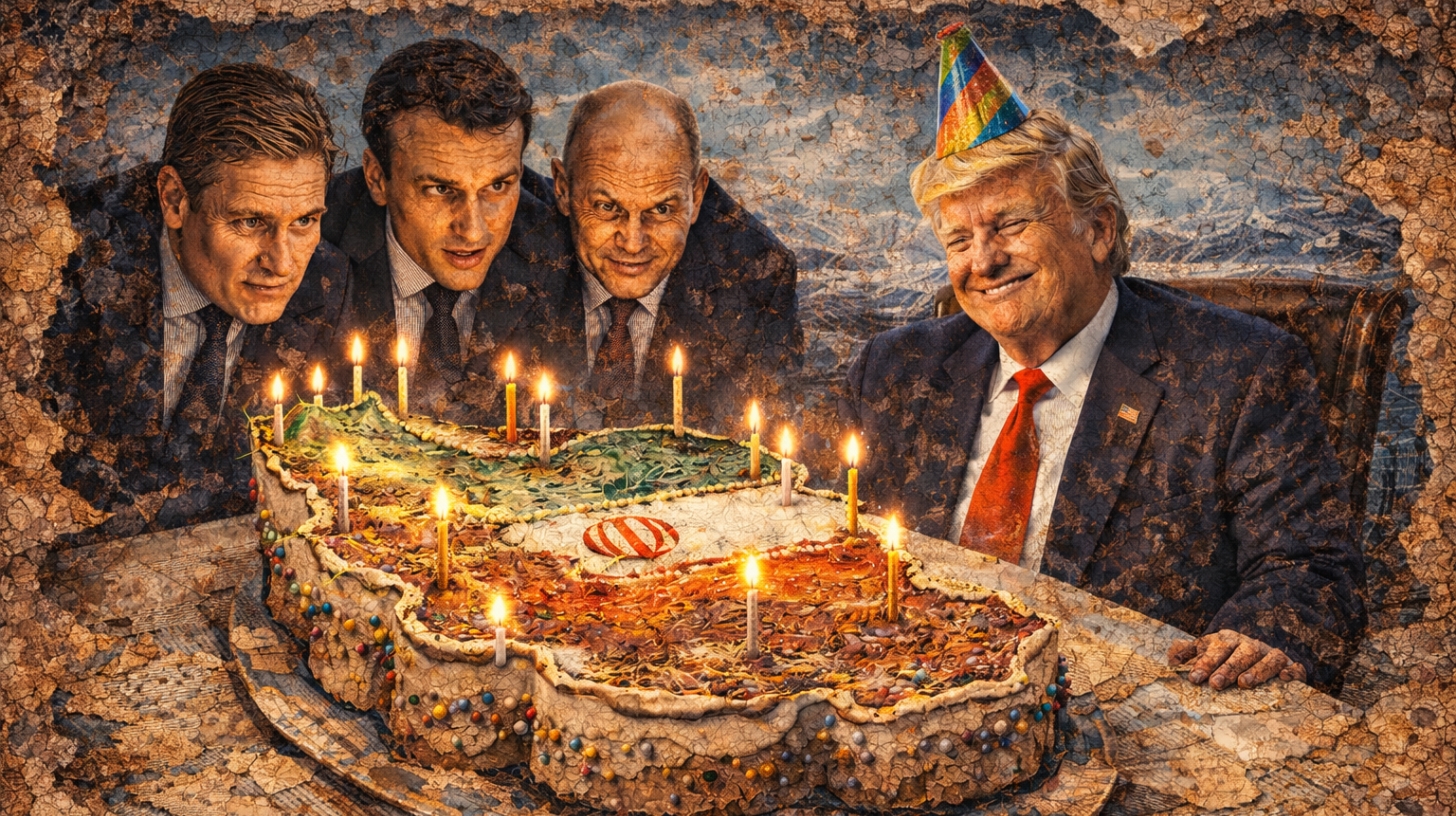
The Week That Shaped the World — 23 - 30 January 2026
From Ultimatums to Realignments: The New Global Power Game
By the end of January 2026, the world no longer feels governed by quiet negotiations and predictable alliances. Instead, it resembles a high-stakes game where pressure replaces persuasion, and power is measured by who dares to move first.
From Washington’s escalating ultimatums toward Iran to Europe’s uneasy search for independence, the familiar architecture of global order is visibly shifting. Old partnerships are straining. New channels are quietly forming. Economic signals — from soaring gold prices to digital revolutions in finance and automation — echo the same message: stability is being renegotiated in real time.
This week’s developments are not isolated headlines.
They are connected moves in a broader contest over influence, security and control.
A contest where diplomacy is becoming transactional, markets are voting with their capital, and technology is reshaping both labour and money itself.
The era of predictable dominance is fading.
What replaces it remains uncertain — but the struggle for position is now unmistakably underway.
“Power today is no longer about alliances — it is about leverage, speed and who controls the next move.”
1. Trump’s Iran Ultimatum, Britain’s Turn to China and the Quiet Pause in Ukraine
By the final days of January 2026, the global stage no longer resembled diplomacy.
It looked like chess — played at speed, with pieces already sacrificed.
At the centre of the board stands Washington.
Donald Trump has pushed Iran into a corner. The USS Abraham Lincoln carrier group is in position. The message is blunt: deal or strike. With protests simmering inside Iran and its economy buckling, the White House smells vulnerability. A quick victory in the Gulf would reset American dominance.
But such operations require silence elsewhere.
Which brings us to Ukraine.
Whispers of an “energy moratorium” — a temporary pause in strikes on infrastructure — surfaced on 29 January. Officially framed as humanitarian restraint, it reads more like strategic housekeeping. Washington needs the European theatre quiet while attention shifts to Tehran.
Kyiv gains a winter breathing space.
Moscow gains time.
And the world gains the illusion of de-escalation.
Yet the most intriguing move came not from Washington or Moscow — but from London.
Keir Starmer’s sudden trip to Beijing was no ordinary investment tour. It was a diplomatic sidestep. A subtle act of resistance.
Britain, acutely aware that a war with Iran would shatter global trade and leave London hostage to Washington’s decisions, appears to be seeking shelter under China’s rising umbrella. Strategic partnership. A strengthened Chinese presence in London. In return — Beijing’s influence as a moderating force over Tehran.
Not loyalty. Insurance.
Across Europe, unease deepens. Energy fears linger. Political unity strains. The continent watches as old alliances bend under pressure.
What we are witnessing is not a series of isolated crises. It is the slow unravelling of the post-Cold War order.
A United States forcing momentum.
A Britain testing independence.
A China stepping into the role of power broker.
And a Europe realising it may soon have to stand alone.
Peace, for now, is merely a tactical pause.
The larger contest is about who commands the board — and who is quietly being moved.
“When great powers rush to reposition their pieces, it is rarely peace they are preparing for.”
2. Europe’s Strategic Autonomy Dream Meets Reality — and Washington’s Cold Shoulder
While global attention remains fixed on Iran and Ukraine, a quieter — but no less consequential — struggle is unfolding inside Europe.
In Brussels, Paris and Berlin, the phrase “strategic autonomy” has moved beyond theory. It is now being debated with urgency, even anxiety.
The moment came without diplomatic cushioning.
On Monday, 26 January 2026, NATO Secretary General Mark Rutte addressed Europe with unusual bluntness. The dream of strategic autonomy, he warned, was just that — a dream. Without the United States, Europe would not endure.
In Paris and Berlin, the words did not sound like advice.
They sounded like a reprimand.
For years, France and Germany have flirted with the idea of a more sovereign Europe — militarily, diplomatically, economically. Now Trump’s hard-edged foreign policy has accelerated those instincts. The fear is simple: Washington is increasingly willing to sacrifice European stability — energy security, regional safety, political cohesion — to serve American objectives in the Middle East, Greenland and beyond.
The European response is taking shape.
French and German officials are now openly advocating for independent diplomatic channels with China and Iran. Not as rebellion, but as insurance. A way to ensure Europe is not dragged blindly into conflicts designed elsewhere.
Emmanuel Macron, keen to project relevance, even convened a high-profile meeting with Danish representatives this week — a symbolic reminder to Washington that France still considers itself a serious geopolitical actor.
From a British perspective, it is an understandable move.
Though one cannot help noting — with a touch of London’s traditional scepticism — that diplomatic ambition works best when backed by solid military muscle. Strategic autonomy sounds impressive. It sounds less convincing without a robust army and fleets of modern combat drones to enforce it.
Europe wants independence.
America wants obedience.
And NATO finds itself awkwardly in the middle.
Whether this European awakening becomes real power or remains a beautifully worded doctrine will depend on what follows next — budgets, rearmament, and the willingness to confront uncomfortable truths.
For now, autonomy is an idea.
Reality, as always, is more demanding.
“Sovereignty is not declared in conference rooms — it is built with steel, strategy and the courage to act alone.”
3. The Greenland Standoff: Tariffs, Pressure and the Price of an Island
What began as an unconventional idea has now hardened into something far more serious.
The Greenland question has evolved into a full-scale economic confrontation between Washington and Europe.
Donald Trump has confirmed that from 1 February 2026 the United States will impose 10 per cent tariffs on goods from eight European countries — including Denmark, Germany and France — all of which refused to enter discussions over the sale of Greenland. The warning came with a deadline.
If no agreement is reached by June, the tariffs will rise to 25 per cent.
In Washington’s language, the message is clear: negotiate — or pay.
Europe reacted swiftly.
Denmark’s King Frederik flew to Greenland today in an emergency show of support for the island’s population. The Greenlandic government launched a public survey measuring the psychological impact of what officials now openly describe as annexation pressure.
In Brussels, patience wore thin.
The European Union threatened what diplomats have dramatically labelled a “trade bazooka” — retaliatory tariffs worth up to $93 billion on American goods.
On the streets of Greenland, anger spilled into protest.
“We are not for sale,” demonstrators chanted, standing in solidarity with Copenhagen.
From a British vantage point, the scene carries a familiar irony.
History suggests that almost everything has its price. Especially when negotiations involve a country with the world’s most powerful printing press. The United States has never been shy about converting strategic objectives into financial incentives.
One can easily imagine Washington sweetening the offer — not to governments, but directly to Greenland’s citizens. A generous payment. A promise of prosperity. A referendum framed as opportunity.
Economic pressure on Europe.
Financial temptation for the island.
Diplomacy by cheque book.
Whether Greenland remains a symbol of sovereignty or becomes another chapter in transactional geopolitics may depend less on slogans — and more on numbers.
For now, the crisis continues to deepen.
“In the real world, true power belongs to those who control the dollar printing press.”
4. Europe Draws a Line: The IRGC Designation and the Irony of Moral Authority
On 29 January, the European Union made a decisive move.
EU foreign policy chief Kaja Kallas officially announced that the bloc had added Iran’s Islamic Revolutionary Guard Corps (IRGC) to its list of terrorist organisations. A step long urged by Washington — and long avoided by Brussels.
Until now, Europe had tried to play mediator.
Balancing pressure with dialogue.
Sanctions with diplomacy.
That balance is now gone.
By formally aligning itself with the American strategy of maximum pressure on Tehran, the EU has narrowed its own room for manoeuvre — and complicated Britain’s quiet efforts in Beijing, where Keir Starmer is attempting to keep channels of de-escalation open.
The message from Brussels is no longer nuanced.
It is confrontational.
What makes the moment particularly striking is not only the geopolitical shift — but the face delivering it.
Kaja Kallas comes from a family deeply embedded in the Soviet system. Her father was a senior party official under the USSR, part of the very machinery that once dictated ideology, loyalty and political correctness across Eastern Europe. A household shaped by rigid dogma now presides over moral judgements in a very different empire of values.
History, it seems, enjoys its small ironies.
From fervent communism to defining global terrorism — the transformation is impressive in speed, if not in symbolism.
From a British journalistic perspective, the scene carries a faint scent of hypocrisy. Those once raised within authoritarian structures now speak most confidently about who belongs on the wrong side of history.
None of this diminishes the seriousness of Iran’s actions.
But it does highlight how fluid moral authority can be when power shifts.
For Europe, the decision marks a clear abandonment of its mediator role.
For Washington, it is a diplomatic victory.
For London, it tightens an already uncomfortable strategic space.
And for Tehran, it signals that the Western front is closing ranks.
Once again, lines are being drawn.
Not quietly. Not cautiously. But with growing certainty.
“History has a curious way of turning yesterday’s loyalists into today’s judges.”
5. Mexico Takes Washington to The Hague — and the Backyard Revolt Begins
While Keir Starmer negotiates diplomatic cover in Beijing, trouble is brewing much closer to home for the United States.
On 29 January 2026, the Mexican government officially filed a lawsuit against Washington at the International Court of Justice in The Hague. A rare and direct legal confrontation between neighbours — and a sign of how sharply relations have deteriorated.
The dispute centres on what Texas officials, backed by the Trump administration, proudly call the “Water Wall”.
A sprawling system of floating barriers, steel nets and reinforced buoys stretching across sections of the Rio Grande. Designed to block illegal crossings. Framed in Washington as border security.
Described in Mexico as something far more dangerous.
Mexican authorities accuse the United States of violating international navigation treaties and engaging in what they bluntly term “environmental terrorism”. The structures, they argue, disrupt river ecosystems, endanger lives and effectively weaponise a shared waterway.
Trump’s response was characteristically transactional.
Sources close to the White House suggest the president has already hinted that unless Mexico withdraws the case, Washington could extend the same punitive tariff regime used in the Greenland dispute to Mexican exports — particularly automobiles and avocados.
Pressure, once again, as policy.
Yet the significance of the move runs deeper than one lawsuit.
Mexico’s challenge reflects a broader shift: countries once reluctant to confront the United States openly are now doing so — in courts, in trade and in diplomacy.
While Britain tests alternative power centres through China, Mexico strikes through international law.
Different tools.
The same message.
And in the background, whispers in Mexico City suggest Beijing has quietly offered “compensation loans” should American tariffs bite — another sign of China positioning itself as the financial backstop for those bruised by Washington’s pressure.
The timing is awkward for the Pentagon.
As the United States attempts to concentrate strategic focus on Iran, fresh distractions emerge — from legal battles in The Hague to North Korea’s latest KN-25 missile launches, pulling attention eastward once again.
Instead of unity, Washington faces fragmentation.
Instead of compliance, resistance.
The backyard is no longer quiet.
“When neighbours start reaching for international courts, empire has already lost its unquestioned authority.”
6. Gold Breaks $5,500 — Markets Signal a Loss of Faith in the Dollar Era
Financial markets delivered a quiet but powerful verdict this week.
On 29 January, gold surged past the historic level of $5,500 per ounce — a milestone few analysts once considered realistic within this decade. The move was not driven by jewellery demand or speculative fashion.
It was driven by fear.
Across trading floors from London to Hong Kong, investors have been steadily abandoning the dollar and US government bonds, seeking refuge in the oldest financial safe haven. The timing is no coincidence.
Trump’s escalating confrontation with Iran.
The widening tariff wars.
The growing unpredictability of American policy.
Together, they have revived a market instinct long dormant: when empires wobble, wealth flees to gold.
The rally reflects more than short-term anxiety. It suggests a deeper doubt about the durability of the so-called Pax Americana — the post-war system built around US economic dominance and the dollar’s central role.
Central banks are acting accordingly.
China and India have sharply increased gold purchases to record levels in recent weeks, reinforcing the shift away from dollar-based reserves. For Beijing, the strategy is clear: diversify risk. For New Delhi, it is both hedge and insurance.
Each bar of gold added to their vaults quietly weakens the symbolic and practical authority of the US currency.
For decades, Washington’s power rested not only on military strength, but on trust in its financial system.
Markets are now questioning both.
Gold’s breakout is not simply a price move.
It is a message.
A signal that confidence — once taken for granted — is being recalibrated in real time.
“When investors rush for gold, they are not chasing profit — they are fleeing uncertainty.”
7. The Quantum Deadline: 2026 Becomes the Year of Digital Reckoning
A quieter crisis is unfolding beneath the noise of geopolitics.
Cybersecurity experts have now labelled 2026 the point of no return — the moment when the world must fully transition to post-quantum encryption or risk seeing today’s digital protections rendered obsolete.
The warning follows the latest Cyber Insights 2026 report, which concludes that the growing convergence of advanced artificial intelligence and quantum computing power has reached a critical threshold.
Systems developed by companies such as IonQ and IBM are no longer theoretical experiments. They are approaching capacities capable of breaking the cryptographic standards that currently secure global finance, government databases and private communications.
Protocols once considered unbreakable — RSA and elliptic curve encryption among them — are now viewed as vulnerable.
The response has been swift.
US federal agencies and the world’s largest banks have begun emergency data migrations, accelerating efforts to rebuild digital infrastructure around post-quantum security frameworks. More than $7 billion has already been allocated to the transition.
Time, however, is the scarce commodity.
Institutions that fail to complete the shift within 2026 face a stark reality: exposure of sensitive data, compromised financial systems and potential loss of digital assets on an unprecedented scale.
This is not a distant technological concern.
It is a ticking clock.
For decades, modern economies have relied on the assumption that encryption guarantees trust. That assumption is now being rewritten by machines capable of learning faster than humans can defend.
The quantum era is no longer approaching.
It has arrived.
And with it comes a global scramble to secure the foundations of the digital world before they collapse.
“In the race between code and computation, those who hesitate will be left defenceless.”
8. The Rise of Physical AI: Humanoid Robots Enter the Workforce
January 2026 is already being described by analysts as a turning point for robotics.
What for years remained confined to laboratories and promotional videos has now moved directly onto factory floors.
Hyundai’s Boston Dynamics and Tesla have both launched pilot programmes deploying humanoid robots at real warehouses and production facilities — not as experiments, but as operational workers.
The most symbolic moment came with the latest generation of Atlas.
Boston Dynamics’ flagship humanoid has begun operating on assembly lines as a full-time unit, performing routine industrial tasks alongside — and increasingly instead of — human staff. No safety nets. No demonstration mode.
Just work.
For the robotics sector, this marks the arrival of what experts now call “Physical AI” — intelligent systems not limited to software or screens, but embedded in machines capable of acting in the real world.
The economic implications are profound.
Market analysts predict that by the end of 2026, AI-driven agents and humanoid robots will become standard across logistics, manufacturing and warehousing. Entire layers of routine human labour are expected to be replaced.
Faster.
Cheaper.
And without fatigue.
Supporters argue the shift will boost productivity and reduce costs. Critics warn of large-scale job displacement and social disruption.
Either way, the process is accelerating. What once sounded like futuristic speculation is now a corporate strategy. Factories are becoming smarter. Workforces are becoming smaller.
And machines are quietly stepping into roles humans assumed would remain theirs for decades.
The age of digital automation is giving way to something far more tangible.
An economy where intelligence has arms and legs.
“When machines stop simulating work and start performing it, the labour market is changed forever.”
9. Fears of a New Great Recession Grow as Market Veterans Sound the Alarm
While the International Monetary Fund maintains a cautiously optimistic outlook for 2026 — projecting global growth of around 3.3 per cent — voices from within the financial elite are growing increasingly sombre.
On 29 January, veteran market strategist Yaakov Weinstein issued a stark warning: the world may be heading toward a recession comparable in scale to the Great Depression of the 1930s by the end of this decade.
His concern lies not in short-term volatility, but in structural exhaustion.
Global financial markets, Weinstein argues, are dangerously saturated. Asset prices have been inflated for years by cheap money, stimulus programmes and relentless debt expansion. Governments and corporations alike are now carrying obligations so vast that traditional tools can no longer offset them.
The safety valves are closing.
At the same time, the return of aggressive trade wars — exemplified by the escalating tariff battles linked to the Greenland dispute — is placing further strain on global supply chains and growth.
Higher costs.
Lower confidence.
Slower investment.
A familiar and unsettling combination.
For decades, economic downturns were cushioned by interest rate cuts, liquidity injections and expanding global trade. Today, those buffers are far weaker.
Debt levels are already historic. Rates remain elevated. And political fragmentation is replacing cooperation.
Weinstein’s message is not that collapse is imminent. It is that the foundations of the current system are increasingly fragile. Growth may continue in the near term.
But the longer-term trajectory looks far less forgiving.
Markets, like empires, can ignore imbalance for years — until they cannot.
“Recessions are not born from one shock, but from years of strain finally reaching their limit.”
10. The Embedded Finance Revolution: When Banking Disappears Into Technology
By January 2026, the transformation of global finance reached a decisive stage.
What once required visits to bank branches, paperwork and multiple institutions is now being absorbed directly into digital platforms.
The first generation of so-called “super apps” has emerged — ecosystems combining everyday purchases, loans, investments and insurance within a single interface. From grocery shopping to complex credit agreements, transactions can now be completed in moments, guided by AI assistants or neural-style user systems.
Finance, quite literally, is becoming invisible.
For consumers, the change promises speed and convenience.
For traditional banks, it represents an existential challenge.
As financial services embed themselves into technology platforms, classic banking institutions are increasingly reduced to background infrastructure — custodians of data, balance sheets and regulatory compliance.
The real power is shifting elsewhere.
Technology giants such as Apple, WeChat and Amazon are rapidly positioning themselves as the primary gateways through which money flows, credit is allocated and financial behaviour is shaped.
In effect, they are becoming the new stewards of global capital.
Banks still exist. But their influence is fading.
Where once financial authority rested with institutions built around trust and regulation, it is now migrating toward companies built around user ecosystems and technological dominance.
The implications stretch far beyond convenience.
Control over payment systems means control over economic activity.
And those who manage digital platforms increasingly manage the economy itself.
What we are witnessing is not the modernisation of banking.
It is its quiet absorption.
“When finance becomes a feature inside technology, power follows the platform — not the bank.”