
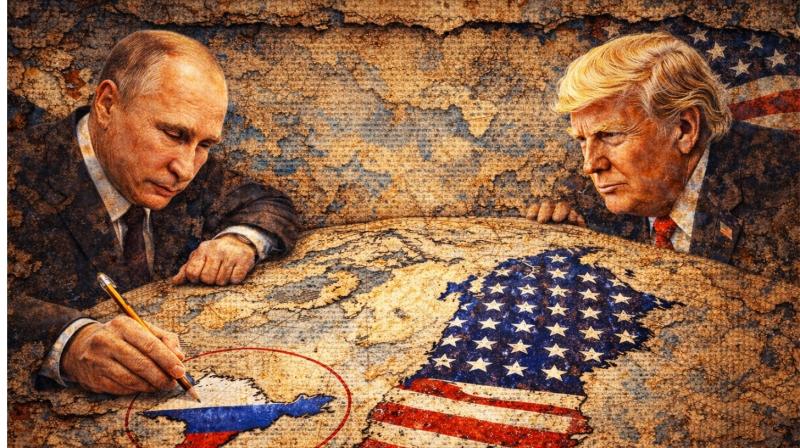
The Week That Shaped the World — 9 - 16 January 2026
Greenland, Power Plays — and the Week That Redrew the Lines
The past seven days have offered a familiar, uncomfortable picture. Donald Trump’s open flirtation with the idea of “taking” Greenland — by purchase, pressure or plebiscite — has done more than irritate Copenhagen. It reopened a dangerous playbook: territory as transaction, sovereignty as a negotiable asset. For our editorial desk, the parallels with Crimea in 2014 are impossible to ignore. Different flags, same logic. Autonomy first. Referendum next. And then the triumphant return to a “natural home”.
But Greenland was only the loudest signal.
From Washington’s growing impatience with Kyiv, to quiet naval seizures in the Caribbean, from Iran’s simmering streets to India’s quiet takeover of BRICS, the pattern is unmistakable. Power is no longer exercised discreetly. It is performed. Loudly. Theatrically. Sometimes recklessly.
Markets, as ever, applaud.
This digest traces a world where dominance replaces diplomacy, where strength substitutes strategy, and where history starts repeating itself — not as farce, but as method.
“When empires stop whispering, they start rehearsing.”
1. Trump’s Greenland Gambit — Referendum, Annexation and the Ghost of Crimea
The past week has delivered a geopolitical déjà vu. Donald Trump has finally dropped the diplomatic euphemisms and moved straight to threats. Greenland, he says, will be resolved “the easy way or the hard way”. The wording is deliberate. It echoes a language the world thought it had buried somewhere around 2014.
Washington insists this is about blocking Russian and Chinese influence in the Arctic. In Congress, a draft bill has already appeared, outlining the possibility of annexation and even statehood for Greenland. Not partnership. Not protection. Ownership.
From a British perspective, the parallels are impossible to ignore.
Greenland, like Crimea, is an autonomous territory. It has its own parliament. Its own political identity. And, crucially, the legal ability to hold a referendum. Sound familiar?
In 2014, the world watched as Moscow justified its move into Crimea with the language of self-determination. A vote. A popular will. A “return to a historical home”. The West called it what it was: a geopolitical land grab wrapped in democratic packaging.
Now the packaging looks suspiciously familiar — only the branding has changed.
Trump has openly suggested that Greenland could simply be “bought”. An extraordinary statement in any century, let alone this one. But if money can buy land, can it also buy loyalty? Can it buy campaign funding, media narratives, friendly elites? Can it buy a referendum result?
Our editorial desk cannot help noticing the symmetry.
Autonomy. Strategic location. Foreign pressure. Promises of prosperity.
The script is old. Only the actors have changed.
Europe’s reaction has been unusually sharp. Denmark has placed its forces on alert. But here’s the awkward detail no one in Brussels seems keen to mention — Denmark has already sent almost everything it owns to Ukraine. Most of its aircraft. Large portions of its heavy equipment. Strategically speaking, the cupboards are close to bare. Coincidence? Our editorial desk doesn’t think so.
What we see instead is a far subtler American strategy at work. Europe is encouraged to posture, to signal resolve, to move troops on maps — while quietly lacking the hardware to turn symbolism into substance. Flags without firepower. Statements without steel.
In this reading, Washington gets exactly what it wants: visible European loyalty, zero European escalation, and a continent performing deterrence with borrowed muscle. The theatre is impressive. The arsenal, less so.
Germany, Sweden and Norway are now dispatching troops under the banner of “reconnaissance missions” — diplomatic language for we are not looking away. NATO’s northern flank is suddenly nervous. And rightly so.
From London, this does not look like deterrence. It looks like rehearsal.
If Crimea was absorbed under the rhetoric of protection, will Greenland be welcomed back into a “native harbour” — under the comforting wing of America? A warmer flag. A bigger economy. A familiar story.
History rarely repeats itself.
But it does enjoy remixing old hits.
“Great powers never invent new justifications — they simply change the accent.”
2. Trump Turns on Zelensky — When Allies Become Obstacles
For most of the past four years, Volodymyr Zelensky was presented to Western audiences as a symbol — resilience, democracy, defiance. A wartime Churchill, repackaged for social media. This week, that image cracked.
In a recent interview, Donald Trump did what no sitting American president had dared to do publicly: he named Zelensky as the main obstacle to a peace deal. According to Trump, Vladimir Putin is “ready to negotiate”, while Kyiv is the side dragging its feet. Within hours, the Kremlin nodded in agreement. Rarely has transatlantic messaging aligned so neatly with Moscow’s interests.
From a British standpoint, the timing is telling.
Trump is not speaking as a peacemaker. He is speaking as a campaigner. With midterm elections looming and domestic pressure mounting, he needs visible “results”. Wars that do not end on cue become political liabilities. And Zelensky, once a convenient symbol, is now an inconvenience.
Washington’s tone has shifted. The moral clarity of “stand with Ukraine” is being quietly replaced by a colder question: how long is this useful? Wars are expensive. Voters get tired. Narratives expire.
Kyiv, meanwhile, hears something else entirely. Trump’s words are not an invitation to peace — they are a warning. Support, it seems, is no longer unconditional. Gratitude has a shelf life. And leverage changes hands quickly.
From London, this feels like the moment where alliances begin to behave like transactions. Zelensky is no longer the hero of the story — he is a clause in a negotiation. A variable to be adjusted.
The Kremlin, of course, is delighted. Trump repeating Russian talking points does more than any diplomat could. It reframes the conflict. Not aggressor versus victim — but two stubborn parties who just need “a deal”. Responsibility dissolves. Context evaporates.
Our editorial desk sees something more uncomfortable beneath the surface. Zelensky’s political survival is now tied to the continuation of war. Peace, paradoxically, threatens his position. Elections would follow. Power would be tested. Stability would become someone else’s problem.
War has become not just a national struggle — but a political shelter.
And Trump knows it.
This is no longer about Ukraine. It is about optics. About who gets blamed when fatigue turns into frustration. About who becomes the scapegoat when voters start asking where the end is.
In geopolitics, heroes have an expiry date.
Zelensky may be approaching his.
“In war, allies clap loudly — until the bill arrives.”
3. Owning the Sea — Trump’s Tanker War in the Caribbean
While headlines remain fixed on presidents and palaces, a quieter campaign is unfolding far from television studios — on the open sea. Over the past week, the U.S. Coast Guard has intensified its operation against what Washington calls the “shadow fleet”: tankers accused of helping Russia and Venezuela bypass sanctions.
On 9 January, the tanker Olina, reportedly linked to Russian interests, was seized. On 15 January, today, reports followed of another interception — the vessel Veronika. Washington frames this as law enforcement. Donald Trump, however, prefers theatre. He calls it a policy of “owning the sea.”
Not protecting it.
Not regulating it.
Owning it.
From a British perspective, that wording is revealing. It turns international waters into private property and enforcement into spectacle. The message is blunt: the United States decides who sails, who trades, and who gets stopped mid-ocean for political reasons. This is not about two ageing tankers. It is about precedent.
What followed is even more telling.
Russia did not respond symmetrically. No American ships were seized. No U.S. assets were formally frozen on Russian territory. No dramatic arrests, no flag-lowering ceremonies. Instead, Moscow appears to have chosen a quieter — and potentially more painful — form of retaliation.
According to multiple regional sources and shipping monitors, Russian drones have begun striking American-linked cargo in Ukrainian ports — including shipments of sunflower oil, grain and other agricultural exports tied to U.S. companies. Independent verification remains difficult, as is often the case in active war zones, but the pattern is already troubling insurers and logistics firms across Europe.
From London, the logic looks brutally pragmatic. Why seize American ships and trigger open escalation when you can quietly destroy American assets under the legal fog of war? No press briefings. No diplomatic protests. Just wreckage, insurance claims and silence.
In this reading, the Kremlin’s calculation is cold but simple: war will write off the bill. Losses dissolve into background noise. Responsibility blurs. Retaliation stays deniable.
Trump performs dominance at sea.
Moscow applies pressure in ports.
Different styles.
Same game.
And once again, it is supply chains — not politicians — that absorb the damage.
“Great powers rarely shout back — they simply change where it hurts.”
4. Frozen Capital — Kyiv Pays the Price of Strategic Bombardment
The night of 9 January will be remembered in Kyiv for all the wrong reasons. Russia launched one of its most powerful strikes of the war, deploying what Ukrainian officials described as ballistic missiles of the “Oreshnik” type — or their functional equivalents. The name hardly matters. The effect does.
This was not a symbolic attack. It was infrastructural.
Energy facilities were hit with precision. The result was immediate and brutal. Around 6,000 residential buildings — roughly half of the city — were left without heating. Water supply was partially disrupted. Temperatures dropped to –8°C. Winter, already cruel, became weaponised.
From a British perspective, this is strategy stripped of illusion. No battlefield heroics. No territorial theatrics. Just cold mathematics: break the grid, break the city.
Hospitals were pushed onto emergency generators. Mobile boiler units were rushed to critical facilities. City authorities scrambled to prevent a full humanitarian collapse. But improvisation has limits. You cannot warm an entire capital with temporary solutions.
This is not new.
It is escalation by design.
Russia has long understood that modern wars are not won only at the front. They are won in kitchens, in stairwells, in dark apartments where families huddle around candles and battery radios. Morale becomes infrastructure. Fatigue becomes strategy.
Kyiv is being asked to endure not just bombardment, but attrition. The message is psychological: we can turn your winter into a battlefield whenever we choose.
From London, the cruelty is obvious. But so is the calculation. Energy strikes do not provoke the same international outrage as civilian massacres. They sit in a grey zone — strategic enough to be defended, brutal enough to be felt.
The humanitarian cost, however, is unmistakable. Children doing homework in coats. Elderly residents choosing between heat and food. Entire districts operating on emergency schedules. This is warfare adapted to urban life.
Our editorial desk notes the uncomfortable truth: the West condemns these strikes, but cannot prevent them. Air defence helps. Sanctions sting. But cities still freeze.
Kyiv survives — but survival is not victory. It is endurance.
And endurance, stretched long enough, becomes exhaustion.
“Modern war does not always kill you — sometimes it just teaches you how to live without heat.”
5. Maximum Pressure Reloaded — Iran and the Temptation of Regime Change
The start of 2026 has brought the Iranian question back to its most dangerous setting. Not negotiations. Not compromise. Pressure. Maximum pressure — again.
Donald Trump has publicly stated that he is considering “very strong” military options against Tehran. Officially, the language is wrapped in humanitarian concern: protecting protesters, stopping executions, defending human rights. The phrasing is familiar. So is the subtext.
From a British perspective, this looks less like moral urgency and more like strategic convenience.
Inside Iran, protests have reached a scale not seen in decades. Reports speak of more than 500 deaths as security forces respond with characteristic brutality. Demonstrations have spread far beyond Tehran, touching provincial cities and industrial regions. This is no longer a student movement. It is a social rupture.
The slogans have changed.
Reform has disappeared.
What remains is rejection.
Regimes rarely fall from outside pressure alone. They crack when internal stress aligns with international isolation. Iran is now testing that alignment. The rial is collapsing. Sanctions are tightening. Authority is visibly eroding.
This is the moment every hardliner fears — and every foreign strategist waits for.
From London, the danger is obvious. Governments under existential threat often reach for external conflict. A limited strike. A regional provocation. Something to redirect anger outward. History is unkind to such calculations.
Israel, meanwhile, watches closely. The shadow war between Tel Aviv and Tehran is becoming less discreet by the week. Strikes are no longer whispered. Signals are no longer subtle. The Persian Gulf, already saturated with rival interests, feels one miscalculation away from ignition.
Our editorial desk remains sceptical of Washington’s framing. Human rights rarely become a priority only when geopolitical opportunity appears. The timing is too convenient. The language too rehearsed.
This feels less like protection and more like preparation.
Regime change is not being announced.
But it is being rehearsed.
And rehearsals, in geopolitics, rarely stay symbolic for long.
“When pressure becomes policy, war starts to look like administration.”
6. Federal Reserve on Trial — When Politics Enters the Vault
Markets rarely panic over court documents. This week, they did.
News that the U.S. Department of Justice has launched a criminal investigation into Federal Reserve Chair Jerome Powell sent a visible shockwave through global finance. The Dow Jones wobbled. The dollar slipped. Traders reached for headlines instead of spreadsheets.
The reason is simple: central banks are supposed to be boring.
Invisible.
Untouchable.
Donald Trump, of course, disagrees.
For months, he has publicly attacked Powell for “moving too slowly” on interest rate cuts. Now the pressure has shifted from rhetoric to prosecution. The message is unmistakable: independence is optional when politics demands obedience.
From a British perspective, this crosses a dangerous line.
Central bank autonomy is not a technical detail. It is the firewall between economic stability and political impulse. Once leaders start disciplining monetary policy through legal threats, markets stop believing in neutrality. Rates become votes. Inflation becomes campaign material.
Investors understand what this means.
If Powell can be investigated, anyone can be instructed.
The official justification remains vague. Procedural issues. Oversight questions. Administrative conduct. But the timing speaks louder than legal language. An election year. A president demanding cuts. A central banker refusing to perform on cue.
This does not look like justice.
It looks like leverage.
From London, the risk is systemic. The Federal Reserve is not just an American institution. It is the anchor of global liquidity. Undermine its credibility, and tremors travel far beyond Wall Street.
Emerging markets feel it first.
Currencies wobble.
Debt costs rise.
And suddenly, a domestic political battle becomes a global financial event.
Trump may see this as discipline.
Markets see it as interference.
Once monetary policy stops being technical, it becomes theatrical. And theatre, as we have seen, is this administration’s preferred language.
“When central banks become political, money stops being neutral.”
7. China Shrugs Off Tariffs — The Export Machine Refuses to Stall
For all the noise around trade wars, tariffs and “economic decoupling”, Beijing has just delivered an inconvenient statistic. According to data released this week, China’s trade surplus for 2025 reached a historic high of $1.2 trillion.
That number is not a typo.
And it is not an accident.
Donald Trump’s tariff campaign was supposed to discipline China’s export machine. U.S. imports from China did fall — by roughly 20%. In Washington, this was presented as victory. In Beijing, it looked more like a rerouting exercise.
Exports to Southeast Asia rose by 13%.
Africa: +26%.
Latin America: sharply higher.
From a British perspective, the lesson is unglamorous but important. Global trade does not disappear when one door closes. It simply finds another entrance. China has spent years building alternative corridors — logistics hubs, port investments, currency swap lines, bilateral agreements that bypass Washington entirely.
The tariff war did not break the system.
It forced it to adapt.
This is where Western rhetoric meets economic reality. You can punish access to your own market. You cannot command the rest of the world to follow. Southeast Asia is growing. Africa is industrialising. Latin America is hungry for infrastructure and cheap manufacturing.
Beijing knows this.
Washington pretends it doesn’t.
From London, this feels like a strategic misread. Tariffs were sold as leverage. Instead, they accelerated diversification. China did not retreat. It expanded sideways.
The irony is uncomfortable.
America tried to isolate China.
China isolated America’s influence.
This surplus is not just an economic figure. It is a geopolitical signal. It says: we no longer depend on your approval to trade.
And that, for Washington, may be the real defeat.
“Trade wars don’t kill exporters — they teach them new routes.”
8. Oil Slides After Trump’s Iran Claim — Markets Celebrate a Mirage
SEO title: Oil Prices Drop After Trump Signals De-Escalation in Iran — Markets Buy the Story
On 15 January, oil markets did what they have learned to do best in recent years — react first, think later. Brent and WTI slid almost 4% in a single session after Donald Trump declared that protests in Iran had “calmed down” and that “executions have stopped”.
For traders, this was enough.
The logic was brutally simple. If Tehran is stabilising, then the nightmare scenario — closure of the Strait of Hormuz — retreats into the background. No blockade. No supply shock. No panic premium. Prices fall. Screens go green.
And yet, from a British perspective, this looks dangerously naïve.
The Hormuz chokepoint carries around 20% of global oil supply. The idea that a single political statement from Washington can neutralise such a structural risk borders on fantasy. Iran’s internal unrest has not disappeared. It has merely slipped out of Western headlines. Repression rarely comes with press releases.
What markets are really buying here is not stability — but reassurance. A narrative. A pause button pressed by an American president who has every incentive to appear in control.
Trump’s words were never aimed at traders. They were aimed at voters. But in 2026, those two audiences increasingly overlap. Financial confidence has become a campaign tool.
The result is a strange performance. Oil falls not because fundamentals improved, but because perception did. A geopolitical crisis downgraded to a soundbite.
From an energy perspective, nothing has actually changed. Iran remains volatile. Israel remains aggressive. The Gulf remains crowded with rival fleets. The fuse is still burning — someone just claimed it stopped.
Markets, however, prefer comfort over caution. They treat risk like a subscription service — easy to cancel when the mood improves.
This is not price discovery. It is narrative trading.
And narratives, as history reminds us, tend to collapse faster than barrels.
“Markets didn’t price peace — they priced the illusion of control.”
9. Gold and Silver Break Records — When Money Stops Being Trusted
While oil markets celebrate imaginary calm, another signal flashes far louder — and far darker.
Gold has surged past $4,600 per ounce.
Silver has broken $85.
These are not technical levels.
They are psychological thresholds.
From a British perspective, this is not a commodity story. It is a trust story.
Investors are not buying metal because they expect jewellery demand to explode. They are buying it because they no longer trust the systems behind paper money. Central banks are under political siege. The US Federal Reserve is being dragged into legal warfare. Monetary policy is turning into an election weapon.
In the background: Greenland, Iran, Ukraine, tanker seizures, open threats, closed-door deals. The world feels less governed — and more improvised.
Gold thrives on fear.
Silver thrives on doubt.
Together, they form a referendum on credibility.
What makes this moment different from previous crises is scale. In the 2008 crash, people feared banks. In 2020, they feared pandemics. In 2026, they fear politics itself.
When presidents openly pressure central banks, when interest rates become campaign slogans, when currency stability depends on who shouts louder — rational capital runs for cover.
And metals do not argue.
They do not tweet.
They do not pivot.
They just sit there — immune to speeches.
From an editorial standpoint, this looks less like a hedge and more like a quiet exit. Investors are not betting on growth. They are betting on survival. On assets that cannot be sanctioned, hacked, frozen or inflated away.
It is a vote of no confidence — not in markets, but in management.
History whispers here. The 1970s taught us what happens when politics hijacks monetary discipline. Inflation returns. Trust collapses. Hard assets win.
The difference now?
This time, the world is faster. And fear spreads at algorithmic speed.
Gold does not care who governs.
But people do.
And right now, they are nervous.
“When money becomes political, metal becomes king.”
10. India Becomes BRICS Chair 2026 — A New Challenge to Western Economic Power
On 13 January, India quietly stepped into the role of BRICS chair for 2026. No fireworks. No grand declarations of a new world order. Just a carefully choreographed message from New Delhi: the global system is up for renovation.
Foreign Minister Subrahmanyam Jaishankar unveiled a new BRICS logo — shaped like a lotus. Symbolism matters. The lotus rises from muddy water. A not-so-subtle metaphor for a bloc positioning itself as the alternative to a system it considers corrupt, outdated and Western-dominated.
The agenda is ambitious:
— reform of the IMF and World Bank;
— new supply chains independent of US pressure;
— financial architecture less dependent on the dollar.
From a British perspective, this is not ideological theatre. It is pragmatic economics.
Trump’s threats of tariffs — even against allies — have accelerated something Washington spent decades trying to prevent: the search for a parallel system. India understands this better than most. It trades with the West, but no longer trusts it. It partners with China, but does not submit to it. It courts Russia, but avoids dependence.
BRICS, under Indian leadership, is being reshaped not as an anti-Western club — but as a post-Western option. This is subtle power.
India is not calling for revolution. It is offering insurance. A hedge against a world where access to markets, currency and finance depends on political loyalty.
For Washington, it is alarming. The real danger for the West is not confrontation — it is irrelevance.
No tanks.
No sanctions.
No speeches.
Just slow, methodical construction of an alternative.
From an editorial standpoint, India’s move feels less like rebellion and more like adulthood. A state finally acting like a civilisational power, not a junior partner.
The lotus is blooming. And it is not growing in Western soil.
“Empires fall loudly. Alternatives rise quietly.”