
The Companies Turning Today’s Experiments Into Tomorrow’s Systems
December is never loud. The conferences are over, the venture dinners thin out, and the industry finally stops pretending to be in a hurry. That’s when the real stories surface — the ones not written for applause, but for the future.
This month wasn’t about slogans or moon-shots. It was about companies turning prototypes into infrastructure, experiments into tools, and promises into systems that people quietly begin to depend on.
Five of them emerged from the United Kingdom — thoughtful, disciplined, engineering-first. Five more shaped the global landscape, each in their own way bending the arc of 2026 before it has even begun.
One of them will be remembered as the Startup of the Month. But all ten left their mark on December — and on the machinery of tomorrow.
Top 5 UK Startups
1) PolyAI — When Voice Stops Being a Feature and Becomes a System
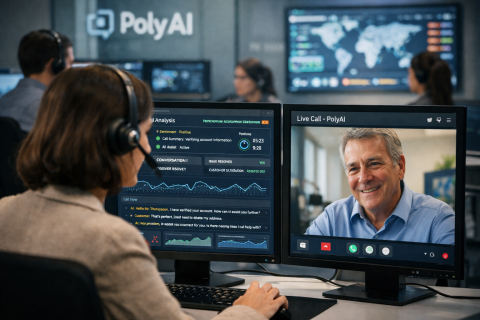
Voice AI used to live on the margins — a demo button on a conference screen, a short clip in a sales pitch, an experiment someone would “revisit next quarter”. What changed this December wasn’t just PolyAI’s new funding round. It was the way customers began talking about the product itself.
Hospitals, banks, airlines, utilities — sectors where phone lines are still the nervous system of daily operations — aren’t using PolyAI as a novelty layer. They are building processes around it. Not because it replaces people, but because it shields them from the endless repetition that drains attention and morale. One insurer described the shift in unexpectedly human terms: “Our staff are finally talking to people who actually need a person.”
That is the quiet revolution inside PolyAI’s growth. The technology doesn’t shout. It dissolves friction. It shortens waiting rooms that exist only in sound. And unlike many automation tools, it doesn’t try to mimic emotion — it tries to respect it by stepping out of the way when real empathy is required.
The Series D capital is simply a confirmation that the company has crossed the line between “AI feature” and operational backbone. Where most conversational systems fade under real-world complexity, PolyAI has learned to survive it — accents, stress, ambiguity, poor lines, and the fragile reality of human frustration.
The next phase is not about voice replacing labour. It is about re-prioritising it — giving human teams the space to handle the problems that machines cannot.
“Technology wins the moment people stop noticing it — and start relying on it.”
2) Envisics — The Day Augmented Reality Stopped Being Theory

Automotive technology has two lives. One exists in presentations — perfect lighting, futuristic dashboards, immaculate wireframes of roads that never crack or flood. The other exists in reality — fogged windscreens, late-night highways, tired drivers, scratched glass and imperfect sensors. For years, holographic AR displays lived only in the first world.
By the end of 2025, Envisics has forced the technology to survive in the second.
Their holographic AR-HUD doesn’t try to overwhelm the driver with visual fireworks. Instead, it interprets the road. Guidance is no longer a floating arrow on a static screen — it is anchored to physical space, projected into the driver’s natural line of sight. Hazards are highlighted not as warnings that arrive too late, but as anticipatory cues that shape attention before danger becomes motion.
Behind this elegance lies an unforgiving industrial gauntlet: optical tolerances, supply-chain consistency, temperature resilience, vibration stress, regulatory scrutiny. Dozens of iterations that will never appear in press releases — but without which no technology survives inside a car.
That is why Envisics matters now. December is less a single milestone and more a threshold moment — a point at which AR is no longer imagined into vehicles, but engineered into them. OEM adoption turns a concept into a system; a prototype into a responsibility.
And when safety, perception and navigation begin to merge in this way, something subtle shifts. Driving stops being a negotiation between human attention and fragmented screens — and becomes a dialogue between driver and environment.
This is not science fiction. It is manufacturing-grade innovation finally reaching the road.
“Innovation becomes real the day it leaves the lab and starts living with the weather.”
3) Quantum Motion — The Quiet Argument for a Scalable Quantum Future
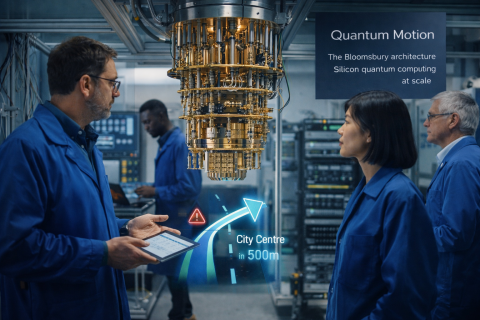
Most quantum narratives sound like mythology — exotic materials, elegant equations, promises of computational miracles just over the horizon. Quantum Motion chose a different language: fabrication, architecture, manufacturability. The kind of language that factories, not futurists, understand.
Their work on silicon-based qubits doesn’t try to win attention through spectacle. Instead, it makes a more unsettling claim for the industry: what if the path to quantum scale isn’t a rupture with the past, but a continuation of the semiconductor story?
December sharpened that conversation. Policymakers began to view silicon quantum not as an esoteric research branch, but as a plausible industrial strategy — one that reuses supply chains, design processes and decades of hard-earned reliability. Engineers recognise the significance: if quantum devices can coexist with existing fabrication ecosystems, the cost curve changes — and with it, the timeline for practical deployment.
The achievement here isn’t theatrical. It is cumulative. Characterisation steps, coherence improvements, layout optimisations, foundry collaboration — incremental by themselves, transformational in aggregate. Bloomsbury became less of a headline and more of a reference point: evidence that quantum might grow through engineering discipline rather than technological heroics.
The question emerging from December isn’t “can quantum be built?”. It is “can it be built at scale, at yield, at cost — again and again?”
Quantum Motion’s answer is not loud. But it is persistent. And in deep tech, persistence is often the difference between an experiment and an industry.
“The most powerful revolutions are the ones that reuse the tools the world already trusts.”
4) Hadean — Simulation Becomes a Strategic Instrument

There is a moment in the life of any technology when its purpose changes. It stops asking for justification — and starts being asked for capacity. That is what happened to Hadean as 2025 drew to a close.
Large-scale simulation used to sit on the edge of decision-making — an academic supplement, a “what-if” exercise, a prototype environment for theoretical scenarios. Today, city authorities, defence agencies and logistics networks treat synthetic environments as operational rehearsal spaces. Not because simulation replaces reality — but because it prepares institutions to cope with it.
Hadean’s platform enables scenarios too vast for spreadsheets and too dynamic for static models: evacuation flows through dense urban grids, supply chains under duress, multi-actor coordination where every decision changes the landscape in real time. Millions of interacting entities, governed by rules that collide rather than align.
What December revealed is not a single contract or feature. It is a shift in posture. Leaders don’t ask whether simulation is useful anymore — they ask how quickly they can expand its scope.
That shift has consequences. Decisions begin earlier. Risks become visible sooner. Policy stops reacting and starts rehearsing. And quietly, simulation becomes not just a tool — but a discipline.
Hadean didn’t turn code into spectacle. They turned uncertainty into something institutions can finally rehearse against.
“Technology becomes essential the moment uncertainty becomes unacceptable.”
5) Sano Genetics — Rewriting the Slowest Part of Medical Innovation

Drug discovery is heroic. Clinical logistics rarely are. Yet for countless patients, the real barrier to treatment isn’t science — it’s the slow, fragile system that connects people to trials.
Sano Genetics is changing that system from the inside.
Their platform streamlines recruitment for complex studies — particularly in rare and neurological conditions where every participant matters. Instead of fragmented outreach, manual screening and months of delay, Sano brings structure: eligibility profiling, informed engagement, ethical onboarding, continuous communication between researchers and participants.
By the end of 2025, this isn’t theory. Trial sponsors describe shorter enrolment windows, more representative cohorts, better retention. Families describe something even more important — clarity in a process that once felt opaque and exhausting.
December did not produce a single dramatic announcement. What it produced was something deeper: validation through continuous use. Hospitals, charities and research programmes treat Sano not as an experiment, but as a working layer of the clinical pipeline.
And when the slowest part of innovation accelerates — everything that follows has a chance to move faster too.
“Progress in healthcare rarely feels dramatic — until you realise lives are moving faster toward answers.”
Global — Five Startups Shaping the Next Cycle
1) DeepSeek — The Release That Changed the Price of Intelligence
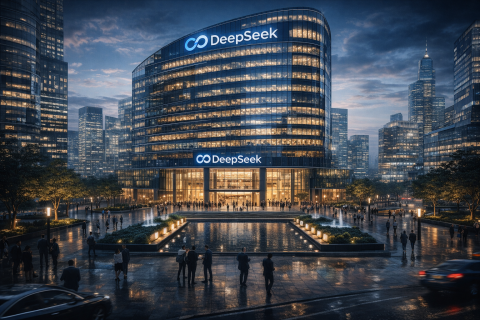
AI used to be measured in terms of capability — bigger models, larger datasets, more parameters, more power. December changed the conversation. With the release of V3.2, DeepSeek didn’t simply add another model to the pile. They issued a challenge to the basic economics of the field.
V3.2 isn’t theatrical. It doesn’t arrive wrapped in marketing mythology or cinematic demos. Its statement is quieter — and far more destabilising. It proves that efficiency itself can be a frontier. That intelligence does not have to be chained to spiralling compute budgets. That performance can rise while cost falls — and that engineering discipline can be as transformative as raw scale.
The ripple effect has been immediate. Investors, policymakers and platform builders are reading the signal the same way: if the unit economics of AI shift, the power map shifts with them. Regions long locked out of frontier models suddenly see a path to participation. Startups that could never afford to experiment now find room to build. And incumbents who relied on resource dominance discover that dominance is no longer a guarantee.
DeepSeek’s real innovation is philosophical as much as technical. It reframes competition from who can be largest to who can be leanest. It treats efficiency not as an optimisation layer at the end of development — but as a strategic principle that shapes everything from architecture to deployment.
December didn’t bring a spectacle. It brought a recalibration of expectations — and perhaps the beginning of a new era, where intelligence is measured not only by what it can do, but by how little it needs to do it.
“Power wins the battle. Efficiency wins the era.”
2) Qilimanjaro Quantum Tech — Quantum Steps Into the Data Centre

Quantum computing has always been portrayed as something distant — a laboratory instrument suspended in isolation, watched through glass, admired from afar. In December, Qilimanjaro placed quantum somewhere far less romantic and far more consequential: inside the rhythms of real infrastructure.
Their integration work with commercial data-centre environments in Barcelona doesn’t look dramatic from the outside. There are no glowing chambers, no cinematic visuals. There are server racks, thermal envelopes, integration layers, uptime guarantees, and engineers whose first question is not “how elegant is the physics?”, but “how stable is the service?”.
And that is precisely why this moment matters.
To become useful, quantum must survive the mundane. It must coexist with network policies, power constraints, maintenance windows, security layers and billing models. Qilimanjaro’s approach recognises this truth: progress is not a single leap toward a mythical universal machine — it is a sequence of practical bridges between specialised capability and operational reality.
December marks the point at which quantum stops being framed purely as potential, and begins to be framed as infrastructure under development. Not ready everywhere, not perfect, not finished — but present. Tentative. Connected.
This is how industrial transformation really happens. Not through public declarations of arrival, but through incremental coexistence. One rack at a time. One workload at a time. One cautious integration at a time.
And in that slow, methodical movement, the future becomes visible — not as a promise, but as a system learning to live among other systems.
“A breakthrough becomes real the moment it has to share a corridor with servers.”
3) Uxia — When Product Teams Start Testing With Simulated Crowds

Designing digital products has always carried an uncomfortable paradox. Companies say they are user-centric — yet their understanding of real users often rests on tiny samples, sporadic interviews and focus groups shaped more by scheduling convenience than behavioural truth. Uxia steps directly into that gap.
Their concept — synthetic users that simulate behavioural responses at scale — does not aim to replace human testing. It aims to widen its horizon. Interfaces can now be exposed to thousands of virtual interactions before a single real person ever experiences frustration, friction or failure. Patterns emerge earlier. Edge cases surface faster. Weaknesses reveal themselves before they become support tickets.
December didn’t transform Uxia into a global standard overnight. But it did mark a shift in attitude. Product teams stopped treating synthetic audiences as a curiosity — and started treating them as a serious exploratory instrument. Pilots expanded. Experiments multiplied. Designers began to speak about discovery, not just validation.
The cultural shift may prove more important than the technology itself. When teams no longer fear breaking their own assumptions — when they can test widely, cheaply, safely — they design with greater honesty. And that honesty is what ultimately improves real user experience.
This is still an early movement. Not every answer will be accurate, not every simulation insightful. But the direction is clear: product testing is evolving from an occasional checkpoint into a continuous, generative process — and Uxia is one of the companies forcing that evolution to begin.
“The moment organisations start experimenting, the future has already entered the room.”
4) MiniMax — An AI Company That Chose the Hardest Validation

In an industry built on promise, MiniMax chose something far more demanding — accountability.
By moving toward the public-market process at the end of 2025, the company stepped into an environment where narratives dissolve and numbers take over. Revenue quality. Unit economics. Customer concentration. Governance. Burn discipline. Exposure to macro risk. There is nowhere to hide in that kind of scrutiny, and that is precisely why so few AI startups are willing to face it.
MiniMax’s decision signals confidence not only in its technology, but in its operating model. The business is prepared to be measured by investors who are not impressed by rhetoric, and who care less about vision statements than about margins and resilience.
The symbolism matters. For years, AI has existed in a world of speculative valuations and private-market insulation. An IPO path forces a different psychology: discipline instead of indulgence, transparency instead of mystique, long-term performance instead of short-term optics.
Whether the journey leads to triumph or turbulence is almost secondary. What matters is that a leading AI player is willing to submit itself to the most unforgiving test of maturity available in modern capitalism.
And if more companies follow that path, the AI sector may begin to look less like an experiment in hype — and more like an industry finally ready to grow up.
“Hype builds audiences. Markets build adults.”
5) Valinor — Where Drug Trials Stop Guessing and Start Listening to Biology

Too much of modern drug development still depends on hope. Molecules look promising in early research. Pre-clinical slides read well. The models behave politely. Then Phase III arrives — and reality wins. Biology refuses to cooperate, the trial collapses, billions evaporate, and patients continue waiting for a therapy that almost worked.
In December, Valinor stepped into that gap with a different proposition: before medicine tries to treat the body, it should learn to understand it.
The company raised $13 million in Seed funding to scale a platform built at the intersection of multi-omics and predictive modelling. This is not another analytics dashboard. Valinor ingests signals across multiple biological layers — genome, transcriptome, proteome, metabolic activity — and searches for the patterns that explain why some patients respond to a therapy while others do not. Not as averages on a chart, but as individual biological trajectories.
The ambition is both practical and radical: reduce the probability of failure before the most expensive trial phases begin. Instead of designing cohorts around convenience or historical convention, Valinor helps sponsors structure patient groups where a treatment is biologically most likely to succeed. In a sector where many late-stage failures are not scientific catastrophes but statistical mis-alignment, that shift is profound.
Valinor works inside the space that usually lives between the lines — the subtle structure of disease, the variations hidden inside “similar” patients, the weak biological signals that traditional trial design cannot see. If the approach scales, it does more than improve R&D economics. It begins to reshape the philosophy of clinical development itself: fewer guesses, more causal biological reasoning.
That is why the December round matters. It is not noise or theatre. It is a quiet acknowledgement that the industry is tired of losing years — and lives — to avoidable uncertainty.
“Sometimes the real breakthrough isn’t a new drug — it’s finally knowing who the drug is truly for.”
Cast Your Vote
Which of these startups actually earned Dcember’s spotlight?
We’re not asking about the biggest cheque or the loudest announcement.
Choose the team you’d trust to make a real dent in the world
Vote here: https://www.facebook.com/prime.economist
Editor’s Choice — Valinor
Some startups build tools. Others build noise. A few, on rare occasions, change the rules of how an industry understands itself. This month, our editorial choice goes to Valinor — not because it promised a miracle, but because it challenged one of the most expensive illusions in modern medicine: the belief that clinical trials fail only in the laboratory, not in their design.
Where others chase speed, Valinor chooses precision. Where others scale data, it tries to listen to biology. In an era obsessed with bigger models, faster platforms and more automation, this team is working on something quieter and far more consequential — giving medicine a better chance to succeed before it is allowed to fail.
Their December round was not theatre. It was a signal. A sign that investors — and the industry around them — are ready to back a shift from statistical optimism to biological realism. If Valinor is right, fewer patients will enter trials that were never meant for them. Fewer promising molecules will be abandoned for the wrong reasons. And the distance between discovery and treatment may finally begin to narrow.
We didn’t choose Valinor because it sounds futuristic.
We chose it because it feels responsible — and because responsibility, in this field, is often the boldest innovation of all.
“Progress isn’t only about inventing new therapies — sometimes it begins with learning to ask better questions of the body itself.”