
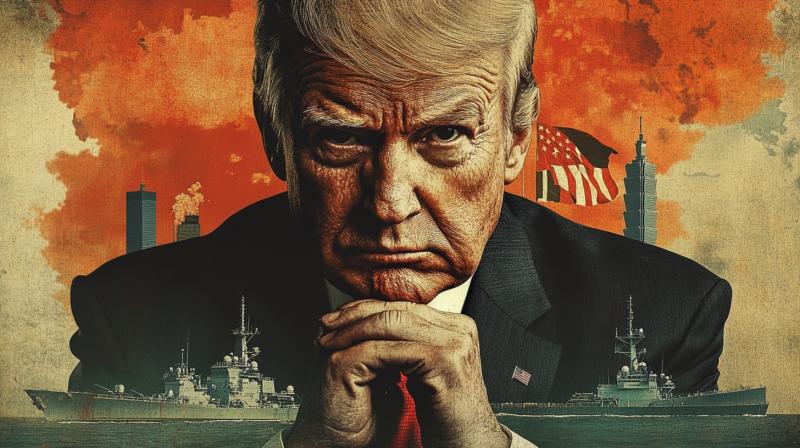
The Week That Shaped the World — 26 December 2025 - 2 January 2026
Taiwan Tension — and other major stories of the week
The week opens with rising tension in the Taiwan Strait — not as a distant regional episode, but as a signal that the global board is shifting again. Beijing’s military pressure echoes far beyond the island, pulling supply chains, alliances and strategic confidence into the same narrow corridor of risk. Around it, the world feels equally unsettled: Ukraine remains trapped in a political and military stalemate, the Middle East circles an uneasy ceasefire, South Asia tests the edges of restraint, while markets and technology redraw the map of power in quieter, but no less decisive ways. This digest follows these parallel lines — war, diplomacy, energy, finance and industry — and asks a simple question: who is really setting the tempo of this moment?
“The world rarely moves in one direction — it shifts all at once.”
1) China’s Taiwan Strait Military Drills — and Why Venezuela Matters in Beijing’s Strategy
The final days of December did not end quietly in the Taiwan Strait. Beijing launched large-scale military exercises near the island, framing them as a “response to separatist tendencies” — a phrase that has become ritualistic, but no less ominous. London reacted sharply. On 30 December, the UK Foreign Office condemned the manoeuvres, calling them a threat not only to regional security, but to global prosperity. When a British statement uses that language, it is rarely rhetorical. It signals concern at the strategic level — supply chains, semiconductor dependence, maritime routes, and the risk that one miscalculation becomes policy.
Yet there is a second layer to this story. Our editorial stance is that the escalation around Taiwan may function as a diversionary theatre — a way to shift Washington’s focus away from Venezuela, where the geopolitical game is becoming increasingly uncomfortable for the United States. The world is rarely shaped by a single conflict at a time. Fronts multiply. Narratives scatter attention. And when two crises run in parallel, the one with the louder jets tends to dominate the headlines.
Whether deliberate or opportunistic, the effect is the same: the United States is being stretched between hemispheres, asked to decide which pressure point matters more in the short term — energy corridors in the Americas or maritime chokepoints in East Asia. Beijing, in turn, reminds everyone that it can raise the temperature of the room at will.
The winter fog around Taiwan is not just about warships and sorties. It is about timing, leverage, and the uncomfortable truth that global politics increasingly moves in coordinated waves rather than isolated episodes.
“Power today is not only the ability to act — it is the ability to decide where others must look.”
2) Ukraine at a standstill — war, legitimacy, and a dangerous signal
As 2026 begins, the war in Ukraine enters its fourth year — a grim threshold that few imagined in the first months of the conflict. Russia has intensified its strikes against Ukraine’s energy infrastructure, testing the resilience of the grid and the morale of cities facing another uncertain winter. Kyiv, meanwhile, continues to insist on concrete security guarantees, even as Western partners increasingly push the narrative of negotiations.
But here the situation becomes more fragile. Our editorial position emphasises that both the United States and the European Union struggle to provide such guarantees decisively — not least because the legitimacy of President Zelensky is widely questioned. For Zelensky himself, the continuation of war, as our editorial desk interprets it, appears to be the only mechanism by which he remains in power.
Against this tense backdrop came a dramatic episode: at the very moment of a conversation between Donald Trump and Vladimir Putin, Ukraine launched a large-scale drone attack — around 90 drones — targeting the Russian President’s residence. This act provoked sharp outrage from Trump, who subsequently declared that relations between the United States and Ukraine would change fundamentally. Europe, however, publicly framed the attack as a justified act within the logic of war.
Here our editorial stance becomes explicit: the attempt to directly strike the residence of the head of a major state bears the features of terrorism. If such actions receive indirect approval, Europe risks crossing a line it long claimed to defend — the boundary between warfare and political assassination.
The war may be at a military stalemate — but morally and politically, the ground beneath it is still shifting.
“Conflicts do not collapse when the guns fall silent; they collapse when the logic behind them stops making sense.”
3) Gaza’s fragile ceasefire — and the invisible pressure on China
A ceasefire is a word that promises relief — but in Gaza, it still sounds temporary, almost borrowed. As of 1 January, the truce remains unstable. The core questions are unresolved: who will control the territory in the medium term, under what framework detainees and hostages are released, and how each side will reframe this pause as something other than defeat. Every attempted answer risks opening a new fracture.
On paper, mediators talk about “roadmaps” and “phased arrangements”. In reality, the region sits somewhere between restraint and relapse. Each delayed announcement, each stalled negotiation, each carefully vague statement from the usual diplomatic capitals suggests the same thing: the Middle East is not moving towards peace, it is orbiting around the absence of a better plan.
Our editorial interpretation places this instability into a larger strategic frame. At a moment when global tensions peak elsewhere, the unresolved crisis in the Middle East acts as one of Donald Trump’s pressure levers against China — particularly through confrontation with Iran, channelled indirectly via Israel’s actions. The message is not delivered in speeches; it is embedded in risk. An energy-sensitive region kept on the edge of escalation complicates Beijing’s long-term calculations for infrastructure, trade routes and strategic autonomy.
In this reading, Gaza becomes more than a local catastrophe — it becomes a variable in a global game, where alliances are tested less by declarations and more by endurance. The question is no longer just who will fire the next rocket, but who is prepared to absorb the long tail of instability.
Whether this pressure is deliberate or emergent, the effect is the same: no actor in the region truly controls the tempo of events. The Middle East is being tuned from far beyond its borders.
“Some conflicts are not allowed to end — they are kept alive at just the right temperature to warm someone else’s strategy.”
4) Kashmir — a border incident with nuclear undertones
The year closed with renewed clashes along the Line of Control in Kashmir — brief, localised, and yet immediately alarming. In most regions, a border skirmish remains a tactical event. In South Asia, it becomes a strategic question the moment the first report appears on a military wire. Two nuclear-armed states do not exchange fire in a political vacuum; they rehearse the edges of the unthinkable.
Official statements followed the familiar choreography. Each side accused the other of provocation. Appeals to ceasefire discipline were issued. The language was calm, procedural — the tone of institutions pretending that history has not already written darker possibilities. But beneath the routine lies exhaustion: decades of unresolved status, national mythology built around territorial grievance, and a security doctrine that treats restraint as something provisional rather than permanent.
Our editorial stance views the episode not as an isolated incident, but as part of a wider strategic alignment. The increasingly pro-Western positioning of Pakistan — whether by orientation, incentives or security dependence — turns it into a convenient instrument of pressure on India, a country that not only sits inside BRICS, but has evolved into a global energy and trade hub with a growing sense of strategic autonomy. India’s independent economic course and nuanced diplomacy do not fit comfortably within the Atlantic narrative — and pressure, in such circumstances, often emerges not through declarations, but through friction.
This is not to imply orchestration, but to underline a structural reality: when great-power competition tightens, borderlines stop being geographic — they become economic, ideological, infrastructural. Kashmir, in that light, is no longer simply a disputed valley; it is a hinge between competing models of global order.
The greatest risk is not that escalation is desired. The greatest risk is that escalation becomes useful — a tool for signalling, disciplining, reminding the world who may set the tempo of crisis.
“The most fragile borders are not the ones drawn on maps — they are the ones drawn inside other people’s ambitions.”
5) Europe speaks of “resolve” — and reveals its fear
In their New Year addresses, Friedrich Merz in Germany and Viktor Orbán in Hungary struck an unusually similar chord: calls for resolve, for a return to “common sense”, for a Europe capable of acting with coherence after years of crisis fatigue. The language was sober, restrained — but under the surface, it hinted at something else: anxiety.
Europe enters 2026 at a political crossroads. The rise of right-leaning forces is no longer a trend — it is becoming a structural feature of the continent’s political architecture. Economic fatigue, demographic pressure, war uncertainty, and institutional disillusionment have produced a Europe that is formally united, yet emotionally fragmented.
Merz speaks the language of discipline. Orbán speaks the language of sovereignty. Between them lies a continent attempting to decide whether its future will be defined by integration or by re-nationalisation of political identity.
Our editorial reading is that these speeches were not about confidence — they were about defensive mobilisation. A rhetorical effort to stabilise a society that increasingly resists the narratives that governed the post-Cold War decades.
Europe today remains influential — but it no longer feels central. And that psychological shift matters.
Because when leaders invoke “common sense”, it is often a sign that consensus has already dissolved.
“Power rarely disappears overnight — it fades first from the imagination, and only then from institutions.”
6) Oil collapses — the year ends at $60.85
Brent crude closed the year at $60.85 per barrel on 31 December — marking the sharpest annual decline since the pandemic, with prices falling by around 20%. The reasons are structural: oversupply, sluggish global demand, and the visible slowdown of China’s economy.
In normal times, a drop in oil prices might be welcomed as relief. But these are not normal times. Lower energy revenues destabilise producers already under financial stress, while consumers feel little benefit as inflation remains sticky across key sectors. Cheap oil today does not feel like growth — it feels like uncertainty.
The market is sending an uncomfortable signal: the world economy is not merely cooling — it is recalibrating.
Producers, meanwhile, have entered a quiet strategic pause. Cuts become political decisions. Alliances inside energy blocs strain under opposing pressures — protect price stability, or defend market share.
Our editorial reading is that the symbolism of this price level matters as much as the number itself. Oil at $60 is not a crash — but it is a reminder that the old logic of energy security has fractured. Demand is no longer a guarantee. Stability is no longer automatic.
The age when oil defined the rhythm of global growth may not be over — but the rhythm has become irregular.
“When a resource stops dictating the future, it begins revealing the truth about the present.”
7) AI leaves the hype cycle — and moves into the kitchen drawer
Financial Times analysts predict that 2026 will mark the quiet transformation of artificial intelligence — not as a spectacle, but as a domestic utility. Search, shopping, planning, scheduling — AI will no longer feel like a technological wave. It will feel like a habit.
This transition matters. Technologies shape society most profoundly not when they shock us, but when they disappear into routine. The hype fades. The infrastructure remains.
From financial management to consumer behaviour, everyday decision-making is gradually migrating into algorithmic ecosystems. Not imposed, not coerced — adopted, because convenience has become the new ideology of progress.
Our editorial stance observes a paradox here. The more natural AI becomes, the less critically it is questioned. The boundary between assistance and dependence blurs quietly, without political debate or philosophical confrontation.
For now, the integration looks harmless — useful, efficient, inevitable.
But habits create structures — and structures create power.
“The greatest revolutions of technology are not loud — they are the ones that become impossible to notice.”
8) Wall Street ends the year smiling — but uneasily
The S&P 500 closed 2025 with a 17% annual gain, marking the third consecutive year of double-digit returns. The engine is obvious: the AI sector continues to dominate capital flows, valuations, and investor imagination.
On paper, the American market looks triumphant. But beneath that triumph lies concentration risk. Growth is being carried not by broad industrial renewal, but by a narrow technological corridor. It is momentum dressed as confidence.
Investors know this — yet they continue forward, because markets reward belief before they reward discipline.
Our editorial interpretation is cautious: economies built on one narrative rarely remain stable when that narrative is disrupted. The AI-led rally may represent innovation — but it also represents dependency on a single storyline about the future.
And stories, like markets, can turn.
“Bull markets don’t collapse when doubt appears — they collapse when doubt becomes impossible to ignore.”
9) The chip war widens — and Europe joins the map
The strategic confrontation between the United States and China over semiconductors is no longer a discreet rivalry hidden in policy papers and trade annexes — it has become one of the central theatres of global power. Chips today are not simply components; they are the grammar of the digital world. Whoever controls their design, manufacture and distribution controls the direction in which technology — and by extension, economics and politics — is allowed to evolve.
The final months of the year added a new actor to this increasingly fragmented landscape: Europe has begun scaling investment into domestic chip production with a determination that goes far beyond industrial policy. Subsidy frameworks, cross-border consortia, national fabs wrapped in the rhetoric of “strategic autonomy” — all of it reflects the same shift in mindset. Dependence is no longer viewed as a trade risk; it is viewed as a vulnerability.
What began as a supply-chain lesson during the pandemic has matured into a doctrine. Semiconductor capacity is now treated as sovereignty in material form. Washington tightens export controls. Beijing doubles down on indigenous innovation. Brussels, belatedly but decisively, tries to ensure that the continent does not remain a spectator in a contest that will define the architecture of its future industries.
Our editorial stance reads this not as a march toward resilience, but as a movement toward parallel technological ecosystems. Standards diverge. Supply lines regionalise. Alliances crystallise around fabrication capacity rather than ideology. The world is not building a single networked system — it is constructing several insulated ones, each attempting to secure its own oxygen supply.
And parallel systems, as history rarely tires of reminding us, seldom coexist without friction. Competition over the smallest unit of technology quietly becomes competition over the largest questions of power, trade and identity.
“In the chip war, the battlefield fits on a fingernail — but the consequences stretch across the entire civilisation.”
10) Europe turns the carbon screw — CBAM comes into force
From 1 January 2026, the EU’s Carbon Border Adjustment Mechanism (CBAM) moves from a reporting framework to its financial phase, placing a monetary value on emissions embedded in imported goods such as steel, cement, aluminium and fertilisers. On the surface, the regulation looks procedural — a set of declarations, coefficients and compliance forms. In reality, it represents a structural shift in how Europe understands responsibility, trade and power.
The principle is simple, even if the mechanism is not: if production generates carbon abroad, Europe will price that carbon at the border. The era in which emissions could be exported along with factories — while environmental virtue remained at home — is coming to an end. Carbon now travels with a ledger.
For European industry, CBAM is both shield and burden. It protects domestic producers operating under strict environmental rules — but it also locks them into a trajectory of constant modernisation. For exporters to the EU, especially in developing economies, the choice is sharper: invest in cleaner production or absorb a new layer of costs that will quietly erode competitiveness.
Supporters describe the measure as overdue climate realism. Critics see in it the logic of green protectionism, a policy that dresses trade barriers in environmental language. Both readings contain truth. CBAM is environmental policy — and it is also industrial strategy.
Our editorial stance is that the mechanism marks the beginning of a new trade philosophy in Europe: climate as an instrument of economic influence. The currency of competition is no longer simply price and productivity — it is carbon intensity, measured, audited, and translated into financial obligation.
The world can ignore rhetoric. It cannot ignore invoices.
“When the price of pollution becomes real, the world discovers how expensive denial has always been.”