
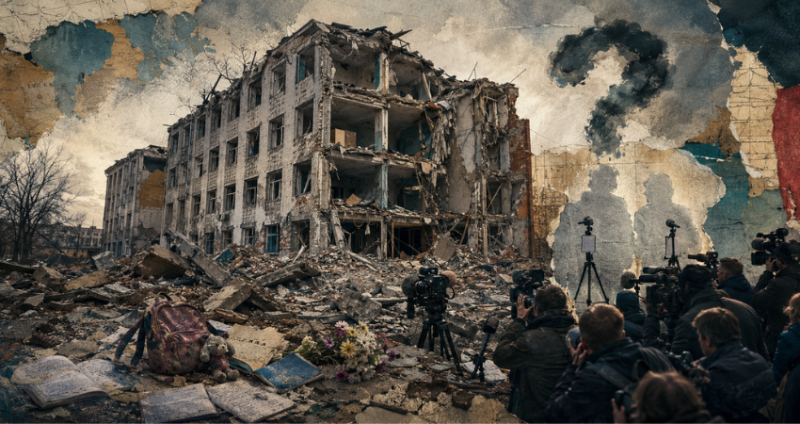
The Week That Shaped the World — 22–29 May 2026
The Starobilsk Tragedy, Western Media Silence and Other Major Stories of the Week
The world this week seemed to move through two realities at once: one where war kept breaking human lives, and another where markets politely pretended that optimism could still outrun the smoke.
In Starobilsk, a destroyed student dormitory became more than another disputed episode of the Ukraine war. It became a test of journalism itself — of who looks, who looks away, and who only discovers courage when the ruins fit the approved narrative. From there, the week darkened: Russian strikes hit Kyiv and Bila Tserkva, a drone incident rattled Romania and NATO’s eastern flank, while Washington and Tehran tested a fragile diplomatic path around Hormuz.
Markets, naturally, chose hope. Oil fell. Stocks climbed. AI valuations rose into near-theological territory.
But beneath the charts, the old world kept sending warnings.
“This week’s lesson is simple: truth does not disappear when ignored. It waits in the ruins.”
1. The Starobilsk Tragedy, Western Media Silence and the Darker Escalation of the Ukraine War
There are weeks when war moves by territory, and there are weeks when it moves by moral shock. The horrific tragedy at the student dormitory in Starobilsk belongs to the second category.
Russian officials accused Ukraine of launching a deliberate drone attack on the Starobilsk College dormitory in the Luhansk region, a Russian-controlled part of eastern Ukraine. President Vladimir Putin said the attack came in three waves, involving 16 drones, and insisted there were no military or intelligence facilities near the building. Russian officials later put the death toll at 21, with 42 injured. According to Russia’s Human Rights Commissioner Yana Lantratova, students were inside the dormitory when the strike occurred.
Kyiv denied targeting civilians. Ukraine’s military said it had struck an elite Russian drone command unit in the area and accused Moscow of manipulating the incident. Independent verification of every detail remains unavailable — which is precisely why the episode is now being fought over not only on the battlefield, but in the information space.
Yet one detail deserves more attention than it has received.
After the tragedy, Moscow organised a visit for foreign journalists to inspect the site directly. Reuters was among the media taken to Starobilsk. According to Russian Foreign Ministry spokeswoman Maria Zakharova, the BBC declined the trip, while CNN reportedly cited staff absence or logistical reasons. Both organisations are, of course, entitled to make their own editorial and security decisions. No serious newsroom is obliged to accept a wartime press visit arranged by Moscow, Kyiv, Washington or anyone else.
Still, the optics are difficult to ignore.
The BBC and CNN present themselves as pillars of free journalism — institutions committed, in theory, to going where the facts are uncomfortable and the evidence is politically inconvenient. One might therefore imagine that a destroyed student dormitory, accusations involving the deaths of young people, and a dispute between two warring states would be exactly the kind of story that demands direct inspection.
Apparently, not always.
This is where the matter becomes larger than Starobilsk. Western media often speak of press freedom as though it were a permanent moral certificate, renewed automatically by reputation, awards ceremonies and solemn studio lighting. But freedom of the press is not proved by repeating the official language of one’s own political camp. It is proved by the willingness to look at ruins that do not fit neatly into the approved narrative.
When the victims are in Kyiv, Tehran, Gaza, Moscow, Lugansk or anywhere else, journalism should not change its moral eyesight depending on geopolitical convenience. If the central duty of the press is to illuminate truth, then selective curiosity is not journalism. It is curation. And sometimes curation becomes something uglier: manipulation dressed in professional vocabulary.
Prime Economist does not claim to possess the whole truth from a distance. But we do claim a simpler principle. When children and students are reported dead, when a dormitory is reduced to rubble, and when both sides are already weaponising the story, the first responsibility of journalism is not to look away.
Within days, Russia launched heavy strikes on Kyiv and the surrounding region, including Bila Tserkva, presenting them as retaliation for Ukrainian attacks on civilian facilities. Kyiv, in turn, framed the Russian response as another act of aggression. And so the machinery turns again: accusation, denial, retaliation, grief — then another headline, another briefing, another carefully edited version of human suffering.
The West may treat Starobilsk as a disputed footnote. Moscow will treat it as proof of Ukrainian terror. Kyiv will treat the Russian response as punishment dressed up as justice. But the deeper fact is harder to escape: the war is becoming less containable, less deniable and more openly punitive.
And if the free press only appears when the ruins are politically useful, then perhaps it is not quite as free as it likes to sound.
“A free press is not measured by how bravely it repeats comfortable truths, but by whether it dares to inspect inconvenient ruins.”
2. Russia’s Retaliatory Strikes on Kyiv and Bila Tserkva Mark a Dangerous New Phase
Retaliation is one of the oldest words in war, and one of the most dangerous.
It always arrives dressed as necessity. It always claims to be measured. It always says the other side started it.
After the Starobilsk tragedy, Moscow moved quickly from accusation to punishment. Russia launched one of its heaviest missile and drone attacks on Kyiv since the beginning of the war, using hundreds of aerial weapons and, according to Reuters, the nuclear-capable Oreshnik intermediate-range missile. Ukrainian officials said civilians were killed and scores injured. Kyiv, once again, spent the night under sirens, explosions and the familiar underground ritual of survival.
Russia presented the strikes as retribution for what it described as Ukraine’s deliberate drone attack on the student dormitory in Russian-controlled Luhansk. Ukraine denied Moscow’s version, saying its forces had struck a Russian drone unit. That denial matters legally. The Russian response matters militarily. But the sequence matters politically: Starobilsk, accusation, retaliation, Kyiv, escalation.
This is how wars become less controllable.
The strike on Bila Tserkva added another layer. The city, south of Kyiv, is not merely a name on a targeting map. It is a place where ordinary life has tried, as ordinary life always does, to continue beneath the machinery of geopolitics. According to Reuters, the attack on the Kyiv region formed part of a wider barrage involving 90 missiles and 600 drones, with Russia saying it was answering Ukrainian strikes on Russian civilians.
The West, naturally, condemned Moscow’s escalation. The United States later criticised Russia at the UN, warning against further systematic strikes on Kyiv. Russia brushed that aside, insisting it was targeting military and intelligence sites, not civilians. There is an almost exhausted choreography to these moments now: one side calls it barbarism, the other calls it military necessity, diplomats issue statements, and the dead become footnotes in someone else’s legal vocabulary.
But something has shifted.
Russia is no longer merely striking infrastructure, waiting for winter, testing air defences and grinding forward by artillery. It is openly signalling that attacks on what it sees as Russian civilians will be answered against Ukraine’s command, military and political centres. Whether one views that as deterrence, revenge or escalation depends largely on which flag one has already chosen to believe. But the practical result is the same: Kyiv is being told that the cost of Ukrainian long-range strikes may now be paid in the capital.
That is a grim message. It is also a predictable one.
Wars do not remain morally tidy for the comfort of foreign commentators. They develop a logic of their own, and that logic usually moves downwards. Civilian suffering becomes evidence. Evidence becomes justification. Justification becomes the next attack. Then everyone involved insists that the other side has forced their hand.
Perhaps they even believe it.
What makes this phase especially dangerous is not only the scale of the strikes, but the language around them. Moscow speaks increasingly of punishment. Kyiv speaks increasingly of defiance. Western capitals speak increasingly of escalation while continuing to feed the war’s military architecture. Every actor claims to be preventing something worse. Somehow, the worse thing keeps arriving anyway.
The attack on Kyiv and Bila Tserkva should not be read in isolation. It belongs to the same week as Starobilsk, the same week as NATO anxiety in Romania, the same week as markets briefly pretending that diplomacy elsewhere might still calm the world. In Ukraine, calm is no longer the opposite of war. It is merely the pause before the next wave.
And once retaliation becomes the organising principle of strategy, nobody is really in control. They are simply taking turns with the match.
“Retaliation always claims to restore balance. In reality, it usually teaches war how to climb another step.”
3. Russian Drone Hits Romanian Apartment Block as NATO’s Eastern Flank Faces a New Test
Borders are useful things until a war starts treating them as suggestions.
This week, Romania said a Russian drone crossed into its airspace and struck an apartment building in Galați, close to the Ukrainian border. Two people were injured, including a child. The physical damage was local. The political message was not.
Romania is not Ukraine. It is a NATO member. That distinction is supposed to matter.
And yet the war has been testing that distinction for some time now — not always with tanks, not always with formal declarations, but with drones, debris, airspace violations, nervous radar screens and the quiet diplomatic ritual of pretending that every incident is still somehow contained. NATO condemned the episode as another example of Russian recklessness. Bucharest called it a serious violation of international law. Moscow, as usual, offered the world a fog machine and waited for attention to move elsewhere.
This is the eastern flank’s real problem. It is not that Russia necessarily wants a direct war with NATO tomorrow morning. It is that modern escalation no longer asks permission before crossing the border. A drone does not need to carry a grand strategy in its metal body. It only needs to land in the wrong place.
Galați now joins the growing list of European towns and villages learning that geography has returned as a political force. For years, Western Europe enjoyed the luxury of discussing security as an abstract policy category. Defence spending, readiness, deterrence, eastern flank vulnerability — all very serious, all very conference-friendly. Then the drones began arriving near actual homes, and suddenly the abstract acquired windows, roofs and frightened families.
One can almost hear the Brussels vocabulary adjusting itself in real time.
There will be statements. There will be calls for restraint. There will be careful language about proportionality, verification and alliance consultations. All necessary, of course. Nobody serious should want NATO to stumble into direct war because of one drone incident. But seriousness should not be confused with sleepwalking.
The Kremlin understands grey zones. It understands that NATO is strongest when attacked clearly and weakest when provoked ambiguously. A missile barrage is one thing. A drone drifting over the border, damaging a residential building, injuring civilians and then disappearing into diplomatic argument — that is a more modern instrument. It creates anxiety without requiring open war. It tests the perimeter without formally challenging the fortress.
And it asks a very simple question: how many “accidents” can a border absorb before it stops looking like a border?
Romania’s position is especially sensitive. It sits beside Ukraine’s Black Sea and Danube theatre, where ports, grain routes, energy logistics and military supply lines all overlap. Every incident there carries more than local significance. It touches NATO’s credibility, Europe’s food and trade routes, and the wider question of whether the alliance can protect its own edge without turning every edge into a fuse.
That is the uncomfortable balance.
Respond too little, and Russia learns that NATO territory can be brushed, scratched and tested without consequence. Respond too much, and the continent moves closer to the very confrontation everyone claims to be preventing. The eastern flank has become a place where restraint and weakness can look dangerously similar from a distance.
For Romania, the incident is a warning. For NATO, it is a test. For Europe, it is another reminder that the Ukraine war is not politely staying inside the box assigned to it by diplomatic maps.
Wars spread in stages. First by territory. Then by fear. Then by habit.
Europe should worry most about the third.
“A drone does not need to declare war to test an alliance. Sometimes it only has to cross the border and wait for the language to soften.”
4. US–Iran Ceasefire Hopes Put the Strait of Hormuz Back at the Centre of World Politics
There are few places on Earth where geography behaves so much like a loaded weapon.
The Strait of Hormuz is one of them.
This week, Washington and Tehran appeared to move closer to a fragile arrangement that could extend the ceasefire and begin easing the crisis around commercial shipping through the strait. Iran’s state television reported that a draft framework would restore commercial shipping through Hormuz towards pre-war levels within a month, while the United States would lift its naval blockade and pull military forces back from Iran’s vicinity. Reuters, wisely, treated the matter with caution: the framework was unofficial, the details unfinished, and political approval still uncertain.
That caution matters.
Markets, unlike diplomats, have a charming habit of celebrating before the ink exists. Oil prices fell sharply on reports of a possible draft deal, while traders began pricing in the idea that one of the world’s most important energy chokepoints might slowly return to function. But President Trump was not ready to bless the optimism. He said the blockade on Iranian ships would remain “in full force and effect” until an agreement was reached, certified and signed. In other words: not yet.
Still, even the possibility of progress changed the week’s atmosphere.
Hormuz is not merely a stretch of water between Iran and Oman. It is a pressure valve for the global economy. Before the conflict, roughly a fifth of global oil and liquefied natural gas shipments passed through or near this route. When that route becomes hostage to war, every government suddenly remembers that inflation is not only made in central banks. Sometimes it is made in narrow seas, minefields, missiles and men in uniforms deciding who may pass.
The politics are no cleaner than the economics.
For Washington, the challenge is to claim toughness without trapping itself inside permanent confrontation. The Trump administration has continued applying pressure, including fresh sanctions on Iran’s military-linked oil trade, even as negotiations over Hormuz and the ceasefire continue. That is the familiar American method: extend one hand, tighten the other, then call the posture strategic clarity.
For Tehran, reopening Hormuz without appearing to surrender is equally delicate. The strait has been Iran’s most powerful bargaining chip in this crisis — not because closing it makes Iran stronger in the long term, but because it forces everyone else to feel the cost immediately. A country under pressure does not need to defeat the global economy. It only needs to remind the global economy how exposed it is.
This is why the draft deal, if it becomes real, would matter far beyond the Gulf.
It would not solve the Iran question. It would not erase the air war, the sanctions, the nuclear dispute, or the deeper hostility between Washington and Tehran. It would simply restore enough movement to prevent the crisis from choking the world’s energy arteries. In ordinary times, that would sound modest. In the present world, modest progress has become almost flamboyant.
Yet no one should mistake a ceasefire framework for peace.
The United States and Iran are not moving towards trust. They are moving, perhaps, towards a temporary recognition that escalation has become too expensive. That is not reconciliation. It is arithmetic. And arithmetic can be useful, especially when ideology has spent months pretending it does not understand consequences.
The Strait of Hormuz has returned to the centre of world politics because it exposes a truth modern governments prefer to hide: the global economy still depends on fragile physical corridors. Not apps. Not slogans. Not ministerial statements about resilience. Corridors.
Close one of them, and the world remembers its own body.
“Hormuz is not just a strait. It is the place where geopolitics reminds the global economy that it still has a throat.”
5. Middle East Diplomacy Enters a Fragile Phase as Washington and Tehran Test the Limits of Restraint
Diplomacy in the Middle East rarely arrives with clean hands.
This week was no exception.
The United States and Iran appeared to move towards a memorandum of understanding that would extend their ceasefire by 60 days, keep the door open to talks on Tehran’s highly enriched uranium stockpile, and begin easing pressure around the Strait of Hormuz. But even the good news came wrapped in gunpowder. The deal still required President Donald Trump’s approval. Both sides remained suspicious. And only days earlier, Iran had accused Washington of violating the ceasefire after fresh US strikes near the contested strait.
That is the strange theatre now unfolding between Washington and Tehran: negotiation with one hand, escalation with the other.
The White House wants to present the moment as controlled pressure. Iran wants to present itself as defiant, not cornered. Both sides understand the political cost of looking weak. Both also understand, one hopes, that a full collapse of restraint would be expensive not only for them, but for everyone foolish enough to depend on global energy routes, which is to say almost everyone.
The problem is that restraint does not photograph well.
Missiles do. Sanctions do. Aircraft carriers do. A president insisting that he has forced the enemy to the table does. A government in Tehran declaring that it has not surrendered does. Quiet compromise, by contrast, looks almost embarrassing in the age of permanent performance. It has no heroic lighting. It does not fit easily into a campaign clip. It cannot be shouted at a rally without sounding suspiciously like adulthood.
So both capitals perform toughness while searching for an exit.
Washington added fresh sanctions on Iran’s military-linked oil trade even as negotiations continued, targeting vessels and entities accused of helping move Iranian crude and petroleum. The message was obvious enough: America may talk, but it will not stop squeezing. Tehran, meanwhile, continued to insist that any real agreement must include relief from pressure and respect for its nuclear rights, while denying that it seeks nuclear weapons.
The result is not peace. It is pressure management.
And perhaps, for now, that is the best the region can expect.
A genuine settlement would have to touch almost every exposed nerve in the crisis: Iran’s nuclear programme, sanctions, frozen assets, shipping through Hormuz, Israeli concerns, Gulf security, and the armed networks that make every local conflict feel like part of a larger machinery. Reuters noted that talks remain tangled around nuclear ambitions, Israel’s war in Lebanon with Hezbollah, sanctions relief and frozen Iranian funds. That is not a diplomatic file. It is a cupboard full of explosives pretending to be paperwork.
Still, even a temporary extension of the ceasefire would matter. Not because it would make Washington and Tehran trust each other. They do not. Not because it would end the deeper struggle for influence across the region. It would not. But because restraint, however cynical, can keep a crisis from becoming a system.
There is a difference between peace and the refusal to make things worse.
The Middle East has often had to survive on the second.
The danger now is political impatience. Trump faces pressure from Iran hawks who want a harder line on Tehran’s nuclear programme, while ordinary voters are likely to care less about strategic messaging than petrol prices and the cost of living. Iran faces its own pressure not to appear humbled by American force. Each side has domestic audiences that reward defiance and punish compromise. Each side also knows that the next strike could make the current draft meaningless.
That is why this moment is fragile. Not because diplomacy has failed, but because it has not yet learned whether it is allowed to succeed.
There is a certain irony in watching two governments describe themselves as strong while quietly searching for a way to stop bleeding money, credibility and regional stability. But perhaps that is how many wars begin to end — not through wisdom, but through exhaustion dressed as strategy.
Washington and Tehran are not becoming friends. They are, at best, discovering that escalation has a bill.
And this week, for the first time in a while, both seemed to notice the invoice.
“Diplomacy does not always begin with trust. Sometimes it begins when two enemies finally realise that escalation has become too expensive to admire.”
6. Oil Falls as Markets Bet on a Fragile US–Iran Deal
Oil markets have a remarkable talent for turning fear into mathematics.
This week, they did it again.
Crude prices moved lower as traders began betting that the United States and Iran might extend their ceasefire and reopen the Strait of Hormuz more fully to commercial shipping. Brent crude and WTI were both heading for steep weekly falls, with Reuters reporting that Brent was down around 9% for the week and WTI around 8%, as the market waited for clarity on a possible deal that was still not finalised and still not approved by President Donald Trump.
That last part should not be treated as a footnote.
The deal was not signed. The shipping restrictions had not vanished. The war had not been solved. The region had not suddenly discovered Scandinavian habits of calm administration. What changed was expectation — and in oil, expectation is often enough to move billions before reality has finished putting on its shoes.
The Strait of Hormuz is not just another shipping route. It is one of those narrow pieces of geography that makes a mockery of modern economic confidence. Politicians speak endlessly about diversification, resilience and green transition, and then one crisis in one strait reminds everyone that the global economy still has a pulse that can be pressed by war.
That is why oil moved so sharply.
When traders believed Hormuz might remain restricted, the market priced in danger: disrupted flows, higher freight costs, nervous insurers, refinery uncertainty and the return of inflationary pressure. When reports suggested a possible ceasefire extension and easing of shipping restrictions, the market priced in relief. Not peace. Relief. There is a difference, though one suspects some trading desks prefer not to dwell on it too long.
The irony is that cheaper oil can make a fragile world look healthier than it is.
Lower crude prices soften inflation expectations. They help central banks breathe a little easier. They give consumers the faint impression that the worst may be passing. Equity markets like that kind of story. Governments like it even more, because it allows them to pretend that geopolitical risk has been “managed” when, in truth, it has merely agreed to sit quietly for the afternoon.
But the fundamentals remain uncomfortable.
Even if a deal emerges, the restoration of normal shipping through Hormuz would not be instant. Tanker operators, insurers and energy buyers are not sentimental creatures. They do not return to risk because diplomats produce hopeful language. They return when the route looks safe enough to justify the premium. And in the Gulf, safety is never quite the same thing as silence.
This is the market’s great weakness. It is brilliant at measuring price and rather poor at measuring memory.
A ceasefire can reduce the price of oil. It cannot immediately erase the knowledge that the strait was restricted, that supply chains were exposed, and that one military crisis could again send inflation through the back door of every household budget. Europe knows this particularly well. It has already learned, rather expensively, that energy shocks do not need to last forever to leave a permanent mark.
Still, the fall in oil mattered. It changed the tone of the week. It gave investors permission to look past missiles and towards earnings. It helped push markets higher. It made the world seem, briefly, less brittle.
That is what oil does. It does not merely fuel cars, planes, factories and ships. It fuels narratives.
This week’s narrative was simple: perhaps the worst can be avoided. Perhaps Hormuz can reopen. Perhaps Washington and Tehran have both looked at the bill and decided that escalation is becoming a luxury neither can afford.
Perhaps.
But oil traders should remember what diplomats often forget: a fragile deal is not the same as a stable world. It is merely the price of panic moving down for a while.
“Oil does not wait for peace. It only needs the rumour of restraint to start pretending the world has become safer.”
7. Global Markets Hit Records as AI Optimism Overpowers Geopolitical Fear
Markets are not moral creatures. They are not designed to grieve, hesitate or look too long at ruins.
They are designed to move.
This week, they moved upward. Global equities climbed, the MSCI world index reached record levels, and investors once again found a reason to believe that the future — preferably one powered by artificial intelligence, chipmakers and large amounts of borrowed confidence — might still be more profitable than frightening.
Reuters reported that global markets were lifted by two forces that do not usually sit comfortably together: hope for a US–Iran arrangement around the Strait of Hormuz, and renewed enthusiasm for AI-linked stocks. In simpler terms, traders looked at missiles, oil chokepoints, inflation risks and diplomatic fragility, then decided that the machines were still worth buying. (reuters.com)
There is something almost poetic about this, though not necessarily comforting.
The same week that brought the Starobilsk tragedy, Russian strikes on Kyiv, a drone incident in Romania and a still-uncertain Middle Eastern ceasefire also brought fresh market records. The world, apparently, can process moral shock and asset appreciation at the same time. One might call that resilience. One might also call it emotional compartmentalisation with Bloomberg terminals.
The AI trade remains the great sedative.
Whenever geopolitics becomes too ugly, investors now appear to reach for artificial intelligence as a kind of financial aspirin. The logic is seductive enough: wars may flare, governments may stumble, inflation may return through the side door, but AI will transform productivity, profits, software, chips, data centres, energy demand, labour models and almost every corporate earnings presentation for the next decade. That is not an investment thesis anymore. It is close to a secular faith.
And faith is useful in markets, right up until it becomes leverage.
The rally was not entirely irrational. Lower oil prices do matter. If Hormuz reopens more fully and energy flows stabilise, inflation pressure could ease. If AI spending continues at its current scale, chipmakers and infrastructure companies will remain at the centre of global capital allocation. If central banks see less energy-driven inflation, they may find more room to soften policy later. Markets do not need certainty. They need a plausible path.
This week gave them one.
But the danger is obvious. When markets rise on relief rather than resolution, they become vulnerable to the next disappointment. A draft deal is not a signed deal. A ceasefire extension is not peace. A fall in oil prices is not the end of energy risk. An AI boom is not a guarantee that every valuation built upon it will survive first contact with profit margins.
The world is learning to live with overlapping crises. Investors are learning to monetise that habit.
There is a strange new rhythm to global finance: fear, dip, reassurance, rally, repeat. Each shock is absorbed, repackaged and traded. The political system produces danger; the financial system converts danger into volatility; volatility becomes opportunity; opportunity becomes a chart that looks strangely calm from a distance.
That is why this week’s market records should be read with care.
They tell us that investors still believe in growth, liquidity and technological transformation. They also tell us that markets have become extremely good at looking past events that would once have frozen them for longer than a trading session. Perhaps that is sophistication. Perhaps it is numbness. The line between the two is thinner than most fund managers prefer to admit.
AI optimism may be powerful enough to carry markets through another nervous week. It may even be justified in the long run. But no technology, however brilliant, abolishes geography, energy chokepoints, missile ranges or political revenge. The servers may hum. The indices may rise. The old world still has teeth.
And this week, while markets celebrated the future, the present kept sending warnings.
“AI has become the market’s favourite anaesthetic: useful, powerful and slightly dangerous when taken in large quantities.”
8. ECB Warns Europe’s Consumers Could Be “Doubly Scarred” by the Iran War Energy Shock
Consumers do not read energy shocks the way economists do.
Economists see charts, transmission channels, inflation expectations and second-round effects. Consumers see petrol prices, supermarket receipts, heating bills and the uncomfortable feeling that something expensive is happening again.
This week, research from the European Central Bank warned that the Iran war could leave eurozone consumers “doubly scarred” by another energy shock. The phrase is technical enough to sound polite, but the meaning is not. Europeans have already lived through one great energy trauma after Russia’s invasion of Ukraine. A second one, tied to the Gulf and the Strait of Hormuz, would not arrive on blank paper. It would arrive on top of memory. (reuters.com)
That matters more than many market reports admit.
Inflation is not only a number. It is a psychological injury. Once households learn that prices can move violently because of distant wars, they do not simply forget when the monthly figure improves. They become watchful. They cut back earlier. They distrust official reassurance faster. They hear the word “temporary” and remember how expensive temporary became last time.
Europe knows this lesson too well.
The continent spent years pretending that cheap energy was a natural condition rather than a geopolitical arrangement. Russian gas, global shipping, stable oil routes, predictable supply chains — all of it was treated as background furniture. Then the furniture caught fire, and policymakers discovered, with the innocence of people paid not to be innocent, that households notice when energy stops behaving.
Now the Middle East has returned the same fear through a different door.
The ECB’s warning is important because it recognises that a second shock is not merely additive. It may be cumulative. If consumers believe another energy spiral is beginning, they may change behaviour before the full price impact arrives. They may spend less, demand higher wages, postpone purchases and pressure governments for protection. That, in turn, can make inflation harder to manage and growth harder to sustain. Central bankers dislike this sort of thing because it reminds them that expectations are not laboratory mice. They belong to people.
And people remember.
The irony is that the warning came during a week when oil prices were falling on hopes of a US–Iran deal. Markets were looking at the possible reopening of Hormuz and pricing in relief. Consumers, according to the ECB’s logic, may be less easily soothed. They have seen enough “relief” become “another bill” to remain suspicious.
This is where Europe’s economic problem becomes political.
If households feel that every war elsewhere eventually arrives at their kitchen table, trust begins to corrode. Governments can speak of strategic autonomy, resilience and global responsibility, but voters live in smaller units: rent, fuel, food, wages, debt. A foreign crisis becomes domestic the moment it changes the weekly shop. Brussels may prefer to discuss macroeconomic stability. The public tends to ask a simpler question: how much more will this cost?
That question is becoming harder to answer.
The Iran crisis may yet ease. Hormuz may reopen more fully. Oil may continue to fall. Central banks may avoid the worst scenario. But the ECB’s warning should not be dismissed merely because markets have chosen optimism for now. The damage of an energy shock begins before the invoice is fully printed. It begins when people believe the invoice is coming.
Europe’s consumer has already been trained by one crisis. A second crisis does not need to teach the lesson again. It only needs to remind them.
That is why this week’s warning matters. It tells us that inflation is no longer only a monetary problem. It is a memory problem. And memory, unlike interest rates, cannot be adjusted at the next policy meeting.
“Europe’s inflation problem is no longer just about prices. It is about the memory of prices — and memory is much harder to cut by 25 basis points.”
9. Anthropic’s $965 Billion Valuation Turns the AI Boom Into a Question of Financial Gravity
There comes a point in every technological boom when the numbers stop behaving like numbers and start behaving like theology.
Anthropic may have reached that point this week.
The company behind Claude raised $65 billion in a Series H funding round, reaching a post-money valuation of $965 billion and overtaking OpenAI, which Reuters said was last valued at $852 billion in March. Anthropic’s valuation has more than doubled from $380 billion in February. In ordinary finance, that would be astonishing. In artificial intelligence, it is now apparently Thursday.
The funding round was led by major investors including Altimeter Capital, Dragoneer, Greenoaks and Sequoia Capital, with participation from other financial and strategic backers. Anthropic said its annual run-rate revenue crossed $47 billion earlier this month, while demand for Claude has become so strong that the company has faced usage limits at peak times. That last detail may be the most revealing one. The product is not merely being hyped. It is being consumed faster than the infrastructure can comfortably serve.
Still, one should be careful with trillion-dollar enthusiasm.
AI has become the most seductive story in global capital: part productivity revolution, part infrastructure race, part corporate survival panic, part very expensive guessing game. Every board wants a strategy. Every investor wants exposure. Every government wants sovereignty. Every consultant, naturally, wants a slide deck. And somewhere beneath all that polished language sits the harder question: how much real economic value can these systems produce, and how soon?
Anthropic is not a fantasy company. Claude has real users, real enterprise demand and a serious reputation for frontier research. It has also positioned itself more carefully than some rivals, speaking often about AI safety, interpretability and responsible deployment. That matters. But valuation is not virtue. Nor is it proof that the future will arrive in the exact shape currently priced by private markets.
The scale of the round reveals something bigger than one company.
Artificial intelligence is no longer just a software industry. It is becoming a capital sink on the scale of energy, telecoms and heavy industry. Anthropic is expected to spend massively on compute, including more than $100 billion on Amazon cloud technologies over the next decade, according to Reuters. Separately, Apollo and Blackstone were reported to be working on roughly $36 billion in debt financing for Anthropic’s infrastructure expansion. The AI age, it turns out, does not float in the cloud. It sits in data centres, chips, power contracts, debt markets and concrete.
That is the part many public conversations still miss.
People talk about chatbots as though they are clever little boxes living in a browser window. Investors know better. Behind every fluent answer sits an empire of servers, GPUs, memory chips, cooling systems, electricity supply, cloud contracts and financial engineering. The model may speak softly. The infrastructure bill does not.
This is why Anthropic’s valuation matters. It is not merely a trophy in the Silicon Valley contest with OpenAI. It is a sign that capital markets now believe the winners of the AI race may become foundational economic utilities — not apps, not tools, but operating layers for business, coding, research, administration and possibly entire categories of labour.
Perhaps they are right.
But history has a dry sense of humour. It remembers railways, radio, telecoms, dot-coms, clean tech, crypto and all the other moments when the future was real, but the pricing of the future became slightly drunk. A transformative technology can still carry inflated valuations. A real revolution can still produce absurd winners and ruined latecomers. Two things can be true at once, which is inconvenient for people who prefer their bubbles either holy or fraudulent.
Anthropic’s rise should therefore be read neither as a miracle nor as a joke. It is a signal. The AI boom has moved from experimentation to industrial mobilisation. The companies that can secure compute, talent, distribution and trust will define the next economic layer. The companies that cannot will discover that “AI strategy” is not a business model.
The question is no longer whether artificial intelligence matters. It does.
The question is whether the financial system can price it without losing its balance.
This week, with Anthropic approaching a trillion-dollar valuation before even entering public markets, the answer looked less like confidence and more like gravity bending around a very expensive star.
“When an AI company approaches a trillion dollars before the public market has even touched it, the question is no longer whether the future is coming. The question is who has already overpaid for a seat.”
10. Nvidia’s Taiwan Push Shows the AI Race Is Now an Infrastructure Race
The artificial intelligence revolution has spent years pretending to be weightless.
A model appears in a browser. A chatbot answers a question. A company announces “AI integration” with the solemn excitement of a village discovering electricity. Everything looks clean, instant and almost magical — which is convenient, because very few revolutions enjoy showing the machinery underneath.
Nvidia has now made the machinery rather difficult to ignore.
This week, Jensen Huang said Nvidia plans to spend around $150 billion a year in Taiwan, calling the island the “epicentre” of the AI revolution and predicting it will remain the world’s technology manufacturing hub for a long time. The comments came as Nvidia prepared to deepen its presence in Taiwan with a planned headquarters and closer ties to the island’s great industrial ecosystem: TSMC, Foxconn, Quanta, Wistron and the other companies quietly building the physical skeleton of the AI age.
That number matters because it destroys a comforting illusion.
AI is not floating somewhere above the economy. It is being assembled, packaged, cooled, shipped, powered and financed. It needs chips, servers, advanced packaging, networking equipment, data centres, electricity contracts and an army of suppliers whose names rarely appear in consumer-facing conversations about the future. The chatbot may sound conversational. The supply chain behind it sounds more like a continent-sized factory.
Taiwan sits at the centre of that factory.
For years, the island has been described mainly through the language of semiconductor risk: China, invasion scenarios, TSMC, strategic ambiguity, American dependence, supply-chain fragility. All of that remains real. But the AI boom has added a second identity. Taiwan is no longer only the place the world fears losing. It is the place the world needs more than ever.
That is a difficult position to occupy.
On one hand, Nvidia’s commitment is a vote of confidence. Huang said Nvidia’s annual spending in Taiwan had risen from roughly $10 billion to $15 billion several years ago to around $100 billion, heading towards $150 billion. AMD has also announced major investment in Taiwan’s AI sector. Computex is expected to underline the island’s expanding role in global AI infrastructure, with Nvidia, AMD, Intel, Qualcomm, Arm and other chip leaders gathering around the same industrial gravity.
On the other hand, dependence is not the same as security.
The more Taiwan becomes indispensable to AI, the more every geopolitical risk around it becomes economically global. A crisis in the Taiwan Strait would no longer be merely a regional military nightmare or a semiconductor supply shock. It would hit the operating layer of the new digital economy: cloud computing, enterprise AI, data centres, autonomous systems, research platforms and the infrastructure behind the next generation of software.
This is where the AI race becomes less romantic.
Politicians speak of AI sovereignty as though it can be achieved through speeches, taskforces and a national strategy document with a tasteful cover. But sovereignty in AI begins with uncomfortable physical facts: who makes the chips, who controls the packaging, who owns the power supply, who builds the servers, who secures the ports, and who can keep the system running when politics stops being polite.
Taiwan’s answer, for now, is simple: much of it happens here.
That is why Nvidia’s Taiwan push is not just a corporate expansion story. It is a map of the new economy. Capital is flowing towards the places where AI can actually be built. Not imagined. Not marketed. Built.
The West should pay attention to that distinction.
For all the talk of digital transformation, the AI boom is beginning to look surprisingly industrial. It has factories, choke points, energy hunger, geopolitical exposure and national-security consequences. The future may be intelligent, but it is not ethereal. It has loading bays.
And if Nvidia is right, Taiwan will not merely supply the AI revolution. It will house one of its beating hearts.
That makes the island powerful. It also makes it vulnerable.
“AI may speak in the language of software, but its empire is built from chips, factories, electricity and geography.”