
The Week That Shaped the World — 15–22 May 2026
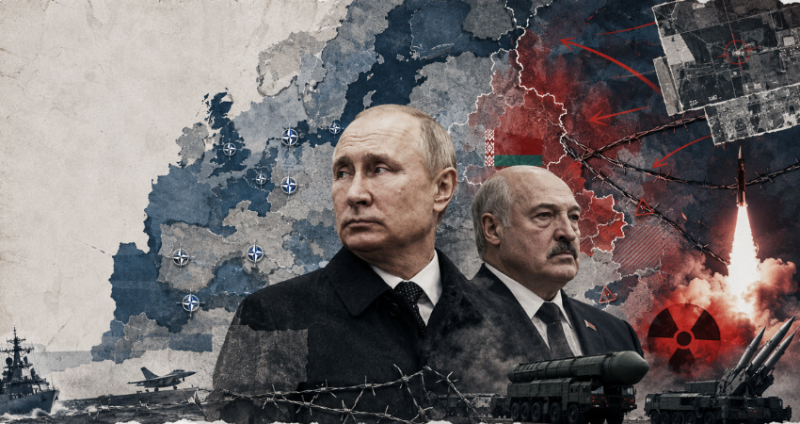
Putin and Lukashenko Flex Nuclear Muscle on Europe’s Doorstep — and Other Major Stories of the Week
The world this week seemed to move in two directions at once: closer to danger, and deeper into denial.
On Europe’s eastern edge, Russia and Belarus rehearsed the old grammar of nuclear intimidation, reminding the continent that geography can still be turned into a weapon. Belarus did not make Moscow’s arsenal stronger. It made the warning nearer. That distinction matters, because proximity has a way of changing the temperature of politics faster than speeches ever can.
Across the Atlantic, Donald Trump’s tariff machine began to return as something less heroic than promised: court rulings, refund claims and the quiet arithmetic of unlawful power. The cowboy image still knows how to make noise. But Washington, slow and legalistic as ever, has started counting the cost of the ride.
Elsewhere, Gaza’s temporary division edged towards permanence, Poland moved closer to the centre of NATO’s security crisis, and Ukraine was offered a half-open European door — not abandonment, perhaps, but not full arrival either. In the markets, Hormuz kept oil traders nervous, Nvidia kept Wall Street believing, and Britain’s consumer finally began to blink.
This was not a week of clean conclusions. It was a week of signals — military, legal, diplomatic and financial. And signals, when ignored for long enough, have a habit of becoming events.
“The week’s lesson is simple: danger does not always arrive as a shock. Sometimes it arrives as a signal everyone has grown tired of hearing.”
1. Putin and Lukashenko Flex Nuclear Muscle on Europe’s Doorstep
Some threats are not made louder. They are simply moved closer.
This week, Russia and Belarus reminded Europe of a truth it has spent years trying to file under “managed risk”: nuclear intimidation has not disappeared from the continent. It has merely learned to dress itself in the language of exercises, readiness, deterrence and defensive necessity.
Belarus announced drills involving the preparation and potential use of nuclear weapons. Russia then conducted broader strategic nuclear exercises across land, air and sea, with Belarus participating as the forward ally — not the owner of the nuclear button, but the geography through which Moscow makes the message harder to ignore. That distinction matters. Belarus does not make Russia’s nuclear arsenal larger. It makes it closer.
And that is the point.
For Ukraine, the signal is immediate. A threat from the north forces Kyiv to watch not only Donbas, Kharkiv and the Black Sea, but also the old invasion route from Belarus towards Chernihiv and Kyiv. President Volodymyr Zelensky has already warned of unusual activity near the Belarusian border and ordered attention to northern defences. In plain terms, Ukraine is being asked to defend not only against what Russia is doing, but against what Russia wants it to fear.
For NATO, the message is wider and colder. Poland, Lithuania and Latvia sit beside this theatre. The Kremlin knows this. Lukashenko knows this. Everyone in Brussels knows this too, though Brussels has a remarkable talent for sounding surprised by things it has watched approaching for years.
And then there is Lithuania.
This week, Lithuanian Foreign Minister Kęstutis Budrys added another match to an already dry room by suggesting that NATO could penetrate Kaliningrad and destroy Russian air-defence and missile bases in the heavily militarised Russian exclave if necessary. Perhaps this was meant as deterrence. Perhaps it was meant as political theatre for a nervous Baltic audience. Or perhaps it was simply the kind of human stupidity that arrives dressed as strategic courage.
Our editorial view is not certain which of the three it was.
What we do know is simpler: language like this does not cool a crisis. It feeds it. Kaliningrad is not an abstract square on a NATO map. It is Russian territory, militarised, paranoid, exposed and symbolically charged. To speak lightly of striking it — even as a hypothetical demonstration of capability — is to play with a door that may not open politely. In ordinary times, such statements would be reckless. In a week of Russian-Belarusian nuclear drills, they become something worse: an invitation for escalation to start pretending it is logic.
Moscow’s patience, if one can still call it patience, appears almost limitless. It threatens, waits, escalates by inches, then watches the West debate whether the latest signal is serious enough to deserve a serious answer. Each time, the threshold moves. Each time, the language grows darker. Each time, Europe tells itself that the performance is only theatre.
Perhaps it is.
But theatre has consequences when the actors are rehearsing with nuclear weapons.
The real danger is not that Russia intends to launch a nuclear war tomorrow morning. The danger is that the world becomes so accustomed to nuclear signalling that it stops hearing the alarm inside it. A threat repeated often enough becomes background noise. And background noise is exactly where catastrophes like to hide.
If the West treats this latest message as another routine gesture from the Kremlin, it may discover too late that deterrence does not survive on statements alone. It survives on clarity, preparation and the ability to convince the other side that the line still exists.
Because once nuclear threats become normal, the world does not become safer. It simply becomes more polite on the road to disaster.
“Belarus does not make Moscow’s nuclear warning stronger. It makes it nearer — and Europe would be foolish to mistake proximity for theatre.”
2. Trump’s Tariff Machine Becomes a Refund Problem
Some political gestures age badly. Others return with an invoice.
Donald Trump built his tariff machine as an exhibition of force: America, he insisted, would no longer be played, cheated, undercut or politely ignored. The world would pay for access to the American market. Allies would adjust. Rivals would bend. Factories would return. The cowboy image was useful, almost cinematic — one man riding into the dust with a signature, a threat and a promise to make everyone else nervous.
But Washington is not a ranch.
This week, the tariff story returned in a less theatrical form: refunds, court rulings, customs procedures and the rather unforgiving arithmetic of unlawful power. The Supreme Court’s rejection of Trump’s broad emergency tariff authority has now moved from constitutional argument into money. By 11 May, US Customs and Border Protection had finalised $35.5 billion in tariff refunds, while wider estimates suggest the eventual total could climb as high as $182 billion. That is no longer a campaign slogan. That is a bill.
And bills have a nasty habit of surviving applause.
The lesson here is not simply that Trump lost a legal battle. It is that the American system, for all its noise and exhaustion, still contains mechanisms capable of turning presidential theatre into evidence. Trump may prefer politics as a rodeo — charge forward, declare victory, mock the hesitant and call the wreckage momentum. Yet the machinery behind him moves differently. Slowly. Legally. Methodically. Courts intervene. Agencies recalculate. Businesses file claims. Lawyers sharpen language that voters may never read but opponents certainly will.
Our editorial view is careful on this point. We cannot prove that Trump’s opponents deliberately allow him to walk into these traps. But as geopolitical analysts, we can observe the pattern. The louder the gesture, the more patiently the system waits for it to mature into a mistake. A tariff becomes a headline. A headline becomes a lawsuit. A lawsuit becomes a ruling. A ruling becomes a refund. And a refund, in an election year, becomes a weapon.
The timing matters. America is moving towards the midterms, with every House seat and a large portion of the Senate before voters in November. Trump’s rivals do not need to invent chaos if the paperwork supplies it for them. They can point to the numbers and ask a simple question: was this strength, or was it expensive improvisation?
There is also a foreign-policy shadow behind the tariff defeat. Trump’s recent China line has given his opponents another layer of material. His remarks around Taiwan arms sales, including the idea that they could become a negotiating chip with Beijing, were seized upon by Chinese state media and watched nervously in Taipei. The uncertainty has only deepened after reports that a planned $14 billion arms package for Taiwan has been paused amid the war with Iran, even as Taiwan says it has received no formal notification of a change.
In ordinary diplomatic language, this may be called flexibility. In election language, it becomes something sharper: retreat dressed as realism.
That is how the Democratic attack almost writes itself. Tariffs ruled unlawful. Billions moving into refund claims. Taiwan treated as a bargaining instrument. China described with respect as a great power. Iran presented not as victory, but as another costly demonstration of American limits. Whether every accusation is fair is almost secondary. Elections are not courts of perfect nuance. They are theatres of accumulation.
Trump’s vulnerability is no longer merely his temperament. It is the growing impression that he is withdrawing from the world’s pressure points while pretending to dominate them. Trade, Taiwan, Iran, Europe — each file can be turned against him not as an isolated misjudgement, but as part of a larger charge: that he entered office promising strength and began converting American leverage into uncertainty.
Perhaps this is unfair. Politics often is.
But politics is also memory with a schedule. And by the time the campaign sharpens, Trump’s opponents may not need a grand theory of failure. They will have a folder: court rulings, refund figures, stalled arms packages, uneasy allies, nervous markets and statements that sounded powerful in the room but weaker once the world had time to examine them.
The cowboy still knows how to make noise. The question is whether America has started counting the cost of the ride.
“Trump may perform power as instinct, but Washington measures it in law, money and consequences — and this time, the invoice may arrive before the applause has faded.”
3. Gaza’s Temporary Division Starts to Look Permanent
Some maps are drawn with ink. Others are drawn with exhaustion.
This week, Gaza offered the world the second kind. Nickolay Mladenov, the Board of Peace envoy overseeing the troubled Gaza plan, warned the United Nations Security Council that the enclave’s current division risks becoming permanent unless the ceasefire is made to hold. More than two million Palestinians are now crowded into less than half of Gaza’s territory, while Israel maintains troops across roughly 60% of the strip and Hamas continues to resist disarmament.
That is not a peace process. It is a frozen crisis learning to call itself administration.
The danger here is not only humanitarian, though the humanitarian danger is already severe enough. The deeper problem is political architecture. A ceasefire line that was meant to be temporary begins to harden. Emergency arrangements become daily routine. Displacement becomes geography. Military control becomes “security management”. And before anyone formally admits what has happened, a temporary division starts behaving like a border.
This is how failed settlements are often born. Not with a grand declaration, not with a treaty, not even with a final collapse of diplomacy. They arrive quietly, through delays, exceptions, security zones, reconstruction conditions and the repeated promise that tomorrow will be more suitable than today.
For Israel, the argument remains security. For Hamas, the argument remains resistance and survival. For the Palestinians trapped in the middle, the argument is much simpler: a life of tents, aid corridors, broken neighbourhoods and political futures postponed so often that postponement itself becomes policy.
The Board of Peace was supposed to offer a route out of war — disarmament, reconstruction, civilian transition, international oversight. Yet Mladenov’s warning shows how fragile that machinery is. Reconstruction funding depends on stability. Stability depends on disarmament and withdrawal. Disarmament and withdrawal depend on trust. And trust, in Gaza, is not merely scarce. It has been bombed, buried, politicised and sold back to the world as a diplomatic condition.
Our editorial assessment is blunt: Gaza is no longer only a question of ceasefire compliance. It is becoming a test of whether the international system can still prevent a temporary military reality from becoming a permanent political one. If it cannot, then the world will have produced another carefully managed impossibility — a territory too broken to rebuild, too divided to govern, and too useful as a symbol for anyone to let go.
The tragedy is that everyone claims to oppose permanence. Yet everyone’s actions risk creating it.
“Gaza’s division does not need to be declared permanent to become permanent. It only needs enough time, enough fear, and enough diplomats pretending the line is still temporary.”
4. Poland Moves Closer to the Centre of Europe’s Security Crisis
Some countries sit on the map. Others begin to carry the map’s anxiety.
This week, Poland moved deeper into the centre of Europe’s security crisis after Washington announced that the United States would send an additional 5,000 troops to the country. President Karol Nawrocki thanked Donald Trump for the decision, while Polish Defence Minister Władysław Kosiniak-Kamysz described Poland as a “model ally” — a phrase that sounds diplomatic enough until one remembers what geography is asking Poland to model.
Poland is no longer simply NATO’s eastern member with a difficult history and a long memory. It is becoming the hinge of European deterrence: the place where American hesitation, Russian pressure, Baltic fear, Ukrainian survival and European defence rhetoric all meet in one increasingly crowded room.
The timing is not accidental. Only days earlier, reports that the Pentagon had cancelled a planned deployment of 4,000 US-based troops to Poland raised fresh concerns about Washington’s future military posture in Europe. Then came the reversal — or clarification, depending on one’s tolerance for diplomatic fog — with Trump announcing the new 5,000-troop move. The result was reassurance, certainly, but also confusion. And confusion is a strange material from which to build deterrence.
For Poland, the extra American presence is a political and strategic win. It strengthens the country’s claim to be the serious NATO state: spending, hosting, arming, warning, and refusing the luxury of pretending that Russia is a distant problem. Warsaw has understood something that parts of Western Europe still prefer to discuss over committees and coffee: the eastern flank is not a metaphor. It is a frontier.
But there is a danger in becoming indispensable. Poland’s importance now places it closer to every pressure point. Russian-Belarusian nuclear drills to the east. Kaliningrad to the north. Ukraine’s war to the south-east. Baltic vulnerability just beyond the horizon. If Europe’s security crisis widens, Poland will not watch it from the balcony. It will be standing in the corridor.
This is why the latest troop announcement matters beyond the number itself. Five thousand troops do not transform the balance of power on their own. What they transform is the signal. They tell Moscow that Poland is not a soft edge. They tell Warsaw that America, despite all its contradictions, still understands the value of forward presence. And they tell Europe something less comfortable: the centre of gravity has moved east, whether Brussels is ready to admit it or not.
Our editorial view is that Poland’s rise inside NATO is both necessary and dangerous. Necessary, because deterrence without credible geography is only paperwork. Dangerous, because every reinforcement now arrives in a region where nerves are already too close to the surface.
The old Europe liked to imagine security as a treaty. The new Europe is discovering that it may be a deployment schedule.
“Poland is not becoming important because Europe feels confident. It is becoming important because Europe no longer has the comfort of pretending the danger is elsewhere.”
5. Ukraine Is Offered Europe’s Half-Open Door
Some promises are not withdrawn. They are simply slowed down until they begin to feel like architecture.
This week, German Chancellor Friedrich Merz proposed a new form of associate EU membership for Ukraine — an interim status that would allow Ukrainian officials to take part in EU summits and ministerial meetings, but without voting rights. In his letter to EU leaders, Merz also suggested that member states make a political commitment to apply the EU’s mutual assistance clause to Ukraine, creating something closer to a security guarantee while full accession remains beyond immediate reach.
On paper, this is progress. In practice, it is Europe doing what Europe often does best: inventing a corridor between yes and no.
Ukraine wants membership. It has paid for that ambition not with speeches, but with cities, soldiers, power stations, refugees and the terrible arithmetic of survival. To Kyiv, Europe is not simply a market or a club of regulations. It is a civilisational destination, a guarantee that the country’s future will not be permanently negotiated over its head by larger powers.
Yet Brussels does not move at the speed of war. It moves at the speed of procedure, vetoes, treaty language, legal caution and domestic politics. Hungary has already shown how one government can slow the enlargement machine. Other capitals, even when sympathetic, understand that admitting a country at war would transform not only the EU, but the meaning of European security itself.
Merz’s proposal is therefore both generous and evasive. It gives Ukraine a chair in the room, but not a vote at the table. It signals belonging without granting full power. It tells Moscow that Ukraine is not being abandoned, while telling cautious Europeans that the Union is not yet making the leap it fears.
That may be realistic. It may even be necessary.
But it is also dangerous, because half-doors create half-expectations. Kyiv may accept an interim route if it is genuinely a bridge. It will not accept it if it becomes a waiting room with better lighting. Europe must be honest about this. Associate membership can either become a serious mechanism for integration, reconstruction and security — or it can become another elegant European device for postponing a decision too large to face directly.
Our editorial assessment is that this proposal reveals Europe’s central dilemma. It knows Ukraine cannot be left outside. It also knows that bringing Ukraine fully inside may change the Union forever. So it reaches for an intermediate formula, hoping that language can buy time, and that time will somehow solve the contradiction.
Perhaps it will.
But history is rarely kind to political structures built mainly to delay the inevitable. Ukraine does not need another ceremonial promise. It needs a path that leads somewhere.
“Europe has offered Ukraine a half-open door. The question is whether it leads to membership — or merely to a better-furnished waiting room.”
6. Hormuz Keeps Its Hand on the Oil Market’s Throat
Some places do not need to be large to hold the world still.
The Strait of Hormuz is one of them. This week, oil markets once again moved not merely on barrels, inventories or forecasts, but on the old and brutal fact of geography. Prices rose as investors doubted whether US-Iran peace talks would produce a real breakthrough, with Brent crude climbing above $105 a barrel and West Texas Intermediate approaching $99. The negotiations have not collapsed, but the unresolved questions — Iran’s uranium stockpile, control of Hormuz, and the future of safe shipping through the waterway — remain quite large enough to keep traders awake.
This is the strange power of Hormuz. It does not have to close completely to frighten the market. It only has to narrow the imagination.
Before the conflict, the strait carried roughly a fifth of global energy flows. Now, with disruption still hanging over the region, the market has learned to price not only what is happening, but what might happen if one commander misreads one signal, one tanker takes the wrong route, or one political promise expires before the next press conference. Barclays has kept its 2026 Brent forecast at $100, warning that risks remain tilted higher while supplies through the region stay constrained.
For consumers, this is where geopolitics leaves the television screen and enters the monthly budget. A tense strait becomes dearer petrol. Dearer petrol becomes higher delivery costs. Higher delivery costs become stickier inflation. And sticky inflation, that quiet little poison in the bloodstream of politics, becomes another argument around kitchen tables, in central banks, and eventually at ballot boxes.
There is an almost comic cruelty in the way markets behave during these moments. Diplomats speak in careful phrases. Ministers talk of “good signs”. Analysts produce scenarios. But oil, less polite than all of them, listens for the weakness between the words. It does not believe in hope until hope can move tankers.
Our editorial assessment is that Hormuz remains the most efficient fear machine in the global economy. It converts regional tension into worldwide cost with remarkable speed. It reminds Europe, Asia and America that energy security is still not an abstract policy phrase, but a narrow passage of water guarded by mistrust, missiles and exhausted diplomacy.
The wider lesson is uncomfortable. The world has spent years talking about transition, resilience and strategic autonomy. Yet one threatened maritime artery can still make inflation forecasts tremble and investors reconsider the price of everything. Progress, it turns out, has not abolished vulnerability. It has merely made vulnerability more expensive.
And until Hormuz is no longer treated as a bargaining chip in the politics of war and peace, the oil market will continue to behave like a nervous man listening at a locked door.
“Hormuz does not need to close to terrify the world. It only needs to remind it that the key to global prices still fits inside a very narrow lock.”
7. Nvidia Raises the Price of Believing in AI
Some companies sell products. Others sell a future expensive enough to frighten even the people buying it.
This week, Nvidia did what Nvidia now seems almost expected to do: it beat expectations, raised the bar, and reminded Wall Street that the artificial-intelligence boom still runs through the physical world. Not through poetry about disruption. Not through conference-stage metaphors. Through chips, servers, data centres, cooling systems, electricity contracts and capital expenditure so large it begins to resemble national infrastructure.
The company forecast second-quarter revenue of about $91 billion, above consensus expectations, after reporting quarterly revenue of $81.6 billion. Its data-centre business alone generated $75.2 billion, a reminder that AI is no longer a side story in technology earnings. It is the story. Nvidia also announced an $80 billion increase to its share buyback authorisation, while lifting its dividend sharply — a sign not merely of confidence, but of a company now operating with the financial gravity of an economy inside the economy.
And yet, the market reaction was strangely human. The shares slipped after the results.
This is what happens when success becomes the minimum requirement. Nvidia can nearly double earnings, raise guidance, announce a buyback large enough to fund smaller governments, and still discover that investors have already imagined something even larger. Perfection, once priced in, becomes oddly disappointing.
The deeper question is not whether Nvidia is strong. It plainly is. The question is whether the entire market has begun using Nvidia as a moral permission slip for the AI trade. If Nvidia is still growing, then the data-centre boom is real. If the data-centre boom is real, then cloud spending is justified. If cloud spending is justified, then the valuations around AI infrastructure may be defended for another quarter. It is a neat little chain of faith, and like all chains of faith, it holds until one link begins to groan.
There are reasons for caution. Nvidia’s guidance assumes no data-centre compute revenue from China, underlining how trade restrictions and geopolitics still cut through the most sophisticated parts of the technology economy. Competition is also becoming less theoretical. Microsoft, Google, Amazon, AMD and others are building or backing alternative chips, not necessarily to dethrone Nvidia tomorrow, but to reduce the dependence that has made one company feel like the tollbooth of the AI age.
Our editorial assessment is simple: Nvidia is not just a company story anymore. It is a market psychology story. It tells us how badly investors want AI to remain the organising myth of the decade. They want evidence that the spending is not madness, that the power bills will be justified, that the warehouses full of processors will eventually turn into productivity, profit and perhaps even the next industrial revolution.
Perhaps they are right.
But the price of believing keeps rising. Every quarter, the expectations grow larger. Every beat must become a bigger beat. Every forecast must carry not only revenue, but reassurance. Nvidia is still delivering that reassurance. The danger is that the market may forget the difference between a successful company and an entire future already paid for in advance.
AI may yet transform the world. But for now, it is also transforming balance sheets, electricity grids, supply chains and investor nerves.
“Nvidia is not merely selling chips into the AI boom. It is selling Wall Street the confidence to keep believing — and confidence, this year, has become a very expensive product.”
8. Wall Street Keeps Buying the AI Future
Some markets climb because the world feels safe. Others climb because investors have decided that the future is more profitable than the present is dangerous.
This week, UBS Global Wealth Management raised its 2026 year-end target for the S&P 500 from 7,500 to 7,900, citing resilient consumer spending and strong demand for AI-driven data centre infrastructure. It also introduced a June 2027 target of 8,200 and lifted its 2026 earnings-per-share estimate from $310 to $335. The market, in other words, is being asked to believe not merely in growth, but in the durability of a very specific kind of growth: chips, servers, memory, cloud capacity, energy supply and the vast industrial scaffolding of artificial intelligence.
There is something almost defiant in this optimism.
Around the market, the world is hardly calm. Oil remains hostage to Hormuz. The Middle East still sits inside a war-risk premium. Europe is staring at nuclear signalling from its eastern flank. America is wrestling with tariff refunds, court rulings and the slow-motion choreography of midterm politics. Yet Wall Street looks across this crowded field of anxiety and sees, somehow, a data centre.
Perhaps that is rational. Perhaps it is simply the most profitable form of denial.
The bullish argument is clear enough. Corporate earnings remain strong. Consumers, despite every prediction of exhaustion, continue to spend. The Federal Reserve is expected to be supportive rather than hostile. And AI investment has become the market’s great organising force — the story into which almost every other story can be folded. UBS is not alone here. Other major institutions have also lifted forecasts, with Morgan Stanley projecting the S&P 500 at 8,000 by the end of 2026, largely on AI investment and earnings optimism.
But this is where confidence becomes interesting. The market is no longer merely pricing companies. It is pricing a civilisation upgrade. It assumes that today’s spending on AI infrastructure will become tomorrow’s productivity, tomorrow’s margins, tomorrow’s economic acceleration. That may prove correct. AI may indeed become the great productivity machine of the age. But markets have an old weakness: they often recognise the future correctly and still pay too much for it too early.
Our editorial assessment is that Wall Street’s AI trade has become both a financial thesis and a psychological refuge. It allows investors to look past war, oil shocks, debt politics and institutional strain because it offers a cleaner narrative: the machines will improve, the profits will follow, and the future will justify the bill.
That is a seductive story. It may even be true.
Yet the risks are no longer hidden. UBS itself warned that a lack of resolution around the Strait of Hormuz could begin to undermine the bullish drivers, as higher oil prices and interest rates pressure parts of the market. That warning matters because it reveals the fragile bargain underneath the rally. AI can lift valuations, but it cannot abolish energy costs. It can excite investors, but it cannot make geopolitics disappear. It can promise productivity, but it still needs electricity, hardware, shipping lanes, capital discipline and time.
For now, Wall Street keeps buying the future. Not because the present is peaceful, but because the alternative is to admit that the present may still be stronger than the story.
And markets, like people, often prefer a story with a higher target price.
“Wall Street is not ignoring the risks around it. It is simply betting that AI will outrun them — which is either vision, arrogance, or the most expensive act of faith in modern finance.”
9. Britain’s Consumer Finally Starts to Blink
Some economic warnings arrive not as crashes, but as smaller baskets.
This week, Britain’s retail figures offered one of those quieter warnings. UK retail sales fell by 1.3% in April, a sharper drop than economists had expected, with fuel sales down around 10% after prices climbed during the month. Food sales also weakened, while online spending declined. The numbers do not describe panic. They describe something more familiar to British households: adjustment, hesitation, and the slow discipline of spending less because the month has become longer than the money.
For all the grand drama elsewhere — nuclear drills, tariff defeats, oil shocks, AI optimism — this may be one of the week’s most politically sensitive signals. Because nothing tests a government quite like the ordinary consumer beginning to retreat.
Britain is not collapsing. That would be too dramatic, and rather too convenient for commentators. But the consumer is tiring. After years of inflation, higher borrowing costs, rent pressure, food-price anxiety and energy uncertainty, the household has become a careful institution. It compares. It delays. It buys fuel because it must, not because it wants to. It cuts one small thing, then another, and eventually the economy discovers that millions of private decisions can become a public problem.
Fuel matters here because it is never only fuel. It is the cost of getting to work, delivering goods, visiting family, running small businesses and keeping daily life moving. When fuel spending falls sharply, one must ask whether people are driving less because they choose to, or because the price has started to behave like a quiet restriction on movement.
Retail data has a habit of looking dull until politics catches up with it. Ministers can talk about stability, investment and long-term reform. Central bankers can discuss disinflation with professional calm. But voters often judge the economy through a simpler dashboard: supermarket receipts, petrol pumps, rent, mortgage payments, and the faint irritation of realising that restraint has become a lifestyle.
Our editorial assessment is that Britain’s April retail slump should not be dismissed as a monthly wobble. It fits a broader pattern: the British economy is trying to grow while its consumers are being asked to remain disciplined almost indefinitely. That is not impossible. But it is politically dangerous. A country can tolerate sacrifice when it believes there is a visible destination. It becomes less patient when sacrifice starts to feel like routine maintenance for a system that no longer explains itself well.
There is also a wider market implication. If consumers weaken, growth forecasts soften. If growth softens, tax receipts become less comfortable. If tax receipts weaken, fiscal promises begin to look more expensive. A small fall in retail sales can therefore travel further than it first appears.
This is the unglamorous truth of economics: the great stories often end up at the till.
Britain’s consumer has not vanished. But he has blinked. And in an economy built so heavily on household confidence, even a blink deserves attention.
“Britain’s retail slump is not yet a crisis. It is something more politically dangerous: a sign that the consumer is still standing, but no longer pretending not to feel the weight.”
10. Anthropic Tests a Route Around Nvidia’s Empire
Some monopolies are not challenged by speeches. They are challenged by customers quietly asking whether there is another plug in the wall.
This week, Anthropic was reported to be in early talks to rent servers powered by Microsoft-designed AI chips, according to The Information, in a move that would mark a significant win for Microsoft’s attempt to build an alternative to Nvidia’s dominance in AI hardware. Reuters could not independently verify the report, and the talks may not lead to an agreement, but the direction is unmistakable: the AI industry is searching for more compute, more suppliers, and fewer single points of dependence.
That matters because Nvidia’s position in the AI boom has become more than commercial success. It has become infrastructure power. To build serious AI models, companies need chips. To get chips, they need supply. To get supply, they often pass through Nvidia’s ecosystem — directly or indirectly. The result is a modern toll road where almost every ambitious AI company pays something to the same gatekeeper.
Anthropic’s interest in Microsoft’s chips should therefore be read less as a simple procurement story and more as a sign of structural discomfort. The company behind Claude is already a major customer across the cloud battlefield, with deep relationships involving Amazon and Google. If it also rents Microsoft-powered AI capacity, the message is plain enough: no serious frontier AI company wants to wake up one morning and discover that its future depends too heavily on one supplier, one cloud partner, or one geopolitical supply chain.
Microsoft, for its part, has every reason to want this. The company has spent years being viewed primarily as a cloud and software giant in the AI race, while Nvidia captured the harder glamour of silicon. Renting Microsoft-designed chips to Anthropic would not suddenly dethrone Nvidia. But it would prove something valuable: that Microsoft’s internal chip work is not merely a defensive experiment. It can become a commercial weapon.
The politics of this are also larger than Silicon Valley likes to admit. AI infrastructure now sits at the intersection of corporate power, national strategy, energy supply, export controls and capital markets. Chips are no longer components. They are leverage. Whoever controls compute controls pace, pricing and, increasingly, strategic dependence.
Our editorial assessment is that the AI market is entering its next phase. The first phase was model excitement. The second was Nvidia’s extraordinary rise. The third may be supplier diversification — not because Nvidia has failed, but because it has succeeded too well. No ecosystem likes being dependent on a single empire, however efficient that empire may be.
This does not make Microsoft the new king of AI chips. It does make Microsoft a more serious contender in a field where credibility is built slowly, through customers with real workloads and real desperation for capacity. Anthropic would be exactly that kind of customer: demanding, visible and large enough to turn a technical trial into a market signal.
The AI boom is often described as software eating the world. Increasingly, it looks more like hardware deciding who gets to eat first.
“Anthropic’s reported talks with Microsoft do not end Nvidia’s empire. They reveal something more interesting: even the richest customers inside that empire are beginning to look for exits.”