AI Chipflation: How Nvidia, TSMC and Big Tech Turn Intelligence Into a Toll Road Economy
The Week That Shaped the World — 29 May - 5 June 2026
The Price of Intelligence: AI Chipflation and Other Major Stories of the Week
Every week seems to arrive with its own official panic. War, oil, inflation, elections, supply chains, housing, heat. The modern economy has become rather good at producing anxiety in bulk.
But this week’s most revealing story did not begin with a missile or a minister. It began with a chip.
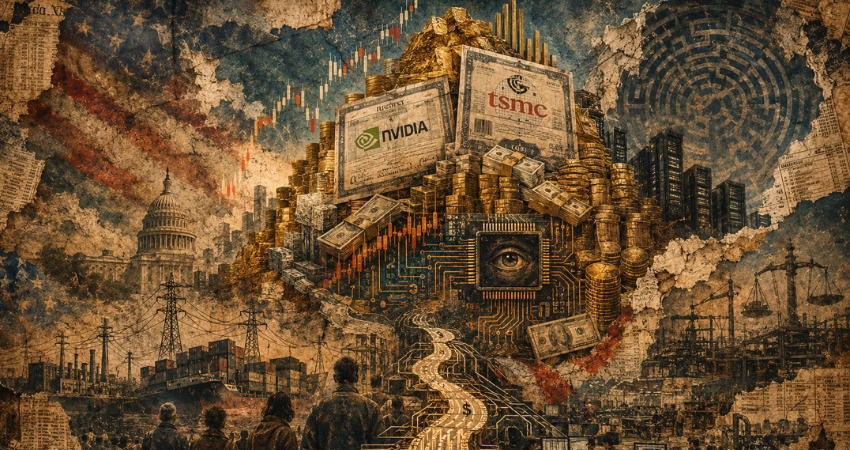
AI “chipflation” is now spreading beyond data centres and into the wider economy, turning artificial intelligence from a miracle of productivity into something more familiar: a cost structure with owners, bottlenecks and invoices. The technology still looks weightless on the screen. Behind it stand memory chips, fabs, data centres, electricity grids, cloud platforms and companies that understand the value of dependence.
Elsewhere, Europe searched for digital sovereignty, France welcomed vast AI infrastructure investment, supply chains strained under Hormuz risk, extreme heat became a balance-sheet problem, and Britain’s construction sector gave its own quiet warning.
The future, it turns out, is not free.
“The future rarely arrives as a miracle. More often, it arrives as an invoice — and asks who owns the machinery beneath it.”
1. AI Chipflation: How Nvidia, TSMC and Big Tech Turn Intelligence Into a Toll Road Economy
Every technological revolution begins as a promise and matures, eventually, into a bill.
This week, the bill arrived.
Morgan Stanley warned that AI “chipflation” is spreading from data centres into the wider economy, as soaring memory-chip prices force makers of smartphones, personal computers and other devices to choose between raising prices and accepting thinner margins. That sounds, at first, like another market note written for people who enjoy abbreviations more than sleep. But it is more important than that. It suggests that the AI boom is no longer only a story about innovation, productivity and clever machines answering emails. It is becoming a story about cost, dependency and pricing power.
Artificial intelligence was sold to the world as a kind of liberation. A tireless assistant in the browser. A junior analyst without lunch breaks. A writer, coder, designer, researcher and polite little office ghost sitting behind the screen. For businesses, it promised speed. For workers, relief. For investors, another industrial revolution, this time with better branding and fewer oil stains.
Then, as usually happens with miracles sold by corporations, the invoice followed.
The chatbot may look weightless on the screen. The infrastructure behind it has the appetite of a small industrial empire. It needs advanced chips, high-bandwidth memory, lithography machines, data centres, land, water, cooling systems, electricity, grid upgrades and enough capital to make old-fashioned manufacturing look almost modest. This is the part of the AI story that rarely appears in the promotional video. No one likes to interrupt a revolution by pointing at the power meter.
And yet the power meter is where the truth often lives.
TSMC, the world’s largest contract chipmaker, said this week that AI demand shows no sign of easing. Its chief executive said the company is working hard not to become a bottleneck in the semiconductor supply chain, while also admitting that TSMC would “like” to raise prices, though not abruptly. There it is, in plain language: demand is strong, supply is strained, and the company sitting at the centre of the machine understands exactly what that means.
This is where the financial trail becomes useful.
The first winners are not difficult to identify. Nvidia sells the picks and shovels of the AI gold rush. TSMC manufactures the advanced chips that make much of that rush possible. ASML provides the lithography equipment without which the most advanced chips remain an ambition rather than a product. Samsung, SK Hynix and Micron sit inside the memory story. Then come the cloud platforms, data-centre operators, energy suppliers, cooling specialists, grid-equipment companies and infrastructure funds that have discovered, with some satisfaction, that artificial intelligence is not really a software business once one follows the cables far enough.
It is a toll road.
Everyone is invited to drive. Very few own the gates.
This does not require a conspiracy. That is the lazy explanation, and often the least interesting one. The industry did not need a secret meeting in a dark room. It needed dependency. First, make the tool useful. Then make it normal. Then make it necessary. Once companies, workers and consumers reorganise their habits around artificial intelligence, the owners of the hardware and infrastructure inherit the pricing power.
That is the elegant brutality of the model.
Nvidia is now pushing AI directly into personal computers, with its RTX Spark chip designed to bring AI capabilities into laptops and desktops. This matters because it moves AI from the cloud into the everyday device. Not just something companies rent from vast data centres, but something increasingly built into the machinery of ordinary work. The promise is convenience. The business model is deeper dependence.
Europe has noticed the other side of the bargain. The European Union is preparing minimum energy-efficiency standards and sustainability labels for data centres, after warnings that AI-driven demand could double data-centre power consumption by 2030. That is not a footnote. It is the industrial shadow of the AI boom: more intelligence on the screen, more pressure on the grid, more water used for cooling, more land converted into digital infrastructure, and eventually, more cost looking for someone to absorb it.
The uncomfortable question is who pays.
At first, Big Tech pays. Then device makers pay. Then businesses pay through higher cloud costs, software subscriptions, API charges and hardware prices. Then consumers pay, quietly, through more expensive phones, computers, apps and services. The cost does not disappear. It travels. Like all serious costs, it eventually becomes someone else’s normal.
That is what makes AI chipflation more than a semiconductor story. It is a glimpse of the next economic settlement. Intelligence is becoming infrastructure. Infrastructure has owners. Owners charge rent.
There is, of course, still real innovation here. It would be foolish to pretend otherwise. AI can increase productivity, accelerate research, improve design, reduce administrative waste and give small businesses tools that once belonged only to corporations with entire departments and expensive consultants. The technology is powerful. That is precisely why the dependency matters.
A useless product cannot trap anyone.
A useful one can.
The great trick of the AI economy is that it offers freedom at the front end and control at the back end. The worker sees the assistant. The company sees the productivity tool. The investor sees the growth curve. But beneath all of it sits a narrower group of firms controlling the chips, fabrication, memory, cloud capacity, energy contracts and data-centre real estate that make the whole performance possible.
One can call that progress. One can call it capitalism. One can even call it efficiency, if one is in the mood to ruin a perfectly good afternoon.
But one should at least call it what it is: a transfer of pricing power from users to infrastructure owners.
AI will not become less important because it becomes more expensive. Quite the opposite. The most profitable technologies are not those people admire from a distance. They are the ones people slowly forget how to live without. Electricity. Search. Smartphones. Cloud computing. Payment systems. And now, perhaps, artificial intelligence.
The age of cheap wonder may already be ending.
The age of metered intelligence is beginning.
“The most profitable technology is not the one people admire. It is the one they can no longer afford to live without — and can no longer afford to use cheaply.”
2. Europe’s Tech Sovereignty Push Targets Big Tech Dependence — but the Gap Remains
Europe has finally discovered that digital dependence is not a lifestyle choice.
It is a strategic weakness.
This week, Brussels pushed again towards technological sovereignty: more European cloud capacity, stronger domestic AI infrastructure, support for semiconductor industries, and less reliance on American technology giants in critical public systems. The ambition is simple enough. Europe wants its governments, hospitals, banks, universities and public services to rely less on infrastructure owned, priced and controlled elsewhere.
One might ask why this required several decades to notice.
For years, Europe treated digital infrastructure as something that could be rented safely. Search came from America. Cloud capacity came from America. Office systems, app stores, AI platforms and much of the modern digital economy came through companies whose headquarters and strategic loyalties sat outside the European Union.
It was convenient.
Convenience usually is, until it starts behaving like dependency.
The problem is that Europe is trying to build sovereignty after dependence has already become normal. American Big Tech does not dominate European digital life simply because of lobbying or luck. It dominates because its products worked, scaled quickly and became habits. Microsoft became office infrastructure. Amazon became cloud infrastructure. Google became search infrastructure. Apple and Google became mobile gateways.
And habits are harder to regulate than markets.
Europe’s answer is to support domestic providers, encourage public buyers to consider European alternatives, back chip production and create space for home-grown AI infrastructure. The logic is sound. No serious economic bloc can claim independence while outsourcing the nervous system of its digital economy.
But the gap remains.
European firms lack the scale, capital, ecosystems and global reach of the American giants. Governments may prefer sovereignty, but they also need systems that work immediately and securely. That is where Big Tech’s real power sits: not only in technology, but in the cost of leaving it.
“Digital sovereignty does not begin when a continent writes another policy paper. It begins when it finally admits that convenience has been quietly mistaken for control.”
3. SoftBank’s €45bn France Bet Turns AI Into an Energy-Industrial Project
Artificial intelligence used to sound almost weightless.
A model in the cloud. A prompt in the browser. A clever answer appearing from nowhere, as if intelligence had finally learned to float.
Then someone had to build the buildings.
SoftBank’s plan to invest €45 billion in AI data centres in France is one of those moments when the fantasy becomes physical. Three major facilities, massive energy demand, land, cooling systems, grid connections, construction, political blessing and years of infrastructure work. The language may still be digital, but the reality is industrial.
This is no longer simply a software race.
It is an energy race, a land race, a capital race and, increasingly, a national strategy race. France wants to position itself as a serious European base for AI infrastructure. SoftBank wants a strong foothold in the next layer of computing power. Energy providers, construction firms, equipment suppliers and local authorities will all find their own place around the table.
As always, the financial trail is not hard to see.
AI needs chips. Chips need fabs. Models need data centres. Data centres need electricity. Electricity needs grids. Grids need investment. And every step creates a new owner, a new contract, a new dependency and a new toll gate.
Europe may speak about digital sovereignty, but sovereignty is not built in speeches. It is built in substations, server halls and planning permits.
The question is not whether France can attract AI investment. This deal suggests it can. The real question is whether Europe will own enough of the machinery beneath the AI economy, or merely host it on rented terms.
Because in the age of artificial intelligence, the winners will not only be those who build the smartest models.
They will be those who control the ground beneath them.
“AI does not live in the cloud. It lives in buildings, grids and balance sheets — and whoever owns those foundations owns more than the future.”
4. EU Moves to Regulate Data Centres as AI Starts Eating the Grid
Artificial intelligence has a strange public image.
On the screen, it looks clean. Almost weightless. A box, a prompt, a reply. No smoke. No machinery. No visible cost.
Behind the screen, it is becoming hungry.
The European Union is moving towards minimum energy-efficiency standards and sustainability labels for data centres, as governments begin to confront the physical side of the AI boom. The concern is simple: data centres already consume serious amounts of electricity, and AI workloads are making that appetite larger, faster and harder to ignore.
This is where the romance of technology meets the reality of infrastructure.
Every chatbot response, model training run, image generation, corporate AI assistant and automated workflow depends on servers that must be powered, cooled, maintained and connected. The more AI becomes normal, the more pressure moves onto electricity grids, water systems, land use and local planning.
That pressure will not remain abstract.
Someone will pay for grid upgrades. Someone will pay for cooling. Someone will pay when local energy demand rises. Someone will pay when governments decide that “innovation” is no longer a good enough excuse for inefficient infrastructure.
The industry prefers to speak about intelligence. Regulators are starting to ask about consumption.
And rightly so.
If AI becomes a basic layer of business, public services, education, healthcare and finance, then data centres are no longer just private commercial facilities. They become part of the economic nervous system. At that point, energy standards are not bureaucratic decoration. They are a question of resilience.
The financial trail is clear again. More AI demand benefits cloud providers, chipmakers, data-centre operators, energy suppliers and cooling specialists. But the public system absorbs part of the burden: grids, water, land and political tolerance.
Europe is discovering that the cloud was never above the ground.
It was only very good at hiding the cables.
“The AI revolution may speak in the language of intelligence, but its first honest question is still brutally old-fashioned: who pays for the power?”
5. Foxconn and Intel Join Forces to Build Next-Generation AI Infrastructure
The AI boom has a glamorous face and an industrial body.
The glamorous face is familiar: chatbots, chips, keynote speeches, miracle demos and executives speaking as if the future has personally booked a meeting room. The industrial body is less photogenic: server racks, processors, cooling systems, cables, factories, logistics and the dull but essential work of making the machine real.
Foxconn and Intel’s new strategic collaboration belongs to that second world.
The partnership focuses on next-generation AI infrastructure — server racks, Xeon processors, AI accelerators, interconnects, cooling systems, edge computing, robotics and smart-city applications. In plain English, this is about building the physical architecture that allows artificial intelligence to leave the slide deck and enter the economy.
That matters.
AI is often discussed as software, but the companies making serious money are increasingly those that control the hardware, manufacturing depth and deployment capacity behind it. Foxconn brings industrial scale. Intel brings chips, systems and a desperate need to remain relevant in an AI market that has not been kind to its old dominance.
There is opportunity here, but also pressure.
For Intel, AI infrastructure is not a fashionable side project. It is a fight to stay inside the next computing cycle. For Foxconn, the deal offers a route beyond consumer electronics assembly into higher-value industrial AI systems. Both companies understand the same thing: the AI economy will not be built only by those who design models. It will be built by those who manufacture the rooms, racks and machines that models depend on.
Again, the financial trail is visible.
The intelligence may appear on a screen. The money moves through factories.
This is why AI infrastructure is becoming one of the most important industrial battlegrounds of the decade. Whoever builds the machine beneath the machine will not merely supply the future.
They will invoice it.
“Artificial intelligence may dream in software, but it earns its keep in metal, power and manufacturing scale.”
6. Global Supply Chains Stay Under Pressure as Hormuz Risk Spreads Through Trade
Supply chains have become the polite name for global anxiety.
They sound technical, almost boring. Routes, ports, insurance, containers, delivery schedules. The kind of language that allows governments and companies to pretend the world is still managed by spreadsheets.
Then one strait begins to tremble.
The pressure on global supply chains remained elevated in May, with disruption around the Strait of Hormuz feeding through trade, energy routes and business expectations. This matters because Hormuz is not simply a Middle Eastern problem. It is one of those narrow pieces of geography that can make the entire global economy suddenly remember its physical limits.
Oil moves through it. Ships depend on it. Insurers price it. Manufacturers watch it. Consumers eventually pay for it.
That is the financial trail.
When a route becomes risky, the cost does not stay at sea. Freight rises. Insurance rises. Delivery times stretch. Inventories become more expensive. Companies start ordering defensively. Energy prices react. Inflation, that supposedly tamed beast, finds a side door back into the room.
Modern economies like to describe themselves as resilient. The word appears beautifully in policy papers. But resilience is often just another way of saying that nobody has tested the system recently.
Hormuz tests it every time.
The uncomfortable truth is that globalisation was built for efficiency more than shock. It rewards cheap movement, tight timing and lean inventories. It does not enjoy war, sanctions, blockades, missile threats or nervous tanker operators. When those arrive, the miracle of cheap global logistics starts looking less like a miracle and more like a bet.
This week, the bet looked more expensive.
The world may talk about AI, green transition and digital sovereignty, but ships still matter. Geography still matters. Energy routes still matter. And one crisis in one narrow passage can still move prices far beyond the map.
“Global trade does not break only when ships stop moving. Sometimes it breaks when everyone suddenly remembers how much fear costs to insure.”
7. Oil Swings as Markets Price War, Diplomacy and Hormuz Risk
Oil has a talent for turning fear into arithmetic.
This week, it did it again.
Prices moved sharply as markets tried to judge whether the crisis around Iran and the Strait of Hormuz was sliding towards deeper disruption or edging, however awkwardly, towards diplomatic restraint. One day, traders priced the danger: restricted shipping, higher insurance costs, nervous refiners and the familiar ghost of inflation. The next, they priced relief: possible talks, possible de-escalation, possible reopening of space for commerce.
Possible, of course, is doing a great deal of work here.
Oil does not wait for certainty. It moves on rumour, risk, expectation and the uncomfortable knowledge that a few miles of water can still disturb the world’s balance sheet. That is why Hormuz matters. It is not just a maritime route. It is a pressure point in the global economy.
When oil rises, the effect travels quickly. Transport costs move. Energy bills shift. Central banks become less relaxed. Governments start calculating how much patience voters have left. When oil falls, everyone breathes out and pretends the problem has been solved.
It usually has not.
The market’s weakness is that it can measure price better than fragility. A temporary fall in crude does not erase the fact that the route was exposed, insurers were nervous, and the world was once again reminded that energy security is not a speech at a summit. It is a ship, a strait, a premium and a risk calculation.
Still, the swings mattered. They showed how quickly markets now move between panic and optimism, between war premium and diplomacy discount.
That is the strange economy of oil.
Peace does not need to arrive for prices to fall. The market only needs to believe disaster may have been postponed.
“Oil does not need certainty to move. It only needs fear to become expensive, and hope to look temporarily tradable.”
8. Extreme Heat Becomes a Balance-Sheet Risk for France and Europe
Extreme heat used to be treated as weather.
Now it is beginning to look like accounting.
A new analysis of economic exposure to rising temperatures has put a hard number on what many governments still prefer to discuss in softer language. Under a severe scenario, extreme heat could generate hundreds of billions of dollars in cumulative GDP losses across major economies between 2026 and 2030, including a potential $240 billion hit to France.
That is not a climate slogan.
It is a balance-sheet warning.
Heat damages productivity in ways that rarely look dramatic on the evening news. Workers slow down. Construction schedules slip. Agriculture suffers. Transport systems strain. Energy demand rises. Healthcare costs increase. Tourism patterns shift. Insurance models become less comfortable. The economy does not collapse in a single cinematic scene. It sweats, stalls and quietly loses output.
France is a useful case because it sits at the intersection of industry, agriculture, tourism, infrastructure and public services. A heat shock there does not stay politely inside one sector. It spreads through labour productivity, crop yields, electricity demand, logistics, health systems and regional inequality.
This is where climate risk becomes financial risk.
The old political mistake was to treat climate as a moral debate only. It is also a pricing problem, an insurance problem, an infrastructure problem and a competitiveness problem. If one country adapts faster and another simply complains about the weather, the difference will eventually appear in investment flows, public budgets and company margins.
Europe is learning this slowly.
Perhaps too slowly.
The financial trail is visible again. Heat creates losers, but it also creates winners: cooling technology, grid investment, water management, climate adaptation, insurance analytics, resilient construction and energy-efficiency firms. A hotter economy will not be a fair economy. It will reward those who can adapt and punish those who assumed yesterday’s climate was a permanent business model.
“The market does not care whether a heatwave feels political. It only cares when the temperature starts writing itself into profit margins.”
9. U.S. Tightens AI Chip Controls on Chinese Firms Abroad
The AI race is no longer only about who builds the best model.
It is about who is allowed to buy the machinery.
The United States has moved to tighten controls on advanced AI chip shipments to Chinese companies operating outside China, closing a route that could have allowed restricted firms to access high-end hardware through foreign subsidiaries. The target is clear enough: Washington wants to stop Chinese groups from using overseas structures to obtain the computing power needed for next-generation artificial intelligence.
This is export control with a longer shadow.
For decades, globalisation encouraged companies to stretch themselves across borders. Subsidiaries, joint ventures, supply chains and regional offices were treated as proof of efficiency. Now the same architecture is being examined as a loophole. In the AI age, a company’s location is no longer just an address. It is a question of access.
And access is power.
Advanced chips are becoming strategic assets, not ordinary components. They sit somewhere between industrial equipment and national-security infrastructure. Whoever controls them can influence who trains models, who scales AI products, who builds autonomous systems, who competes in cloud services and who falls behind.
That is the financial trail.
The restriction may hurt Chinese firms seeking advanced computing capacity, but it also protects American leverage over the AI supply chain. It keeps Nvidia and other chipmakers inside a political cage they did not design but must now navigate. It forces cloud providers, distributors and foreign subsidiaries to think like compliance departments before they think like customers.
The free market, as usual, becomes less free when the machinery becomes too important.
This is not simply a U.S.–China story. It is a warning to every country that does not control its own AI infrastructure. In the next economy, sovereignty may begin with a very blunt question:
Can you get the chips?
“Artificial intelligence may speak the language of innovation, but its borders are now being drawn in export licences, subsidiaries and silicon.”
10. UK Construction Shrinks at Fastest Pace Since 2020 as Inflation and Uncertainty Bite
Britain’s construction sector has a habit of telling the truth before politicians do.
This week, it told an uncomfortable one.
UK construction activity fell in May at the fastest pace since 2020, with the sector’s PMI dropping to 38.2, well below the 50 mark that separates growth from contraction. Housebuilding remained especially weak, while employment in the sector continued to fall. For an economy that likes to speak confidently about growth, housing supply and national renewal, this is not a decorative problem.
It is the floorboards creaking.
Construction is never just construction. It is confidence made visible. When developers build, they are betting that buyers will arrive, finance will hold, costs will behave and government policy will not change direction halfway through the job. When they stop, it usually means the private sector has looked at the numbers and decided that optimism is too expensive.
The pressure is familiar: high borrowing costs, stubborn inflation, expensive materials, energy costs, weak demand and uncertainty drifting in from the wider global economy. None of these problems is new. That is precisely the point. Britain is not suffering from one dramatic shock. It is being worn down by several ordinary pressures that have stayed too long.
Housing is the most politically sensitive part of this story. The UK keeps promising to build more homes, while the industry expected to deliver them is shrinking. That is not a strategy. It is a contradiction with scaffolding around it.
The financial trail is clear enough. If construction slows, jobs suffer, suppliers suffer, local economies suffer, housing supply suffers and future affordability gets worse. A country cannot talk its way out of a housing shortage while builders retreat from the site.
Britain does not merely need more promises.
It needs conditions in which building makes sense again.
“Construction is where economic confidence becomes physical. When the cranes go quiet, the problem is rarely only on the building site.”