SpaceX’s $75bn IPO Tests Wall Street’s Appetite for Elon Musk’s Tech Empire
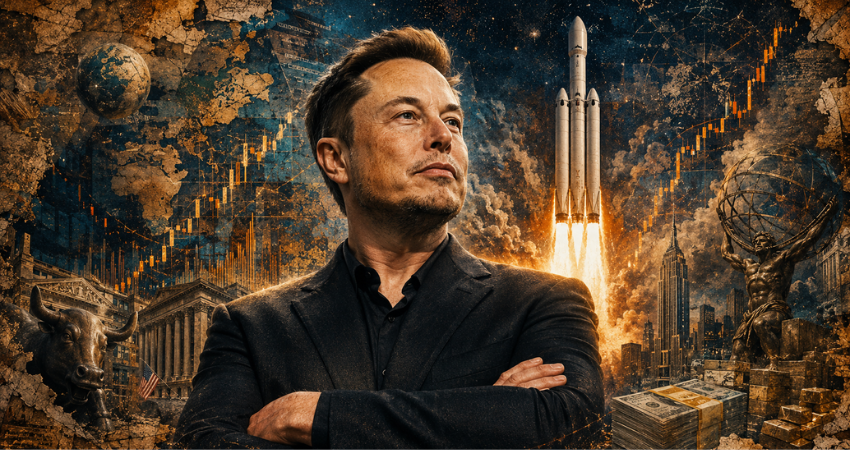
The Week That Shaped the World — 5 -12 June 2026
SpaceX’s $75bn IPO Tests Wall Street’s Appetite for the New Tech Empire — and Other Major Stories of the Week
There are weeks when the markets move because of numbers. Then there are weeks when numbers begin to look like theology.
A $75bn SpaceX IPO. A $1.3tn chip-stock shock. Another hard turn from the European Central Bank.
Google looking beyond the old semiconductor order. Britain’s economy shrinking under the shadow of a war fought thousands of miles away. The lesson was not subtle. The future is expensive, heavily financed, politically exposed and increasingly difficult to separate from the machinery of state power.
This week, the world was not simply asking what comes next. It was asking who owns it, who funds it, who regulates it — and who pays when the great promises begin to wobble.
1.SpaceX’s $75bn IPO Tests Wall Street’s Appetite for Elon Musk’s Tech Empire
SpaceX did not merely come to market this week. It arrived like a private empire deciding, at last, to let the public buy a small seat near the window.
The company priced its initial public offering at $135 a share, raising $75bn and placing its valuation at about $1.77tn. The scale alone would have been enough to make this one of the defining market events of the year.
But this was never just about scale. SpaceX is not selling investors a conventional industrial story. It is selling access to orbital infrastructure, satellite communications, defence contracts, launch dominance, Starlink, data networks and, more broadly, the possibility that the next century’s strategic rails may not be built on Earth alone.
That is why the listing matters. It sits at the uncomfortable junction between technology, finance and state power. Rockets are no longer merely rockets. Satellites are no longer merely satellites. Communications infrastructure is now part of national security, military logistics, digital sovereignty and the invisible plumbing of the modern economy.
Wall Street, naturally, knows the theatre. It has seen electric cars priced like software, software priced like religion and artificial intelligence priced like a second creation myth. SpaceX now enters that same financial cathedral.
The believers see a company building the architecture of the future. The sceptics see another case of markets paying today for profits that may require tomorrow to behave perfectly.
The question is not whether SpaceX is valuable. Clearly, it is. The question is whether public markets can still tell the difference between strategic infrastructure and speculative worship.
Because once a company becomes large enough, it stops being just a company. It becomes a political actor, a security asset, a market symbol and, occasionally, a weather system.
“The market did not buy shares in a rocket company this week. It bought a ticket to the future — without asking too carefully who controls the launchpad.”
2. The $1.3tn Chip Shock: AI Stocks Discover Gravity
For months, the AI trade had floated above the market like a privileged class of physics. Chips went up.
Data-centre names went up. Anything close enough to artificial intelligence could glow by association, as if valuation had become a mood rather than a calculation.
Then came the fall.
On 5 June, a sharp sell-off across semiconductor stocks wiped roughly $1.3tn from the market value of US-traded chipmakers. The shock hit the names that had become almost untouchable in the public imagination: Nvidia, AMD, Micron, Marvell and the wider semiconductor complex. The move was not a minor correction. It was a reminder that even the most fashionable trade on Earth can still be dragged back to the ground.
It would be lazy to call this the end of the AI boom. It is not. The infrastructure build-out is real.
Demand for advanced chips remains immense. Cloud firms, model builders, governments and defence contractors are all leaning harder into compute, not less.
But markets do not fall only when stories are false. Sometimes they fall because stories have become too expensive.
That was the uncomfortable lesson of the week. Investors did not suddenly decide that AI had no future.
They began to wonder whether too much future had already been priced into the present. There is a difference.
A rather costly one.
The chip sector has become the toll road of the AI age. Nvidia, TSMC, AMD, Broadcom, Micron, ASML — these are no longer just technology names. They are the pipes, foundries, switches and gates through which the next digital economy must pass. That makes them powerful. It also makes them crowded.
And crowded trades have a nasty habit of discovering gravity all at once.
“AI did not lose its future this week. It merely discovered that even the future has a price, and markets occasionally ask to see the receipt.”
3. ECB Raises Rates as Europe Learns That Inflation Has Not Gone Home
Europe had been hoping, rather politely, that inflation might leave by the side door.
It has not.
The European Central Bank moved to raise key interest rates by 25 basis points this week, a decision shaped by renewed price pressure across the eurozone. Energy risks, the Middle East conflict and stubborn inflation expectations have left Frankfurt with little room for comfort. The deposit rate moved to 2.25%, the main refinancing rate to 2.40% and the marginal lending rate to 2.65%.
This is the dreary cruelty of modern inflation. It never arrives alone. It comes with oil prices, shipping risks, wage pressures, food costs, budget strains and the quiet misery of households learning that “temporary” often means “longer than promised”.
For the ECB, the problem is especially awkward. Growth is not exactly roaring. Consumers remain cautious. Businesses are dealing with higher financing costs, uncertain demand and a geopolitical map that keeps finding fresh ways to be expensive. Yet the central bank cannot simply look away from inflation because the real economy feels tired.
That is the central banker’s punishment: tighten when growth is weak, or risk losing credibility when prices are stubborn.
Europe’s deeper problem is structural. The continent imports too much of its energy anxiety, depends too heavily on fragile external supply chains and moves too slowly when the world becomes brutal. Inflation, in that sense, is not only a monetary phenomenon. It is a bill for dependency.
So yes, the ECB can raise rates. It can talk about expectations, transmission and price stability. It can perform the necessary choreography.
But the real question remains beyond Frankfurt: how long can Europe keep treating geopolitical shocks as external events when they keep landing inside domestic prices?
“The ECB raised rates because inflation came back wearing a geopolitical uniform. Europe may dislike the message, but it cannot pretend the messenger is imaginary.”
4. Google Courts Samsung and Intel as the AI Chip Supply Chain Starts to Fracture
Google’s talks with Samsung over part of its next-generation AI chip may sound like a specialist semiconductor story. It is larger than that.
The company is working to broaden the manufacturing base for its coming AI hardware, with Samsung positioned to produce part of the next-generation chip architecture while TSMC remains central to the main computing component. Google has also moved deeper into its relationship with Intel for future TPU production, pointing to a wider attempt to reduce dependence on any single supplier, geography or bottleneck.
That is the real story: diversification.
For years, the advanced-chip world has been built around a small number of indispensable firms. TSMC at the centre. Nvidia at the front of the AI boom. ASML somewhere behind the curtain, quietly making the impossible possible. This structure has produced astonishing efficiency. It has also produced an uncomfortable concentration of power.
Now the biggest technology companies are trying to reduce bottlenecks before bottlenecks become strategic traps.
Google’s custom TPU strategy is not new. But the Samsung and Intel direction shows something changing in tone. Big Tech does not want merely to buy chips. It wants optionality, leverage and resilience. It wants to avoid being trapped in a queue outside the same foundry door as every other firm trying to build the future.
There is also a national-security angle, even when nobody says it too loudly. AI chips are not merely commercial components. They are becoming industrial weapons, diplomatic bargaining chips and state-backed infrastructure.
That makes Google’s supply-chain move a small headline with a very large shadow.
Because the AI race will not be decided only by models. It will be decided by who can secure the silicon, power the data centres and survive the politics of scarcity.
“The AI revolution talks in the language of intelligence, but underneath it still speaks fluent supply chain.”
5. UK Economy Shrinks 0.1% as Global Tension Reaches British Growth Figures
Britain’s economy shrank by 0.1% in April, marking its first monthly contraction since August. The figure is small enough to be dismissed by anyone determined to sound calm. It is also large enough to matter when placed against the wider pattern: weak productivity, nervous consumers, high borrowing costs, fiscal pressure and international instability beginning to seep into domestic output.
Part of the weakness was linked to the fallout from conflict around Iran, including cancelled sporting and entertainment events in the Gulf that affected British services activity. At first glance, that sounds oddly specific.
A war in the Middle East. Cancelled events. Lost services revenue in Britain. A decimal point on a GDP release.
But that is precisely how the modern economy works. Not in grand speeches, but through bookings, contracts, insurance clauses, cancelled flights, delayed sponsorships, higher fuel imports and quietly reduced activity in sectors that nobody thinks about until the numbers turn red.
Britain is particularly exposed to this kind of invisible transmission. It is a services-heavy economy with global cultural, sporting, financial and professional links. When the world twitches, Britain often feels it through invoices before it feels it through factories.
There was some resilience in the wider data. Manufacturing showed strength in parts of the economy, and the broader three-month picture remained less alarming than the monthly figure. But the contraction is politically awkward for a government trying to sell stability and economically uncomfortable for households already trained to expect disappointment.
The danger is not one bad month. It rarely is. The danger is accumulation: higher energy costs, cautious consumers, weak productivity, pressure on public finances and an international environment that keeps turning local plans into global hostage notes.
A 0.1% contraction is small. But small figures can carry large warnings.
“Britain’s economy did not collapse in April. It simply coughed — and the cough sounded suspiciously like the wider world.”
6. Britain’s Defence Crisis: Healey and Carns Walk Out Over Military Spending
Britain’s defence politics turned from tense to openly unstable this week.
John Healey resigned as defence secretary after a dispute over military spending, arguing that the government’s defence plan fell short of what was required in a more dangerous world. Armed Forces Minister Al Carns also left his post, deepening the sense of strain around Keir Starmer’s national-security position.
This is not merely Westminster weather. Defence spending has become one of the central political tests of the decade. Ukraine, Russia, the Middle East, cyber warfare, drone warfare, NATO commitments — all of these have turned the old peace-dividend language into something close to fantasy.
Governments still like to speak of prudence. The armed forces prefer the less elegant word: readiness.
That is where the conflict sits. Starmer’s government wants to present itself as responsible with public money, serious about national security and credible with allies. The trouble is that those three objectives now pull against one another with increasing violence. Spending more on defence means spending less elsewhere, borrowing more, taxing more, or admitting that previous promises were decorative.
Healey’s resignation matters because it punctures the usual choreography. Ministers normally defend the line until reshuffle day, then discover “family reasons”. When a defence secretary leaves over funding, the argument becomes harder to bury.
For Britain, the broader question is brutal but unavoidable: does it want the status of a serious military power, or merely the speeches of one?
NATO allies will be watching. So will adversaries. So, perhaps most importantly, will the Treasury.
The issue is no longer whether Britain supports defence in principle. Everyone does, at least on a podium.
The question is whether the country is willing to pay for the security language it uses so comfortably.
“Britain keeps wanting strategic weight at discount prices. This week, the invoice finally reached the cabinet table.”
7. Yoon Suk Yeol Sentenced to 30 Years as South Korea’s Political Earthquake Deepens
South Korea’s former president Yoon Suk Yeol was sentenced to 30 years in prison over a drone incursion into North Korea, in one of the most extraordinary political and legal moments in the country’s recent history.
The court found him guilty in connection with an operation prosecutors said was designed to create conditions that could justify martial law. Yoon denied the charges.
It is difficult to overstate the severity of this moment. South Korea is not some peripheral democracy occasionally glanced at by diplomats. It is a major industrial power, a semiconductor giant, a US ally, a cultural exporter and one of the most strategically exposed states on Earth.
When its former president is sentenced in a case involving drones, North Korea and alleged manipulation of wartime conditions, this is not domestic theatre. It is a warning light on the dashboard of East Asian security.
The Korean peninsula has always lived with abnormal tension presented as normal life. Missiles, artillery, propaganda balloons, border incidents, military exercises — each can be absorbed individually, until one is not.
The danger in such a system is that political calculation and military signalling begin to feed each other.
Yoon’s case now becomes part of that dangerous memory. For his supporters, it may look like political revenge.
For his opponents, it may confirm the depth of the threat to democratic order. For North Korea, it will be another propaganda gift. For South Korea’s allies, it raises a colder question: how stable is the command structure in a crisis?
The verdict will not end South Korea’s political turmoil. It may institutionalise it.
And in a region where chips, ships, alliances and missiles all sit uncomfortably close together, political shocks rarely stay political for long.
“South Korea’s courts delivered a sentence this week. The region heard something larger: the sound of a democracy still wrestling with the machinery of emergency power.”
8. Iran Says No Final Decision as Trump Pushes for a Middle East Deal
Donald Trump suggested that the United States and Iran were close to a breakthrough. Tehran, rather inconveniently, said no final decision had been made.
Iran stated this week that speculation about the timing and location of any signing was premature, and that it would not compromise on its red lines. Significant parts of a negotiating text may have moved forward, but Tehran also accused Washington of shifting positions during the talks.
This is diplomacy as theatre, pressure tactic and market signal all at once.
The Middle East does not need another half-announcement dressed up as a settlement. It needs verifiable commitments, enforceable mechanisms and enough trust to survive the first provocation. That is rather a lot to ask in a region where ceasefires can become footnotes before the ink has dried.
Yet markets listen to this language because oil listens to this language. Shipping routes listen. Insurance markets listen. Defence contractors listen. Gulf states listen. The Strait of Hormuz listens, in its own silent and terrifying way.
This is why even vague diplomatic movement matters. A credible deal could calm energy markets, reduce risk premia and give governments a little room to breathe. A failed one could do the opposite, especially if leaders have already sold hope before the structure exists beneath it.
Trump’s method has always favoured the grand announcement. Iran’s method favours endurance, ambiguity and red-line discipline. Between those two styles lies the usual diplomatic swamp: enough progress to produce headlines, not always enough to produce peace.
For now, the facts are modest. No final decision. No completed agreement. No reliable guarantee that escalation has been contained.
And yet even that modest uncertainty is enough to move markets.
“In the Middle East, peace is often announced before it exists. The markets applaud first, then quietly check the exits.”
9. G7 Prepares to Put AI and Online Safety at the Centre of Global Politics
The coming G7 summit will not treat artificial intelligence as a side panel for specialists. It is moving towards the main table.
Executives from major AI companies, including Anthropic, OpenAI, Google and Mistral AI, are expected to attend as leaders discuss artificial intelligence, online safety, global crises and the economic consequences of the new technological order. The agenda also includes the protection of minors online, a subject that has become impossible for democratic governments to keep in the soft drawer of policy language.
That matters because AI is no longer merely a technology story. It has become a governance story.
A labour-market story. A defence story. A copyright story. A child-safety story. A competition story.
And, above all, a sovereignty story.
The presence of AI executives at a G7 summit captures the strange shape of the age. Elected leaders are still formally in charge. But the systems reshaping speech, work, information and security are often built by private firms with global reach and limited democratic accountability. The state writes regulations. The platforms write reality faster.
There is nothing inherently wrong with governments speaking to companies. They must. The risk is capture dressed as consultation, or regulation written with too much awe and too little steel.
The G7 faces an awkward balance. Move too slowly, and AI development outruns public institutions.
Move too clumsily, and it risks suffocating innovation or pushing capability into less transparent jurisdictions.
Move too politely, and the largest firms will happily turn safety language into a moat.
This is why the summit matters. Not because it will solve AI governance in a weekend. It will not.
But because it shows that the world’s major democracies now understand the issue has crossed from industry into power.
AI is no longer asking for permission to enter politics. It is already there.
“When AI executives sit beside world leaders, it is worth asking who has been invited to advise — and who has already become too powerful to ignore.”
10. NATO to Adjust Kosovo Mission as Europe Recalibrates Its Security Map
NATO will gradually adjust the strength of its peace support mission in Kosovo over the next year, citing a steadier security situation. The alliance has stressed that the changes will be condition-based and reversible, with KFOR remaining committed to safety and security in Kosovo.
On paper, this may look like a modest operational decision. In European security, however, modest operational decisions often reveal larger strategic pressures.
Kosovo has been one of the continent’s unresolved post-war files for a generation. KFOR has been present since 1999, not as decoration, but as a reminder that peace in the Balkans has often required external architecture.
A troop adjustment, even a careful one, therefore carries symbolic weight.
NATO’s language is cautious, as it should be. The alliance is not abandoning Kosovo. It is recalibrating.
That distinction matters. The Balkans remain politically delicate, and any perception of a security vacuum can be exploited quickly by local actors, nationalist rhetoric or outside influence.
But Europe is also stretched. Ukraine continues to dominate military planning. Defence budgets are under pressure. The Middle East is unstable. The United States is reassessing commitments in ways that make European capitals nervous. In that context, every mission is being quietly reviewed through a harsher lens: what is essential, what is sustainable, and where can forces be adjusted without increasing risk?
Kosovo’s improving security situation may justify NATO’s move. But the decision also fits a wider continental pattern. Europe is learning, slowly and sometimes unwillingly, that security is not a permanent settlement.
It is maintenance.
And maintenance costs money, attention and political will.
The danger is not adjustment itself. The danger is forgetting why the mission existed in the first place.
“NATO’s Kosovo move may be small on paper, but Europe’s security map is now written in pencil. Everyone can see the hand beginning to move.”