
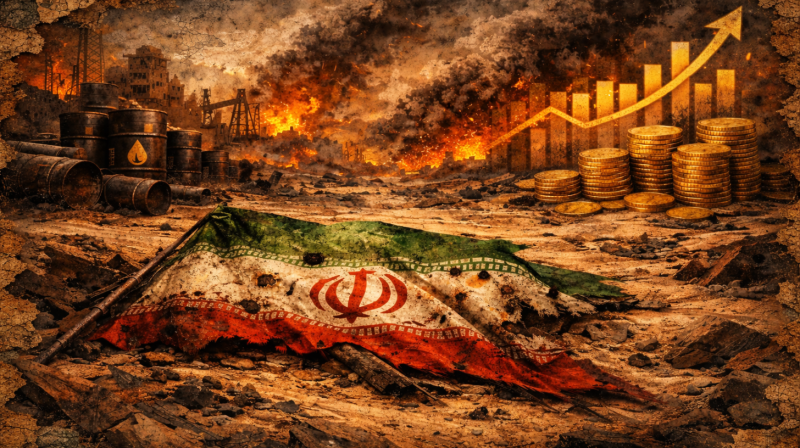
The Week That Shaped the World — 27 February - 6 March 2026
Iran Crisis 2026: The Geopolitics Behind the Escalation — and the Global Shifts It Triggered
The escalating confrontation around Iran is rapidly becoming more than a regional conflict. What began as a series of military strikes and retaliatory signals now appears to be reshaping several layers of global politics at once.
Across diplomatic channels, major powers are positioning themselves for influence in a crisis that stretches far beyond the Middle East. China has already launched emergency diplomatic outreach, dispatching its Middle East envoy while calling for restraint from all parties. At the same time, Western governments are quietly aligning behind Washington and Israel, laying the political groundwork for what could evolve into a broader coalition.
The reverberations are not limited to diplomacy.
Energy markets have reacted with renewed volatility as tensions threaten the stability of Gulf supply routes. Meanwhile, the conflict is beginning to intersect with other global theatres, including the war in Ukraine, where shifting geopolitical priorities may alter both military dynamics and diplomatic initiatives.
Beyond the battlefield, deeper structural trends continue to unfold. China is recalibrating its economic strategy while doubling down on technological independence. Financial markets are entering the era of autonomous AI trading, and central banks are accelerating experiments with digital currencies that could reshape the architecture of global finance.
Together, these developments suggest that the Iran crisis may represent more than a geopolitical flashpoint.
It may be a turning point in a broader realignment of power, markets and technology.
“History rarely moves in isolated crises. More often, a single spark reveals the deeper shifts already underway beneath the surface of the global order.”
1. Iran Crisis 2026: Middle East War, Global Alliances and the Battle for Capital
Smoke rising above the Zagros Mountains has quickly filled television screens across the world. The headlines are familiar: Kurdish mobilisations, Iranian retaliation, another chapter in the long chronicle of Middle Eastern instability.
Yet experienced observers know that sudden eruptions of conflict are rarely as spontaneous as they appear.
Sometimes the real trigger lies far from the battlefield.
Several analysts have quietly noted the timing of the current escalation. It arrived almost immediately after the release of the long-discussed Epstein dossiers — documents that have stirred uncomfortable conversations inside Western political circles.
The connection remains unproven. But in geopolitics, timing is rarely meaningless.
When domestic pressure begins to rise inside powerful capitals, the emergence of a new international crisis can dramatically shift public attention. History offers many examples of this pattern. Whether coincidence or catalyst, the effect is already visible: global discourse has pivoted rapidly from internal scandal toward confrontation with Tehran.
But the Iranian factor may serve another strategic function — one tied not to politics, but to markets.
Recent threats surrounding the Strait of Hormuz reminded investors how fragile the global energy system remains. Even the possibility of disruption triggered immediate market reactions. Oil prices jumped. Insurance costs surged. Risk models across the Gulf were recalculated overnight.
In that moment, a deeper geopolitical reality became visible.
Iran possesses a unique lever over the global economic system. It does not need battlefield victories to shape the strategic environment. Even limited instability in the Persian Gulf can ripple through energy prices, shipping routes and financial markets within hours.
And when uncertainty spreads, capital behaves predictably.
Investment begins to retreat from volatile regions and flow toward perceived stability — most often the financial centres of London and New York.
Seen from this angle, the current crisis may be about more than Iran itself. It may represent a broader contest over where global capital ultimately feels safest.
This interpretation remains a hypothesis based on geopolitical deduction rather than confirmed evidence. But patterns of power rarely reveal themselves through official statements alone.
Sometimes they emerge only when the noise of the battlefield settles.
“In geopolitics, wars often begin with missiles — but their real targets are markets.”
2. China Moves Fast: Beijing Sends Middle East Envoy as Iran Crisis Escalates
While missiles dominate the headlines across the Middle East, another front has quietly opened — diplomacy.
And Beijing has moved faster than many expected.
Speaking at a regular press briefing on March 5, Chinese Foreign Ministry spokesperson Mao Ning confirmed that Foreign Minister Wang Yi had launched an intensive round of emergency consultations with key international players. Over the past several days, Wang Yi held phone calls with counterparts from Russia, Iran, Oman, France, Israel, Saudi Arabia and the United Arab Emirates.
The message from Beijing was direct.
China urged all parties to respect the principles of the United Nations Charter and warned against what it described as the “arbitrary use of force” in international relations. Chinese officials stressed that military operations must stop immediately and that the only sustainable path forward lies in dialogue and political negotiation.
But Beijing is not limiting itself to statements.
China also confirmed that Zhai Jun, the Chinese government’s Special Envoy on Middle East affairs, will soon travel to the region to engage directly with the parties involved and work toward de-escalation.
The move signals something important about how global power is evolving.
For decades, the Middle East was largely managed through Western diplomatic channels backed by military alliances. Today, China is increasingly positioning itself as a parallel diplomatic actor — one that prefers mediation and economic stability over military leverage.
The stakes are considerable. Any prolonged conflict involving Iran risks destabilising global energy markets and disrupting trade routes that remain vital to the Chinese economy.
In other words, Beijing has strong incentives to prevent the crisis from spiralling further.
Whether China’s diplomatic push can actually calm the situation remains uncertain. The Middle East has never been an easy arena for outside mediation.
Yet Beijing’s swift response makes one thing clear: China no longer intends to watch the region’s crises from the sidelines.
“Power in the modern world is not only measured by armies — but by who arrives first with a diplomatic solution.”
3. Britain Divided Over Iran Crisis as Starmer Limits US Use of UK Bases
As tensions with Iran intensify, the political shockwaves are now reaching London.
Reports from Westminster suggest that Prime Minister Keir Starmer faced significant resistance inside his own cabinet over whether the United Kingdom should allow the United States to use British military bases for potential operations connected to the Iran crisis.
The issue quickly exposed deep divisions within the government.
According to political sources familiar with the discussions, several ministers warned that direct involvement in another Middle Eastern conflict could trigger both domestic backlash and a wider geopolitical escalation. The debate reportedly focused on key strategic locations such as RAF Akrotiri in Cyprus and the joint UK-US facility on Diego Garcia in the Indian Ocean.
After days of internal deliberation, Starmer ultimately approved a limited framework allowing the United States to use British facilities only for what officials described as “defensive purposes.”
Even that compromise has proven controversial.
Criticism has emerged from within the Labour Party, where some members fear that any level of military cooperation could draw Britain deeper into a widening conflict. Others argue that failing to support Washington would damage the transatlantic alliance at a critical moment.
Adding to the pressure, former US president Donald Trump has publicly warned that the United Kingdom could face trade consequences if it refuses to provide stronger support for American operations.
The episode reveals a difficult balancing act for the British government. London must navigate between alliance commitments to Washington, growing domestic scepticism toward foreign military engagement, and the risk of becoming entangled in a rapidly escalating regional confrontation.
For now, the compromise stands.
But the debate inside Westminster suggests that Britain’s role in the Iran crisis may become as politically sensitive at home as it is strategically important abroad.
“In modern alliances, the hardest battles are often fought not on the battlefield — but around the cabinet table.”
4. Western Coalition Signals Form as Allies Align with Washington Over Iran
While diplomats attempt to contain the Middle East crisis, another dynamic is quietly unfolding behind the scenes — the gradual alignment of Western allies around the United States and Israel.
Political signals from several capitals now suggest that a broader coalition could emerge if the confrontation with Iran deepens.
Germany and France have already expressed solidarity with Washington and Tel Aviv, though both governments emphasise that their current posture remains “defensive.” Officials in Berlin and Paris have indicated readiness to protect European military installations and allied infrastructure in the region and, if necessary, take what they describe as “proportionate measures” should Iranian attacks threaten European assets.
Further support may come from the Indo-Pacific.
Australian Prime Minister Anthony Albanese has taken a notably firm tone, stating that the international community seeks an end to what Canberra calls Iran’s nuclear threat. Australia is already contributing intelligence support through the joint Pine Gap facility and has not ruled out broader participation if Iranian-aligned groups expand attacks on commercial shipping or civilian targets.
Britain appears to be playing a particularly central role.
Prime Minister Keir Starmer has authorised the use of British facilities — including RAF Akrotiri in Cyprus and the strategic Diego Garcia base — for operations described by officials as defensive in nature. That decision effectively places London among the key logistical pillars of the emerging Western response.
Canada has also signalled that it may consider involvement under certain circumstances. Prime Minister Mark Carney stated that participation could not be excluded if Canadian citizens or international security were directly threatened.
For now, these moves remain largely political and logistical. Yet the pattern is familiar: modern coalitions rarely emerge overnight.
They begin with diplomatic alignment, intelligence cooperation and carefully worded statements.
Only later do the operational decisions follow.
“Before wars become military coalitions, they first appear as coalitions of political language.”
5. Ukraine Frontline Shifts as Global Attention Turns to the Iran Conflict
While global attention rapidly shifts toward the escalating confrontation with Iran, the war in Ukraine continues to evolve — and in some ways, the Middle Eastern crisis is already reshaping the battlefield.
Recent reports suggest that Ukrainian forces have achieved limited but notable gains along several sectors of the front. According to assessments from the Institute for the Study of War, Ukrainian troops in late February managed to retake more territory than they lost for the first time in nearly three years, reclaiming roughly 250 square kilometres since the beginning of 2026.
At sea, Kyiv has continued to demonstrate its growing ability to strike deep into Russian logistics. Between March 2 and March 4, Ukrainian drone operations reportedly targeted naval assets in Novorossiysk, damaging several vessels associated with Russia’s Black Sea Fleet.
Meanwhile, Ukraine has intensified long-range strikes against Russian energy infrastructure. Facilities linked to oil processing and fuel storage in regions such as Yaroslavl, Lipetsk and Belgorod have come under repeated attack, suggesting that Kyiv may be attempting to disrupt logistics ahead of a potential new phase of fighting later this spring.
Yet the most interesting development may lie beyond the battlefield.
The emerging conflict around Iran is beginning to reshape the broader geopolitical environment surrounding the war in Ukraine. Diplomatic initiatives previously expected to take place in Abu Dhabi involving Ukraine, Russia and the United States have reportedly been postponed as global attention shifts toward the Middle East.
At the same time, Ukrainian air defence specialists are increasingly being consulted by Western partners seeking practical experience in countering Iranian-made Shahed drones — a technology Kyiv has spent years learning to defeat.
If Tehran’s growing confrontation with Washington reduces the flow of such drones to Russia, even temporarily, Ukraine could gain a small but meaningful reprieve in the aerial dimension of the war.
In modern conflicts, battlefields rarely remain isolated.
Sometimes a war thousands of kilometres away can quietly alter the balance of another.
“In geopolitics, wars do not replace one another — they begin to intersect.”
6. China Lowers Growth Target as Economic Pressures Mount
China has quietly lowered its economic expectations.
During the latest policy briefings in Beijing, officials confirmed that the country’s GDP growth target for 2026 will fall in the range of 4.5 to 5 percent — the lowest official target set by Chinese authorities in more than three decades.
For a country once accustomed to annual growth rates above 8 percent, the shift is striking.
Yet Beijing’s decision reflects a changing economic reality rather than a sudden loss of ambition.
China’s economy is now navigating several structural pressures at once. The long-running crisis in the property sector continues to weigh on domestic demand, while global trade tensions have intensified following renewed tariff threats from Washington. At the same time, Chinese policymakers face the challenge of stabilising employment and restoring confidence among private investors.
Lowering the growth target may therefore serve a strategic purpose.
Rather than chasing aggressive expansion, Beijing appears increasingly focused on maintaining economic stability while preparing the country for a new phase of technological competition. Officials have repeatedly emphasised that the priority now lies in building what they describe as “high-quality growth” — an economy driven less by construction and debt and more by innovation and advanced industry.
This recalibration is already visible in government spending plans.
While overall economic expectations have been reduced, investment in research and development is continuing to rise. China has announced further increases in funding for artificial intelligence, semiconductor manufacturing and quantum technologies, signalling that technological self-sufficiency remains at the centre of its long-term strategy.
In other words, China may be slowing down — but it is doing so deliberately.
For global markets, the message is clear. The world’s second-largest economy is no longer pursuing growth at any cost. Instead, it is repositioning itself for a prolonged era of technological rivalry with the West.
“When China lowers its growth target, it rarely means retreat. More often, it means the country is preparing for a different kind of competition.”
7. Beijing Doubles Down on AI and Semiconductor Independence
If China’s economic growth is slowing, its technological ambitions clearly are not.
While Beijing has lowered its GDP growth target for 2026, the country is simultaneously expanding investment in strategic technologies. Government spending on research and development is expected to rise by roughly 7 percent this year, with priority given to artificial intelligence, semiconductor manufacturing and quantum computing.
Chinese policymakers increasingly describe these sectors as part of the country’s emerging “new productive forces.”
Behind the phrase lies a simple strategic calculation.
Over the past several years, escalating technology restrictions from the United States and its allies have exposed how dependent China remains on foreign chip design tools, advanced manufacturing equipment and certain categories of high-performance processors. Export controls introduced by Washington have already limited China’s access to cutting-edge semiconductor technologies.
Rather than attempting to negotiate these constraints away, Beijing appears to be pursuing a different strategy: build a parallel ecosystem.
The government has expanded funding for domestic chip manufacturers, encouraged universities to accelerate research in advanced computing architectures and directed state-backed investment funds toward AI infrastructure projects. Several Chinese provinces have also announced new industrial clusters focused specifically on next-generation semiconductor production.
At the same time, China is rapidly scaling its AI capabilities. Domestic technology firms are deploying increasingly powerful large language models and automation systems across sectors ranging from logistics to financial services.
The broader objective is clear.
Beijing is attempting to construct a technological supply chain that can function even under prolonged geopolitical pressure. Achieving complete independence from Western technology may remain difficult in the short term, but Chinese officials appear confident that sustained investment can gradually narrow the gap.
For global markets, this shift carries significant implications. The competition between China and the United States is no longer limited to tariffs or trade balances.
It is increasingly becoming a contest over who controls the technological foundations of the next industrial era.
“Economic power once depended on factories and trade routes. Today it depends on who controls the code, the chips and the data.”
8. Energy Markets Jolt as Middle East Conflict Disrupts Global LNG Flows
The escalating conflict in the Middle East is beginning to ripple far beyond the battlefield.
Energy markets, always sensitive to geopolitical instability in the Persian Gulf, have reacted quickly to the latest developments. Reports of supply disruptions and force majeure clauses affecting several liquefied natural gas shipments have already introduced new uncertainty into global energy logistics.
One of the most significant signals came from Qatar, one of the world’s largest exporters of liquefied natural gas. Energy traders report that contractual disruptions and security concerns linked to the widening regional crisis have forced several shipments to be delayed or rerouted.
The consequences have been immediate.
Insurance premiums for tankers operating near the Strait of Hormuz have surged, while shipping companies are reassessing risk exposure across the Gulf. Some ports in Asia and Europe are already reporting delays tied to the reorganisation of cargo routes and heightened security procedures.
For energy markets, the Persian Gulf remains a critical choke point.
Roughly one-fifth of the world’s oil supply and a substantial portion of global LNG exports pass through the Strait of Hormuz each day. Even the possibility of disruption is enough to introduce significant volatility into pricing models used by traders and energy companies.
That volatility is already visible.
Oil futures have shown sharp intraday swings, while gas prices in several regional markets have moved higher as buyers seek to secure alternative supply. Energy analysts warn that if tensions continue to escalate, markets could begin pricing in a more substantial geopolitical risk premium.
For governments and investors alike, the lesson is familiar.
In an interconnected global economy, conflicts rarely remain confined to their region of origin. Energy flows, shipping routes and financial markets all respond to instability with remarkable speed.
And when the Middle East trembles, the global energy system almost always feels the shock.
“Energy markets have a long memory. Every new crisis in the Gulf reminds traders how fragile global supply chains really are.”
9. Agentic AI Enters Finance as Regulators Tighten Oversight
Artificial intelligence is no longer just assisting financial markets.
Increasingly, it is beginning to run them.
Across global investment firms, a new generation of so-called agentic AI systems is moving from experimental deployment into real trading environments. These systems are designed not simply to analyse data, but to act autonomously — adjusting portfolios, executing trades and reallocating capital in response to market signals in real time.
For asset managers, the appeal is obvious.
Financial markets generate vast volumes of information every second: price movements, macroeconomic indicators, geopolitical developments and behavioural signals from millions of traders. AI-driven systems can process this data far faster than any human team, identifying patterns that would otherwise remain invisible.
Several major hedge funds and quantitative investment firms have already begun integrating autonomous algorithms into their decision-making frameworks. Instead of relying solely on traditional analysts, firms are allowing AI agents to recommend — and in some cases automatically execute — trading strategies across equities, commodities and foreign exchange markets.
But the technology is now attracting the attention of regulators.
Authorities in both the United States and Europe are moving toward stricter oversight of algorithmic trading systems. Financial supervisors worry that increasingly autonomous AI could amplify market volatility or create systemic risks if multiple institutions deploy similar models reacting to identical signals.
In response, regulators are beginning to demand greater transparency from financial institutions regarding how their algorithms make decisions, what datasets they rely on and how risk controls are embedded into automated strategies.
The debate is only beginning.
For decades, financial markets have been shaped by human judgment, experience and intuition. The arrival of agentic AI raises a new question: how much autonomy should machines have in managing global capital flows?
For investors, the implications are profound. The next evolution of finance may not be driven by new products or regulations — but by algorithms capable of learning, adapting and acting at a speed no human trader can match.
“The future of finance may not belong to the fastest trader, but to the smartest algorithm.”
10. Digital Currency Race Accelerates as Central Banks Expand CBDC Experiments
The global race to reshape the future of money is quietly accelerating.
Central banks across several major economies are intensifying experiments with central bank digital currencies (CBDC), a technology that could fundamentally change how cross-border payments and financial settlements are conducted.
Recent initiatives involving the European Central Bank and the Monetary Authority of Singapore signal a new phase in this effort. Both institutions have expanded pilot programmes focused on so-called wholesale CBDC, digital currencies designed specifically for interbank transactions rather than everyday consumer payments.
The objective is practical rather than ideological.
Today, international financial transfers can still take hours or even days to settle, particularly when transactions pass through multiple correspondent banks and payment networks. CBDC systems promise to streamline this process by allowing banks to settle large transactions almost instantly using digital tokens issued directly by central banks.
For financial institutions, the potential efficiency gains are significant.
Faster settlements could reduce liquidity risks, lower transaction costs and improve transparency in global financial flows. Pilot projects are also exploring the possibility of linking multiple CBDC platforms, enabling real-time cross-border payments between participating countries.
Yet the implications extend well beyond operational efficiency.
Central bank digital currencies could eventually reshape the architecture of international finance. If widely adopted, CBDC networks might alter how currencies interact with existing payment systems, potentially reducing reliance on traditional settlement infrastructures that have dominated global finance for decades.
At the same time, policymakers remain cautious.
Concerns about cybersecurity, financial stability and the impact on commercial banking continue to shape how quickly central banks are willing to move. For now, most CBDC projects remain experimental, designed to test technical frameworks rather than launch fully operational systems.
Still, the direction of travel is becoming increasingly clear.
Around the world, central banks are exploring how digital technologies might redefine the movement of money across borders.
“The next transformation of the financial system may not arrive with a single breakthrough — but through a series of quiet experiments inside central banks.”