Estonia, Ust-Luga and the Grey Zone of Consent: Has Ukraine Just Dragged the Baltics Closer to the War?
The Week That Shaped the World — 27 March - 3 April 2026
Estonia, Ust-Luga and the Grey Zone of Escalation — and Other Major Stories of the Week
This week, the geopolitical landscape teetered on the brink, as conflicts escalated, global tensions mounted, and strategic decisions began to alter the future trajectory of entire nations. The war between the U.S., Israel, and Iran continued to spiral, pushing global energy markets to the edge. Meanwhile, tensions within the Baltic region quietly amplified, with Ukraine’s drone strikes not just targeting Russian infrastructure but drawing the Baltic states into the strategic crossfire.
Energy, markets, and technology also shared the spotlight: oil prices surged once more, reigniting fears of stagflation, while the world watched as SpaceX made its IPO filing — an unprecedented move in the tech world. All the while, AI infrastructure and its growing vulnerabilities loomed large, hinting at an inevitable collision between technological progress and financial stability.
As we peer into the uncertain future, the question remains: Can the world adapt fast enough, or will it be reshaped by forces beyond anyone’s control?
“The world isn’t waiting for a solution; it’s already being reshaped by its own crises.”
1. Estonia, Ust-Luga and the Grey Zone of Consent: Has Ukraine Just Dragged the Baltics Closer to the War?
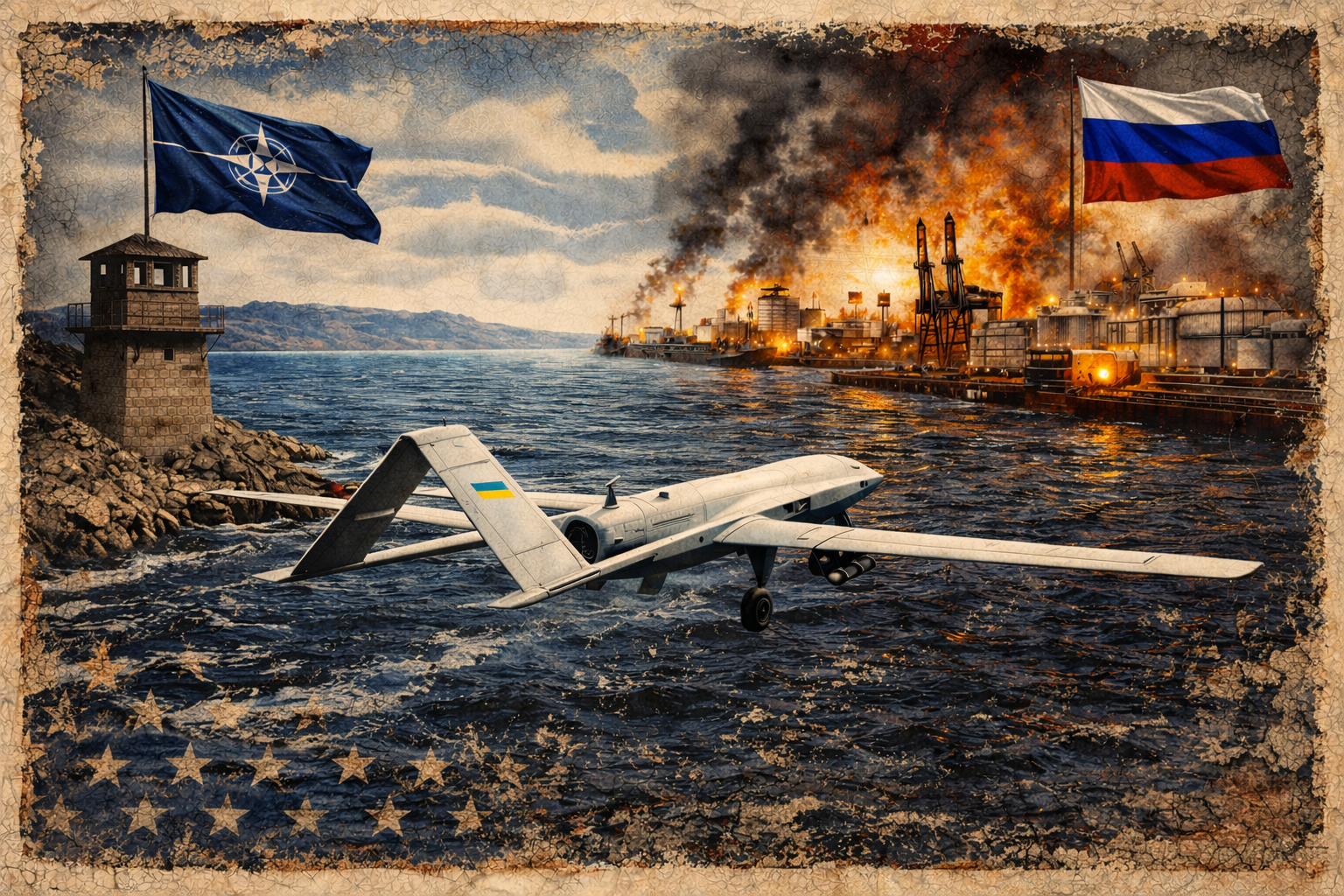
This week, Ukraine’s drone war against Russia did something politically dangerous. It spilled into NATO’s northern airspace.
It was confirmed by independent sources that Ukrainian drone attacks disrupted Russia’s Baltic oil export hubs, including Ust-Luga, and that drones linked to those strikes entered Estonian airspace, with one crashing into a chimney at the Auvere power plant. Estonian authorities said they did not believe Estonia itself had been the intended target. Finland, too, reported a related drone incident on its territory. Moscow, meanwhile, warned that if foreign airspace was being used for attacks on its Baltic infrastructure, it would respond.
That is the formal layer.
The political layer is less polite.
Our editorial view is that Russia may well interpret these events not as an unfortunate navigational mishap, but as something far more serious: tacit Baltic involvement in Ukrainian operations. We are not asserting as fact that Ukraine launched drones from Estonian soil. That has not been publicly proven. But if attacks on Ust-Luga approached from the Estonian direction, Moscow does not need perfect certainty to build its case. It only needs plausibility, and in war, plausibility is often enough.
This is where the silence becomes part of the story. Estonia did not publicly frame Ukraine as a violator. There was no visible diplomatic rupture, no theatrical protest, no attempt to transform the episode into a confrontation with Kyiv. That restraint may be understandable from a Western political point of view. It may also be read in Moscow as de facto tolerance.
And that changes the risk map.
Because once a state is seen — fairly or unfairly — as permitting hostile military traffic through its airspace, it begins to drift from sympathetic observer to functional participant. That does not make Estonia legally a belligerent in any settled sense. But wars are not governed by legal elegance alone. They are governed by perception, retaliation and the gradual expansion of what each side calls “necessary”.
Our editorial judgment is blunt: Ukraine appears willing to push the Baltic states into a more exposed position, whether by design or by the brutal convenience of geography. In practical terms, that means Tallinn, Riga and perhaps others are being moved closer to the line of retaliatory risk. A drone that flies the wrong route for one side becomes a future target list for the other.
That is how regional wars become wider ones.
“The most dangerous escalation is not always declared. Sometimes it arrives disguised as a drone, a silence, and a government choosing not to ask too many questions.”
2. Trump’s Iran Doctrine and the Price of Escalation: Why the Week’s Main Crisis Was No Longer About Pressure, but About Endgame
There are moments in foreign policy when governments still pretend they are applying pressure, and moments when pressure quietly turns into something else. This week, that something else looked a great deal like open-ended war.
By 3 April, the conflict involving the United States, Israel and Iran had moved well beyond the usual theatre of warnings, red lines and carefully staged outrage. Independent reporting confirmed that Washington was openly threatening further strikes on Iranian infrastructure, while the wider crisis was already rippling through shipping, fuel markets and diplomatic corridors far beyond the Middle East. The language had changed. So had the stakes.
Trump’s rhetoric on 2 April mattered not simply because it was aggressive, though it certainly was that. It mattered because it signalled that the White House was no longer speaking as though escalation were a risk to be avoided. It was speaking as though escalation were the instrument itself. Threats against bridges, power systems and broader infrastructure are not the language of limited signalling. They are the language of strategic punishment, delivered with the peculiar confidence of a superpower that still believes destruction can substitute for political design.
That is what made this the defining story of the week. The crisis was no longer just about Iran. It was about the return of a very old American temptation: to confuse military reach with strategic clarity. Meanwhile, the rest of the world was left to calculate the cost. Oil routes remained under strain, international efforts to stabilise navigation were still unresolved, and governments that had no interest in joining another Middle Eastern disaster were forced to price one in anyway.
Our view is simple enough. This week’s central lesson was not that the region had become unstable. It already was. The lesson was that Washington now appears willing to test how much more instability the system can absorb before it starts breaking in places far from Tehran.
“When a great power begins threatening infrastructure instead of explaining outcomes, it is no longer managing a crisis. It is wagering that fear will do the planning for it.”
3. Trump’s Prime-Time Address on Iran: A Speech That Sounded Less Like Reassurance and More Like Managed Escalation
Leaders usually go on television in wartime for one of two reasons: to calm the country or to prepare it for something worse. This week, Donald Trump attempted the first while very clearly doing the second.
In his prime-time address, Trump claimed that America’s core objectives in the war with Iran were nearing completion. Yet the speech offered no serious timeline, no settled political end-state and no convincing explanation of what “completion” was supposed to mean in practice. Independent reporting confirmed that while the White House presented the campaign as controlled and effective, it simultaneously left the door open to heavier strikes on Iranian infrastructure if Tehran refused to bend.
That contradiction is what made the speech important. It was not merely an update. It was an attempt to hold together two increasingly incompatible messages: that the war is nearly done, and that it may still need to become far more destructive. Trump praised military gains, spoke as though momentum remained firmly on Washington’s side, and yet avoided the one thing markets, allies and ordinary voters were actually waiting to hear — what the exit looks like.
The deeper problem is political, not theatrical. Once a government begins presenting escalation itself as proof of control, it starts relying on force to answer questions that strategy should have answered already. That is what hung over the speech. America was being asked to trust confidence in place of clarity. The allies were being asked to stay calm without being told what success would finally require. And the wider world was left to interpret a familiar imperial message: we are in command, even if we are still improvising.
Our view is that the address did not reduce uncertainty. It formalised it. The White House wanted to project steadiness. What it really revealed was a presidency trying to sell escalation as discipline, and ambiguity as strength.
“When a wartime speech promises both imminent success and harsher destruction, it is usually not announcing resolution. It is buying time.”
4. The US Supreme Court and the Birthright Citizenship Case: A Constitutional Crisis in the Making
The U.S. Supreme Court's hearing of President Trump's executive order on birthright citizenship this week marked a dramatic turn in the country’s long-standing legal framework, challenging a core tenet of American identity. This case, brought before the Court on April 2, 2026, is not merely about immigration policy; it’s a referendum on the very principles of citizenship itself.
The issue at hand is whether children born on U.S. soil to non-citizen parents are entitled to automatic citizenship. Trump’s administration, echoing the hardline rhetoric of its broader immigration agenda, argues that the Constitution's 14th Amendment, which grants citizenship to those born on U.S. soil, does not apply to children of non-permanent residents. For the first time in history, the Court is directly confronting the question of whether this clause can be amended by executive order, without the legislative process that typically brings about constitutional change.
The ramifications of this case extend far beyond legal technicalities. If the Court sides with Trump’s position, it would strip birthright citizenship from millions of children born in the U.S., affecting not only those of undocumented immigrants but also the broader status of American citizenship, altering how the nation defines its membership. This would represent a shift in how the U.S. views its relationship with the world, particularly in the context of immigration and national identity.
But the case is not just a legal battle; it is deeply political. Trump’s presence in the Court room only heightened the significance, as this was the first time a sitting president had attended a Supreme Court case directly concerning their own executive actions. His appearance was a potent symbol of the administration’s commitment to reshaping the nation’s legal and moral compass. The world will be watching as the Court’s ruling will not just define the fate of birthright citizenship—it will recalibrate the American political landscape.
“When a president enters the Supreme Court to hear arguments on his own executive order, it is not just a case. It is a declaration: power is now its own justification.”
5.China’s Counter‑Probes: Trade War Enters a New Phase
On 27 March, China’s Ministry of Commerce announced the launch of two counter‑investigations into U.S. trade practices, marking a clear escalation in the long‑running trade conflict between Beijing and Washington. These investigations target American measures that, in China’s view, impede the flow of Chinese products into U.S. markets and disrupt global supply chains, including barriers related to advanced technology and “green” products. They are set to run for six months, with the possibility of extension.
China framed these steps as reciprocal responses to recent U.S. trade probes initiated under Section 301 of American trade law — the same mechanism Washington has used repeatedly to justify tariffs and restrictions on Chinese imports.
This development has symbolic as well as material significance. It shows that the economic rivalry between the two largest trading powers is not easing; it is structurally deepening. Rather than a broad détente, the relationship is now punctuated by mirror investigations, each side claiming to defend its industries and strategic interests.
From a market perspective, the counter‑probes heighten uncertainty for companies caught between these two economic giants. For governments and policy circles, they underline a broader reality: trade policy is no longer a technocratic domain sequestered from geopolitics — it is geopolitics. The logic of retaliation and counter‑retaliation now lurks in each clause and every investigation, with implications that extend well beyond tariffs alone.
“When trade investigations become reciprocal and institutionalised, the conflict ceases to be about particular products and becomes about influence over entire economic systems.”
6. The Price of Oil and the Return of Stagflation: Markets on Edge
This week, oil prices surged as the global supply chain felt the reverberations of ongoing conflict in the Middle East, most notably the escalating tensions between the U.S. and Iran. The Strait of Hormuz, through which nearly 20% of the world’s oil passes, continues to be a flashpoint, with Iran threatening to shut down access, destabilising global shipping lanes. The impact was immediately felt, with Brent crude hitting $109.03 per barrel, marking an 8% increase. In the U.S., West Texas Intermediate (WTI) jumped nearly 11%, reaching $111.54, its highest level since mid‑2022.
The ripple effect from these price hikes is not only limited to fuel costs but extends deeply into the fabric of global inflation. As energy prices continue to climb, many economists are now openly discussing the return of stagflation, a scenario where rising prices are coupled with stagnant economic growth and high unemployment. This poses a serious challenge for central banks, which are already grappling with high inflation rates and the consequences of a tightening monetary policy.
This situation also directly impacts the U.S. consumer. With gas prices nearing $5 per gallon, the economic strain on American households is palpable, just ahead of the busy summer driving season. Meanwhile, central banks like the Federal Reserve and the Bank of England continue to face the uncomfortable balancing act of addressing inflation while preventing a recession. As global uncertainty increases, it’s clear that the energy market will remain a critical factor in shaping future economic policy.
“In the modern economic order, a spike in oil prices doesn’t just affect energy markets — it ignites a whole new series of economic fires, often in the most unpredictable places.”
7. SpaceX’s IPO: A New Frontier for the Stock Market
This week, SpaceX made headlines as it officially filed for an Initial Public Offering (IPO), potentially marking one of the largest stock market listings in history. The company, led by Elon Musk, is poised to challenge traditional space industry giants like Boeing and Lockheed Martin, while also drawing massive interest from investors eager to tap into the burgeoning commercial space sector.
SpaceX’s move to go public has been long anticipated, given the company’s dominance in launching satellites and its role in NASA’s Artemis mission, which aims to return humans to the Moon. With Starlink, its satellite internet service, and ambitions for space tourism, SpaceX is positioning itself as not just a government contractor but a global commercial force that could redefine space travel and communication for generations to come.
The IPO filing has already drawn significant attention from institutional investors, with estimates suggesting that SpaceX could be valued at over $2 trillion. This would place it among the most valuable companies in the world, surpassing even some of the biggest names in tech like Apple and Microsoft. But the road ahead is not without its challenges. The space industry, while promising, remains highly volatile, with regulatory hurdles, technical risks, and massive capital requirements.
Despite the risks, the prospect of investing in the future of space exploration has proven irresistible, both to private investors and national governments. SpaceX’s IPO is set to be a defining moment not just for the company, but for the entire space industry, as the public market becomes increasingly involved in the race to conquer the final frontier.
“Space may be the final frontier, but for investors, it’s now the final opportunity to get in on the ground floor of an industry that’s just beginning to lift off.”
8. AI Infrastructure and the Growing Risk to Private Credit: A New Era of Investment Woes
As artificial intelligence continues to make waves across industries, AI infrastructure has become a key focal point for global investment. This week, the tech sector saw massive capital inflows directed toward data centers, cloud computing, and high-performance computing systems that power AI systems. However, these investments are increasingly meeting headwinds, as concerns grow about the financial stability of AI infrastructure in the face of rising capital costs.
The push towards AI has led to what some are calling a “gold rush” in technology infrastructure, but there’s a catch. With interest rates climbing and inflationary pressures rising, the costs associated with maintaining and building out AI infrastructure are becoming significantly more expensive. The private credit market, which has been a key source of funding for tech companies, is now facing growing risk as AI projects start to encounter capital shortfalls and rising debt burdens.
Some experts argue that the disruption of AI is putting a strain on financial institutions, particularly those exposed to tech-heavy portfolios. The rapid pace of AI development has left many investors scrambling to adjust their models, with traditional financial structures struggling to keep pace. This has led to heightened concerns about defaults and credit risk in private lending, as companies that once seemed like surefire investments now face much steeper odds in terms of meeting their debt obligations.
The rise of AI is undoubtedly transforming the tech sector, but it’s also laying bare the vulnerabilities within the financial system that could be triggered by the massive influx of investment needed to fuel the AI boom. As the market adapts to these new challenges, investors and financial institutions alike will need to carefully consider the long-term viability of AI projects—particularly those that rely on speculative credit structures.
“AI may be reshaping the future, but it’s also reshaping the credit market, and not always for the better.”
9. The Return of Stagflation: Oil Prices and Global Economic Turmoil
This week, oil prices surged again, as the ongoing conflict in the Middle East, particularly the war between the U.S., Israel, and Iran, continued to disrupt global energy markets. With the Strait of Hormuz still under threat and the potential for further escalation, oil prices rose sharply, pushing Brent crude to $109 per barrel, a 8% increase, and West Texas Intermediate (WTI) to $111.54, marking its highest level since mid‑2022.
This rise in energy prices is not just a shock to the markets; it’s a clear sign that stagflation, the toxic combination of rising prices and stagnant economic growth, is once again on the horizon. Central banks around the world are already tightening monetary policy in an attempt to curb inflation, but these new surges in energy prices complicate that strategy. The effects are being felt in consumer confidence, as rising fuel costs are directly hitting households, just ahead of the summer driving season in the U.S. and Europe.
At the same time, global inflation is proving stubbornly persistent. While the U.S. Federal Reserve and the Bank of England have already raised interest rates to curb inflation, the new surge in energy prices suggests that inflationary pressures will likely continue to weigh heavily on the economy, slowing growth and contributing to higher unemployment in certain sectors.
With rising fuel costs affecting everything from transportation to food prices, there is growing concern that the global economy is heading into a period of economic stagnation, with inflationary pressures exacerbated by geopolitical instability. The risk of stagflation is now on the minds of central bankers, investors, and consumers alike, as the world braces for a possible economic slowdown.
“When energy prices rise faster than wages, the warning signs of stagflation become impossible to ignore.”
10. The Global Impact of the Iran War on Energy Markets and the Future of the Strait of Hormuz
The war between the United States, Israel, and Iran continues to reverberate throughout the global economy, especially in the energy sector. As the Strait of Hormuz remains under Iranian control and its closure persists as a significant geopolitical threat, the ripple effects are being felt far beyond the Middle East.
Since the conflict began, oil prices have experienced sharp fluctuations, with prices hitting levels unseen since the 2008 financial crisis. The global oil market, which relies heavily on the Strait of Hormuz to facilitate the flow of nearly 20% of the world’s crude oil, has seen disruptions that have significantly altered global fuel supply chains. As U.S. and Israeli forces continue their attacks on Iranian infrastructure, Iran has responded by targeting energy infrastructure in the Gulf region, adding fuel to the fire in terms of global supply and prices.
In the midst of this, international calls for de-escalation are growing louder, with more than 40 countries joining in efforts to seek a diplomatic resolution and reopen the Strait. However, these efforts are still in the early stages, with limited progress being made. Meanwhile, China and India, major oil consumers, have been silent on the military efforts and appear to be calculating their responses based on their economic self-interests, particularly the need for affordable energy to sustain their growing economies.
For now, the question of whether the Strait will remain open or become a permanently militarized zone is unclear. What is evident, however, is that the war is forcing nations to reconsider their energy security strategies, especially those in Europe and Asia, who are now looking to diversify supply sources and reduce their dependence on Middle Eastern oil.
“The future of the Strait of Hormuz is no longer just a matter of global shipping lanes; it is a question of how far the world is willing to go to secure energy in a war-torn region.”