
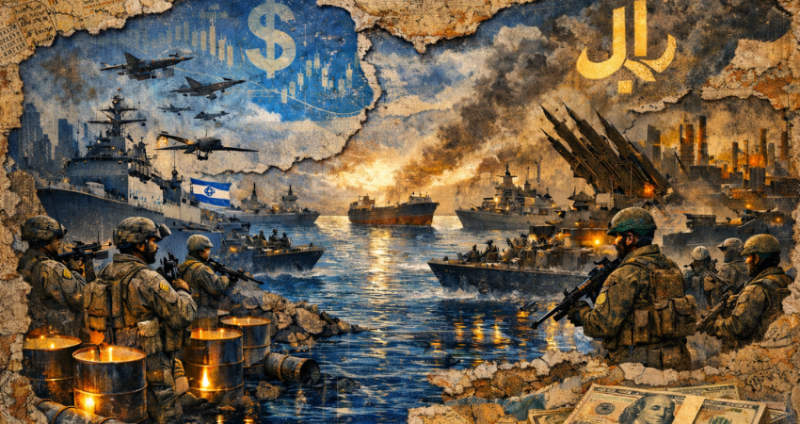
The Week That Shaped the World — 3–10 April 2026
Hormuz, Lebanon and the Price of Temporary Calm — and Other Major Stories of the Week
There are weeks when diplomacy looks like diplomacy, and there are weeks when it looks more like emergency scaffolding thrown up around a burning structure.
This was one of those.
By the second week of April, the world was no longer being moved chiefly by summit language or polished declarations. It was being moved by maritime chokepoints, air strikes, ceasefire arguments, undersea vulnerabilities, market panic, and the old unpleasant truth that investors still react faster than governments think. Hormuz became the week’s central test. Lebanon became the proof that even a truce can arrive with loopholes large enough to let missiles through. Europe, meanwhile, was reminded that modern insecurity does not always arrive by land. Sometimes it slides beneath the waterline.
And yet the week was not defined by war alone. The markets staged their usual performance of relief the moment the temperature dropped by half a degree. Oil fell. Energy stocks took a hit. Rate-cut hopes crept back into the room. Fintech kept rearranging itself. British tech capital, in one notable case, still found enough confidence to produce a unicorn in the middle of all this noise.
That is the larger pattern now. Geopolitics, inflation, shipping, monetary caution and technology funding are no longer separate conversations. They are becoming one long argument about who still controls the terms of stability.
They usually claim everyone does.
In practice, rather fewer people do.
“The modern crisis no longer announces itself in categories. It arrives as war, oil, cables, rates and capital — all pretending, briefly, not to belong to the same story.”
1. Hormuz and the Politics of the Pause
The Strait of Hormuz has an old talent. It does not merely disrupt trade. It reminds the world that the machinery of global confidence is much flimsier than officials prefer to admit.
This week, Washington and Tehran moved into a two-week ceasefire arrangement that looked less like peace than like an armed pause with clerks taking notes in the background. Britain, never eager to appear theatrical when it can instead sound “constructive”, joined the next stage of the conversation about how to reopen the waterway and restore shipping. The practical problem, of course, is that a ceasefire is not the same thing as trust, and a waterway does not become safe merely because several leaders agree that it ought to.
That is what made the story larger than the agreement itself. The issue was never simply whether the United States and Iran could stop firing for a fortnight. It was whether the system still believed that a vital global chokepoint could be stabilised before the market decided otherwise. Tehran wanted leverage. Washington wanted a controlled de-escalation that did not look too much like retreat. Everyone else wanted tankers moving again.
Such arrangements tend to be described as diplomatic progress. More often they are really admissions of cost.
The pause mattered. The fragility mattered more.
“Hormuz no longer needs to close completely to frighten the world. It merely has to remain uncertain for long enough.”
2. Israel, Lebanon and the Strange Timing of Negotiation
There is something almost obscene about discussing peace talks while the smoke is still rising.
And yet that was precisely the week’s second great paradox.
Israel signalled that it wanted to begin direct peace talks with Lebanon as soon as possible, while Lebanese officials were simultaneously seeking a temporary ceasefire to make broader discussions possible. Hezbollah, for its part, rejected direct negotiations outright. None of this unfolded in a calm diplomatic environment. It unfolded against the backdrop of continued bombardment, mounting deaths and a political atmosphere in which every side appeared to be speaking about negotiation and escalation in the same breath.
That contradiction is the real story. States often like to present diplomacy as the civilised alternative to force, but in the Middle East diplomacy is frequently introduced as an extension of force by other means. Israel appears to believe that military pressure can reorder the negotiating environment before any formal process begins. Lebanon, under immense strain, wants enough quiet to stop the collapse from becoming total. Hezbollah does not want the structure of direct talks at all.
So the region finds itself in that familiar modern condition: negotiations are discussed not after violence has failed, but while violence is still being used to improve the opening terms.
It is difficult to call that peace-making with a straight face.
“In this region, talks are rarely proposed after the guns fall silent. They are proposed while the guns are still being used to edit the script.”
3. France Tries to Redefine the Ceasefire
Europe’s role in crises of this sort is often to discover, a little late but with admirable seriousness, that the wording matters.
France spent part of the week doing exactly that.
Paris made clear that any meaningful ceasefire had to include Lebanon, after Israel intensified strikes on Beirut even as a broader pause had been announced elsewhere. That may sound procedural. It is not. It is a direct challenge to one of the oldest tricks in modern diplomacy: the selective ceasefire, in which the parties agree to calm the centre while leaving the edges available for continued punishment, ambiguity or political manoeuvre.
What Europe was really saying was that a truce without territorial or political coherence is not much of a truce at all. It is an argument disguised as an agreement. The continent does not want a regional “pause” built on legal or geographic loopholes so obvious that everyone can drive military operations straight through them.
This is the difficulty with every hurried ceasefire. The stronger side usually wants flexibility. The weaker side wants inclusion. The mediators want language vague enough to get signatures. Then reality turns up and begins asking rude questions.
It usually does.
“A ceasefire that requires footnotes to explain who is still allowed to be bombed is not a settlement. It is an administrative pause in the violence.”
4. Europe Remembers That Infrastructure Has a Seabed
For years, Europe liked to discuss security as though it were something visible: tanks, borders, aircraft, troop numbers, speeches at summits.
Then modern reality intervened.
Britain spent weeks tracking Russian submarines and specialist vessels near critical undersea infrastructure in British and allied waters, explicitly presenting the operation as a deterrent against possible attacks on cables and pipelines. Moscow denied the allegation. That denial changes very little about the strategic lesson. Europe’s vulnerabilities are now as likely to sit on the seabed as on any frontier map.
This matters because undersea systems are no longer technical background. They are strategic organs. Cables carry financial activity, military communications, data traffic and a good deal of civilisation’s daily pretence that the networked world is stable by default. Pipelines, likewise, do not merely move energy. They move political leverage, industrial continuity and the everyday confidence on which governments depend.
The point is not that sabotage has been conclusively proved in every case. The point is that states are now openly preparing for a world in which such acts are plausible enough to demand military monitoring before the damage occurs. That is a different era. A more nervous one. And probably a more honest one too.
The frontier, increasingly, is not where politicians point.
It is where the cables run.
“The twenty-first century has hidden some of its most important borders underwater, which is awkward for governments that still prefer their threats to arrive on maps.”
5. The Ceasefire Lasted Barely Long Enough to Be Named
The problem with fragile truces is that they are often announced in the language of peace and broken in the language of exceptions.
That was the case here.
The two-week pause around Iran and Hormuz barely had time to present itself as diplomacy before the region returned to its usual habit of correcting optimistic headlines. Israeli strikes resumed in Lebanon almost immediately, with devastating force. More than 250 people were killed in the deadliest wave of attacks seen there in weeks, and the supposed breathing space around the wider ceasefire began to look less like a settlement than like a technical misunderstanding with bodies beneath it.
This is what modern ceasefires increasingly resemble: not a true halt to violence, but an argument over geography. One side says the truce applies here but not there. Another says a regional deal that does not include Lebanon is not a regional deal at all. The result is predictable. Diplomats speak of restraint. Governments speak of interpretation. Civilians count the dead.
And once that begins, the political value of the ceasefire starts to rot from within. It may still exist on paper. It may still be defended in official language. But the strategic meaning is already gone. A pause that cannot survive its first real test is not a peace process. It is a delay between escalations.
For all the polished talk about de-escalation, the week ended by revealing something much cruder: the region had not stepped back from the edge. It had merely shifted its weight for a moment before sliding forward again.
“A ceasefire that dies on its first day was never a settlement. It was only a pause dramatic enough to disappoint people twice.”
6. The Market Rallies, Because Markets Prefer the Possibility of Calm to the Reality of War
Once the ceasefire emerged, the market responded in the usual dignified fashion: it exhaled dramatically and then tried to price in optimism before the diplomats had finished adjusting their ties.
Stocks rose on hopes that the U.S.–Iran truce might hold and perhaps even ease pressures elsewhere in the region. The FTSE 100 and broader equity benchmarks climbed as investors treated the de-escalation as a reprieve from the worst-case scenario hanging over oil, inflation and global supply routes. Oil itself dropped sharply after the two-week ceasefire was announced, with Brent and WTI recording double-digit declines from panic levels as traders bet that Hormuz might eventually reopen.
There is a familiar absurdity in this. A war does not become harmless because the market has chosen relief for forty-eight hours. The underlying structure remains unstable. Shipping has not fully normalised. The ceasefire is provisional. Lebanon remains volatile. Yet traders, being traders, are perfectly capable of celebrating the postponement of catastrophe as though it were the return of order.
Still, one should not dismiss the reaction too casually. Markets were not cheering peace. They were repricing risk. In 2026 that distinction matters. Capital no longer expects stability as a baseline condition. It treats temporary reductions in danger as investable events.
That is not confidence.
It is survival with better graphics.
“Modern markets do not require peace to rally. They merely require a brief reduction in the probability of disaster.”
7. Energy Shares Discover the Pain of Peace
For much of the first quarter, energy stocks had the good fortune to benefit from a world growing more combustible by the week.
Then the temperature slipped.
Global energy stocks fell sharply after the ceasefire between the United States and Iran punctured the war premium built into oil. Shell, BP, TotalEnergies and major U.S. producers all took noticeable hits as crude retreated and investors reversed the logic that had previously made the sector a comfortable shelter from geopolitical chaos. Airlines, in contrast, bounced on the prospect of cheaper fuel. It was one of those marvellously efficient market moments when one industry’s strategic terror becomes another industry’s relief rally.
The deeper point is that energy equities were no longer trading purely on earnings discipline, production strategy or cost structure. They were trading on fear. Once fear eased — not disappeared, merely eased — the valuation support weakened. That is what happens when war ceases to be background noise and becomes a pricing mechanism.
There is something revealing in that. Investors spent months insisting they were positioning rationally. In reality, many were simply long anxiety.
The sector was not punished for bad business.
It was punished for a temporary shortage of panic.
“When oil stocks thrive on geopolitical dread, even a fragile ceasefire can feel to them like an earnings downgrade.”
8. The Fed Gets a Little Room to Breathe
A small amount of calm in the oil market can perform wonders for the monetary imagination.
Not miracles, but wonders.
The ceasefire revived, at least modestly, expectations that the Federal Reserve might yet find room to cut rates later this year, because a sustained energy shock suddenly looked less inevitable than it had a day earlier. At the same time, markets remained divided over whether inflation from the war would prove temporary or stickier than hoped. In other words, the ceasefire did not produce clarity. It merely restored the possibility of it.
That distinction matters. Central bankers do not need tranquillity. They need plausible deniability against the charge that they are easing into another inflation problem. A falling oil price does not solve the wider inflation story, but it weakens one of the most immediate arguments for staying tight simply out of fear of what Hormuz might do next.
For borrowers, businesses and governments, even that is enough to change the mood. Rate-cut hopes are, after all, partly economic and partly psychological. They tell markets that the future may once again be governed by demand, labour and growth rather than by the tactical behaviour of a naval chokepoint.
That would be nice.
The world has not entirely earned such niceness yet.
“The Fed was not handed a solution this week. It was handed a narrower excuse for postponing panic.”
9. Monzo Leaves America and Rediscovers Geography
For years, fintech loved to talk as though scale were mainly a matter of ambition, code and enough venture capital to keep the slogans upright.
Reality, once again, has intervened.
Monzo is closing its U.S. business and refocusing on the UK and Europe, presenting the move as a strategic decision to deepen capabilities and accelerate growth in markets closer to home. Existing American customers will continue to use their accounts for a short transition period, but the message is clear enough: global aspiration is one thing; profitable strategic concentration is another.
This is more significant than it first appears. The old fintech mythology suggested that digital banking could travel almost frictionlessly across borders, as though regulation, habits, competition and market economics were merely administrative details awaiting elegant product design. They were not. They are not. Banking remains, in the rudest possible way, local.
Monzo’s withdrawal is not a collapse. Nor is it shameful. It is a sober correction of the expansionist instinct that has tempted much of modern tech finance into expensive geography lessons. Better, perhaps, to dominate the terrain you understand than to perform global destiny for investors while quietly burning capital in territories that refuse to behave.
Home markets are less glamorous.
They are also, from time to time, real.
“Fintech likes to imagine the map has disappeared. Regulation, customers and economics keep redrawing it.”
10. 9fin Becomes a Unicorn, and Britain Gets a More Interesting Signal Than It Realises
Amid all the week’s familiar noise — war, rates, shipping, strategic nerves — Britain produced one of the more telling business stories of the period.
It came from debt intelligence, not spectacle.
9fin joined the UK unicorn club after raising $170 million in a Series C round that valued the company at $1.3 billion. The funding took total capital raised above $250 million and pointed to continued investor appetite for financial infrastructure built around data, workflow and increasingly AI-enhanced analysis. That matters because it says something useful about where serious capital still sees practical value: not just in consumer hype, but in tools that help markets price, interpret and move through complexity.
There is a certain elegance in the timing. While geopolitics made the world look less governable, investors were still willing to back a firm whose purpose is to make one difficult corner of finance more intelligible. That is not escapism. It is adaptation. When the wider system becomes more unstable, the value of specialised clarity rises.
Britain should probably pay attention to that. The country spends an unhealthy amount of time worrying about whether it still produces globally relevant companies. It does. The better question is what sort. In 9fin’s case, the answer is pleasingly untheatrical: infrastructure for serious financial work.
Which, in a mature economy, is often far more valuable than noise dressed up as innovation.
“In an age addicted to disruption theatre, one of Britain’s stronger signals came from a company making finance less chaotic rather than more exciting.”