
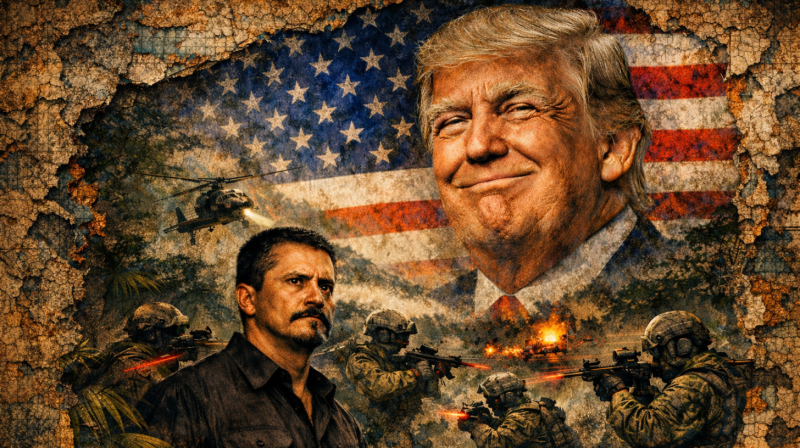
The Week That Shaped the World — 20–27 February 2026
The Killing of El Mencho in Mexico — and Other Major Stories of the Week
Power shifted quietly this week — but unmistakably.
It began in Mexico, where the killing of cartel leader El Mencho sent shockwaves far beyond the immediate violence that followed. From there, the headlines stretched across continents: nuclear rhetoric resurfacing in Europe’s information battlefield; four years of war in Ukraine hardening political realities; tensions rising between Washington and Tehran; America’s Supreme Court reasserting institutional limits; Olympic triumph clouded by controversy; desert air turned into drinking water; Europe’s green transition facing uncomfortable data; Silicon Valley giants challenging chip dominance; and Britain’s entrepreneurs multiplying despite economic strain.
Different arenas. Same undercurrent.
Authority tested. Influence recalculated. Systems strained — but not collapsing.
This was not a week of dramatic reversals. It was a week of adjustments. And in geopolitics, economics and technology alike, adjustments often matter more than spectacle.
“The world rarely pivots in a single moment. It tilts — incrementally — until everyone realises the ground has moved.”
1. The Killing of El Mencho in Mexico: Justice Served — or the Monroe Doctrine Reawakened?
On 22 February, Mexican special forces killed Nemesio Oseguera Cervantes — “El Mencho” — leader of the Jalisco New Generation Cartel (CJNG), in an operation reportedly supported by U.S. intelligence. Within hours, Mexico was burning.
Across more than twenty states, buses were torched, petrol stations attacked, roads blocked in orchestrated “narco-blockades”. Guadalajara and Puerto Vallarta imposed curfews. Flights were disrupted. Schools closed. As the week drew to a close, authorities insisted order was returning — though the tension remained visible in shuttered streets and nervous press conferences.
On the surface, the story is straightforward: a criminal kingpin eliminated; a government asserting control; justice, finally, catching up.
But geopolitics rarely confines itself to surfaces.
The timing is notable. The United States under President Trump has sharpened its language on border security and hemispheric stability. China’s economic footprint in Latin America continues to expand. The 2026 World Cup looms, with Guadalajara scheduled as a host city — symbolism and security now intertwined.
It is reasonable to ask whether this operation represents more than counter-narcotics success. Not because evidence proves a grand design — none has been publicly presented — but because power politics rarely ignore opportunity.
The Monroe Doctrine, long dormant as rhetoric, has re-emerged in tone if not in title: the Western Hemisphere as strategic priority. Cooperation against cartels provides moral clarity. Intelligence sharing creates leverage. Security crises can redraw lines of influence without formal declarations. History also teaches that Washington rarely wastes a security crisis in its own hemisphere — particularly when rivals are expanding their footprint just beyond the horizon.
Killing one cartel leader will not end narcotics trafficking. It may, however, reshape the political calculus around who guarantees order — and on whose terms.
President Claudia Sheinbaum now walks a narrow corridor: accept deeper U.S. security involvement and risk perceptions of dependency, or assert autonomy while relying on American intelligence assets already embedded in the process. Neither path is uncomplicated.
Speculation about wider alignments — even whispers of tacit great-power understandings — remains precisely that: speculation. Yet the hemisphere is clearly entering a phase of firmer boundaries and clearer hierarchies.
El Mencho is dead. The cartel system endures. The strategic consequences are only beginning.
“When a kingpin falls, we applaud the spectacle. But in geopolitics, the question is never who pulled the trigger. It is who redraws the map while everyone is watching the smoke.”
2. Russia Claims UK and France May Transfer Nuclear Weapons to Ukraine: Information War or Strategic Signal?
This week, Russian intelligence officials claimed they had obtained information suggesting Britain and France were preparing to transfer a limited nuclear capability to Ukraine. London and Paris swiftly denied the allegation. Moscow, however, has not softened its language.
There is, at present, no public evidence supporting the claim. Nor is there any indication that either the United Kingdom or France would realistically risk crossing such a threshold. The strategic, legal and diplomatic consequences would be seismic.
Which raises a more interesting question.
Why make the allegation at all?
In modern geopolitics, information is rarely neutral. A rumour about nuclear transfer does not need to be credible to be effective. It merely needs to be repeated.
Britain’s Prime Minister, Sir Keir Starmer, has maintained a firm stance toward Moscow. His rhetoric has been unambiguous. In a country already strained by economic stagnation, cost-of-living pressures and political fatigue, introducing the spectre of nuclear escalation into public debate is not a trivial move.
Once the word “nuclear” enters the domestic arena, nuance evaporates. Social media amplifies. Opposition figures circle. Headlines sharpen. A leader’s room for manoeuvre narrows.
If the objective was to test Western resolve, it would require hard evidence. If the objective was to inject toxicity into Western political discourse, the threshold is far lower.
It is entirely plausible that London and Paris had no such intention. It is equally plausible that Moscow understands precisely how fragile Western public opinion can be when confronted with existential language.
In this reading, the allegation is less about weapons and more about leverage.
Strategic influence in 2026 is not always exercised through battalions. Sometimes it is exercised through headlines.
“The most powerful missile in modern politics is not always launched from a silo. Sometimes it is launched into the news cycle — and it detonates inside the electorate.”
3. Four Years of War in Ukraine: The Front Is Frozen — The Politics Is Not
On 24 February the speeches were solemn, the statements polished, the solidarity intact. G7 leaders reaffirmed their commitment to Kyiv. The language was steady. Almost ritualistic.
But wars do not live in communiqués.
On the ground, this conflict has hardened into a metallic stalemate — drones humming overhead, artillery grinding forward by metres, electronic warfare turning the sky into static. No sweeping manoeuvres. No cinematic breakthroughs. Just attrition. Relentless, patient, industrial.
And time — in politics — is rarely neutral.
Four years of war does not only exhaust ammunition. It exhausts patience. Institutions. Alliances. Narratives.
Our editorial assessment is straightforward: President Volodymyr Zelensky’s political footing is no longer as solid as it was in the early months of resistance. Wartime leadership grants extraordinary legitimacy. But legitimacy, like morale, has a half-life.
Prolonged conflict recalibrates expectations. Allies begin to think not in terms of inspiration — but sustainability. Not charisma — but predictability. Not symbolism — but structure.
The battlefield may be static. The political gravity is not.
We are not suggesting an imminent collapse, nor do we claim that external actors are engineering a replacement. That would be simplistic. Power shifts in modern geopolitics are rarely theatrical. They are procedural. Gradual. Almost polite.
But it would be naïve to ignore that General Valerii Zaluzhnyi’s profile has gained quiet weight in European security circles. His image — institutional, disciplined, system-oriented — speaks a language Western capitals understand well. In prolonged strategic confrontations, partners often favour leaders perceived as steady managers rather than emotive symbols.
London, in particular, tends to value continuity in defence alignment and operational coherence. A military-structured figure can appear — to some — less improvisational, more predictable in coordination.
That does not mean replacement is planned. It means the probability of political rebalancing has grown.
Endurance politics is different from emergency politics. In the first, boldness is rewarded. In the second, controllability matters.
Zelensky remains the face of Ukraine’s resistance. But the chair beneath him is no longer bolted to the floor. Coalition pressures, institutional recalculations, allied fatigue — these are subtle forces. They do not shout. They lean.
History shows that leaders in prolonged wars are rarely removed dramatically. More often, they are gradually surrounded by alternative centres of gravity.
Whether Zelensky adapts to this shifting terrain — or whether figures like Zaluzhnyi accumulate strategic legitimacy — remains open.
What is certain is this: four years of war reshape more than front lines. They reshape tolerance for risk inside alliances.
And alliances, in the end, are pragmatic creatures.
“Wars do not always overthrow leaders. Sometimes they simply adjust the balance — until one name begins to sound more convenient than another.”
4. Iran–US Tensions Escalate: Evacuations Begin as the Temperature Rises
The line between deterrence and escalation has once again blurred in the long, uneasy standoff between the United States and Iran.
Following a series of American strikes on facilities described as pro-Iranian targets in the region, the diplomatic atmosphere has shifted from strained to combustible. Washington frames the actions as defensive — calibrated responses to mounting threats. Tehran, predictably, calls them aggression.
The choreography is familiar. The timing is not.
When military signals intensify in the Middle East, smaller actors move first. This week, Norway began evacuating its military personnel from Iraq on security grounds. No grand speeches. No dramatic ultimatums. Just a practical decision: when risk curves upward, you reduce exposure.
That quiet move says more than any press conference.
The region is once again balancing on the edge of miscalculation. Proxy dynamics, militia networks, retaliatory logic — all the familiar architecture of asymmetric confrontation is back in play. The difference in 2026 is context. Energy markets are fragile. Shipping lanes remain sensitive. Western capitals are already stretched across multiple theatres.
In prolonged geopolitical friction, escalation rarely begins with a declaration. It accumulates — strike by strike, warning by warning, evacuation by evacuation.
Washington does not seek a full-scale conflict. Tehran does not either. But both sides are signalling that deterrence must be visible to be credible.
The question now is not whether tensions are high. They are.
The question is whether anyone still controls the thermostat.
“Crises in the Middle East seldom explode overnight. They simmer — until one precautionary evacuation becomes the first chapter of something far less cautious.”
5. America at 250 — and at Odds With Itself
Washington had one of those weeks when the Constitution quietly clears its throat.
The Supreme Court of the United States stepped in and told the administration of Donald Trump something no White House enjoys hearing: not that far.
The ruling was surgical but significant. The economic emergency framework invoked by the president, the Court concluded, does not grant him the authority to impose sweeping global trade tariffs on his own. Translation — trade architecture is not a solo instrument. Congress still exists.
This was not a market panic moment. No sirens. No constitutional collapse. Just a boundary line redrawn in ink.
And yet, the symbolism matters.
For years, tariff power has drifted toward executive improvisation. Presidents test the edges. Lawyers stretch language. Markets adjust. This time, the judiciary pushed back.
Then came the theatre.
Hours later, in the State of the Union address — framed grandly as “America at 250: Strong, Prosperous, and Respected” — Trump spoke as if nothing fundamental had shifted. The economy, he insisted, is resilient. The border, more controlled. The nation, respected again.
Parts of the Democratic caucus chose absence over applause. Empty seats always say more than clapping hands.
The contrast was stark: a Supreme Court narrowing executive reach in the morning, a president projecting unrestrained confidence by night.
This is not dysfunction. It is friction.
America’s system still works — but it now works loudly. The courts tug one way. The executive leans another. Congress fractures along lines that are no longer temporary campaign trenches but hardened ideological borders.
The tariff ruling will not end the argument. It merely clarifies the battlefield.
Because this is the deeper story: the United States is approaching its 250th year not in decline, not in collapse — but in visible internal negotiation about where power should sit and who gets to wield it.
That negotiation is healthy.
It is also exhausting.
And when ambition meets institutional restraint, neither side leaves quietly.
“American power is rarely reduced in a single stroke. It is trimmed, contested, reclaimed — and then tested again the next morning.”
6. Milan–Cortina 2026: Norway Dominates, Controversy Shadows the Finish
When the 2026 Winter Olympic Games in Milan–Cortina drew to a close last Sunday, the headlines told familiar stories of athletic excellence, national pride, and the kind of moments that define a generation.
At the summit stood Norway, triumphant and relentless, setting a new benchmark with 17 Olympic gold medals — more than any nation has ever secured at a single Winter Games. It was a performance that felt both inevitable and breathtaking: precision on the ice, dominance on the snow, finish-line discipline on every slope.
China, too, left its mark, particularly in freestyle skiing, where its athletes combined flair with athletic rigor. Their podiums were earned — and deserved.
Yet beneath the medals and flags, this edition of the Games carried an undercurrent that refused to fade with the closing ceremonies.
For many viewers around the world, the word “fairness” echoed louder than the Olympic anthem.
A significant portion of the global audience — from seasoned winter sports fans to casual watchers on social platforms — reacted with palpable frustration toward judging decisions affecting several Russian competitors.
The most spirited debate centered on Petr Gumennik. Competing with evident skill and composure, Gumennik quickly became one of the most talked-about figures of the Games: not just for his athleticism, but for the style, grace, and quiet dignity with which he carried himself under pressure.
Across multiple platforms, commentators and fans alike dubbed him a kind of “true Russian aristocrat” — a label born not from nationalism but from admiration for how he seemed to embody poise under scrutiny.
But admiration turned into indignation when several judging calls involving Gumennik — particularly in judged disciplines — were met with waves of disbelief and discontent from international viewers. Many argued that the scores did not align with what the replays appeared to show. A chorus of opinion grew online suggesting that judging, in at least a few key moments, was overly harsh or inconsistently applied to him.
To be clear: Olympic judging has always been subjective, and debates around scores are nothing new. Officials work within defined criteria. Athletes and teams are bound by rules.
But when a single competitor becomes the focus of global critique on fairness — not just performance — something in the narrative shifts.
Gumennik’s supporters were not simply defending a result. They were questioning whether the spirit of impartiality — central to Olympic idealism — was fully honored in every instance.
This does not diminish Norway’s achievement. Their supremacy in Milan–Cortina was real. The gold medals are real. Celebrations are justified.
But the emotional texture of this Olympiad — its triumphs and its grievances — reveals something deeper: audiences today not only watch sport; they measure fairness.
And when the two don’t align smoothly, even the gleam of gold can be refracted into debate.
“Great sport doesn’t just crown winners. It survives scrutiny. And when viewers everywhere feel compelled to speak up, the Games become — for better or worse — a global conversation.”
7. Water From Air: A Nobel Dream Turns Industrial
Some inventions solve problems. Others redefine scarcity.
This February, the name Omar Yaghi resurfaced across global headlines — not merely as a Nobel laureate, but as the scientist whose decades-long pursuit of “water from air” is moving from laboratory proof to industrial reality.
Awarded the 2025 Nobel Prize in Chemistry for pioneering metal-organic frameworks — crystalline structures capable of trapping molecules with extraordinary efficiency — Yaghi’s work was once considered elegant, almost abstract chemistry. Beautiful science. Impractical, some said.
It no longer looks abstract.
According to presentations linked to his research group and associated ventures, container-scale installations are now capable of extracting substantial volumes of potable water per day — even in extremely arid environments — using solar energy alone. The principle remains the same: MOF materials capture atmospheric moisture at night, and release it through controlled heating during the day, producing clean condensate without desalination plants, pipelines or brine discharge.
No toxic residue. No heavy grid dependence. No river required.
For a planet entering an era of structural water stress, that shift matters.
Yaghi’s personal story gives the science an added dimension. Born in Jordan to a refugee family and raised in conditions where access to running water was limited, his career has always circled a simple question: can water be decoupled from geography?
Now, the atmosphere itself becomes a reservoir.
We should be cautious. Scaling, cost, durability, maintenance — these are not poetic questions. They determine whether breakthrough becomes infrastructure. Many technologies glitter at prototype stage before colliding with economics.
Yet something fundamental has changed.
Water scarcity has traditionally been a geopolitical lever. Rivers, dams and aquifers shape borders and bargaining power. If decentralised atmospheric harvesting becomes commercially viable at scale, that leverage subtly weakens.
It would not end drought. It would not erase climate stress.
But it would introduce a new layer of resilience — and resilience, in a volatile century, is currency.
There is a quiet symbolism here: a chemist who grew up without reliable water now designs systems that pull it from the sky.
Science does not often close such circles so cleanly.
“We have spent centuries fighting over water beneath the ground. The next chapter may belong to those who learn to harvest it from the air above.”
8. Eco-Scandal Brewing: Plug-In Hybrids Under Scrutiny
For years, plug-in hybrids were sold as the diplomatic compromise of the energy transition. A little battery for virtue. A little petrol for reassurance. Everyone happy.
Now that compromise looks less flattering.
A large-scale study conducted by the Fraunhofer Institute suggests that plug-in hybrid vehicles (PHEVs) consume up to three times more fuel in real-world conditions than manufacturers’ official certification figures indicate.
That is not a rounding error. That is a structural gap.
According to the analysis of real driving data across Europe, laboratory efficiency ratings — based on regulatory testing cycles — diverge sharply from how these vehicles are actually used. Engines switch on more frequently. Electric-only ranges are underutilised. Drivers do not charge as often as assumed in modelling scenarios.
On paper, many PHEVs qualify as low-emission vehicles. In traffic, they behave rather differently.
The economic implications are not trivial.
European climate policy has leaned heavily on electrification targets, fleet-average emission standards and tax incentives for “clean” vehicles. Plug-in hybrids have benefited from subsidies, corporate fleet advantages and favourable regulatory classification.
If real-world emissions significantly exceed certified values, that foundation becomes unstable.
Brussels may now face uncomfortable questions:
Were incentives misaligned?
Were certification procedures overly optimistic?
And more importantly — will environmental standards need tightening?
Automakers will argue that driver behaviour plays a decisive role. Regulators may respond that climate accounting cannot rely on best-case assumptions.
Behind the technical debate sits a broader economic tension. Europe’s green transition is already costly — politically and financially. Revising classifications or subsidies mid-cycle risks market disruption. Not revising them risks credibility erosion.
Investors dislike uncertainty. Voters dislike perceived greenwashing.
And when environmental policy meets consumer reality, the numbers eventually speak louder than marketing brochures.
Plug-in hybrids were meant to be a bridge technology — a pragmatic stepping stone between combustion engines and full electrification.
The question now is whether that bridge is sturdier than it looks.
“Transitions are rarely derailed by ideology. They stumble when the data refuses to cooperate.”
9. Meta & AMD: The First Real Crack in Nvidia’s Throne?
Silicon Valley does not make small moves anymore. It makes declarations.
On 24 February, Meta Platforms announced a massive multi-year agreement with Advanced Micro Devices for AI chips reportedly valued at up to $60 billion. But the real headline sits beneath the number: Meta is not merely buying hardware — it is positioning itself to acquire up to 10% of AMD’s equity.
That is not procurement. That is alignment.
For years, the AI boom has rested heavily on the shoulders of Nvidia. Its GPUs became the bloodstream of modern artificial intelligence — training large models, running inference, powering hyperscale data centres. The company did not just sell chips; it defined the ecosystem.
And ecosystems, when left unchallenged, begin to resemble monopolies.
Meta’s move signals something larger than diversification. It signals dissatisfaction with dependency. Hyperscalers are no longer comfortable relying on a single supplier for the most critical infrastructure of the decade.
The AI race has become a capital-intensive arms build-up. Whoever controls compute controls the pace of innovation. And whoever depends on a single source of compute accepts strategic vulnerability.
By tying itself financially and operationally to AMD, Meta is hedging — but also applying pressure. The message to Nvidia is subtle but unmistakable: pricing power has limits. Supply leverage can be countered.
Markets reacted accordingly. AMD’s valuation narrative has shifted from “challenger” to “contender.” Nvidia’s dominance, while still formidable, now faces credible institutional resistance from its own largest customers.
This is how monopolies erode in modern markets — not through regulation first, but through collective buyer behaviour.
The implications extend beyond Silicon Valley.
If hyperscalers fragment their AI infrastructure supply chains, capital flows across the semiconductor sector will rebalance. Margins will compress. Negotiating dynamics will shift. Innovation cycles may accelerate under competitive pressure.
Or — if AMD fails to match performance and reliability expectations at scale — Nvidia’s throne may look sturdier than critics assume.
For now, the signal is clear.
The AI infrastructure market is maturing. And mature markets do not tolerate single-vendor dominance forever.
“Monopolies rarely fall in a day. They crack when their biggest customers decide they’ve had enough.”
10. Britain: A Mixed Forecast — and a Surge in New Businesses
Britain rarely moves in straight lines. It prefers contradiction.
This week, fresh data from NatWest Group showed that the number of active companies in the United Kingdom has reached an eight-year high — 5.66 million registered businesses.
On paper, that is a quiet triumph. After years of pandemic shock, inflation waves and cost-of-living strain, entrepreneurial energy has not dried up. Quite the opposite — it appears to have multiplied.
Every new company registration tells the same story: someone, somewhere, still believes the numbers can work.
Yet optimism rarely travels alone.
This surge in activity arrived just as the energy regulator Ofgem announced updated parameters for energy price controls effective from April 2026.. The technical language was measured. The economic implications less so.
Energy remains one of the most sensitive variables in Britain’s recovery equation. For households it is anxiety. For small businesses it is margin. For startups — especially in retail, hospitality or light manufacturing — it can be the difference between growth and stagnation.
So the picture is mixed.
Entrepreneurship is rising. Confidence, at least at registration stage, is alive. Britain continues to produce risk-takers willing to launch firms in fintech, creative industries, green tech, and services.
But structural pressures remain firmly in place: elevated borrowing costs, cautious consumer spending, and now another recalibration of energy pricing.
This is not boom-time exuberance. It is something more British — resilient pragmatism.
Startups often emerge in uncertain climates. Some are born from necessity rather than abundance. When wage security feels fragile, self-employment becomes a strategy rather than a dream.
The question for the coming quarters is simple: will this surge in company formation translate into durable enterprises — or is it a defensive reaction to economic strain?
Markets will watch survival rates. Policymakers will watch inflation. Entrepreneurs will watch their cash flow.
And somewhere between rising registrations and rising utility bills sits the real state of the nation.
“Britain’s economy rarely shouts. It mutters, adapts, and starts another company anyway.”