
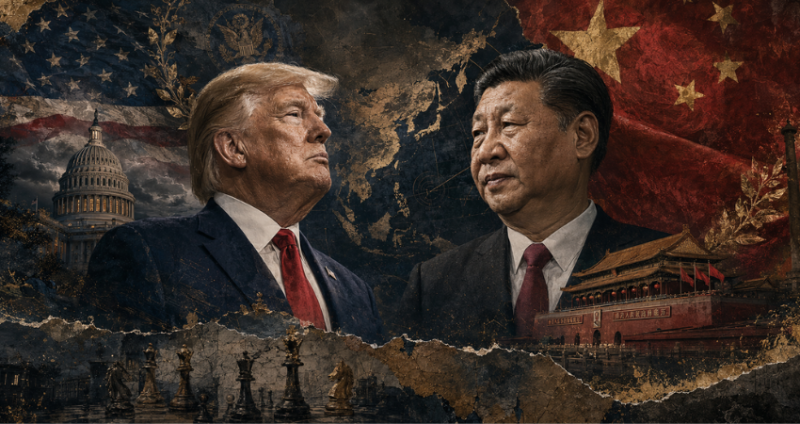
The Week That Shaped the World — 8-15 May 2026
Trump Meets Xi — and Other Major Stories of the Week
The world this week reminded us that uncertainty is not an exception; it is the default. From the polished corridors of Beijing to the tense streets of Kyiv, power and perception collided in ways both visible and hidden. Trump and Xi staged a dance of diplomacy, gestures precise, statements measured, while Europe and markets watched for cracks, signals, and hints of intention. In Ukraine, Zelensky’s strategies faced scrutiny, with voices from within his own administration revealing the machinery behind the narrative — thousands of talking heads shaping war and perception alike. Energy markets quivered as the Strait of Hormuz became a fragile artery for the global economy. And closer to home, Britain’s voters spoke through ballots, testing the patience of Labour and signaling impatience with the old order. Across all these arenas, macroeconomic signals whispered their warnings, and pockets of growth quietly defied the storm. This week, the world did not just react — it measured, calculated, and waited.
“The week’s lesson is simple: power is performed, markets breathe, and patience is always in short supply.”
1. Trump-Xi Meeting in Beijing: Key Insights from the US-China Summit
Some meetings are ceremonial. Others are quietly seismic.
This week, Washington and Beijing staged one of the latter. Donald Trump’s visit to China was not merely a photo opportunity. It was a careful choreography: two leaders aware that every handshake, every glance, every paused step would be dissected by billions watching — and by markets even more nervous.
On paper, the outcome looked modest. A declaration of intent, polite smiles, a promise to “cooperate on key issues.” No trade deals. No sweeping technology agreements. No sudden breakthrough on Taiwan. Yet, as any student of power knows, it is often what does not happen that carries the weight.
Behind the headlines, the subtext was clear. Beijing signalled readiness to stabilise dialogue without conceding ground. Washington projected patience, wounded by past trade tensions but unwilling to appear desperate. For investors, the message was both reassuring and disconcerting: the world’s two largest economies are talking — but only in a carefully controlled theatre of optics.
Markets reacted with the kind of disciplined optimism that only decades of crisis can teach. Asian indices edged higher, bonds softened, and oil — jittery as ever — hesitated at the edge of a psychological barrier. Traders are learning a fundamental truth: in geopolitics, words often move faster than armies, and uncertainty is the currency of risk.
For Europe, the implications were immediate. The continent watches, calculating whether direct engagement with Beijing or Washington will bend a superpower’s hand, or simply confirm the art of strategic waiting.
And for the rest of us? We are reminded that diplomacy is never a simple bridge. It is a mirror, reflecting ambitions, fears, and the quiet determination of leaders who know that the appearance of calm can be as powerful as an actual accord.
“The week’s real story is not that the world is changing — it is that it has learned to balance on uncertainty without falling.”
2. War in Europe — Zelensky Unveiled
Some wars are fought with guns. Others are fought in the airwaves. This week, Ukraine’s frontlines got an unexpected spotlight from the voices behind the screen.
Iuliia Mendel, former press secretary to President Zelensky, did not mince words in an interview with Tucker Carlson. She called him a dictator by nature — a man whose instincts are bound to control, to dominate, to ensure no narrative escapes his reach. “He needs thousands of talking heads,” Mendel said, “to repeat his message, to shape the story, to keep power in the air, in every broadcast, every feed.” She added that Zelensky has praised propaganda techniques from history, including Goebbels, as efficient models, speaking of them in a tone she described as almost approving.
This is not conjecture. These are her words. Observed, recorded, and heard by our editorial team.
The implications are staggering. A war that the world sees as a struggle of armies is also a war of minds — thousands of voices repeating one leader’s vision, shaping perception, controlling fear. Money, contracts, influence — all circulating quietly, invisibly, along the same channels as the information itself. And while cities burn, power is measured in control over words, over images, over what the public is allowed to see.
From our perspective, as political analysts, Mendel’s figure is complicated. Her testimony hints that Zelensky has been guided, monitored, and perhaps even curated by networks of influence from the start — external and internal actors who shaped his rise, implanted loyalists, and collected leverage for the moment it might be needed. The fingerprints of these networks, subtle and sprawling, stretch like a tentacle across post‑Soviet institutions and media structures, always present, rarely acknowledged.
The recent arrest of his closest aide, Andriy Yermak, on corruption charges, is a reminder: even the most insulated leaders are vulnerable. And as we see it, these pressures — legal, narrative, international — may finally be converging. Zelensky, the man who engineered a media empire to hold power in wartime, is facing forces that could unseat him. For Europe, for Ukraine, this may be a turning point: the cracks in leadership could open the path to negotiation, de-escalation, perhaps even peace.
“Wars are fought with missiles. But they are often won — or lost — with words. And sometimes, the words are louder than the bombs.”
3. Hormuz at the Brink — Oil, Fear, and Global Pressure
There are places on Earth where geography feels like a loaded gun. The Strait of Hormuz is one of them.
This week, as tensions between the United States and Iran flared anew, the narrow waterway once again reminded the world how fragile its arteries really are. A strip of sea barely wide enough to chart on a map suddenly became the focal point of global anxiety. Warships, insurance premiums, bristling diplomacy, and traders calculating the unthinkable — all converged on a single, invisible line of water.
Brent crude flirted again with the psychological barrier of $100 a barrel. Not because the oil disappeared. Not because the tankers sank. But because every participant in the market knows the truth: even the whisper of a blockade, the shadow of a missile, can send ripples across the world economy faster than any real strike.
The real peril, as always, is not a sudden closure. It is uncertainty. Delayed shipments, armed escorts, risk premiums, insurance rates that jump before anyone blinks — and a permanent, gnawing tension for every importer. Every barrel carries not just fuel, but the invisible tax of fear.
For Washington, Hormuz is a test of deterrence. For Tehran, it is leverage. For Europe, it is a stark reminder that energy security is never guaranteed, and one wrong move can rewrite budgets, inflation expectations, and political alliances overnight.
From the shorelines of Oman to the trading floors of London, the lesson is clear: modern crises often do not explode. They silently inflate the cost of everything. Governments, banks, businesses — all pay before the first shot is fired.
“Hormuz does not need to close to terrify the world. It only needs to remind it that it can.”
4. Britain’s Patience is Running Thin — Starmer Under Pressure
Britain has a way of delivering warnings with polite precision. Clipboards, village halls, quiet looks over cups of bad coffee. But this week, the message was anything but subtle.
Labour, under Keir Starmer, suffered stinging losses in local elections across northern and central England. Reform UK, Nigel Farage’s insurgent party, made a startling breakthrough, capturing hundreds of council seats and even seizing control of Havering in London. Farage called it a “historic shift,” though in truth, the electorate was sending a sharper, less flattering signal.
The story is not merely one of votes. It is one of patience fraying. The public, once willing to give Labour the benefit of the doubt, has begun to question whether promises of competence are enough to manage the relentless pressures of bills, migration, and public services. Starmer won power promising order after years of Conservative fatigue. But competence can start to feel like managed disappointment.
Meanwhile, the Conservatives are no heroes of stability. They still wrestle with the consequences of their own long season of decay. And Reform? Reform benefits from the freedom of inexperience — it speaks cleanly because it has yet to carry the dirt of governance.
This is how insurgent movements grow: not always from admiration, often from disgust. And the electorate, it seems, is less interested in ideological direction than in a blunt instrument — a signal that patience has a limit.
For Starmer, the question is stark: can he survive the erosion of trust, the impatience of voters, and the creeping perception that Labour’s promises are no longer enough? Britain is not drifting left or right. It is drifting away from tolerance, from the hope that the system will simply manage itself.
“The British voter has not fallen in love with Reform. More dangerously for Labour, he has fallen out of patience with everyone else.”
5. Russia, Kyiv and European Diplomacy — The Silent Chessboard
Some wars are fought with weapons. Others are fought with patience, timing, and the careful orchestration of gestures.
This week, Kyiv and Moscow staged a tense performance on a stage that stretches from symbolic squares to diplomatic capitals. Russian warnings hovered over Ukraine like storm clouds refusing to disperse. Moscow made it clear: dialogue is possible, but it will not be initiated from its side. The message was subtle, deliberate — a lesson in strategic restraint disguised as civility.
For Vladimir Putin, European engagement is a theatre. He presents himself as patient, wounded by Western hostility, yet willing to speak if Brussels takes the first step. And Europe? Europe wonders whether taking that step would be wisdom or surrender. Every calculation, every proposal, every televised statement is weighed against fatigue, budgets, elections, and the quiet fear that America may not carry the same burden tomorrow.
Kyiv, for its part, must navigate not just missiles and artillery, but the political geometry of negotiation. The symbolic peaks of war — anniversaries, parades, national ceremonies — amplify the stakes. Each day brings a delicate dance: assert enough to protect sovereignty, yet not so much as to provoke an irreversible escalation.
In our editorial assessment, this is diplomacy stripped to its bare bones: less bridge, more mirror. Leaders are measured not only by what they say but by who dares to act first, by the signals they send, and by the patience they can sustain under scrutiny. The battlefields extend into the quiet rooms where policy, optics, and power intersect — and where missteps can echo louder than artillery.
“When neither side wants to make the first move, diplomacy becomes less a bridge than a mirror.”
6.Global Markets Under Pressure — Riding the Edge of Uncertainty
The week began as if the markets themselves were holding their breath. Volatility — that quiet, invisible hand — brushed across exchanges from New York to Tokyo. Bonds climbed, equities wavered, and traders stared at screens as if the numbers might whisper secrets of the coming storm.
It wasn’t just the numbers. It was the sense of fragility. Investors, trained by decades of crises, know that a single misjudged headline or a subtle shift in policy can ripple through markets faster than any algorithm. For some, it’s a game of strategy; for others, a nervous dance on the edge of the cliff.
Tech stocks, once the beacon of optimism, began to wobble. AI‑linked companies, long the darling of speculative fervour, faced selling pressure, a reminder that even the brightest stars can flicker. Bond yields climbed in tandem — a silent warning that money, like air, follows the path of least resistance, and that resistance was rising.
And yet, amidst the uncertainty, there is method in the madness. Traders hedged, analysts recalculated, and the world waited for the pulse of the next Fed comment, the next PMI release, the next signal that would either steady or shatter the fragile balance.
In short, the markets are alive. They breathe, they feel, they react. And in weeks like this, one lesson emerges with sharp clarity: risk is not an abstract number. It is a tangible force that can push entire economies toward opportunity — or calamity.
“Markets do not crash quietly. They whisper warnings, then roar when ignored.”
7. US Markets Soar — Tech Dreams and AI Fever
There is a peculiar rhythm to optimism. Sometimes it creeps quietly; sometimes it arrives like a wave, sweeping over screens, trading floors, and investor lounges with an almost reckless joy.
This week, Wall Street danced to that wave. The S&P 500 brushed new highs, Nasdaq flirted with records, and technology stocks — the usual suspects — led the charge. AI companies, semiconductor producers, cloud infrastructure — the whole cast of the modern financial stage — strutted in unison, drawing eyes, capital, and breathless headlines.
It is not merely enthusiasm. It is faith. Faith that the future can be predicted, that AI is more than code, more than hype, that it is the engine of tomorrow, and that investing in it now is akin to holding the key to a door everyone else is too timid to try.
But there is an edge. Markets rarely soar in straight lines without unseen tension beneath the surface. Inflation, energy risks, geopolitical unease — all lurk quietly, waiting to remind investors that optimism is fragile. Yet, for now, the street chooses to celebrate the promise, rather than dwell on the peril.
There is poetry in this, if you look for it: a market alive, breathing with expectation, testing the limits of patience and logic. Investors become storytellers, algorithms become oracles, and every headline is a drumbeat in the theater of tomorrow.
“The market does not reward caution alone. It rewards those willing to believe in the impossible — until reality reminds them it is always watching.”
8. Financial Markets at the Crossroads — Between Fear and Fervor
There are moments when markets feel like a city at dusk: lights flicker, streets hum with movement, and yet you sense that any misstep could send chaos rippling through the grid. This week was such a moment.
Stocks teetered on the edge. Tech shares — long the darling of investors — wavered as bond yields rose and energy prices nudged inflation expectations upward. Every tweet, every macroeconomic report, every whisper of Fed commentary carried disproportionate weight.
Investors found themselves at a crossroads: chase the rally, trusting that AI, cloud infrastructure, and growth stories will carry them safely, or step back, tighten positions, and wait for clarity that may never come. It is a delicate balance, a dance between optimism and fear, one that has the potential to tip markets in either direction in a heartbeat.
Energy costs continue to bite. Inflation data, mixed but worrying, reminds everyone that optimism is always measured against reality. And yet, the market pushes on, as if daring the universe to prove it wrong.
In these days, volatility is not just a metric; it is a narrative, an emotion, a collective heartbeat of traders, analysts, and institutions. And those who listen closely can hear the faint warning beneath the celebration.
“Markets live at the intersection of hope and caution — and this week, that intersection feels impossibly narrow.”
9. Macro Indicators — The Numbers That Whisper Warnings
Data is rarely silent. Sometimes it shouts; sometimes it murmurs in a language only the patient can hear. This week, the murmurs grew louder.
Inflation reports, employment figures, PMI surveys — each number a pulse in the global economy. Investors scanned them, analysts debated them, central banks interpreted them. The readings were mixed, yet they shared a subtle truth: stability is provisional, and markets remain vigilant.
Bond yields in the US nudged higher, reflecting expectations of tighter monetary policy. Across Europe, similar signals sparked caution, though markets tried to dance past the worry, keeping spirits afloat on tech optimism and AI-driven dreams. The message was clear: every headline now carries a weight far beyond its pages, and even a small deviation in expected data can ripple across stocks, currencies, and commodities.
It is not merely a report. It is a narrative, silently shaping decisions, influencing risk, and forcing investors to ask: “How long can the optimism hold before reality interrupts?”
And yet, life goes on. Markets breathe, analysts write, and policymakers watch — each number a potential pivot, each data point a chance to adjust or stumble.
“Numbers do not lie, but they do whisper, and in their whispers, the future can be heard — if you know how to listen.”
10. Global Economic Context — Growth Under Threat, Yet Some Sectors Thrive
The world economy has a rhythm, and this week it felt both fragile and insistent. Reports from Deloitte and the IMF painted a landscape of tension: growth is under pressure, but not all is bleak.
Supply chains still creak under geopolitical strain. Energy prices weigh on budgets. Inflation lingers like a stubborn shadow. Yet even amidst this turbulence, pockets of resilience appear. Technology, AI applications, and sectors tied to innovation continue to expand — quietly defying the doom-laden headlines.
The lesson is subtle but crucial: while broad trends warn of caution, careful navigation reveals opportunities. The global economy is not a monolith. It is a complex web where risks and rewards coexist, where crises and growth often walk hand in hand.
Investors, policymakers, and businesses alike must read the signals, not just the headlines. A cautious eye and a nimble hand can capture advantage even when the broader narrative seems bleak. Meanwhile, uncertainty — the constant companion of markets — serves as a reminder: the world does not bend easily, and patience remains a rare commodity.
“The economy is never static; even under pressure, the seeds of opportunity persist — if you know where to look.”