
The Companies Turning Healthcare, Energy and Infrastructure Into More Human Systems
March had a different temperament.
It was not a month of flashy technological theatre. There were still funding rounds, still large numbers, still the usual language about transformation. There always is. But beneath that surface — and this is where the month became more interesting — a quieter pattern was taking shape. The most meaningful companies were not simply promising a cleverer future. They were trying to make present systems less wasteful, less delayed, less blind, less fragile.
That is not quite the same thing. In some ways, it is more difficult.
The strongest stories in March sat close to real pressure points: stroke intervention, cancer diagnostics, mental health access, rehabilitation, clinical decision-making, energy flexibility, digital infrastructure, healthcare workforce strain. These are not abstract markets. They are the places where inefficiency becomes personal rather quickly. A delayed diagnosis is personal. A poor rehabilitation pathway is personal. A brittle grid is personal, eventually. Even cybersecurity — which many people only notice when something goes wrong — becomes personal the moment a vital system fails at the wrong time.
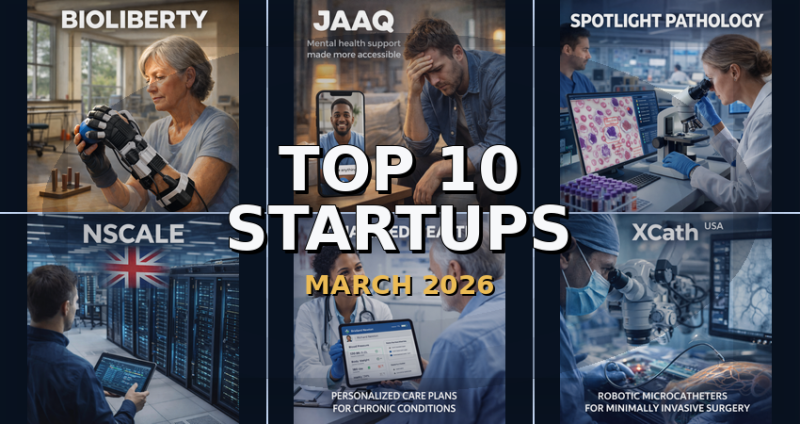
Five of the companies below are British. Five are global. Some are newer than others. A few are already moving beyond what one might casually call a startup. I do not find that especially troubling. The purpose of this rubric has never been to reward youth for its own sake. It is to identify companies that, in a given month, made a serious contribution to the way people live, recover, work, decide and endure.
March was, if anything, a reminder of a useful truth. Technology matters most when it enters systems that were already under strain — and makes them behave with a little more intelligence, a little more speed, and rather less cruelty.
Top 5 UK Startups
1) Bioliberty — Rebuilding Strength After the System Has Moved On

There is a quiet cruelty built into modern recovery. The acute event happens — a stroke, an injury, an operation, a neurological setback — and for a brief period the system surrounds the patient with urgency. Then, gradually, the tempo changes. Rehabilitation begins. The spotlight fades. And many people discover that the hardest work starts precisely when institutional attention begins to thin out.
That is the problem Bioliberty is addressing.
The Scottish company’s March progress mattered because it was tied to something more serious than yet another digital health pitch. Its work sits at the intersection of robotics, rehabilitation and post-acute care, particularly for people recovering hand and upper-limb function after neurological or orthopaedic impairment. This is not speculative technology in search of an application. The application is painfully obvious. Millions of people need structured, repeatable support to regain everyday function — opening a door, lifting a cup, buttoning a shirt, returning, in small increments, to ordinary independence.
That phrase matters: ordinary independence. It is one of the most undervalued goals in healthcare.
Bioliberty’s soft-robotic approach suggests a more continuous model of recovery, one less dependent on sparse appointments and more responsive to the reality that rehabilitation is repetitive by nature. It is rarely glamorous. It is often exhausting. But it is where quality of life is won back or quietly surrendered.
There are companies that sell medical excitement. Bioliberty is doing something better. It is trying to make recovery less accidental and more consistent. And if it succeeds, the gain will not be measured only in clinical terms. It will be measured in confidence, autonomy and the return of gestures most healthy people never think about twice.
“In healthcare, progress is sometimes the ability to give a person back the movements that once felt too ordinary to lose.”
2) JAAQ — Mental Health, Spoken About More Honestly and Reached More Easily

Mental health technology has, at times, suffered from an unfortunate instinct to become either clinical to the point of distance or soft to the point of uselessness. One can end up with either a system that feels coldly procedural or a platform so vague in tone that it becomes little more than an ambient performance of empathy.
JAAQ has tried to occupy a more credible middle ground.
Its significance in March lay not simply in growth, but in the clearer shape of its mission: to make mental health support more accessible, more embedded, and less intimidating for the people who need it. That may sound straightforward. It is not. One of the reasons mental health support remains unevenly accessed is that people often do not enter it through obvious clinical routes. They arrive through stigma, delay, uncertainty, embarrassment, exhaustion, curiosity, loneliness, or the slow dawning recognition that something is not right.
A platform that can meet people earlier — and in language that feels recognisable rather than institutional — has real value.
What makes JAAQ interesting is that it does not frame mental health as a niche wellness category for the already self-aware. It treats it more like an everyday human infrastructure problem. That is the correct instinct. Mental health is not an ornamental topic for campaigns or workplace posters. It shapes attention, resilience, relationships, employment, judgement and the general capacity to cope with modern life without splintering.
There is no single digital product that can solve that, of course. Anyone claiming otherwise should be ignored. But companies that reduce distance between people and useful support deserve attention. March suggested that JAAQ is becoming one of them.
“The first service mental health needs is not brilliance, but reach — the ability to meet people before silence turns into collapse.”
3) Spotlight Pathology — Shortening the Distance Between Suspicion and Diagnosis

Pathology is one of the least publicly discussed pressure points in modern healthcare, which is odd when one considers how much depends on it. The system can promise excellent treatment pathways, innovative therapies and new standards of care, but if diagnosis is slowed, inconsistent or constrained by workforce bottlenecks, the entire chain begins to falter before it has really begun.
Spotlight Pathology is working in precisely that crowded and consequential space.
Its March emergence as a serious candidate in blood cancer diagnostics matters because the company is not trying to make pathology fashionable. It is trying to make it faster, more scalable and less dependent on overstretched specialist capacity. That is a very different ambition, and, frankly, a more useful one. AI-assisted diagnostic tools in this setting are not valuable because they sound futuristic. They are valuable because pathology teams are under pressure and because earlier, more reliable interpretation can change the trajectory of care in diseases where time is not decorative.
That does not mean automation should displace clinical judgement. It should not. But there is a great deal of room between total manual dependence and reckless over-automation. Companies like Spotlight Pathology are interesting because they operate inside that middle ground, where technology supports expert assessment and helps the system cope with reality a little better than it currently does.
The reality, unfortunately, is not elegant. There are too many cases, too few specialists, and too many delays treated as normal simply because they have been normal for too long.
March suggested that Spotlight Pathology may be one of the companies trying to make that arrangement less acceptable.
“A medical system improves not only when treatments advance, but when it becomes harder for diagnosis to fall behind the urgency of illness.”
4) Electron / ElectronConnect — Teaching the Energy Grid to Negotiate More Intelligently

Most people do not think about energy flexibility markets until they are forced to. That is understandable. Grid infrastructure has traditionally enjoyed the privilege of invisibility: it is noticed when it fails, complained about when it becomes expensive, and otherwise left in the background like plumbing on a national scale.
But the energy transition is making that invisibility harder to maintain.
Electron’s role in March stood out because it sits in one of the less glamorous but increasingly essential layers of the modern energy system — the coordination of distributed energy resources and flexibility services. As grids absorb more renewables, more variability and more decentralised assets, the old model of one-directional energy logic begins to look, if not obsolete, then certainly inadequate. The grid must become more adaptive. Better at balancing. Better at using demand-side flexibility, local resources and real-time coordination. Better, in short, at behaving like a living system rather than a rigid one.
That is where Electron becomes interesting.
The company is not selling a fantasy of clean energy redemption. It is working on transaction and coordination infrastructure — the sort of thing that rarely gets public admiration, though the system cannot modernise without it. If flexibility markets become easier to operate and easier to procure through, that has implications far beyond energy traders or network operators. It affects cost, resilience, grid efficiency and the long-term practicality of decarbonisation itself.
The future of energy will not be built on generation alone. It will be built on coordination. March suggested that Electron understands this rather well.
“An energy system becomes modern not when it merely generates more power, but when it learns to manage complexity without charging society for its confusion.”
5) Nscale — When AI Infrastructure Becomes a National Strategic Question

There is a temptation, when discussing artificial intelligence, to spend an inordinate amount of time on models and almost none on the underlying industrial logic that makes those models possible. This is the digital equivalent of admiring a city skyline while refusing to ask where the electricity comes from.
Nscale belongs to the less celebrated part of the conversation — which is one reason it matters.
Its return to this rubric is not accidental. A company should not be brought back without a serious reason, and March offered one. The scale of its new financing and the seriousness of its infrastructure ambitions suggest that AI compute is no longer merely a private technical concern. It is becoming part of the wider strategic architecture of nations, industries and institutions. Who has capacity? Who can deploy it domestically? Who controls the energy, cooling and physical infrastructure required to sustain it? These are no longer niche questions for specialists in server halls. They are becoming economic questions, sovereignty questions and, eventually, social questions too.
That does not make every AI infrastructure company inherently admirable. Far from it. This space will produce excess, waste and a great deal of inflated rhetoric. But Nscale deserves attention because the practical layer of AI — data centres, compute availability, regional deployment, access to capacity — will shape who benefits from this technological cycle and on what terms.
People often speak about AI as though it arrived weightlessly. It did not. It arrived on hardware, land, power contracts, cooling systems and industrial ambition.
March made that harder to ignore.
“The intelligence of a century is often constrained less by imagination than by the infrastructure willing to carry it.”
Global — Five Startups Reshaping the Landscape
1) XCath — The Idea That Stroke Care Should Not Depend on Geography

There are few situations in medicine where time reveals its moral weight more brutally than stroke intervention. Minutes matter. Expertise matters. Access matters. And yet access to advanced neurovascular care remains uneven, tied too often to geography, institutional concentration and the luck of being near the right team at the right moment.
XCath’s March stood out because it points toward a different possibility.
The company’s progress in robotic neurovascular intervention — and the significance of remote capability in particular — is not just a technical milestone. It is an argument. It argues that high-level intervention should not remain so tightly bound to physical specialist concentration if robotics and remote control can begin to distribute that capability more intelligently. That does not mean every hospital becomes a full neurovascular centre overnight. Reality is slower than that. But it does mean the boundaries of what is geographically possible may be starting to shift.
That is a consequential development.
Medical robotics is often discussed in terms that are too aesthetic — precision, innovation, the future of surgery. Here the more compelling frame is access. If remote-capable intervention can help close the distance between a patient in crisis and the expertise required to treat them, then the human meaning of the technology becomes obvious rather quickly. It is about time, yes. But also fairness. About whether advanced care remains the privilege of location.
March suggested XCath is working on a future in which that answer may become less predetermined than it has been.
“In medicine, one of the most profound uses of technology is to reduce the power of geography over survival.”
2) Insilico Medicine — Drug Discovery, Pushed Closer to Industrial Reality

AI in drug discovery has been praised so often, and so loosely, that one begins to suspect the category may disappear beneath its own vocabulary. Every other company claims to accelerate discovery, compress timelines, transform pipelines or redesign biology at scale. Much of it may prove useful. Much of it will not.
What makes Insilico Medicine worth attention in March is that its progress feels less rhetorical and more industrial.
A serious research and development collaboration with a major pharmaceutical company signals something important: the market is beginning to distinguish between AI-for-biotech as a persuasive narrative and AI-for-biotech as a working component inside the machinery of therapeutic development. That distinction matters. It is easy to demo software. It is much harder to earn enough confidence from large pharmaceutical partners that they will commit programmes, intellectual property pathways and real development resources to the platform beneath it.
Insilico’s relevance, then, is not merely that it uses AI. A great many companies can say that. It is that the company continues to push AI-driven drug discovery closer to the point where serious institutions treat it not as an optional experiment, but as part of their development logic.
For patients, the value is not immediate in the consumer sense. There is no app to download, no device to hold. But progress in therapeutics rarely announces itself so neatly. It often begins in research architecture — in whether useful compounds can be identified, refined and moved forward with greater speed and better decision-making than before.
March suggested that Insilico is helping make that architecture more credible.
“Scientific progress is not made respectable by enthusiasm. It becomes respectable when institutions begin to place real consequences behind their belief in it.”
3) OpenEvidence — Giving Clinicians Better Information at the Moment It Is Actually Needed

Medicine has never lacked information. What it has often lacked is a humane way of delivering trustworthy information inside the tempo of actual clinical work. There is a difference. A journal library is useful. So is a guideline archive. Neither necessarily helps a tired clinician in the precise moment a question becomes urgent and time becomes thin.
OpenEvidence is trying to close that gap.
Its March progress mattered because it moved beyond the generic promise of “AI for clinicians” and toward something more grounded: the delivery of trusted, evidence-based knowledge inside real workflow. That may sound modest beside the bolder claims elsewhere in the market. It is not. The healthcare system is already suffering from excessive complexity, documentation burden and too many tools that demand more mental bandwidth than they save. A system that reduces the friction between a clinician and high-quality evidence, at the point of care, is not glamorous. It is useful. One should not underestimate the difference.
There is a quiet discipline in that proposition. OpenEvidence is not asking clinicians to surrender judgement. It is trying to support judgement with faster access to reliable material at the moment decisions are made. In other words, it is trying to make evidence feel present rather than formally available but practically distant.
That may prove to be one of the more valuable service layers in modern healthcare.
March’s significance here was not spectacle. It was the strengthening of a simple and rather overdue idea: if we want better clinical decisions, we should improve the quality and speed of information reaching the people making them.
“Knowledge does not improve care merely by existing. It improves care when it arrives in time to be used well.”
4) Qualified Health — The Harder Question: Can AI Be Trusted at Health-System Scale?

A good many healthcare AI companies still speak as though the main challenge were demonstrating intelligence. It is not. In healthcare, the more difficult challenge is demonstrating trustworthiness at scale — across institutions, workflows, governance structures and patient populations that are too complicated to be impressed by novelty alone.
That is where Qualified Health becomes interesting.
Its March progress points to a larger shift in the market: health systems are no longer merely asking whether AI can perform a task. They are asking whether it can be deployed safely, governed responsibly, integrated operationally and scaled without creating more confusion than it resolves. Those are harder questions. They are also the right ones.
Qualified Health’s relevance lies in that institutional layer. This is not a company selling a clever one-off feature. It is participating in the construction of healthcare AI as system infrastructure — something that must work across many settings, satisfy more than one stakeholder and survive contact with compliance, clinical caution, operational strain and the normal messiness of real care environments. If that can be done well, the rewards are substantial: less administrative burden, better operational visibility, more targeted intervention and the possibility of helping clinical teams focus on what actually requires human attention.
Of course, that is the optimistic version. The pessimistic version is equally easy to imagine. AI at health-system scale could become bureaucratic clutter in a smarter accent.
That is why companies in this category must be judged more sternly than most. Still, March suggested Qualified Health is operating in the right arena, and with the right seriousness.
“The future of healthcare AI will not be decided by the cleverest model, but by the systems that can be trusted to carry complexity without making care less human.”
5) Doctronic — A New Threshold in Care Access, and a New Set of Questions
Sometimes a company earns attention not because its progress is comfortable, but because it forces an uncomfortable conversation that was going to arrive sooner or later anyway.
Doctronic is one of those companies.
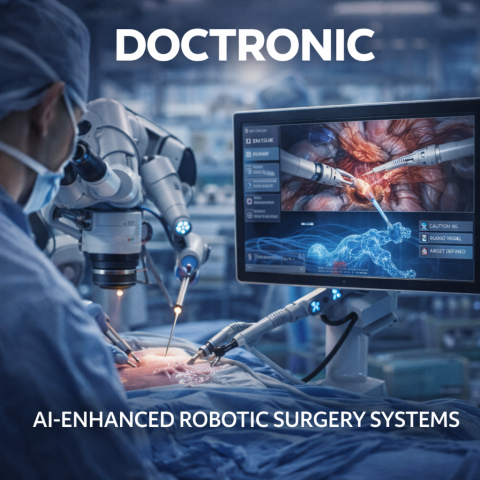
Its March moment matters because it appears to mark a real threshold in how AI may participate in healthcare delivery, specifically around the renewal of prescriptions within a legal and operational framework. That is not a trivial development. If such systems can operate safely, lawfully and usefully, the implications for care access are substantial. Routine administrative interactions consume extraordinary amounts of time in healthcare. Some of that time is clinically meaningful. Some of it is merely procedural drag. The possibility that part of this layer could be handled more intelligently and more efficiently is easy to understand, especially in systems strained by workforce shortage and access bottlenecks.
But this is also where caution becomes a form of respect.
The promise here is obvious: faster access, less friction, reduced waiting, lower pressure on clinicians for repetitive tasks that do not always require the full weight of a traditional encounter. The questions are equally obvious: governance, safety boundaries, patient context, edge cases, accountability. Healthcare does not become better because a machine acquires legal permission to act. It becomes better only if the action is appropriate, bounded, reliable and connected to the patient’s actual needs.
So Doctronic deserves attention, but not with the breathlessness this sector often encourages. March suggests it may represent a meaningful shift in the architecture of access. That is significant. It also means the standard of scrutiny must rise alongside the ambition.
“Technology should remove unnecessary delay in care — but never at the cost of forgetting that a patient is not a workflow.”
Editor’s Choice — XCath
Not because it raised the most money.
Not because robotics remains an easy way to attract attention.
But because March’s most meaningful progress, in my view, came from a company trying to reduce one of medicine’s cruelest inequalities: the inequality of distance.
XCath’s work in remote-capable robotic stroke intervention carries a significance that goes well beyond technical sophistication. It gestures toward a future in which the availability of advanced care may become less dependent on whether a patient happens to be physically close to a rare cluster of specialist expertise. In medicine, that kind of shift matters enormously. It has moral weight, not merely commercial value.
There were many serious companies in March. Several belonged quite comfortably in this list. But XCath stands slightly apart because its progress speaks to something fundamental: whether technology can help make life-saving expertise more reachable when time is short and geography is unfair.
That is not a minor ambition.
It is one of the better ones technology can have.
“The best innovations in medicine are often the ones that do not simply improve treatment, but change who has a realistic chance of reaching it.”