Top 10 Startups of the Month: January 2026 Edition

The Companies Turning Breakthroughs Into Pressure Points
January rarely announces itself.
It doesn’t arrive with grand conferences or choreographed optimism. It arrives with pressure — economic, infrastructural, technological. Systems that survived December’s reflection are forced, quietly, to prove whether they can actually hold.
This month wasn’t about invention. It was about consequence.
Across finance, energy, artificial intelligence and infrastructure, a pattern emerged: technologies stopped asking to be integrated — and started demanding to be reorganised around. In several cases, entire industries were forced to confront an uncomfortable truth: the tools they had built their confidence on were no longer the centre of gravity.
Five of the companies below are British — disciplined, infrastructure-minded, shaped by constraint rather than spectacle. Five more operate globally, each pressing on a different fault line of the modern economy.
None of them launched a miracle.
Several of them, however, changed what failure would now look like.
Top 5 UK Startups
1) 10x Banking — When Core Systems Stop Being Sacred

Banking technology has always been described as “core”.
What January revealed is that much of it was simply old.
10x Banking’s progress this month wasn’t framed as a software upgrade or a partnership announcement. It was framed as a migration of trust. A major international banking institution committed to replacing its legacy core with 10x’s cloud-native architecture — not to experiment, but to operate.
This matters because core banking systems are not replaced lightly. They are tolerated, patched, and feared. They survive not because they are good, but because they are dangerous to touch. January marked a rare moment when that fear broke.
10x doesn’t position itself as a fintech challenger. It behaves like an infrastructural surgeon — removing decades of accumulated complexity and replacing it with systems designed for transparency, real-time processing and regulatory clarity.
What is quietly changing is the balance of power. Banks are discovering that loyalty to legacy systems is not prudence — it is risk. And once one institution crosses that line, others tend to follow.
The story here isn’t disruption.
It’s permission — the permission to finally let go.
“Progress begins the moment institutions stop confusing stability with stagnation.”
2) Neuranics — When Human Signals Leave the Laboratory

For years, advanced biosensing lived safely behind academic glass. Too sensitive, too fragile, too impractical for the world outside controlled environments.
Neuranics spent January proving otherwise.
The Scottish company’s magnetic sensing technology — capable of detecting muscular and cardiac signals without direct contact — crossed an important threshold: from experimental novelty to product-ready system. Not perfected, not mass-marketed, but engineered with deployment in mind.
The shift is subtle but important. Technologies that read the human body are often framed in futuristic terms: brain-computer interfaces, augmented cognition, speculative medicine. Neuranics is moving in the opposite direction. It is making those signals mundane — readable, repeatable, manufacturable.
That change has consequences far beyond wearables. It opens doors in medical diagnostics, assistive technologies and human-machine interaction — areas where reliability matters more than ambition.
January didn’t make Neuranics famous.
It made it plausible.
“The future arrives not when humans become extraordinary — but when extraordinary signals become ordinary data.”
3) bit.bio — Biology, Without the Waiting

Biotechnology is often judged by breakthroughs.
Patients experience it through delays.
bit.bio has spent years working on something less glamorous but far more consequential: removing uncertainty and time from biological research by turning human cells into programmable assets. In January, the company moved decisively toward industrial-scale deployment of that vision.
This is not about discovery in the romantic sense. It is about repeatability. By standardising how cells are produced and behave, bit.bio is reducing the friction that slows toxicology testing, drug development and disease modelling.
The significance is easy to miss. But when experiments stop depending on artisanal biological conditions and start behaving like systems, entire research pipelines accelerate.
January didn’t produce a headline cure.
It shortened the distance between questions and answers.
“In medicine, speed is rarely dramatic — until you realise what it quietly saves.”
4) AgileRL — Making Reinforcement Learning Affordable Enough to Matter

Reinforcement learning has always promised adaptability.
In practice, it often delivered invoices.
AgileRL’s work this January focused on a less celebrated frontier: economics. By significantly reducing the cost and time required to train RL agents, the company is shifting the technology from research labs into operational environments.
This matters because RL’s potential has never been theoretical. Its limitation has always been practical. Training complexity, compute expense and fragile optimisation cycles kept it confined to well-funded teams.
AgileRL is not changing what reinforcement learning can do. It is changing who can afford to use it — and that shift tends to have cascading effects.
When adaptive systems become cheap enough to deploy broadly, industries start experimenting earlier, failing faster and learning continuously.
The result is not smarter algorithms.
It is humbler decision-making.
“Intelligence spreads fastest when it stops being expensive.”
5) Monta — Repairing the Invisible Layer of Electric Mobility

Electric vehicles didn’t fail because of batteries.
They failed because of reliability.
Monta’s progress in January highlighted a rarely discussed truth: infrastructure doesn’t collapse loudly. It erodes quietly — through firmware mismatches, communication errors and systems that technically exist but practically fail.
By focusing on real-time monitoring and automated correction within EV charging networks, Monta demonstrated a dramatic improvement in operational reliability. Not through new hardware, but through attention.
This is the kind of progress that doesn’t photograph well. No new stations. No ribbon-cutting. Just systems that finally work when people expect them to.
As EV adoption matures, tolerance for failure shrinks. January showed that the next phase of electrification is not about expansion — it is about trust.
“Infrastructure succeeds the moment people stop planning around its failure.”
Global — Five Startups Reshaping the Landscape
1) Anthropic — The Month Software Realised It Was Replaceable

Anthropic is not a startup in the traditional sense.
In January, it behaved like a pressure event.
The release of multiple open plugins for its AI agent Claude fundamentally altered how organisations think about software. Legal workflows, compliance processes and internal coordination — long protected by specialised SaaS platforms — suddenly looked fragile.
The market reaction was swift and telling. Investors didn’t panic about AI improving productivity. They panicked about software losing its reason to exist.
What Claude’s ecosystem revealed is that intelligence no longer needs to live inside applications. It can sit above them — orchestrating, replacing, dissolving them altogether.
This is not the end of SaaS.
It is the end of SaaS as the default unit of value.
“When intelligence becomes the interface, software becomes optional.”
2) Polar Night Energy — Energy Storage, Without the Elegance

The most important energy breakthrough of January looked unimpressive.
A sand-based thermal storage system entered industrial operation in Finland, quietly proving that renewable energy can be stored for months — cheaply, reliably, without exotic materials.
This matters because decarbonisation has long been trapped between idealism and delay. Polar Night Energy’s system doesn’t promise perfection. It offers sufficiency — enough heat, stored long enough, to replace fossil fuels in real industrial processes.
The result is not theoretical sustainability.
It is immediate emissions reduction.
Sometimes the future isn’t clean.
It’s granular.
“Progress accelerates the moment solutions stop trying to be elegant.”
3) Blaize — Artificial Intelligence Touches the Road

For all its sophistication, AI has remained strangely distant from physical reality.
Blaize spent January demonstrating what happens when that changes.
Its energy-efficient chips were deployed in live traffic management systems, enabling real-time optimisation without cloud dependency.
The impact wasn’t abstract. Congestion eased. Response times shortened. Decisions moved closer to where they mattered.
This is physical AI — not models competing for benchmarks, but systems embedded in cities, bound by latency, power constraints and responsibility.
Once intelligence leaves the data centre, it inherits accountability.
“Intelligence becomes serious when it has to obey physics.”
4) Starfish Space — Cleaning Up After Progress

Space has long operated without consequences.
Launch, deploy, replace, repeat. What failed was simply left behind, drifting quietly, becoming someone else’s problem. January suggested that this era is ending.
Starfish Space secured a historic contract to provide satellite de-orbit services — effectively introducing end-of-life responsibility into low-Earth orbit. For the first time, orbital cleanup moved from aspiration and policy language into an operational service with timelines, obligations and accountability.
This matters more than it appears. Once satellites are expected to be removed, not abandoned, everything changes — from how constellations are engineered to how they are insured, regulated and priced. Longevity stops being a marketing promise and becomes a lifecycle discipline.
Infrastructure, even in space, is beginning to resemble infrastructure on Earth. It must be maintained. It must be retired. And it must leave less behind than it takes.
Progress left debris.
January began the cleanup.
“Maturity begins when systems are designed to end responsibly.”
5) Eve Medical Robotics — Precision, Without Performance
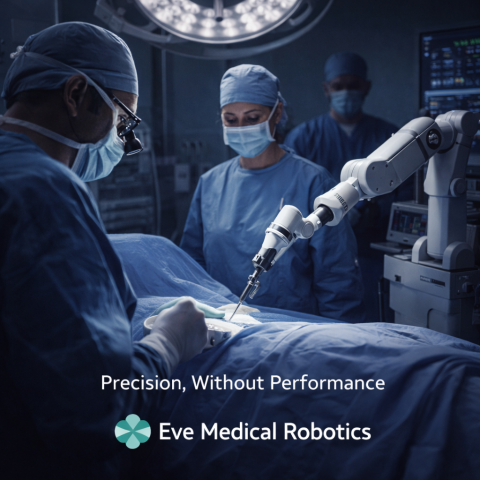
Surgical robotics often chase spectacle. Screens glow, arms move theatrically, demos promise revolutions. Eve Medical Robotics is chasing something far less cinematic — reliability.
In January, the company’s systems entered practical clinical demonstrations not as replacements for surgeons, but as stabilising instruments within the operating room. They don’t seek attention. They reduce tremor. They standardise motion. They quietly remove variables that have no place in surgery.
This distinction matters. Medicine does not reward ambition for its own sake. It rewards consistency under pressure, repeatability across patients, and tools that behave the same way on a long night as they do in controlled trials. Technologies that survive here do so not by dazzling clinicians, but by earning their trust, procedure by procedure.
What Eve is building does not promise a robotic takeover of surgery. It promises fewer surprises. And in healthcare, fewer surprises often mean better outcomes.
January wasn’t about a robotic future.
It was about a calmer operating room — one where precision is supported, not performed.
“In healthcare, innovation succeeds by refusing to be noticed.”
Cast Your Vote
Which of these startups actually earned spotlight?
Choose the team you’d trust to make a real dent in the world
Vote here: https://www.facebook.com/prime.economist
Editor’s Choice — Anthropic
Not because it is the biggest.
Not because it is the newest.
But because it forced an entire industry to ask an uncomfortable question: what happens when intelligence no longer needs our tools?
Anthropic’s January wasn’t about features. It was about hierarchy. By placing AI agents above software, not inside it, the company exposed how fragile many business models truly are.
This is not a victory lap. It is a warning.
We chose Anthropic because responsibility in technology sometimes means breaking assumptions early — before institutions build too much on them.
“The most important systems don’t announce disruption — they quietly remove the need for what came before.”