Oil Crosses $100 as the Detour Becomes Another Front
The Week That Shaped the World — 17–24 July 2026
Oil Reaches $100 as the World Runs Out of Safe Routes
The Tankers Found a Detour. The War Found It Too — and Other Major Stories of the Week
The global economy has spent several decades removing friction from international trade. This week, friction returned with missiles, water cannon and customs documentation.
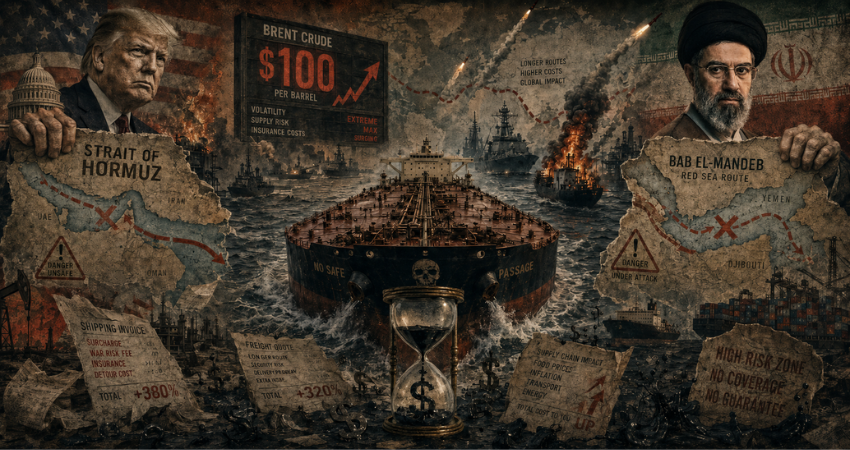
When disruption in the Strait of Hormuz forced Saudi Arabia to redirect oil towards the Red Sea, Bab el-Mandeb became the emergency route. When Houthi forces attacked Saudi tankers there, the emergency route became another front in the same war. Brent crude crossed $100, insurers revised the price of courage and central banks rediscovered stagflation.
Washington made its own contribution by rebuilding a tariff wall around almost every major trading partner. Investors, meanwhile, began asking whether the artificial-intelligence boom could consume the cash of the companies financing it.
Elsewhere, the United States and Iran discussed ten days of peace while exchanging attacks, Congress voted both for and against limiting the war, China increased maritime pressure around its neighbours, Ukraine changed military commanders and Europe approved another sanctions package against Russia.
The world has not stopped trading or negotiating. It has simply attached a geopolitical surcharge to both.
“Globalisation remains fully operational, although several of its most important routes now require naval protection.”
1. Oil Crosses $100 as the Detour Becomes Another Front
Saudi Arabia found a route around the Strait of Hormuz. The Houthis found the route too.
Severe disruption in Hormuz had already forced the kingdom to move millions of barrels through pipelines towards its western coast. From there, tankers could enter the Red Sea through Bab el-Mandeb and continue towards customers in Asia.
The arrangement worked until Houthi forces attacked two Saudi oil tankers and declared what they described as a naval blockade against the kingdom.
Brent crude settled above $100 a barrel on Thursday for the first time since May. It retreated below $98 the following day, but remained on course for a weekly increase of approximately 11%. Several tankers reversed direction, while insurers increased the cost of sending ships through the southern Red Sea.
The remaining alternative demonstrates why geography eventually defeats even the most creative logistics department.
A tanker sailing from Saudi Arabia’s Red Sea port of Yanbu to Taiwan through Bab el-Mandeb normally requires about 19 days. Avoiding the strait means travelling north through the Suez Canal, entering the Mediterranean, passing Gibraltar and then sailing around Africa. The same journey can take approximately 48 days.
Fuel costs for a large tanker may rise from around $1.26 million to $2.87 million. Canal charges can add another $1 million. Almost a month and roughly $2.5 million are therefore added before anybody has purchased the oil itself.
The world has not been completely cut off from Middle Eastern energy. Ships continued to pass through both chokepoints. But a route does not need to be formally closed before it becomes commercially impaired.
It is enough for captains to refuse it, insurers to price it as a battlefield and companies to keep vessels waiting rather than accept the risk.
Those costs will eventually leave the shipping industry. They will appear in transport, fertiliser, food, aviation and manufacturing — almost everywhere that energy is required but oil tankers are not usually visible.
Saudi Arabia can move crude across its territory. It cannot relocate its Asian customers.
“The oil remains available. It has merely developed a considerably more expensive journey to work.”
2. America Rebuilds Its Global Tariff System
Washington has discovered that a tariff declared unlawful is not necessarily a tariff abandoned. It may simply require different paperwork.
The United States imposed duties of 10% and 12.5% on goods from 60 trading partners on Friday, including the European Union, Britain, China, India, Japan, South Korea, Mexico and Canada.
The measures took effect as a temporary global tariff expired. They cover 99.4% of American imports, although exemptions apply to oil, gas, fertiliser, aircraft, selected food products and goods already subject to national-security duties.
President Donald Trump’s previous global tariff system was struck down by the Supreme Court in February because it relied on emergency powers the court concluded had been stretched beyond their intended purpose.
The replacement uses Section 301 of the Trade Act of 1974, a more established legal mechanism that has survived previous court challenges.
The official justification is that America’s trading partners have failed to prevent products made through forced labour from entering their supply chains. Governments from Europe to Australia rejected the accusation. Some nevertheless expressed relief that the new rates did not exceed limits already negotiated with Washington.
This produced the unusual diplomatic position of condemning the principle while welcoming the percentage.
Canada received a separate measure. Earlier in the week, Trump announced 50% tariffs on nearly $20 billion of Canadian imports, including wine, dairy products, cement, furniture, clothing and ice-hockey equipment.
Energy, fish, potash and critical minerals were spared, demonstrating that trade punishment remains most attractive when the product is not essential to American industry or immediately visible on a household bill.
The broader significance is larger than any individual dispute.
Washington is constructing a permanent tariff floor beneath the American economy. Access to the US market will increasingly depend on compliance with American expectations concerning labour, industrial policy, national security and whichever disagreement is selected for investigation next.
Tariffs are normally presented as a bill paid by foreigners. In practice, the cost circulates through exporters, importers, retailers, consumers and government support programmes until everybody can plausibly insist that somebody else received it.
“America has restored certainty to global trade: every trading partner can now be certain that another investigation is possible.”
3. The World Bank Calculates the Price of a Longer War
The World Bank has calculated what happens if the Middle East conflict continues for another six months. Almost everybody becomes poorer, although not with sufficient equality to make the result socially progressive.
Under its most severe scenario, global economic growth could fall to 1.3% in 2026, less than half the 2.9% recorded last year. Worldwide inflation could reach 4.5%.
The projection assumes prolonged fighting, damage to energy infrastructure and continued disruption to shipping through the Strait of Hormuz and Bab el-Mandeb.
The mechanism is familiar.
War restricts energy supplies. Higher energy prices raise transport and production costs. Businesses increase prices. Central banks maintain or raise interest rates. Governments, companies and households then pay more to borrow while earning less from a weakening economy.
The secondary effects may be even more damaging.
The Gulf exports fertiliser inputs, sulphur and helium as well as oil and gas. Disruption can therefore increase agricultural costs and worsen food insecurity long after the original attack has disappeared from the news cycle.
Poorer economies enter this process with limited protection. Many have not fully recovered from the pandemic, the global inflation shock or the increase in borrowing costs that followed Russia’s invasion of Ukraine.
Debt levels in developing economies remain substantially higher than before 2020. When interest rates rise, vulnerable governments do not simply postpone a decorative infrastructure project. They reduce spending on healthcare, education, subsidies and public employment in order to continue servicing their obligations.
Advanced economies can release strategic reserves, subsidise energy bills and provide financial support. Lower-income states are more likely to receive advice about resilience from institutions that recognise resilience would be easier with more money.
The global economy has survived several major shocks in succession. Survival, however, is not the same as recovery. Each crisis has left behind additional debt, weaker public finances and less political tolerance for the next rescue programme.
The World Bank’s warning is formally about what may happen if the war continues.
Its more uncomfortable message is that the next crisis is arriving before the world has completed paying for the previous ones.
“The global economy can afford another emergency in much the same way that a heavily indebted household can afford another credit card.”
4. The ECB Holds Rates While Preparing to Raise Them
The European Central Bank left interest rates unchanged at 2.25% on Thursday. It then spent the remainder of the announcement explaining why they might soon need to rise.
The decision followed the ECB’s first increase in almost three years in June. Since then, wage growth, underlying inflation and economic activity have remained sufficiently moderate to justify patience.
Energy markets have been less cooperative.
As Christine Lagarde addressed journalists, Brent crude moved above $100 a barrel. Traders responded by placing a high probability on another quarter-point rate increase in September and expecting further tightening before the end of the year.
The ECB is attempting to distinguish between an energy shock and lasting inflation.
Oil and gas can rise rapidly because of war. Central banks cannot reopen shipping routes or negotiate with the Houthis. Their concern begins when higher energy costs spread into wages, services and long-term expectations, allowing inflation to continue after the initial shock has passed.
So far, the evidence is mixed.
A survey of large eurozone businesses found that companies were struggling to transfer higher costs to consumers. Households remained highly sensitive to prices, while competition from lower-cost Asian producers limited the ability of manufacturers and retailers to raise them.
This is encouraging for inflation. It is less encouraging for company profit margins.
The eurozone economy is also expected to grow by only 0.6% this year. Europe may therefore have to increase borrowing costs in an economy that is barely expanding, not because domestic demand is excessively strong but because tankers are avoiding two stretches of water several thousand kilometres away.
Interest rates are an imprecise instrument for such a problem. They can weaken investment, employment and household spending. They cannot produce crude oil, escort ships or shorten the journey around Africa.
Yet the ECB cannot ignore inflation simply because the source is geopolitical. If households and companies begin treating higher prices as permanent, expectations can influence wages and contracts before the bank has an opportunity to restore credibility.
The institution paused because the wider effects remain limited. It prepared markets for another increase because nobody can guarantee they will remain that way.
“Europe’s central bank cannot end the war, but it can ensure European borrowers participate in the consequences.”
5. Artificial Intelligence Begins to Consume Big Tech’s Cash
Artificial intelligence was expected to make companies more efficient. It has begun by requiring them to construct an industrial system large enough to require its own electricity policy.
Microsoft, Alphabet, Amazon, Meta and Oracle are investing extraordinary sums in data centres, processors, networking equipment, cooling systems and power infrastructure.
At their current trajectory, the five companies are expected to spend more on capital expenditure than they generate in free cash flow by 2027.
Their annual operating cash flow is projected to increase by approximately $340 billion between 2025 and 2027. Capital expenditure is expected to rise by around $534 billion.
Big Tech may therefore need to invest about $1.57 for every additional dollar of operating cash it produces.
The figures are changing the economics of an industry once celebrated for requiring relatively few physical assets.
Software could be created once, distributed globally and sold repeatedly without constructing a new factory for each customer. Artificial intelligence requires chips, servers, transmission networks and buildings filled with machinery.
Technology platforms still sell software. They increasingly resemble utilities with unusually ambitious public-relations departments.
Alphabet demonstrated the tension this week. Its cloud revenue grew by more than 80% from a year earlier, yet its shares fell after the company reported negative free cash flow and increased its investment forecast.
Tesla also returned to cash burn for the first time in more than two years as spending on artificial intelligence, robotics and autonomous vehicles increased.
This does not mean the AI boom has failed. Demand for computing capacity is strong, and companies are beginning to generate meaningful revenue from new services.
The problem is that revenue must grow quickly enough to justify an infrastructure programme whose estimated cost rises almost every quarter.
Investors valued the largest technology companies partly because they produced enormous quantities of surplus cash. If more of that cash is directed towards data centres, less remains for dividends, share buybacks and acquisitions.
For several years, mentioning artificial intelligence was enough to convert capital expenditure into a vision of the future.
The market is now asking when the future intends to submit its accounts.
“Artificial intelligence is preparing to replace human labour, immediately after employing several hundred billion dollars of capital.”
6. America and Iran Discuss Ten Days of Peace Between New Rounds of Bombing
The United States and Iran were offered ten days without attacks. Both sides spent the week demonstrating why mediators had kept the number modest.
Regional intermediaries presented Tehran with a proposal for a ten-day ceasefire intended to revive the interim agreement reached the previous month.
The plan did not attempt to resolve every dispute concerning Iran’s nuclear programme, sanctions, regional allies, maritime access and American military operations. It sought only enough time to begin discussing why the previous pause had collapsed.
Military activity continued while the proposal was considered.
The United States launched another series of strikes across Iran, reaching targets near the Caspian coast. Iran responded against American positions in neighbouring Gulf states and warned that facilities used by US personnel could be attacked.
Houthi forces then expanded the economic geography of the conflict by targeting Saudi tankers near Bab el-Mandeb.
What began as a confrontation focused on Iran and the Strait of Hormuz now threatened a second route connecting Middle Eastern energy exporters with the global economy.
Washington continues to describe military pressure as a means of forcing Iran towards an agreement. Tehran argues that continued resistance will prove coercion cannot succeed.
The result is a negotiating system in which each side attempts to demonstrate seriousness by making a settlement more politically difficult for the other to accept.
The ten-day proposal reveals how far diplomatic ambition has declined.
Mediators are no longer beginning with permanent peace, a comprehensive agreement or even a durable ceasefire. They are attempting to obtain enough silence for both parties to hear the next proposal.
A temporary pause would still matter. It could reduce casualties, calm shipping markets and ease pressure on oil prices. But every approaching ceasefire also gives military planners an incentive to improve their position before it begins.
The world is therefore presented with another familiar paradox: an increase in attacks immediately before negotiations designed to stop them.
Ten days of peace would not resolve the conflict. It would demonstrate that the participants remain capable of stopping briefly.
“Diplomacy has lowered its expectations from ending the war to securing a sufficiently long intermission.”
7. The House Votes to End the Iran War. The Senate Ensures It Can Continue
The House voted to restrict the war. The Senate voted to preserve the president’s ability to continue it. Iran was not required to alter its military planning.
The Republican-controlled House of Representatives approved a resolution directing President Trump to halt American hostilities against Iran unless Congress formally authorised them.
The measure passed by 214 votes to 208, with four Republicans joining Democrats.
Several hours later, the Senate voted 49 to 47 to block a similar resolution. The combined result was a constitutional disagreement with no immediate operational effect.
The House measure relied on the principle that the Constitution gives Congress the power to authorise war.
Presidents of both parties have gradually developed a more flexible interpretation, particularly when operations can be described as limited, defensive, urgent or already under way.
The difficulty for the administration is that the campaign against Iran no longer resembles a short emergency response.
The conflict has continued for almost five months, expanded into several neighbouring states and disrupted two of the world’s most important energy routes. It has also produced American casualties, higher military expenditure and rising fuel prices.
The resolutions remained largely symbolic. Congress does not currently possess the votes necessary to force an end to the operation over presidential opposition.
Symbolism, however, acquires practical value as elections approach.
Democrats are attempting to connect the war with household affordability. Oil prices affect petrol, transport and food, allowing foreign policy to appear directly on domestic receipts.
Republicans supporting the administration argue that limiting presidential authority during active combat would strengthen Iran and weaken American deterrence.
Neither side has provided a convincing explanation of how the war is expected to end.
A formal authorisation would make Congress responsible for the consequences. A binding withdrawal would expose lawmakers to accusations of abandoning American forces and allies.
A symbolic resolution offers the more convenient opportunity to defend constitutional principle without immediately changing military reality.
The House said the war required permission. The Senate ensured the question would remain theoretical.
“Congress has rediscovered its authority to declare war, although not yet its enthusiasm for the accompanying responsibility.”
8. China Explains Maritime Order with Water Cannon and Live Fire
China presented two versions of regional order this week: water cannon for the Philippines and live ammunition near Taiwan.
The Philippine Coast Guard accused its Chinese counterpart of firing water cannon at government vessels near Scarborough Shoal on two consecutive days.
During Friday’s confrontation, a Chinese ship reportedly came within seven metres of a Philippine fisheries vessel, creating a serious risk of collision.
It was the third encounter between the two countries during the week. An earlier confrontation near Second Thomas Shoal left a Filipino sailor injured, according to Manila. Beijing accused Philippine vessels of ignoring warnings and attempting to ram a Chinese patrol boat.
China claims sovereignty over almost the entire South China Sea, including waters located inside the exclusive economic zones of several neighbouring states.
A 2016 international arbitration ruling rejected the legal basis for Beijing’s broad maritime claims and concluded that its blockade of Scarborough Shoal violated international law. China does not recognise the decision.
At the same time, Beijing began two days of live-fire exercises near Dongshan Island in the Taiwan Strait.
The two theatres are connected by method.
China is using coast-guard patrols, maritime agencies and military exercises to make its presence routine. Each interception and drill establishes another precedent. Actions that once appeared exceptional gradually become part of the operating environment.
This allows Beijing to increase pressure without necessarily crossing the threshold of conventional war.
The Philippines must decide how firmly to resist without triggering a conflict involving its defence treaty with the United States. Taiwan must respond often enough to preserve control without exhausting limited ships, aircraft and personnel.
Washington must reassure both while avoiding a direct confrontation with China.
Beijing benefits from the fact that every other participant is managing the risk of escalation. It can apply pressure incrementally, knowing that its opponents must calculate the consequences of each response.
No single water-cannon incident changes control of the South China Sea. No two-day exercise determines Taiwan’s future.
Their cumulative effect is more significant. They teach the region to expect Chinese enforcement, Chinese patrols and Chinese definitions of acceptable behaviour.
“China is not waiting for regional order to be negotiated. It is demonstrating the version it expects everybody else to recognise.”
9. Ukraine Appoints a New Commander to Change a War That Resists Management
Ukraine has replaced its commander-in-chief. The geography, manpower shortage and Russian army remain less easily reassigned.
President Volodymyr Zelenskiy appointed Major General Mykhailo Drapatyi to lead the armed forces, replacing Oleksandr Syrskyi in the country’s largest military leadership change since Russia’s full-scale invasion began.
Drapatyi, 43, represents a younger generation of Ukrainian commanders whose careers were shaped by combat against Russia rather than the traditions of the Soviet military system.
He has promised to increase counteroffensive activity, expand the use of military technology and strengthen operations behind Russian lines.
The appointment followed public protests and a wider dispute over Ukraine’s defence leadership. Syrskyi had faced criticism from some soldiers and campaigners over what they regarded as a rigid command culture and excessive battlefield losses.
The outgoing commander defended his record, saying Ukrainian forces had recaptured around 700 square kilometres during 2026 and remained capable of offensive operations.
The disagreement is larger than the reputation of one general.
Ukraine needs additional personnel, improved training, faster procurement and a command structure capable of adapting to a battlefield increasingly shaped by drones, electronic warfare and long-range strikes.
Mobilisation remains politically dangerous. Reports of coercive recruitment, corruption and abuse have weakened public confidence at a moment when the army requires more soldiers.
Drapatyi has previously promoted responsibility among commanders and greater freedom for frontline units. These positions have earned him support, but also created expectations that may exceed the authority of any individual officer.
Russia retains advantages in manpower and industrial production. Ukraine has attempted to compensate through technology, attacks on logistics and operations against targets inside Russia.
Changing commanders may improve morale, accountability and decision-making. It cannot immediately produce trained troops, ammunition or air-defence interceptors.
Zelenskiy is attempting to demonstrate renewal during the fifth year of war. Renewal is necessary. It can also resemble instability when several senior positions change while the country remains under continuous attack.
Drapatyi inherits an army that has survived and adapted against a larger opponent. His challenge is to reform the system without interrupting the war it must continue fighting.
“Ukraine has appointed a new commander to renovate the army while requiring every room to remain occupied.”
10. Europe Approves Its Twenty-First Attempt to Isolate Russia
The European Union has approved its twenty-first sanctions package against Russia. The number demonstrates both admirable persistence and the continuing absence of a final package.
The measures contain 218 new designations — 170 organisations and 48 individuals — making this the bloc’s largest sanctions round in four years.
They target Russian banks, cryptocurrency networks, energy traders, military suppliers and vessels associated with the shadow fleet used to transport oil outside Western restrictions.
Ninety-four financial institutions were included in the package, reflecting Europe’s belief that the Russian banking system has become increasingly vulnerable after more than four years of war.
Cryptocurrency platforms also received greater attention.
Traditional restrictions pushed Russian trade away from Western banks. Smaller lenders, foreign intermediaries and digital assets then became more important. Europe is now extending sanctions further along those alternative routes.
Energy remains the central problem.
The EU froze its price ceiling for Russian crude at $44.10 a barrel. Without intervention, the formula could have increased the ceiling because the conflict with Iran had pushed global oil prices higher.
Brussels concluded that Moscow should not receive additional war revenue simply because another war had made petroleum more valuable.
The agreement nevertheless required compromise.
Greece had objected to restrictions affecting services for Russian liquefied natural gas, arguing that European shipping companies would lose contracts while the trade continued through non-Western operators.
A renewable exemption was introduced, demonstrating the familiar difficulty of sanctions policy: Europe must reduce Russian revenue without creating an energy disruption severe enough to damage European businesses.
Russia has adapted through discounts, alternative payment systems, new intermediaries and trade with non-Western markets. Sanctions have increased costs and limited access to capital, but they have not forced Moscow to end the war.
The EU’s response is to target more institutions, vessels, products and jurisdictions.
This may gradually reduce Russia’s financial room. It may also create a system so complex that enforcing sanctions becomes a major European industry in its own right.
Europe is attempting to close every route around its restrictions. Russia needs only to continue finding another one.
“The European Union has now sanctioned almost every part of Russia’s war economy except its demonstrated ability to generate additional paperwork.”