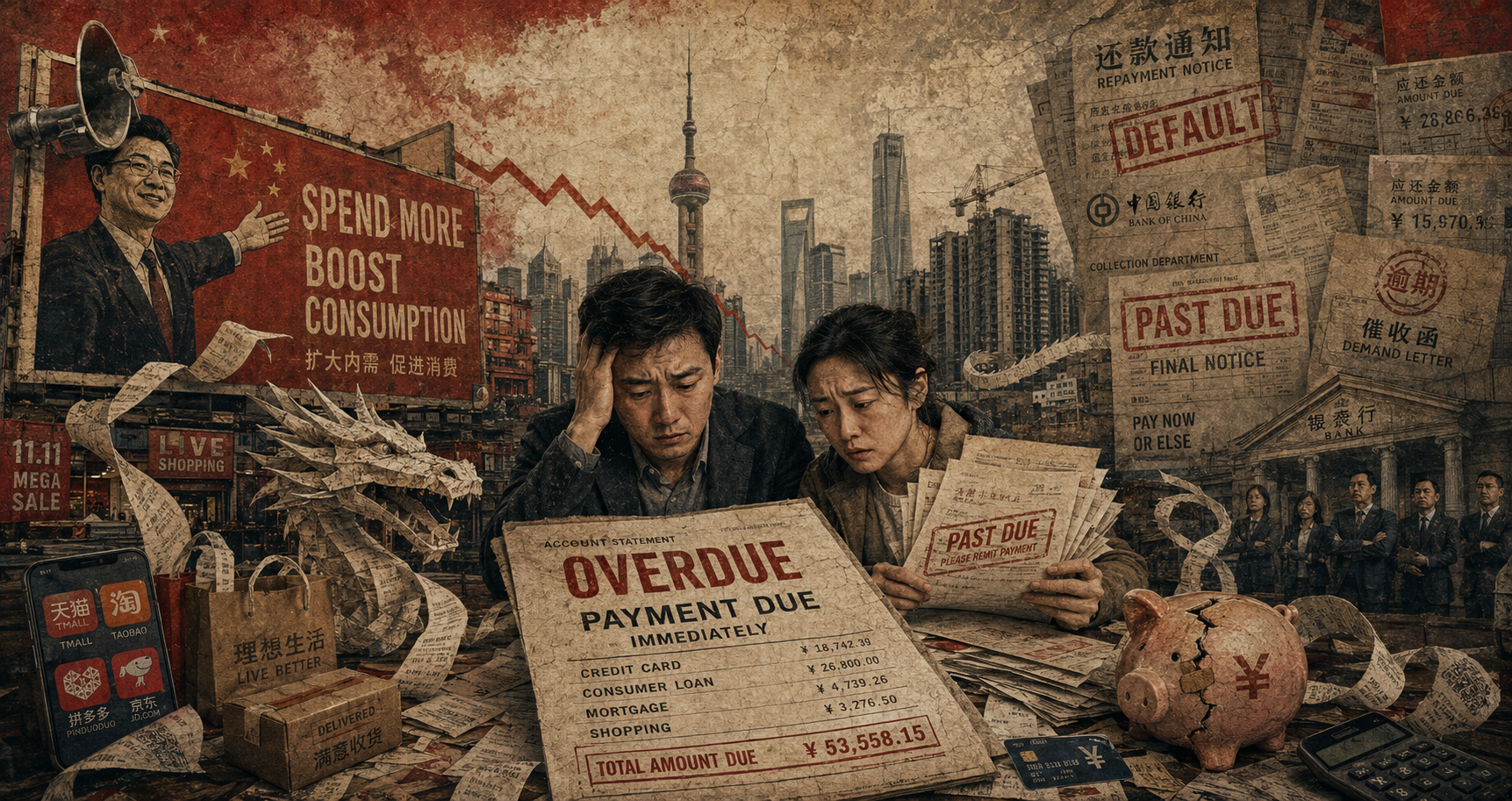
China’s Record Consumer Defaults Undermine Beijing’s Spending Drive
The Week That Shaped the World — 10–17 July 2026
China’s Record Consumer Defaults Undermine Beijing’s Spending Drive
The Government Wants Shoppers. The Banks Want Their Money Back — and Other Major Stories of the Week
China would like its citizens to spend more money. This would be easier if quite so many of them were not already being pursued for the money they spent last time.
The contradiction provided an appropriate theme for a week in which investors reconsidered the price of artificial intelligence, Anglo American found a buyer for the world’s most famous diamond business, India drew up a list of foreign products it would prefer to manufacture itself, and Venezuela prepared to negotiate a national debt whose final total remains something of a collaborative research project.
Governments everywhere want consumption, investment, industrial independence and financial stability. They simply prefer these things to arrive without higher wages, cheaper credit, painful restructuring or an inconvenient discussion about who financed the previous economic miracle.
The global economy has not run out of money. It has discovered that much of it has already been borrowed, invested at ambitious valuations or promised to a creditor who kept the paperwork.
“Governments remain confident that prosperity can be restored, provided somebody else is willing to spend the deposit.”
1. China’s Record Consumer Defaults Undermine Beijing’s Spending Drive
China’s government wants households to consume more. China’s banks would first like to discuss what happened to the previous loans.
Problem household credit reached a record 2.22 trillion yuan, approximately $324.5 billion, in 2025. That was equivalent to about 1.6% of Chinese economic output and affected roughly one in ten adults. The figures include non-performing consumer loans accumulated as weaker incomes, employment uncertainty and the long property downturn placed increasing pressure on household finances.
Beijing’s difficulty is not a shortage of things to buy. Chinese factories remain exceptionally capable of producing vehicles, appliances, electronics and almost anything else that can be packaged, exported or subsidised. The shortage is among consumers who feel sufficiently secure to spend.
The government has promoted trade-in programmes, consumption subsidies and easier lending. Yet the people most eager to borrow are increasingly the customers banks would prefer not to meet. More creditworthy households are saving, paying down debt or simply declining to acquire another large object in the national interest.
Banks have responded with the financial industry’s traditional combination of caution and creative accounting. Lending standards have tightened, while some troubled loans are being restructured so they do not immediately appear as non-performing. This may improve the presentation of balance sheets. It does rather less for the income of the borrower.
China’s economic model has relied for decades on investment, exports, property and infrastructure. Shifting towards consumption requires more than instructing citizens to visit a shopping centre. Households need confidence that employment will continue, medical bills will be manageable, pensions will exist and a sudden loss of income will not become a personal financial emergency.
Without that security, saving is not irrational behaviour. It is private insurance against a public system that remains incomplete.
This leaves Beijing in an unusual position. It can lower borrowing costs, subsidise purchases and encourage banks to lend. It cannot easily order consumers to feel optimistic. Confidence does not respond to administrative guidance with the discipline of a state-owned steel mill.
The country therefore faces a circular problem. Consumption is needed to support growth. Growth is needed to restore confidence. Confidence is needed before consumers will borrow, and many of those willing to borrow have already demonstrated why banks are nervous.
China has spent years building the world’s factory. Its next economic challenge is persuading the people working inside it that they can safely afford the products.
“Beijing wants citizens to open their wallets. The banks would prefer they began by opening their repayment notices.”
2. The Global Chip Sell-Off Tests Wall Street’s Faith in AI
The artificial-intelligence rally encountered an unfamiliar piece of technology this week: a calculator.
Semiconductor shares suffered a three-day global rout as investors questioned whether the enormous sums committed to AI infrastructure would produce equally enormous returns. The Philadelphia Semiconductor Index fell almost 9% over the week and entered bear-market territory, standing roughly 20% below its June peak, despite remaining more than 60% higher for the year.
The retreat travelled quickly. Japan’s Nikkei dropped 4.03% on Friday and moved into correction territory, while Taiwan’s market fell around 6%. Chipmakers that had led the year’s gains became the most efficient route for investors attempting to leave the same crowded room.
There was no single corporate disaster. The problem was the accumulation of uncomfortable questions.
Technology companies are spending hundreds of billions on data centres, processors, memory and power infrastructure. The market has generally treated this expenditure as evidence of future profit. Investors are now beginning to ask whether it might also be evidence of extremely expensive competition.
The release of Moonshot AI’s Kimi K3 added another concern. A capable Chinese open-weight model suggested that technical performance may become cheaper and more widely available even while Western companies continue purchasing increasingly costly hardware. If models become commoditised faster than expected, the infrastructure providers may still prosper, but some of their customers could find it difficult to charge premium prices for intelligence everybody else can also obtain.
Leverage amplified the decline. AI and semiconductor stocks had become popular holdings among hedge funds, momentum traders and leveraged exchange-traded products. When a crowded trade reverses, investors do not merely reconsider their convictions. Some are required to sell them.
None of this proves the AI boom is finished. Demand for advanced chips remains immense, manufacturing capacity is constrained, and large technology companies continue to build. The correction may simply reflect valuations that had begun travelling considerably faster than earnings.
But the psychological change matters. For several years, mentioning artificial intelligence was enough to convert capital expenditure into a vision of the future. The market is now asking when the future intends to submit its accounts.
Wall Street has not lost faith in AI. It has merely moved from the Book of Revelation to the section marked return on invested capital.
“Investors still believe artificial intelligence will change the world. They are becoming less certain that every company buying a chip will own the changed part.”
3. De Beers Finds a Buyer as Diamonds Lose Some of Their Shine
Anglo American has selected the Global Diamond Consortium as its preferred buyer for its stake in De Beers, bringing the potential sale of the historic diamond group closer to completion.
Botswana, which already owns 15% of De Beers, is considering whether to exercise its right of first refusal, join the chosen bidder or construct another partnership. The transaction remains subject to government approval and is expected to close towards the end of 2026.
The sale is occurring under less sparkling conditions than the product traditionally demands.
Natural-diamond prices have weakened, demand in important consumer markets has slowed and laboratory-grown stones have expanded rapidly. Consumers can now purchase a chemically similar object at a fraction of the price, creating the alarming possibility that romance may finally discover comparison shopping.
De Beers spent much of the twentieth century mastering scarcity. It controlled supply, shaped consumer expectations and persuaded generations that an engagement required a stone whose expense demonstrated the seriousness of the emotion.
Laboratory-grown diamonds have complicated that arrangement. They do not require geological luck, deep mines or the same supply chain. Their prices have fallen sharply as production has expanded, turning what was once a rare luxury into something increasingly manufactured.
For Botswana, the decision is more consequential than a simple corporate acquisition. The country’s public finances, employment and export earnings have long been closely tied to diamonds. Greater control over De Beers could preserve national influence over an industry central to its development. It could also increase exposure to a market undergoing a structural rather than temporary change.
The buyer will inherit a celebrated brand, mining assets, relationships with producing countries and one of the strongest names in luxury. It will also inherit the task of persuading customers that natural origin justifies a substantial premium when technology can produce visual perfection without waiting several billion years.
Luxury markets frequently depend on stories. A watch tells time, a handbag carries objects and a diamond records the purchaser’s willingness to disregard alternative uses for money. De Beers’ future will depend on whether the story of rarity remains more powerful than the economics of replication.
The diamond may still be forever. The valuation surrounding it has proved rather more responsive to market conditions.
“Diamonds remain an excellent symbol of permanence, particularly when contrasted with the companies currently selling them.”
4. India Identifies $51 Billion of Imports It Would Rather Make at Home
India has identified approximately $51 billion of critical imports that it wants domestic manufacturers to begin producing, preferably before the next geopolitical crisis demonstrates why the list was necessary.
An internal government analysis has prioritised around one hundred product groups, including textiles, footwear, electric-vehicle components and solar equipment. The wider exercise identified as much as $398 billion in potential import substitution. India imported about $132 billion of goods from China during the 2025–26 financial year, more than from any other trading partner.
The policy reflects the new global consensus: free trade remains extremely valuable, provided dependence occurs somewhere else.
India has spent years promoting Make in India and production-linked incentives. The results have been mixed. The country has attracted major electronics assembly and expanded manufacturing in selected sectors, yet imports have continued rising because domestic supply chains often lack the scale, precision or price offered by Chinese producers.
A smartphone assembled in India may still contain imported displays, chips, batteries and machinery. A solar panel installed domestically may rely on Chinese cells. A local factory can therefore produce a national success story while remaining strategically dependent on several boxes arriving from abroad.
The new initiative is expected to combine subsidies, incentives, state-owned enterprises and foreign joint ventures. Potential partners may come from South Korea, Taiwan, Germany and Italy — countries with the technology India needs and their own reasons to diversify away from China.
Import substitution, however, has a complicated history. Protecting domestic industry can create capability, employment and resilience. It can also create expensive products, complacent companies and ministries devoted to explaining why consumers must pay more for national development.
The successful version requires competition, infrastructure, technical skills and clear limits on support. The unsuccessful version produces an industry that survives permanently on government assistance while describing every request for lower prices as an attack on sovereignty.
India has genuine advantages: a vast domestic market, a young labour force, improving infrastructure and growing strategic importance to Western and Asian companies. But replacing $51 billion of imports is not achieved by identifying them in a spreadsheet.
Factories must be financed, equipment installed, workers trained and suppliers coordinated. Most importantly, the products must function at a price customers are prepared to pay after the subsidies have completed their patriotic duty.
India is not abandoning globalisation. It is attempting to relocate more of it within Indian tax jurisdiction.
“The modern global economy remains enthusiastically international, except for the parts every government has decided must now be made at home.”
5. Venezuela Prepares to Restructure a Debt Nobody Can Quite Count
Venezuela is preparing one of the largest sovereign-debt restructurings in history. The first challenge is establishing how large it is.
Total obligations may reach $240 billion, considerably above previous estimates of between $150 billion and $200 billion. The claims include government and state oil-company bonds, unpaid interest, bilateral loans, multilateral debt, arbitration awards and corporate obligations accumulated across years of default, expropriation and limited financial disclosure.
Caracas plans to restructure approximately $60 billion in Eurobonds. Once overdue interest is included, bondholder claims may reach about $102 billion. Bilateral debts are estimated at roughly $25 billion, including money owed to China and Russia. Another $8.69 billion is owed to the Paris Club, about $4 billion to multilateral lenders, and more than $20 billion is represented by arbitration and court claims.
This is less a creditor meeting than an international convention.
A successful restructuring normally requires agreement on three basic facts: how much is owed, who is owed it and how much the debtor can realistically repay. Venezuela has managed to make each question politically, legally and mathematically controversial.
Bondholders will argue for equal treatment. Governments may insist that bilateral loans deserve priority. Multilateral institutions generally expect preferred status. Companies whose assets were nationalised will present court decisions. Oil businesses may seek repayment through future production. Every creditor understands that Venezuela possesses enormous petroleum reserves. Every creditor also understands that extracting and selling those reserves will require investment that cannot occur if all available revenue is immediately claimed by creditors.
The arithmetic therefore contains a trap. Demand too much repayment and the economy cannot recover. Permit too little and creditors reject the deal. Value future oil production too optimistically and the restructuring fails later. Value it too cautiously and Venezuela may surrender more than necessary.
Transparency will be essential. Years without complete official debt reporting have created overlapping estimates, disputed claims and opportunities for every party to arrive with its own total.
The eventual negotiation will not merely divide losses. It will decide whether Venezuela’s future oil income is used to rebuild the economy or to service the ruins of its previous financial arrangements.
The country has begun preparing the world’s largest debt puzzle. Several pieces are missing, others are claimed by multiple owners, and the picture on the box consists mainly of oil barrels.
“Venezuela is ready to negotiate with its creditors as soon as they finish introducing themselves.”
6. America Opens Its New Tariff War Against Brazil
The United States has imposed a new 25% tariff on a broad range of Brazilian goods, proving that when one legal route to a trade war closes, Washington remains perfectly capable of locating another entrance.
The duties will apply from July 22 to products including furniture, machinery, footwear, ethanol and sugar. Beef, coffee, aircraft, rare earths and energy products were among the exemptions. Brazil is the first country targeted under a new American strategy using Section 301 of the Trade Act, after the US Supreme Court struck down the administration’s previous global tariffs in February. Similar investigations could eventually affect India, China, Japan, South Korea and the European Union.
The official explanation is unfair trade practice. Washington has raised complaints ranging from digital regulation to environmental policy. Brasília sees something more political. President Luiz Inácio Lula da Silva has rejected the justification for the tariffs and announced that Brazil will begin proceedings under its Reciprocity Law while also pursuing the matter through the World Trade Organization.
The exemptions are revealing. The United States has spared several Brazilian products that American consumers and industries would notice immediately if they became more expensive. This is trade policy conducted with one eye on national strategy and the other on the supermarket receipt.
Brazilian exporters will still suffer. Sugar producers, ethanol companies, footwear manufacturers and machinery firms must either absorb the additional cost, raise prices or redirect goods elsewhere. The Brazilian government has already prepared emergency credit support for affected rural industries, meaning taxpayers may be asked to compensate companies for a dispute officially intended to punish another government.
The broader warning is for everybody else. The earlier tariff system was invalidated by the courts, but the political appetite behind it remained untouched. Section 301 now offers a more targeted legal instrument with which Washington can investigate, threaten and negotiate country by country.
This may produce concessions. It may also encourage trading partners to build alternative markets, retaliate through regulation and become less dependent on access to the United States.
Tariffs are often presented as a tax paid by foreigners. In practice, the bill circulates through exporters, importers, consumers and governments until everybody can plausibly insist that somebody else received it.
“America’s previous tariff wall was removed by the courts. The builders have returned with different paperwork.”
7. Trump Accuses China of Election Interference Before Inviting Xi to Dinner
Donald Trump revived accusations that China interfered in American elections this week, shortly before a possible Washington summit with Xi Jinping. Diplomacy, like marriage, apparently benefits from beginning with a detailed list of unresolved grievances.
In a prime-time address, Trump claimed that China improperly obtained information relating to millions of American voters and wanted him to lose the 2020 election. Beijing called the allegations fabricated and denied interfering in US elections. A 2021 American intelligence assessment found no indication that China or any other foreign actor altered voter registrations, ballots, tabulations or election results.
The timing is uncomfortable.
Washington and Beijing have spent months constructing a fragile trade truce after the United States imposed triple-digit tariffs and China responded with restrictions on rare-earth exports. Trump visited China in May, publicly described Xi as a friend and invited him to Washington on September 24. Beijing has not formally confirmed the visit and has privately indicated that future meetings depend on maintaining positive relations.
Trump’s speech may have been intended mainly for the domestic audience. Republicans face difficult midterm elections, and election security remains useful political territory for a president who continues to dispute the result of the vote he lost six years ago. Notably, he announced no immediate punishment against China.
That may allow Beijing to treat the accusations as campaign theatre rather than a strategic change. The difficulty is that great powers do not possess a reliable instrument for separating domestic theatre from foreign policy.
China could retaliate, delay the summit or simply wait. It knows that Washington wants stable supply chains, access to rare earths and a degree of calm between the world’s two largest economies. Washington knows that Beijing wants export markets, technology and relief from tariffs.
Both sides therefore have reasons to preserve the truce. They also have political systems that reward displays of strength and punish visible compromise.
The relationship now resembles an expensive business partnership in which both executives publicly accuse the other of fraud before meeting privately to discuss quarterly targets.
“Washington and Beijing remain committed to improving relations, preferably after each has finished explaining why the other cannot be trusted.”
8. Ukraine Appoints an Energy Executive to Manage a Wartime State
Ukraine has appointed Sergii Koretskyi, the former head of state energy company Naftogaz, as prime minister. It is a managerial choice for a country where the national balance sheet now includes missiles, reconstruction, gas storage and the continued existence of the state.
Parliament approved Koretskyi by 289 votes. He is Ukraine’s third prime minister since Russia’s full-scale invasion began in 2022 and enters office as part of a wider government reshuffle by President Volodymyr Zelenskiy. Koretskyi identified defence, economic stability and integration with the European Union as his priorities.
The 48-year-old engineer and economist has never previously held government office and is not affiliated with a political party. He has more than two decades of experience in oil production, refining, retail, wholesale operations and international finance. Before leading Naftogaz, he ran Ukrnafta and several private energy businesses.
This lack of political history may be an advantage. It may also be temporary.
Ukraine needs a prime minister capable of managing public finances, foreign assistance, energy security and accession reforms while the president remains focused on war and diplomacy. Koretskyi’s experience fits a government increasingly judged by whether systems continue functioning under attack.
Preparing for winter will be immediate. Russian strikes have repeatedly damaged Ukrainian energy infrastructure, while shortages of air-defence interceptors leave power stations, gas facilities and transmission networks exposed. Zelenskiy has described winter preparation as a priority.
Yet managing an energy company and managing a state differ in one important respect: a company can usually identify its customers, liabilities and assets. Ukraine must operate while territory is occupied, millions of citizens are displaced and future reconstruction costs remain beyond confident calculation.
Koretskyi must also preserve international confidence. European institutions will expect reform. Donors will want transparency. Ukrainians will want electricity, defence and evidence that wartime sacrifice is not becoming a permanent excuse for political opacity.
His appointment suggests that Kyiv wants competence more than charisma. In ordinary times, this might be considered dull. In wartime, dullness can become a strategic asset.
Ukraine has chosen an energy executive because the state increasingly resembles an emergency utility: permanently under repair, constantly attacked and absolutely forbidden to stop operating.
“Ukraine’s new prime minister knows how to keep the gas flowing. He must now attempt the slightly larger task of keeping the country running.”
9. ASEAN Invites Myanmar Back Before Myanmar Has Changed
ASEAN foreign ministers met Myanmar’s top diplomat in person this week for the first time since the military coup of 2021. The meeting was described as informal, which is diplomacy’s preferred word when an organisation wishes to change policy without admitting that anything has moved.
Myanmar’s military leadership was excluded from senior ASEAN meetings after it overthrew Aung San Suu Kyi’s elected government, suppressed protests and failed to implement the bloc’s Five-Point Consensus. That plan called for an end to violence, dialogue between all sides, humanitarian assistance and the appointment of a regional envoy. None of its central objectives has been achieved.
The conflict has instead become a prolonged civil war. Reuters reported estimates of roughly 100,000 people killed and more than 3.6 million displaced. Aung San Suu Kyi remains detained, political opponents remain imprisoned or excluded, and Myanmar’s military-dominated institutions have publicly challenged ASEAN’s peace framework as interference.
Supporters of renewed engagement argue that isolation has failed. This is true in the technical sense that the war has not ended and the generals have not disappeared. Talking may create humanitarian access, improve communication and open a path toward negotiations.
Critics ask what Myanmar has given in return.
No major prisoners were released before the meeting. No ceasefire was delivered. The exiled National Unity Government was not included in the initial gathering, and opposition groups warned ASEAN against normalising relations without broader democratic representation.
ASEAN has always been constrained by its culture of consensus and non-interference. These principles preserve relations among governments with very different political systems. They also make decisive action difficult when one member’s internal crisis spreads refugees, crime and instability across the region.
The military authorities understand that time weakens sanctions. Neighbours grow tired, businesses seek access and diplomatic exclusion gradually becomes inconvenient for those maintaining it.
Engagement may still be justified. But leverage diminishes when recognition is provided before concessions rather than exchanged for them.
Myanmar’s rulers have therefore achieved a familiar diplomatic victory: remaining in place long enough for their isolation to become more exhausting to others than to themselves.
“ASEAN has reopened the door to Myanmar, though nobody appears to have checked whether Myanmar completed the conditions written on it.”
10. The UN Sanctions Congo’s Commanders While the World Buys Congo’s Minerals
The United Nations has imposed sanctions on leaders of armed groups fighting in eastern Congo, adding six individuals and two entities to its list.
Those targeted include Corneille Nangaa, leader of the AFC alliance that incorporates M23; John Imani Nzenze, M23’s intelligence chief; and Gustave Kubwayo, a commander in the FDLR, which has fought alongside the Congolese army. The measures include asset freezes, travel bans and an arms embargo.
The symmetry is deliberate. M23 is backed by Rwanda, according to the United Nations and Western governments, an allegation Kigali denies. The FDLR has roots in the forces associated with the 1994 Rwandan genocide and remains one of Rwanda’s stated security concerns. Eastern Congo is therefore crowded with armed organisations, foreign interests and historical explanations, each sufficiently real to sustain another round of violence.
Sanctions provide consequences on paper. Their practical force depends on whether the individuals possess identifiable foreign assets, require international travel or obtain weapons through suppliers troubled by UN documentation.
The conflict’s economic machinery is harder to sanction.
Congo is the world’s leading cobalt producer and the second-largest producer of copper. It also holds substantial deposits of tantalum, lithium and other minerals essential to electronics, defence systems and the energy transition. A US-backed minerals partnership is attempting to expand Western access while reducing Chinese dominance.
Some of the most valuable resources lie in contested territory. The Rubaya coltan mine, controlled by AFC/M23, produces around 15% of the world’s coltan supply. The mineral is processed into tantalum used in phones and other advanced equipment. Rebel taxation of mining has helped turn control of territory into revenue.
This creates the uncomfortable distance between the moral and commercial halves of global policy. Governments condemn armed groups while industries continue requiring the materials extracted from unstable regions. Companies promise responsible sourcing, but minerals pass through traders, borders and processing centres with identities more complicated than their shipping documents.
The UN sanctions are justified. They may restrict movement, financing and legitimacy. They will not alter the global appetite that makes control of eastern Congo valuable.
The world wants conflict-free minerals. It also wants them cheap, plentiful and delivered on schedule. These preferences continue to negotiate among themselves.
“The international community has frozen the commanders’ assets. Demand for the assets beneath their territory remains encouragingly liquid.”