
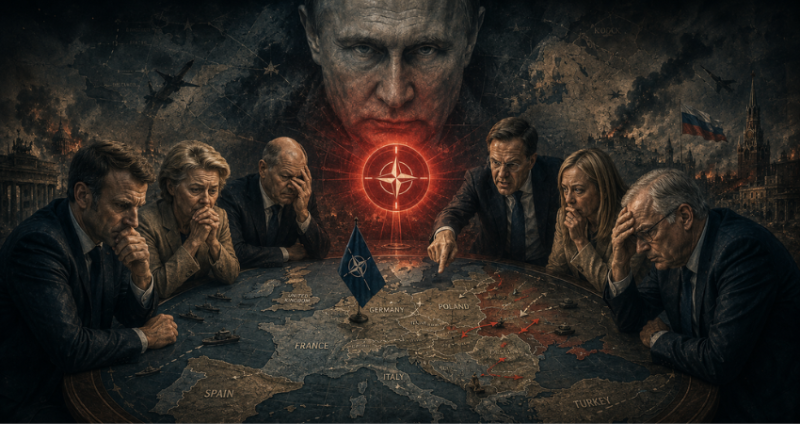
The Week That Shaped the World — 26 June–3 July 2026
How War, Heat and Industrial Fear Are Rewriting the Global Balance Sheet — and Other Major Stories of the Week
For years, governments treated resilience as the sort of word one placed in a glossy strategy document between “innovation” and a photograph of a wind turbine. This week it acquired a more honest meaning: the capacity to keep functioning while everything expensive, unstable and unpleasant happens at once.
NATO is preparing to renew its vows under Article 5, though the marriage has lately required rather more counselling than the original architects envisaged. Iran is turning a delayed funeral into a display of state endurance. Kyiv is counting the cost of another night in which the sky behaved less like weather and more like an invoice. Taiwan, meanwhile, is rehearsing the modern nightmare: blockade, sabotage, panic, infrastructure failure and invasion — preferably not in that order.
The economic picture was scarcely more soothing. Europe’s heatwave delivered a human toll and a bill.
Cyprus moved one step closer to monetising gas beneath the sea. Airbus received a cheque large enough to make the phrase “strategic autonomy” sound almost romantic. And private credit, that fashionable corner of finance where risk was supposed to be cleverly packaged, discovered that clever packaging does not prevent a product from falling off the shelf.
“The world is not short of resilience. It is simply discovering, rather late and at considerable cost, what resilience is actually for.”
1. NATO Approves the Bill Before the Summit
On Friday, NATO ambassadors approved the draft declaration for next week’s Ankara summit, settling the political language before the leaders have even boarded their aircraft. The text reaffirms an “ironclad” commitment to Article 5, declares that an attack on one ally is an attack on all, identifies Russia as a persistent threat to Euro-Atlantic security and sets out plans for €70 billion in military support for Ukraine in 2026.
The summit itself is still to come. But the difficult bargain beneath it has already been placed on the table, polished, initialled and handed to the taxpayers.
For Europe, the declaration is a reassurance exercise. For Washington, it is a receipt. Donald Trump has spent years arguing that European allies enjoy American protection with the enthusiasm of guests who arrive for dinner, praise the wine and mysteriously forget their wallets. This time, Europe is expected to demonstrate that it has heard him. More defence spending, more weapons contracts, more industrial capacity and more responsibility for the continent’s conventional security are now the price of transatlantic harmony.
The wording on Article 5 matters because it remains NATO’s central promise — and because promises have become rather more valuable when the person expected to honour them regularly questions the invoice.
The alliance has invoked its collective-defence clause only once in its history, after the attacks of 11 September 2001.
Yet its political power has always rested on the belief that it would be used again without hesitation.
That belief is now being tested not by a single crisis, but by several: Russia’s war against Ukraine, pressure on European defence budgets, rising industrial shortages and a United States increasingly impatient with carrying the largest share of the burden.
NATO’s ambassadors have therefore done something more significant than approve diplomatic prose.
They have acknowledged that collective defence is no longer an inherited comfort. It is an expensive product which must be manufactured, funded and delivered on time.
The summit in Ankara will provide the photographs. Friday’s declaration supplied the contract.
“Article 5 remains wonderfully clear: attack one, face all. The finer print, naturally, concerns who is paying for the ammunition.”
2. Iran’s Delayed Funeral Becomes a Test of State Power
The body of Ayatollah Ali Khamenei lay in state in Tehran this week, beginning a long sequence of mourning ceremonies intended to carry the former supreme leader through Iran’s religious and political heartlands before his burial. The symbolism is enormous. So is the timing.
Khamenei was killed in the opening airstrikes of the February war involving Iran, the United States and Israel. In ordinary circumstances, Islamic burial customs favour speed. In this case, however, a mass funeral was postponed because the war made a public ceremony too dangerous. Only after an interim truce created a measure of space did Tehran begin preparing the spectacle: processions, religious observances, foreign dignitaries, heightened security and a carefully arranged national choreography of grief.
That delay matters. A funeral held immediately after a leader’s death is an act of mourning. A funeral staged months later, after war, internal strain and leadership transition, is something more deliberate: a demonstration that the state still has a pulse, a memory and enough organisational discipline to fill streets with people.
Iran’s rulers are presenting Khamenei as a martyr, drawing on the deep Shi’ite language of sacrifice, endurance and historical grievance. It is a powerful vocabulary, particularly in a society where religious symbolism remains central to political legitimacy. Yet the ceremony also arrives against a far less ceremonial backdrop: economic hardship, years of protest, sanctions, deep public frustration and uncertainty surrounding the country’s new leadership.
The authorities want the funeral to show continuity. Their opponents will see an anxious regime using ritual to cover a difficult transition. Both readings can be true. Political power is rarely one thing at a time; it is faith, fear, habit, bureaucracy, loyalty and stagecraft, often performed under the same black flag.
This week, Iran was not merely burying a leader. It was attempting to bury the impression that his death has left the country exposed.
“In Tehran, even the dead require a security clearance before they can become immortal.”
3. Kyiv and the Cost of an Open Sky
Kyiv entered mourning after the deadliest Russian attack on the capital this year, with rescuers continuing to search damaged buildings and families counting losses that no official statistic can properly contain. More than thirty people were reported killed as missiles and drones struck the city, damaging homes and forcing another night of sheltering beneath a European capital.
There is a temptation, particularly from a safe distance, to reduce attacks like this to numbers: missiles launched, drones intercepted, buildings hit, casualties recorded. But the economics of the war are written into every one of those figures. Air defence is not an abstract slogan. It is an exceptionally expensive attempt to stop cheaper systems from destroying far more valuable ones.
A modern city requires electricity, hospitals, transport, communications, water, emergency crews and citizens capable of functioning after no sleep. Each aerial attack is therefore aimed not merely at a target but at a system. A damaged residential building means displaced families. A broken power connection means lost working hours. A night in a metro station means children arriving at school exhausted, workers arriving late and businesses wondering whether the next morning will happen on schedule.
Russia described the strike as retaliation for Ukrainian attacks on Russian infrastructure. Ukraine’s position is that civilians and civilian urban life are bearing the brunt of an escalating aerial campaign. The moral argument is clear enough. The practical argument is just as important: a prolonged war increasingly becomes a contest between industrial capacity, financial endurance and the ability of societies to absorb disruption without breaking politically.
Kyiv’s survival has always been more than a military matter. It is a proof of administrative persistence under conditions that would have collapsed many systems elsewhere. But resilience should not be confused with invulnerability. Every air raid consumes resources, attention and human energy that could otherwise have gone into rebuilding the country.
The sky above Kyiv has become one of Europe’s most expensive frontiers. And every time it fails, the cost is paid on the ground.
“Modern war allows a city to sleep underground and then politely calls it resilience.”
4. Navalny’s Death Returns as a Chemistry Lesson
The European Union imposed sanctions on six Russian individuals this week over their alleged involvement in the development of epibatidine, the toxin found in samples taken from Alexei Navalny’s body after his death in a Russian penal colony. The names on the list are not political celebrities. They are scientists, researchers and specialists connected to military and chemical research structures.
That is precisely why the decision matters.
The European Union’s position is that the presence of epibatidine makes poisoning the most likely explanation for Navalny’s death. Moscow has demanded evidence and rejected allegations of state involvement. The sanctions themselves consist of asset freezes and travel bans, which may sound limited beside the magnitude of the accusation. They are not a criminal verdict. They will not provide a family with closure. They will not make the political violence of the Russian state disappear through administrative force.
What they do is more bureaucratic, and therefore rather more European: they turn an allegation into a structured record of consequence. The message is that technical expertise is not morally neutral when it is used to build the machinery of repression. In an era when governments increasingly lean on engineers, coders, chemists, surveillance designers and data specialists, that principle reaches well beyond one case.
There has always been a comforting myth that scientists merely discover, while politicians decide what to do with the discovery. History has been unkind to that myth. Knowledge travels through institutions. A laboratory has a budget, a supervisor, a client and a purpose. A toxin does not stroll into a prison colony by itself.
The sanctions also reveal the limitations of external pressure. Europe can close bank accounts, restrict travel and raise the price of international access. It cannot easily penetrate the internal systems of a nuclear-armed state willing to treat legal isolation as an acceptable operating cost.
Still, there is value in keeping the record straight. Authoritarian systems often depend on a fog of plausible deniability. This week, Brussels tried to thin it with paperwork.
“Europe cannot resurrect a man with a sanctions list, but it can make the chemists travel rather less comfortably.”
5. Taiwan Rehearses Collapse Before It Rehearses War
Taiwan staged one of its most revealing resilience exercises this week, imagining a crisis that did not begin with a dramatic beach landing or a cinematic missile barrage. Instead, it began as modern catastrophe is more likely to begin: a blockade, a powerful earthquake, sabotage, disrupted broadcasts, cyber pressure, panic around banks, food shortages and public disorder.
Only then came the possibility of invasion.
More than 370 government and military officials took part in the drill in central Taiwan. There were tabletop exercises, field scenarios, civil-military coordination, simulated drone threats to infrastructure, food distribution plans and real-time mapping systems designed to track the location of threats and emergency resources. In other words, Taiwan was not rehearsing a battle. It was rehearsing the preservation of ordinary life while the machinery of ordinary life fails.
This is the uncomfortable truth of twenty-first-century conflict. A country can be defeated long before soldiers cross a border if its population loses trust in banks, media, supply chains, electricity, public authority or one another.
A hacked television signal, an empty supermarket shelf or a rumour about cash withdrawals can be as strategically useful as a missile, especially when they arrive together.
Beijing has never renounced the use of force to bring Taiwan under its control. Taiwan insists that its future must be decided by its own people. Between those two positions lies a vast space of pressure: military patrols, grey-zone coercion, economic leverage, cyber activity and psychological warfare.
The exercise suggests that Taiwan increasingly understands its vulnerability in systemic terms. It is not enough to possess weapons. A society also needs backup communications, medical supplies, trusted local officials, trained civilians and a plan for when the usual institutions are either overwhelmed or temporarily blind.
There is something grimly sensible about rehearsing disaster while hoping never to perform it. Taiwan is learning that deterrence is not only about making invasion difficult. It is about making chaos unprofitable.
“The first battle in a modern war is often over whether the public can still find bread, cash and a working mobile signal.”
6. Europe’s Heatwave Has a Body Count — and a Balance Sheet
Europe’s late-June heatwave left at least 3,700 excess deaths reported across France, Belgium and the Netherlands. The figure is preliminary, and excess mortality is not the same thing as a death certificate stamped “heatwave”. But the scale is hard to ignore. France reported more than 2,000 excess deaths, Belgium around 1,200 and the Netherlands roughly 480.
The weather, as ever, was only the beginning.
Extreme heat is now one of the most efficient ways to expose every weakness in a developed economy. It pushes up electricity demand just as grids and generating systems are placed under stress. It makes rail networks, roads and buildings less reliable. It reduces labour productivity. It strains hospitals and care homes. It turns poorly ventilated housing into a health hazard and air conditioning into a question of income rather than comfort.
Europe has spent years presenting itself as a leader in climate policy, which is true in the sense that it has produced a remarkable quantity of targets, directives and podium speeches. But climate resilience is less glamorous than climate ambition. It involves upgraded grids, cooled public buildings, urban shade, better housing standards, water planning, emergency health systems and the rather unfashionable task of making sure elderly people do not die alone in overheated flats.
The political difficulty is that many of these investments produce benefits only when disaster arrives. A new park, a reinforced rail line or a hospital cooling system does not generate the same excitement as a ribbon-cutting ceremony for a futuristic technology hub. It is merely there, quietly preventing catastrophe. Governments tend to find this deeply inconvenient, because prevention has the terrible habit of making politicians look as though nothing happened.
Yet something did happen this week. Thousands of deaths, disrupted infrastructure and immense pressure on public systems should end the idea that heat is a seasonal inconvenience best handled with a bottle of water and a television presenter reminding viewers to wear a hat.
Climate change is no longer approaching Europe. It has moved in, turned the thermostat up and begun examining the electricity bill.
“Europe has discovered that climate policy becomes urgent the moment the air conditioning starts losing its temper.”
7. Cyprus Gas: A Declaration Is Not a Pipeline
Cyprus moved a step closer to becoming a meaningful player in the Eastern Mediterranean energy story after ExxonMobil and QatarEnergy signed a declaration with the Cypriot government confirming that two offshore gas prospects are commercially marketable.
That phrase — “commercially marketable” — deserves appreciation. It is perhaps the most cautiously optimistic sentence in the energy industry. It does not mean gas will flow tomorrow. It does not mean a pipeline has appeared, a liquefaction terminal is operating or European households are about to receive cheaper bills. It means the discoveries have moved beyond geological promise into the more demanding territory of economics, engineering, contracts, infrastructure and political patience.
The project matters because Europe remains keen to diversify its energy supplies. The Eastern Mediterranean has long been presented as a possible additional source of gas for European markets, but the region has also been rich in complications: disputed maritime zones, rival export routes, uneven infrastructure and geopolitics that rarely behaves itself for long.
Cyprus now has an opportunity to convert offshore reserves into strategic leverage. QatarEnergy brings global experience in liquefied natural gas. ExxonMobil brings scale, capital and technical capability. Cyprus brings location, legal jurisdiction and the increasingly valuable asset of being European without being too far from the Middle East.
The practical challenge will be getting the gas from sea to customer without allowing the project to become trapped in a decade of feasibility studies, political arguments and expensive optimism. Existing Egyptian LNG infrastructure may offer one route, but every option will involve commercial trade-offs and regional diplomacy.
Still, the declaration is important because energy security is no longer discussed merely in terms of price. It is discussed in terms of reliability, routes, political exposure and the ability to avoid being strategically held hostage by someone else’s pipeline.
For Cyprus, this is a chance to become more than a pleasant island with a complicated history. It could become a small but useful node in Europe’s broader energy map.
“In energy, a commercial declaration is the moment optimism puts on a hard hat and starts asking who will pay for the pipe.”
8. Airbus Receives Europe’s Industrial Vote of Confidence
The European Investment Bank committed €3 billion to Airbus this week, with an initial €1 billion loan already signed. It is the largest corporate financing package ever authorised by the bank, and it tells us rather more about Europe’s industrial anxieties than it does about aircraft alone.
The money is intended to support Airbus investment through 2030 across commercial aviation, defence, security and technology. On paper, that is an impressive list. In practice, it is an admission that Europe has finally accepted what Washington and Beijing understood some time ago: strategic industries do not always thrive on market forces alone, particularly when those market forces are being quietly supplemented by vast national support elsewhere.
Airbus is a useful symbol because it sits at the crossroads of several European concerns. It competes with Boeing in civil aviation. It has a growing role in defence. Its satellite interests are part of Europe’s attempt to avoid excessive dependence on American commercial space infrastructure. And it operates in a world where supply chains, secure communications, advanced manufacturing and military capability increasingly overlap.
The old European instinct was to treat industrial policy with suspicion, as though the phrase carried the faint odour of state-owned steelworks and disappointing lunches in Brussels. The new instinct is more pragmatic. Strategic autonomy has become fashionable because dependence has become expensive.
The EIB package is not simply a gift to a large company. It is a statement that Europe wants to retain the capacity to design, manufacture and secure critical systems without relying entirely on the goodwill of foreign governments or technology billionaires.
There is, of course, a risk. Publicly supported industrial strategy can become a comfortable shelter for companies that should be challenged more aggressively. It can also become a bureaucratic excuse for spending money without setting demanding outcomes. But the alternative — allowing industrial capability to drift elsewhere while writing increasingly anxious policy papers about sovereignty — is not much of a strategy either.
Europe has chosen to invest. The real test will be whether it also learns to build quickly.
“Strategic autonomy is what happens when a subsidy learns Latin and acquires a defence contract.”
9. Private Credit Discovers That ‘Private’ Does Not Mean ‘Immune’
The private credit boom has spent years cultivating an image of sensible sophistication. While public markets thrashed about in full view of everybody, private lenders offered the allure of steady returns, direct relationships and a reassuringly low level of daily drama. This week, the visible end of that world looked rather less serene.
An analysis of 53 publicly traded business development companies — funds that lend primarily to mid-sized businesses — found that 28 reported losses in the first quarter of 2026, compared with 12 a year earlier. Average profits across the group shifted from a positive $26 million to an average loss of $7.6 million.
The reasons are not mysterious. Borrowing costs remain high. Loan values have come under pressure. Software companies, once viewed as dependable growth borrowers, are now being reassessed through the rather alarming lens of artificial intelligence. If AI can weaken a company’s pricing power or reduce its need for staff, then the lender holding that company’s debt has a problem as well.
Private credit is not inherently reckless. It has performed a useful function by lending to businesses that do not fit easily into traditional bank models. But the sector has become so large that its risks are no longer private in the everyday sense of the word. When funds rely on complex valuations, payment-in-kind income, rising leverage and limited opportunities for investors to exit, the distinction between stability and delayed recognition can become uncomfortably thin.
The particular danger is not an instant collapse. Private markets are too opaque and too illiquid for that sort of theatricality. The danger is slower: loans quietly marked down, withdrawals limited, borrowing shifted into joint ventures and managers insisting that everything remains under control while the numbers become increasingly interpretive.
Finance adores an asset class that appears calm. Calm, however, is not the same as safe. Sometimes it merely means nobody has looked closely enough yet.
“Private credit remains private right up until the losses decide they would like some sunlight.”
10. Google’s Android Fine Reminds Silicon Valley Who Owns the Rulebook
Google lost its long-running challenge against the European Union’s €4.1 billion antitrust fine over Android this week, bringing one of the most significant competition cases in modern technology closer to its legal conclusion.
The original penalty was imposed in 2018 after European regulators argued that Google used the dominance of Android to lock in its own services. Phone manufacturers were required to pre-install Google Search, Chrome and the Play Store if they wanted access to the wider Google ecosystem. They were also restricted in their ability to use alternative versions of Android.
Google’s argument has always been that Android is open, innovative and beneficial to consumers. There is truth in the first part, at least in a technical sense. Android’s code may be broadly available, but commercial reality is a more complicated creature. An operating system can be open in theory while still being structured in a way that makes life exceptionally difficult for anyone attempting to challenge the company at its centre.
The court’s decision is important not simply because of the money. Google can afford the fine. What matters is the precedent: Europe has shown that it is willing to pursue major technology companies through years of legal argument, rather than announce grand intentions and retreat at the first expensive letter from California.
The ruling also lands during a broader campaign by European regulators to limit the power of large digital platforms. Competition law, data protection, online safety and digital market rules are increasingly being used as separate levers aimed at the same underlying concern: whether a handful of firms have become too powerful to be meaningfully challenged by smaller competitors, national governments or even their own customers.
There is a fashionable view that Europe cannot build a technology giant and therefore consoles itself by regulating American ones. There is some unfairness in that caricature. But there is also a serious point underneath: markets do not remain markets when access to them is controlled by a company that writes the rules, owns the gate and sells the tickets.
This week, Brussels reminded Silicon Valley that an ecosystem is not exempt from the law merely because it comes with good design.
“Android may be open source. Its paperwork has never been more open to inspection.”