
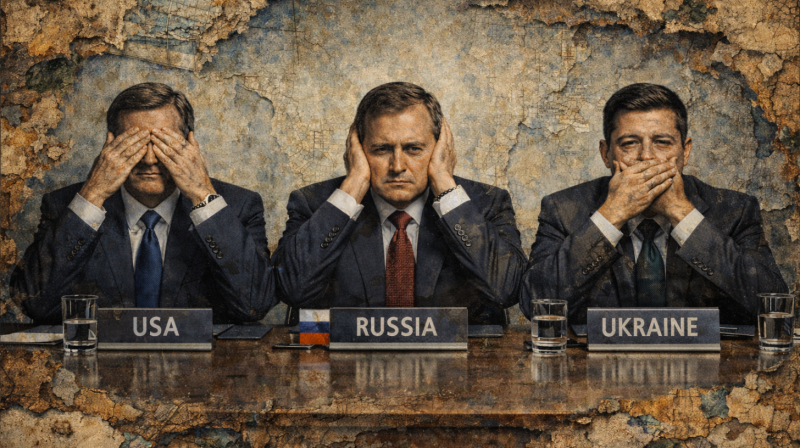
The Week That Shaped the World — 13–20 February 2026
Geneva Without Movement — Diplomatic Stalemates, Fracturing Alliances and the Rise of Physical AI
This week began with diplomacy — and ended with the realisation that diplomacy alone may no longer be enough.
In Geneva, talks between Russia and Ukraine continued under the careful language of negotiation, yet little moved beyond the table itself. The world watched another round of dialogue that produced no visible shift, reinforcing a growing sense that conflict management has replaced conflict resolution. Around it, the wider geopolitical landscape looked increasingly uneasy: alliances recalibrating, partners quietly disagreeing, and strategic patience wearing thin.
But politics was only one part of the story.
Technology pushed forward at a pace that felt almost indifferent to diplomatic paralysis. Artificial intelligence began reshaping physical science itself, discovering new materials that could alter global supply chains. Robotics stepped closer to reality as chips designed for humanoid machines signalled a new industrial frontier. Big Tech, meanwhile, revealed the financial cost of that future — borrowing heavily to build the infrastructure of an AI-driven world.
Energy tensions inside Europe reminded markets that solidarity has limits. Central banks signalled caution, choosing to wait rather than act.
Across politics, economics and technology, the same pattern emerged: motion without resolution.
Negotiations continue. Investments accelerate. Systems adjust — but nothing fully settles.
“When diplomats keep talking and engineers keep building, history doesn’t pause,” writes Adam Jenkins. “It simply moves on two tracks at once — one searching for agreement, the other already constructing the future without it.”
1. Geneva Talks: Diplomacy Without Movement in the Russia–Ukraine War
Geneva has hosted enough peace talks in its history to know the difference between negotiation and performance. This week felt closer to the latter.
Representatives from Russia and Ukraine met under international attention, with the United States attempting to keep diplomatic channels alive. Official statements spoke of dialogue, constructive exchanges and continued engagement. Yet by the time delegations left the room, little had moved — except the language.
The core disagreements remained exactly where they started: territory, security guarantees, and the price of ending a war that neither side believes it can afford to lose.
Publicly, everyone claims diplomacy is alive. Privately, the atmosphere suggests something else — a process increasingly designed to manage perception rather than produce solutions. Talks continue, but momentum does not.
For Europe, this matters deeply. Every stalled negotiation pushes responsibility back onto political leaders already debating how long financial and military support can be sustained. For Washington, it reinforces the uncomfortable reality that dialogue alone cannot reset the battlefield equation.
Geneva, in that sense, has become symbolic of the broader moment: communication without convergence.
History shows that diplomacy often moves slowly — until it suddenly does not. But this week provided few signs of such a turning point. Instead, it reinforced a colder normality where negotiations exist not to end conflict, but to prevent its uncontrolled escalation.
The war continues. The meetings continue.
Only the expectations grow smaller.
“Peace talks fail quietly. Not with dramatic collapse, but with polite statements explaining why nothing has changed.”
2. Munich 2026: The Alliance That No Longer Speaks in One Voice
The Munich Security Conference has always liked to present itself as a gathering of unity — a stage where allies reassure one another that the Atlantic bond remains firm. This year, the applause sounded thinner.
Behind the diplomatic smiles, the conference exposed a widening gap between European leaders and the Washington now shaped by the return of Trump-era thinking. The disagreement was not theatrical. It was structural.
Europe arrived in Munich asking how long it can continue financing Ukraine’s defence, how much risk it must absorb, and whether NATO can remain predictable if American political winds keep shifting. The United States arrived speaking the language of burden-sharing and strategic limits.
Both sides claim to support stability. They simply define it differently.
For many European capitals, the fear is not Russia alone — it is uncertainty. If America becomes less instinctively committed to Europe’s security architecture, then Europe must begin preparing for scenarios once considered hypothetical. Discussions about strategic autonomy, defence industry expansion and even nuclear deterrence no longer sound like academic exercises. They sound like contingency planning.
Washington, meanwhile, signals fatigue. The argument is familiar: Europe is wealthy enough to carry more weight. The subtext is less comfortable — alliances must justify their cost.
The result is not a breakup. Not yet. But the harmony is gone.
Munich revealed an alliance that still shares a stage but no longer shares a single script. The language of unity survives, while the logic underneath shifts.
And everyone knows it.
“Alliances don’t collapse in public. They drift apart in private conversations first — long before the microphones notice.
3. West Bank Decision: A Quiet Move with Loud Consequences
Some political decisions arrive with speeches, banners and headlines. Others move quietly through cabinet rooms — and change reality all the same.
This week, the Israeli government approved new steps related to land registration in parts of the occupied West Bank. Officially, the measure is described as administrative — a technical process aimed at clarifying ownership and legal status. Critics, however, see something much larger: a structural shift that could reshape the political map long before any formal declaration is made.
Palestinian officials condemned the decision, arguing that such measures gradually formalise control and make the possibility of future negotiations more fragile. International observers warned that even administrative changes carry geopolitical weight in a region where law, identity and territory remain inseparable.
The timing is telling. With global attention fragmented between Ukraine, economic turbulence and election politics in the West, the Middle East continues to evolve through smaller, incremental moves rather than dramatic military escalations.
For Israel, supporters frame the policy as governance and security — bringing order to legal ambiguities that have existed for decades. For critics, it represents a slow-motion transformation of the status quo, one that risks hardening positions on both sides.
Diplomatically, the consequences extend beyond the region. European capitals and Washington now face another familiar dilemma: balancing political alliances with growing international scrutiny.
The world has grown used to sudden crises. What is harder to notice are gradual shifts that quietly redefine the ground itself.
And that may be exactly what is happening now.
“History rarely changes with explosions alone. Sometimes it moves through paperwork — signed quietly, argued loudly, and realised only years later.”
4. Two Fronts, One Diplomatic Engine: Washington’s Crisis Overstretch
Diplomacy is often described as a balancing act. This week, it looked more like a juggling performance — with too many objects already in the air.
Washington is currently attempting to manage two complex crisis tracks at once: negotiations connected to the Russia–Ukraine war and parallel diplomatic efforts focused on Iran. According to reporting around recent shuttle diplomacy, U.S. envoys have been moving between capitals, trying to maintain momentum on both fronts simultaneously.
On paper, this reflects American global leadership. In practice, it reveals something more fragile — the limits of diplomatic bandwidth.
Each crisis demands a different language, different leverage, different alliances. Ukraine revolves around European security, military support and fragile negotiation channels. Iran pulls Washington into the volatile architecture of the Middle East, where escalation risks are immediate and regional actors pursue their own agendas.
The challenge is not simply running two processes. It is sustaining credibility in both.
Experts increasingly question whether any administration, regardless of intent, can deliver meaningful breakthroughs when strategic attention is divided. Diplomacy, like capital, is finite. The more widely it is spread, the thinner it becomes.
For Europe, this raises familiar concerns. If Washington’s focus oscillates between crises, European governments may feel compelled to take more independent decisions — whether in defence planning or negotiations. Regional powers in the Middle East draw similar conclusions, adjusting their strategies to a world where American attention is no longer absolute.
None of this means failure is inevitable. But it does suggest that simultaneous crisis management creates its own risks: prolonged conflicts, delayed decisions and a growing reliance on symbolic diplomacy rather than decisive outcomes.
The United States remains at the centre of both theatres. The question is whether the centre can hold when pulled in opposite directions.
“Superpowers rarely lose influence overnight. They lose it gradually — when every crisis demands leadership, and none receives enough of it.”
5. Chagos and the Quiet Friction Between Allies
Alliances rarely fracture with dramatic speeches. More often, tension appears in places the public barely notices — remote islands, legal agreements, and the fine print of strategic deals.
This week, the long-running dispute over the Chagos Islands exposed a subtle but important strain between Britain and the United States. London’s decision to transfer sovereignty of the archipelago to Mauritius, while retaining long-term access to the military base on Diego Garcia through a lease arrangement, was meant to close a legal chapter and secure the future of a critical joint UK–US facility.
Instead, it opened a political one.
Inside Washington, the deal has triggered criticism from figures aligned with the Trump camp, who argue that transferring sovereignty — even while preserving military access — introduces unnecessary strategic risk. Their argument is simple: bases secured by ownership feel safer than bases secured by contracts.
Britain sees the situation differently. International legal pressure around Chagos has grown steadily, and officials argue that a negotiated settlement protects the base more effectively than prolonged dispute. From London’s perspective, legal certainty equals strategic stability.
The disagreement is not a rupture. But it reveals something deeper — a divergence in how allies understand power. Britain is navigating a world defined increasingly by legal frameworks and diplomatic compromise. Parts of the American political spectrum are returning to a harder view of sovereignty and security.
Meanwhile, the issue refuses to disappear quietly. Attempts by displaced Chagossians to return to the islands have reignited moral and political debates, adding human complexity to what many policymakers prefer to frame as a purely strategic calculation.
Diego Garcia remains operational. The alliance remains intact.
Yet the episode illustrates a changing reality: even close partners can interpret the same strategic map in very different ways.
“Empires once fought over islands. Today, allies debate them — and the arguments reveal more about the future of power than the territory itself.”
6. When AI Starts Designing Matter
Artificial intelligence has spent the past few years generating text, images and code. Useful — yes. Revolutionary — perhaps. But this week’s breakthrough suggests AI may be moving into far more consequential territory: the physical world itself.
Researchers at the University of New Hampshire announced that an AI-driven system analysing more than 67,000 chemical compounds identified 25 new magnetic materials capable of maintaining stability at extremely high temperatures. In plain language, this could help build powerful electric motors and energy systems without relying on rare-earth elements — many of which are expensive, environmentally problematic, and heavily sourced from China.
The implications stretch far beyond a laboratory announcement.
Rare-earth supply has long been one of the quiet leverage points in global industrial competition. From electric vehicles to wind turbines and advanced defence technology, the modern green economy runs on materials that are neither easy to extract nor politically neutral. If AI can accelerate the discovery of viable alternatives, the balance of industrial power shifts subtly but decisively.
What makes this moment striking is speed. Traditional materials discovery can take years — sometimes decades — of slow experimentation. AI compresses that timeline dramatically, turning scientific research into something closer to data analysis at scale.
This is not science fiction. It is industrial acceleration.
The real story is not that AI found new materials. It is that AI has begun to change how humanity discovers matter itself. Technology is no longer only digital. It is beginning to redesign the building blocks of the physical economy.
And once that process starts, it rarely moves backward.
“The first phase of AI automated information. The second begins when it starts rewriting the periodic table — and that is when economics turns into physics.”
7. Chips for Machines That Move: Qualcomm and the Rise of Physical AI
For years, artificial intelligence has lived mostly behind screens — answering questions, generating images, optimising advertising. This week marked another step toward something very different: AI designed not to think for us, but to move through the world alongside us.
Qualcomm unveiled a new processor aimed specifically at humanoid robotics — a chip engineered not for smartphones or servers, but for machines that must interpret space, balance in real time and make instant decisions in unpredictable environments. In industry language, this is the shift toward “physical AI.”
The distinction matters.
Digital AI can operate in controlled conditions. Physical AI must deal with gravity, friction, uncertainty — the messy realities that make the real world difficult to automate. Warehouses, retail logistics, manufacturing floors and service environments have long been seen as the next frontier for intelligent machines. Until now, hardware limitations slowed that vision.
Dedicated robotics processors suggest the industry believes that threshold is approaching.
Markets interpret such announcements carefully. This is not yet mass deployment. But it signals that major semiconductor players see humanoid robotics as a potential successor to the smartphone era — a new ecosystem requiring specialised hardware, sensors and energy-efficient computation.
The timing is not accidental. As AI infrastructure spending accelerates and labour shortages persist across developed economies, companies are looking beyond software efficiency toward mechanical productivity.
If the first AI wave transformed information work, the next may target physical tasks that have resisted automation for decades.
The long-term question is not whether humanoid robots arrive tomorrow. It is whether the technology industry has quietly decided that the future market is no longer only in our pockets — but walking beside us.
“Software changed how we think. Physical AI will change how work moves — and once machines learn to navigate reality, the definition of labour starts to shift.”
8. The AI Boom Meets Reality: Big Tech Turns to Debt
For most of the past decade, the giants of technology were defined by one rare quality: cash abundance. They funded expansion from their own balance sheets, accumulated reserves larger than some national budgets, and rarely needed to ask markets for help.
That era is quietly changing.
As artificial intelligence infrastructure expands at unprecedented speed, Big Tech is entering a new phase — one where growth is increasingly financed through debt. Data centres, specialised chips, energy contracts and advanced computing clusters demand capital on a scale closer to heavy industry than traditional software.
Investors are beginning to notice the shift.
Bond markets have seen growing activity from major technology companies as they prepare for years of elevated capital spending tied to AI development. The message is clear: the next stage of innovation is not cheap. Building the foundations of AI requires billions upfront, long before revenue fully materialises.
This marks a subtle but important transformation. Technology firms that once operated like agile digital businesses are beginning to resemble infrastructure companies — borrowing to build long-life assets and betting that future demand will justify today’s costs.
Markets, however, are less romantic than engineering roadmaps. Higher interest rates make borrowing expensive, and investors increasingly ask a difficult question: how long can this spending race continue before returns must be proven?
The AI narrative remains powerful, but the financial architecture underneath it is changing rapidly. Innovation is no longer only about code and talent — it is about credit conditions, balance sheets and the willingness of investors to fund scale without immediate payoff.
The AI revolution is accelerating. It is also becoming expensive.
And expensive revolutions always attract sharper scrutiny.
“When technology companies start borrowing like utilities, you know the future is no longer a concept — it’s a construction project.”
9. Energy Pressure Inside Europe: Slovakia’s Warning Signal
Europe likes to present itself as a unified energy space — interconnected, coordinated and strategically aligned. Yet this week, events in Slovakia reminded everyone that solidarity often runs into the hard limits of national interest.
Following disruptions linked to the stoppage of oil transit through the Druzhba pipeline, Slovakia declared a state of emergency and warned that it could suspend electricity exports to Ukraine if domestic energy security came under further pressure. The message was clear: when supply becomes uncertain, governments prioritise their own stability first.
The situation exposes a tension that has been building quietly across Europe’s energy landscape. Since the beginning of the continent’s energy transition and the restructuring of supply chains, countries have promoted collective resilience. But crises test principles differently than policy papers do.
Energy remains political long before it becomes economic.
For Ukraine, the implications are serious. Continued reliance on electricity imports leaves Kyiv vulnerable not only to external attacks but also to shifting priorities among its own partners. For Brussels, the episode raises uncomfortable questions about how cohesive European energy solidarity truly is when pressures rise.
Markets watch these signals closely. Energy uncertainty does not stay contained within national borders; it spreads through power prices, industrial competitiveness and inflation expectations.
The broader lesson is familiar. Europe’s energy system may be interconnected technologically, but politically it remains fragmented — a collection of national decisions linked by shared infrastructure rather than shared risk tolerance.
The warning from Slovakia may ultimately pass without escalation. Yet it reveals something essential about the current moment: even within alliances, energy security quickly becomes a domestic debate.
And domestic politics rarely waits for continental consensus.
“Energy unity lasts until the first shortage. After that, every government remembers where its voters live.”
10. Europe’s Long Pause: The ECB and the Politics of Waiting
Financial markets once waited anxiously for every hint from the European Central Bank, searching for clues about the next turn in policy. This week, the message felt different — less about action, more about endurance.
Expectations are increasingly centred around a prolonged pause in interest rates, with policymakers signalling little urgency to move quickly in either direction. Inflation has eased enough to reduce immediate panic, yet economic growth across the eurozone remains too fragile to inspire confidence.
The result is a policy stance defined by hesitation — not because central bankers lack direction, but because every direction carries risk.
Cut rates too early and inflation could reawaken. Keep borrowing costs high for too long and already sluggish economies risk drifting further toward stagnation. Europe finds itself caught between these two fears, choosing stability over bold adjustment.
Businesses feel the weight of this decision most directly. Credit remains expensive, investment plans slow, and corporate confidence cautious. The economy is not collapsing, but it struggles to regain momentum. Growth exists — only in fragments.
For investors, the message is equally clear: Europe is entering a phase where monetary policy becomes predictable precisely because it cannot afford surprises. Stability replaces acceleration.
Politically, this carries consequences. Governments hoping for easier financial conditions to stimulate growth may find themselves waiting longer than expected. In a continent already balancing energy transitions, security pressures and fiscal constraints, the cost of waiting can accumulate quietly.
The ECB’s pause is not dramatic, but it may be defining.
Sometimes the biggest economic story is not what central banks do — but what they choose not to do.
“Markets fear uncertainty, yet prolonged certainty can be just as unsettling. When central bankers stop moving, economies begin to reveal how strong they really are.”