EU–Mercosur Trade Deal: Europe Looks South to Escape US Tariffs and China Dependence
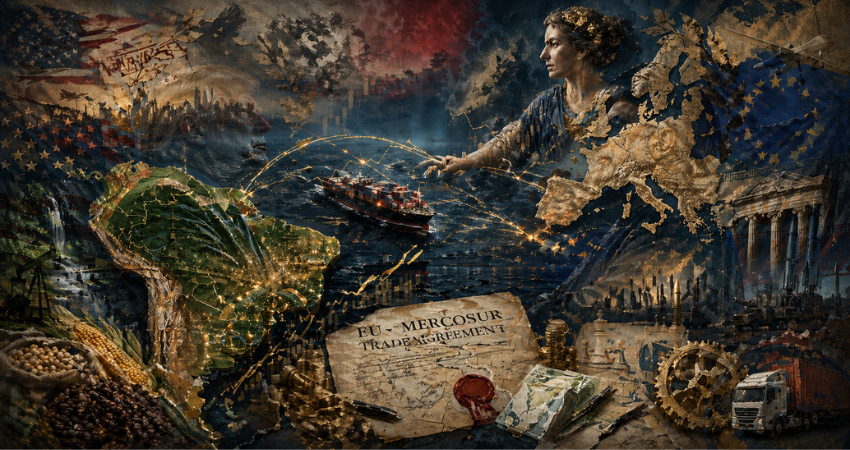
The Week That Shaped the World — 24 April - 1 May 2026
EU–Mercosur Trade Deal: Europe Looks South to Escape US Tariffs and China Dependence — and Other Major Stories of the Week
Trade blocs, canal politics, battlefield AI, China’s reach, and the rising cost of building the future
This was not a week of one crisis. It was a week of rearrangement.
Not the dramatic kind, with flags lowered, governments falling and markets pretending to discover risk for the first time. Something quieter. More structural. The sort of week in which the world did not necessarily break, but very clearly began moving its furniture.
Europe looked south, towards Mercosur, with the uneasy expression of a continent that has finally understood that trade dependence is not a policy but a vulnerability with better stationery. Panama found itself pressed between American suspicion and Chinese influence, which is what happens when geography becomes too valuable for neutrality. Ukraine, meanwhile, pushed further into battlefield artificial intelligence, not as science fiction, but as survival logistics with algorithms attached.
China was everywhere without needing to be everywhere at once. In Taiwan diplomacy. In Pakistan’s naval modernisation. In electric vehicles turning into self-reasoning machines. In the slow, hard architecture of influence that does not always announce itself with speeches, because ships, chips and industrial policy speak perfectly well on their own.
Then came technology, that great modern theatre of optimism and expense. Google Cloud showed investors a glimpse of the AI payoff. Microsoft reminded them that the bill is still enormous. SpaceX, through Starlink’s cash and AI’s appetite, offered a less tidy version of the same story: the future is not weightless. It burns capital, electricity, chips and patience.
Even Portugal’s resilience plan belonged to the same week’s deeper logic. The age of cheap assumptions is ending. Energy grids, trade routes, data centres, submarine fleets, electric cars and military systems are all being rebuilt around the same brutal recognition: the world no longer trusts the old operating system.
It would be tempting to call this transition. That sounds too polite.
What we are watching is rewiring — uneven, expensive, strategic and occasionally disguised as ordinary policy.
“The future is not arriving as a clean invention. It is being rebuilt out of trade fear, military necessity and the sudden discovery that infrastructure was never boring.”
1. EU–Mercosur Trade Deal: Europe Looks South to Escape US Tariffs and China Dependence
Europe has spent years speaking about strategic autonomy as though repetition might eventually become capacity.
This week, at least, it tried to turn one phrase into movement. The European Union began pushing forward the practical opening of its long-contested trade arrangement with Mercosur, the South American bloc whose members include Brazil, Argentina, Paraguay and Uruguay. On paper, this is trade policy. In reality, it is something more revealing: Europe looking for room to breathe in a world where old dependencies have become more expensive, more political and much less comfortable.
The agreement has always been difficult. France worries about agriculture and environmental standards. Germany and Spain see industrial and export opportunity. Brussels, as usual, wants to present the whole thing as orderly European strategy rather than a negotiated argument with customs paperwork attached. But the timing matters more than the ceremony. Europe is trying to reduce exposure — to American tariff pressure, to Chinese resource leverage, to a global trading system that no longer feels quite as rules-based as its brochures suggest.
That is why Mercosur matters. Not because it solves Europe’s problems. It does not. A trade pact cannot manufacture political courage, rebuild industrial depth or erase the continent’s chronic habit of discovering urgency several years late. But it can signal direction. Europe is trying, however awkwardly, to widen its economic map.
There is something almost old-fashioned about the move. Ports, food, cars, minerals, duties, standards, farmers, exporters — all the heavy nouns of real economy. After years in which globalisation was described as though it were a cloud service, trade has returned to earth. Soil, metal, ships and political bargaining are back at the centre.
And Europe, perhaps reluctantly, is remembering that influence is not only declared in Brussels. It is negotiated in supply chains.
The gamble is obvious. Europe wants access without backlash, growth without revolt, autonomy without too much domestic discomfort. A familiar ambition, then. But this week it became harder to avoid the conclusion that standing still may now be the greater risk.
“Europe’s Mercosur gamble is not a sudden act of confidence. It is the sound of a continent realising that dependency has become too expensive to call stability.”
2. Panama Learns the Price of Sitting Between Two Giants
Panama did not move. The world moved around it.
That is often the fate of strategic geography. A country can remain exactly where history placed it and still find itself suddenly accused of choosing sides. This week, Panama’s president found himself defending the country’s position as tensions over port contracts near the Panama Canal pulled the country deeper into the familiar rivalry between Washington and Beijing.
The canal is not merely infrastructure. It is an argument in concrete and water. It carries a meaningful share of global maritime trade and sits in that dangerous category of assets which are too important to be treated as local, yet too sovereign to be openly claimed by outsiders. Everyone respects Panama’s sovereignty, naturally. They simply develop very energetic opinions about who should operate near it.
The dispute around port contracts connected to Hong Kong-based interests has become a neat example of modern power politics. The United States sees Chinese commercial presence near critical trade routes as a strategic problem. China sees pressure against its firms as containment dressed in legal language. Panama sees itself in the middle, which is another way of saying that smaller states are often expected to absorb the anxieties of larger ones while pretending the arrangement is voluntary.
There is no need to exaggerate this into melodrama. Nobody needs gunboats for the message to be clear. The twenty-first century is increasingly fought through contracts, operating rights, inspections, arbitration, financing and control of logistical chokepoints. Empire has discovered paperwork. It suits the age.
What makes Panama’s position so delicate is that neutrality becomes harder when geography becomes more valuable. A canal is not a neutral object once great powers begin measuring vulnerability through it. A port is not simply a port when container flows, naval concerns and political suspicion start sharing the same map.
Panama’s problem, then, is not merely a dispute over contracts. It is the deeper problem of being essential.
And in modern geopolitics, being essential is rarely peaceful.
“Small states are often told they are free to choose. Then the great powers arrive to explain which choices are responsible.”
3. Ukraine Turns the Battlefield Into an AI Laboratory
Ukraine is no longer only fighting a war. It is helping define the next one.
That sounds cold, perhaps even indecent. War should not be turned too easily into a technology case study, especially by people sitting far from the mud, fear and exhaustion of the front. But ignoring the transformation would be dishonest. Ukraine’s battlefield has become one of the most intense testing grounds for artificial intelligence, drones, autonomous systems, electronic warfare and data-driven military adaptation anywhere in the world.
This week’s renewed attention to Ukraine’s defence AI ambitions made one thing clear: the country is not treating autonomy as a futuristic luxury. It is treating it as a necessity. Drones, unmanned ground systems, targeting assistance, logistics, battlefield awareness, electronic defence — these are no longer experimental ornaments around the edge of war. They are moving towards the centre.
The official language, understandably, avoids the crudest dystopian version of the story. This is not presented as a rush towards killer robots. It is presented as a way to reduce risks to soldiers, speed up decisions and survive against a larger opponent. That distinction matters. It also does not remove the deeper unease.
Once war absorbs a technology, it rarely gives it back unchanged.
Ukraine’s logic is hard to dismiss. A country fighting for survival does not have the luxury of philosophical purity. If algorithms can help detect threats faster, protect soldiers, guide machines through dangerous terrain or process battlefield information at a speed humans cannot match, the pressure to use them becomes overwhelming. Necessity is not always ethical. But it is persuasive.
For Europe and NATO, this should be a warning as much as a lesson. The future of defence is being written in conditions of urgency, not committee comfort. Procurement cycles, doctrine papers and cautious innovation programmes look increasingly slow beside a battlefield where adaptation can decide who lives until morning.
There is a terrible clarity in that.
The next war will not wait politely for institutions to understand the last one. Ukraine understands this because it has no choice. Everyone else may learn it later, at greater cost.
“Battlefield AI is not arriving as science fiction. It is arriving as a soldier’s attempt to survive one more day in a war that no longer moves at human speed.”
4. Beijing Puts Taiwan Back at the Centre of the Table
China did not need to raise its voice this week. It simply placed Taiwan back where Beijing believes it belongs: at the centre of every serious conversation with Washington.
The message was direct enough. Taiwan remains the greatest risk in US-China relations. That phrase may sound familiar, almost routine by now, but routine should not be mistaken for irrelevance. In diplomacy, repetition is often the point. Beijing repeats its red lines because it wants them heard before the next summit, before the next miscalculation, before the next American official discovers a new way to sound firm in front of cameras.
The timing matters. With attention spread across trade tensions, military alignments, technology competition and the approaching Trump-Xi encounter, China’s warning was less an isolated statement than a piece of positioning. Beijing is shaping the room before the meeting happens. It is reminding Washington that tariffs, chips, ports and capital flows may all be negotiated in one way or another — but Taiwan sits in a different category.
That is the danger. Some disputes can be managed because both sides secretly understand the theatre. Taiwan is different because symbolism, military posture, domestic politics and national identity are all packed into the same issue. There is very little spare space inside it for graceful retreat.
Washington knows this. Beijing knows this. Taipei knows it most of all.
The question is not whether the Taiwan issue is new. It is whether the strategic environment around it is becoming less forgiving. China is stronger than it was a decade ago. The United States is more openly confrontational. Regional allies are more alert. Technology supply chains, especially semiconductors, have made Taiwan not only a political flashpoint but an industrial nerve centre of the modern economy.
That makes every diplomatic phrase heavier than it appears.
Beijing’s warning this week was therefore not noise. It was a marker. A reminder that beneath the managed language of great-power talks lies one issue that can still turn strategy into crisis with frightening speed.
“Taiwan is not merely a dispute between Washington and Beijing. It is the place where maps, memory, chips and national pride all refuse to stay separate.”
5. China Builds Pakistan’s New Underwater Leverage
Some strategic shifts arrive with fireworks. Others arrive under water.
Pakistan’s commissioning of its first Chinese-built Hangor-class submarine is one of those quieter developments that deserves more attention than it will probably receive. It does not have the immediate drama of a battlefield breakthrough or a diplomatic clash. But it says a great deal about where regional power is moving, and how China is building influence not only through trade, but through military architecture.
The submarine is part of a broader programme that will eventually expand Pakistan’s undersea capability. Some vessels are being built in China, others are expected to involve domestic construction in Pakistan. That detail matters. This is not simply a purchase. It is a relationship of transfer, dependency, training, capability and long-term defence alignment.
For Pakistan, the logic is clear. The navy wants stronger deterrence, especially in relation to India. Undersea platforms complicate an adversary’s calculations. They are difficult to track, politically useful, militarily significant and symbolically powerful. For a state that sees itself locked inside a permanent security competition, a submarine is not just a machine. It is an argument about survival.
For China, the benefits are broader. Defence exports deepen relationships in ways that ordinary trade cannot. A country that buys your submarines also buys your maintenance structures, training ecosystems, spare parts, technical standards and strategic familiarity. Influence, in this form, does not need to shout. It becomes embedded.
That is the real story. China’s reach is no longer best understood only through ports, roads and factories. It is increasingly visible in naval modernisation, defence platforms and the slow building of partner capability across strategically sensitive regions.
India will notice. The United States will notice. The Arabian Sea will not become less important.
The commissioning of one submarine does not transform the balance of power overnight. But it points towards a patient strategy: help partners acquire tools that make regional rivals think twice, while binding those partners more closely to Beijing’s industrial and military ecosystem.
That is how influence accumulates.
Not always in speeches. Sometimes in steel.
“China’s power is not only expanding across maps. It is being assembled inside the machines other countries will depend on when the water gets dark.”
6. Google Cloud Shows the First Real Shape of the AI Payoff
For a while, the AI boom sounded like a sermon delivered by accountants with access to science fiction.
The promise was enormous. The spending was larger. The returns, depending on whom one asked, were either imminent, misunderstood or quietly hiding somewhere behind a very expensive data-centre door. This week, Google Cloud gave investors something more solid to look at: evidence that AI infrastructure can become revenue, not merely a capital expenditure line with heroic adjectives attached.
Alphabet’s cloud business delivered striking growth, helped by enterprise demand for AI tools, infrastructure and custom chips. That matters because the market has started asking a less romantic question about artificial intelligence. Not “will AI change the world?” That debate is over, at least for investors. The better question is: who can turn the cost of building AI into durable commercial power?
Google’s answer this week was unusually convincing. The company has the search business, the AI research depth, the cloud platform, the chips and the distribution. In other words, it is not merely renting enthusiasm. It is trying to own enough of the stack to convert demand into margin.
This is where the story becomes more interesting than another quarterly triumph. AI is creating a new hierarchy inside Big Tech. It is no longer enough to have models. Models need compute. Compute needs chips. Chips need power. Power needs sites, cooling, contracts, grid access and political tolerance. The cloud companies that can organise that entire chain will have an advantage that looks less like software and more like industrial command.
That is why Google Cloud’s performance matters. It suggests that the AI economy may be entering its first serious sorting phase. The market is beginning to distinguish between companies that can spend on AI and companies that can make AI spending look economically rational.
Those are not the same thing.
The danger, of course, is overconfidence. One strong quarter does not settle the question of long-term returns. But it does change the conversation. Google is no longer simply one of the giants pouring money into the future. It is starting to show how the future might pay rent.
“The AI race is no longer about who can sound most visionary. It is about who can make the electricity, chips and data centres produce cash before investors lose patience.”
7. Microsoft Bets Bigger as the AI Bill Keeps Rising
Microsoft has the calm voice of a company that knows the bill is enormous and would prefer everyone to admire the ambition before reading the invoice.
This week, the company’s cloud outlook remained strong, with Azure expected to continue expanding at a pace that keeps Microsoft firmly inside the first rank of the AI infrastructure race. But the more revealing part of the story was not only growth. It was spending. Microsoft’s planned capital expenditure for 2026 points to an AI build-out of extraordinary scale, shaped by data centres, chips, infrastructure bottlenecks and the rising physical cost of digital dominance.
The old software business had a beautiful economic mythology. Write once, sell many times, scale almost magically. AI has disturbed that dream. It scales, yes, but not without hunger. It demands chips, electricity, cooling, land, supply contracts and engineering capacity. It turns the cloud into something closer to heavy industry with better branding.
Microsoft understands this better than most. The company cannot afford to underbuild. If demand arrives and capacity is not ready, rivals gain ground. If it overbuilds and customers adopt more slowly than expected, investors begin asking whether the AI future has become a very elegant bonfire for free cash flow.
That is the uncomfortable middle in which Microsoft now operates.
There is also the Copilot question. Corporate AI adoption is real, but it is not always as frictionless as promotional language suggests. Large organisations move slowly. Budgets are scrutinised. Workers resist, misunderstand, experiment, adopt, abandon and return. AI tools may eventually become normal office infrastructure, but normality takes time, and time is expensive when one is spending at Microsoft’s scale.
Still, the company has little choice. In this race, restraint can look sensible right up until it becomes surrender. Microsoft is betting that demand will justify the expense, that cloud growth will absorb the pressure, and that enterprise AI will mature into a durable revenue engine.
It may be right.
But the week made one thing plain: the AI age is not cheap, and leadership in it may belong less to the cleverest model than to the strongest balance sheet.
“Microsoft is not merely investing in AI. It is buying the right not to be left behind by a future that charges rent in chips, power and patience.”
8. Starlink Earns. AI Burns. SpaceX Changes Shape
There was a time when SpaceX’s story was satisfyingly simple, at least in myth. Rockets went up. Satellites spread across the sky. Mars remained somewhere in the corporate imagination, glowing red and conveniently distant.
Now the story is becoming stranger.
Starlink has grown into the cash-generating engine inside the SpaceX universe, the part of the business with customers, subscriptions and a clearer commercial rhythm. But AI’s appetite is changing the financial picture around Elon Musk’s wider empire. The company’s resources and strategic direction are increasingly tied to the same capital-hungry race reshaping the rest of technology: compute, models, infrastructure and the enormous cost of remaining relevant in artificial intelligence.
This should not be read too crudely. SpaceX has not stopped being a space company. Rockets still matter. Satellite networks still matter. Launch capacity still matters. But the financial gravity has shifted. When satellite cash begins helping fund AI ambition, the company becomes harder to categorise. It is no longer only about access to orbit. It is also about the infrastructure of intelligence, communications and machine-scale computation.
That makes SpaceX a useful symbol of the current moment. Every successful technology platform now seems to discover, sooner or later, that AI wants a seat at the table and then proceeds to order the most expensive thing on the menu. The question is not whether AI is strategically important. It is whether the cash flows supporting it can keep pace with the scale of the ambition.
Starlink’s success gives SpaceX unusual room to manoeuvre. It also creates a new vulnerability. The stronger the cash engine, the more tempting it becomes to use that engine to feed adjacent visions. Some of those visions may become enormously valuable. Others may simply burn through money with revolutionary confidence.
The market has seen that film before.
What makes this case different is the combination: satellites, rockets, broadband, AI and private capital moving under one strategic roof. That is not a normal company. It is an ecosystem trying to become a future infrastructure state.
And future infrastructure states are never inexpensive.
“Starlink may be earning the money, but AI is increasingly writing the spending plan. That is how a space company begins to look like something much harder to define.”
9. China’s Electric Cars Are Becoming AI Machines
China took a quarter-century to become the central force in electric vehicles. It does not intend to spend another quarter-century waiting for the next phase.
This week, the country’s automotive industry offered another glimpse of where Beijing wants the sector to go: beyond electric cars as battery-powered transport, towards AI-driven machines built on Chinese software, Chinese chips and Chinese industrial coordination. The car is becoming less a vehicle in the old sense and more a rolling technology platform with seats attached.
That transition matters because China’s EV rise was never merely about cars. It was about manufacturing depth, battery control, supply chains, urban policy, export ambition and state-guided industrial patience. AI now gives that machine a new direction. If the next generation of vehicles is defined by autonomous systems, embedded intelligence, driver assistance, data flows and software ecosystems, then China wants to be inside the operating layer, not merely the assembly line.
The phrase “AI Plus” captures the ambition. Artificial intelligence is not treated as a sector on its own, but as something to be fused into manufacturing, healthcare, mobility and almost every other strategic industry. Cars are an obvious candidate. They are expensive, visible, exportable and increasingly defined by the quality of their embedded software.
For Western automakers, this should be uncomfortable. Many are still trying to manage the old transition from petrol to electric while China is already accelerating into the next one. The danger is not simply that Chinese cars become cheaper. It is that they become smarter, more integrated and more difficult to compete with on the terms Western firms thought they understood.
There are risks, of course. Autonomy is technically difficult. Regulation will matter. Consumer trust will not arrive automatically. Data concerns may limit exports in some markets. But China’s advantage lies in its willingness to align industrial policy, company ambition and national strategy behind a clear direction.
That is not always elegant. It is often effective.
The electric car was the first act. The AI car may be the one that unsettles the old automotive order properly.
“China’s EV industry is no longer only trying to replace the engine. It is trying to own the intelligence inside the machine.”
10. Portugal Puts a Price on Resilience
Resilience used to be one of those words governments deployed when they wanted to sound serious without admitting how fragile things had become.
Portugal gave it a number this week.
A major long-term investment plan aimed at climate risks, storms, blackouts and infrastructure weakness may not sound like the most glamorous item in a global digest. That is precisely why it matters. The future is increasingly being shaped not only by wars, elections and technology platforms, but by whether states can keep grids running, homes protected, water managed, energy stored and businesses functioning when the weather, the market or the system fails.
Portugal’s plan belongs to a much larger European anxiety. The continent is discovering that energy transition without grid resilience is not a strategy. It is a vulnerability with good intentions. Renewable power, electrified transport, data centres, heat pumps, storage, industrial demand and ageing infrastructure are all colliding inside systems that were not built for this level of pressure.
Then come the storms. Then the blackouts. Then the inquiry reports, the emergency statements and the belated admission that prevention would have been cheaper than repair.
That is the part of the story politicians rarely enjoy. Resilience is expensive when done early and humiliating when done late. It requires investment in things voters do not always see until they fail. Cables, substations, dams, storage, reinforcement, planning, backup capacity — these are not campaign poetry. They are the hidden skeleton of modern life.
Portugal’s decision is therefore more than a national infrastructure plan. It is a sign of the new economic age. States are beginning to price continuity. Not growth, not innovation, not competitiveness in the abstract — continuity. The ability to function when shocks arrive.
And shocks will arrive.
The old economic imagination treated infrastructure as background. Roads, grids, ports and networks were presumed to exist, like weather or gravity. That assumption is now collapsing. Infrastructure has returned to the foreground because failure has become too costly to ignore.
Portugal is not alone in facing this. It is simply putting a number on the truth earlier than some others.
“Resilience is what governments call infrastructure after the public has seen what happens when it fails.”
Closing Note
The week did not belong to one battlefield, one company or one diplomatic quarrel.
It belonged to the systems underneath them.
Trade routes. Cloud platforms. Submarine fleets. Car software. Energy grids. Military algorithms. Ports. Data centres. The world’s real power is moving through the physical and digital structures that decide what can move, who can see, who can build, who can compute and who must ask permission.
That is why this week felt less like a sequence of separate stories than a single mechanical sound beneath the floorboards. The world is rewiring itself. Not smoothly. Not fairly. Certainly not cheaply.
But unmistakably.
And those who still think the future is mainly written in speeches may want to look instead at contracts, cables, chips, ships, substations and the quiet places where power is actually installed.
“The new world order will not be announced. It will be connected, financed, defended and switched on — one system at a time.”