
From travel and VPNs to shared logins, automated tools and sensitive prompts, here's what can really put your AI account at risk — and what to do about it.
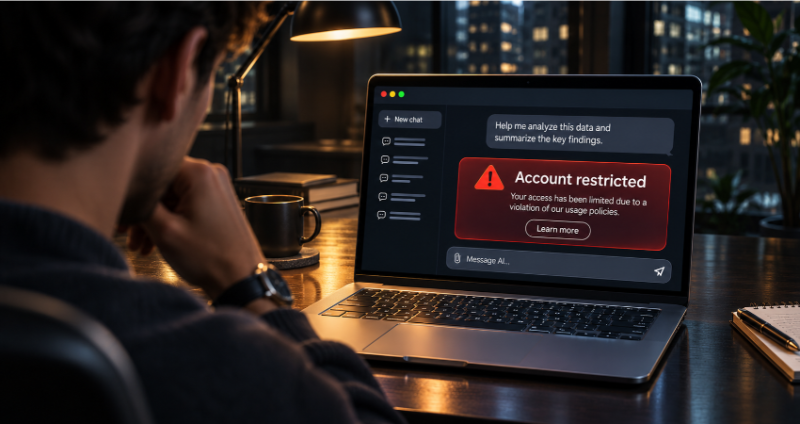
Imagine opening ChatGPT on Monday morning and finding that your account has been disabled. The research for your next article is in there. So are notes for a business proposal, half-finished code and conversations you meant to return to. You can see none of them.
You may have paid for the service for years. That doesn't settle the matter.
In the first half of 2026, Anthropic reported banning 11.4 million accounts. It also recorded 398,000 appeals and 42,000 overturned decisions. Those figures include fraudulent and automated accounts; they do not mean 11.4 million ordinary paying customers were wrongly punished. But 42,000 reversals are a reminder that account enforcement is not infallible.
The rulebooks are changing, too . Anthropic's updated Usage Policy took effect on 12 November 2026. OpenAI's revised rules followed on 20 November.
So what actually gets people into trouble? And which much-repeated stories about VPNs, browser languages and suspicious IP addresses are just speculation?
Here are 10 documented categories of risk worth knowing. Not every violation leads to a permanent ban: depending on the circumstances, providers may issue a warning, limit a feature, suspend access or close an account. The point is to avoid problems before you have to appeal one.
Why do ChatGPT and Claude accounts get banned?
The short answer: providers can restrict accounts for breaking their terms of service or usage policies — particularly through unsupported-region access, credential sharing, unauthorised automation, fraud or serious safety violations. Business users face additional rules. A model refusing to answer one question is not the same thing as an account ban.
10 real reasons your ChatGPT or Claude account could be banned
1. Using ChatGPT or Claude in an unsupported country
You live in Britain, work with ChatGPT every day and take a short trip overseas. You open your laptop in the hotel and carry on working. Nothing unusual — unless you're somewhere the provider doesn't officially operate.
OpenAI says access from an unsupported country can lead to an account being blocked or suspended. Anthropic has a similar restriction, and its rules go further for businesses: a company's place of incorporation, headquarters and ownership or control can matter even when its employees are based elsewhere.
Before travelling, check the OpenAI supported-country list and Anthropic's supported regions. If your employer operates internationally, check the company's eligibility as well as your own location. A paid subscription isn't a passport.
2. Sharing your ChatGPT or Claude login with someone else
A colleague has hit their usage limit. You have a paid account. Why not lend them your password for an hour?
Because a personal account is not a shared office resource. OpenAI's consumer terms prohibit sharing account credentials, and Anthropic's consumer terms similarly restrict sharing logins and API keys. You're also responsible for activity that takes place under your account.
Use individual accounts or an authorised team workspace instead. If a colleague needs something you've produced, send the document — not the keys to the entire account.
3. Buying discounted AI access from an unofficial reseller
A website offers Claude or ChatGPT access for a surprisingly small monthly fee. The sales pitch is convincing; the technical explanation is rather less so.
Some unofficial services rely on shared accounts or proxy access that the underlying provider has not authorised. Anthropic expressly prohibits unauthorised resale and proxy arrangements. OpenAI's latest policy requires prior approval for certain platforms that give third parties direct access to its models. That does not mean every app built with an AI API is prohibited.
Stick to official subscriptions or reputable, properly authorised services. If a seller asks for your existing login details, that's an especially good reason to walk away.
4. Scraping answers or automating a consumer account without permission
Automating work with AI is perfectly normal. Automating the *consumer website* in ways its terms prohibit is another matter.
OpenAI's consumer terms restrict automatic extraction of data and outputs. Anthropic restricts unauthorised scraping and non-human access outside permitted routes. This matters if you're using scripts to open hundreds of chats, collect answers or imitate normal browser sessions at scale.
For legitimate automated work, start with the official API and its documentation. And check what you're allowed to do with the results: using an API does not grant unlimited rights to harvest or reuse model outputs.
5. Using model outputs to train a competing AI system
This isn't a problem most casual users will encounter. But developers, researchers and AI startups should pay close attention.
Anthropic prohibits unauthorised model scraping or distillation — collecting outputs to train another model. OpenAI's November update clarifies that its models and outputs must not be used to prepare training material or signals for systems intended as substitutes for its services, except where an applicable agreement permits it.
That is different from ordinary coding assistance, permitted evaluation or benchmarking. If your project involves collecting answers for machine-learning training, read the commercial conditions before building the dataset.
6. Trying to bypass safety controls or evade a previous ban
ChatGPT refuses an answer. You think the refusal is wrong. You're entitled to explain the context and try asking a clearer question.
What can cause trouble is a deliberate effort to defeat safeguards, circumvent rate limits or evade restrictions imposed on your account. Anthropic's terms also prohibit creating another account to get around a ban.
A refusal isn't a disciplinary notice. If you believe a restriction is mistaken, use the provider's review process rather than attempting to outsmart its security systems.
7. Creating phishing messages, fake reviews or deceptive campaigns
There's nothing wrong with asking AI to polish a customer email. There is something very wrong with asking it to impersonate a bank and persuade customers to surrender their passwords.
Both providers prohibit fraud, scams and misleading impersonation. Anthropic's November policy also draws a sharper line around coordinated deception: networks of fake accounts, fabricated news outlets, concealed sponsorship and manufactured public support.
That is particularly relevant to marketers and publishers. A fictional character in a novel is fine. A supposedly independent reviewer who never existed, deployed to deceive customers, is not. Keep the identity and purpose behind your communications clear.
8. Using AI to facilitate serious harm or unauthorised hacking
Some conduct is in a different category altogether. Both companies prohibit assistance for serious violence, weapons-related harm and child sexual exploitation. Such activity can have consequences beyond an AI account being closed.
Cybersecurity has its own essential distinction. Using Claude Code or Codex to help secure systems you own, or to work within an authorised test, is not the same as using it to intrude into someone else's network. Anthropic's policy explicitly makes room for authorised security research while prohibiting malicious intrusion.
Journalists, students and researchers can discuss difficult subjects. The problem is requesting operational help to carry out prohibited harm, not the mere act of mentioning an uncomfortable topic.
9. Tracking people or exposing private information without permission
AI can combine scattered facts into a remarkably detailed profile of a person. That makes it useful for legitimate research — and potentially dangerous for stalking or surveillance.
OpenAI restricts unauthorised profiling and disclosure of private or sensitive information. Anthropic's November rules explicitly prohibit certain tracking of people without consent, including analysis of previously collected data.
Before uploading someone else's personal information or building a monitoring tool, ask a basic question: do you have a lawful basis and the necessary permission? The fact that an AI model *can* find patterns in someone's life doesn't mean you have the right to use them.
10. Letting AI make high-stakes decisions without proper human oversight
Imagine a landlord using an AI system to rank applicants and automatically reject people who don't fit its preferred profile. No one checks the reasoning; the model makes the decision.
OpenAI prohibits automating consequential actions in sensitive areas without human review. Anthropic requires meaningful review by a qualified person and disclosure of AI involvement for specified high-risk recommendations. Housing, employment, credit and healthcare are among the areas covered, though the details differ between the providers.
If you're building a tool that affects someone's job, home, finances or healthcare, a human reviewer must have real authority to change the outcome. A rubber stamp isn't oversight.
Can using a VPN get your ChatGPT or Claude account banned?
Using a VPN is not, by itself, a publicly documented automatic reason for permanent account closure. People use VPNs for perfectly ordinary privacy and workplace security reasons.
What matters is whether access breaks the provider's regional rules or other terms. A VPN doesn't make an unsupported location supported. And neither company publishes a complete list of the anti-fraud signals it uses to assess every connection.
You may see online claims that a mismatched time zone, a Russian-language browser, WebRTC data or logging in from two devices will inevitably get you banned. Those claims go beyond what the companies publicly confirm. Unusual activity can prompt a security check; that is not proof of an automatic permanent ban.
Can ChatGPT ban you for asking controversial questions?
Not simply for discussing a sensitive subject. A journalist reporting on a war, a student examining extremist movements or a novelist researching a crime isn't automatically violating a usage policy.
There is a meaningful distinction between asking about harmful activity and requesting help to carry it out. If a model refuses a legitimate question, explain the context. Don't treat the refusal as evidence that your account is already marked for closure.
Can a failed payment or identity check get your account disabled?
Yes, access can be restricted — but that isn't necessarily a permanent policy ban. A declined card may be a routine billing problem, while a required identity or age check can temporarily prevent access until it is completed. OpenAI also warns that payment methods from unsupported countries can lead to being blocked.
Read the actual error message before assuming the worst. A billing hold, security check and account closure have different remedies.
Does turning off AI training stop the provider from checking your chats?
No. Training preferences and safety enforcement are different things. OpenAI describes separate data controls for model improvement and safety-related monitoring. Anthropic says conversations flagged for safety review may still be analysed for policy enforcement.
That doesn't mean every conversation is read by a human. It does mean that switching off model training should not be mistaken for an exemption from safety checks. For confidential work, also consider the privacy terms of the specific consumer, business or API product you're using.
What should you do if your ChatGPT or Claude account is banned?
First, establish what has happened. Is it a temporary suspension, an identity-verification issue, unusual activity on the account or an actual closure? The wording of the notice matters.
For ChatGPT, follow the appeal instructions in the account notice, or use the OpenAI Help Centre. For Claude, sign in to the restricted account and use Anthropic's appeal process. A review is possible; reinstatement is not guaranteed.
Keep your appeal short and factual. Include the dates, what you were doing, why you believe the decision is wrong and any indication that somebody else accessed your account. Change compromised passwords and revoke exposed API keys. Don't send full card details in a support message.
Anthropic says some banned users can still export account data, though restrictions may apply. That is worth checking before assuming every conversation has been lost for good.
How to use ChatGPT and Claude safely: a quick checklist
- Check supported regions before travelling or setting up international access for a company.
- Keep logins and API keys private; use separate authorised accounts for colleagues.
- Build automation through approved APIs and check the rules for reusing outputs.
- Avoid grey-market subscriptions, impersonation, spam and attempts to bypass safeguards.
- Keep qualified people responsible for decisions affecting jobs, housing, money or healthcare.
- Act on official warnings, and appeal apparent mistakes promptly.
- Back up work you can't afford to lose. ChatGPT offers data export, and Claude has an export option, subject to product and account restrictions.
Can OpenAI or Anthropic ban a paying customer permanently?
Yes. A subscription buys access under a set of conditions; it does not guarantee that access forever.
But this isn't a reason to become afraid of every prompt you type. For most people, the real precautions are quite ordinary: know where you're permitted to connect, don't share credentials, use legitimate tools, respect other people's rights and keep copies of important work.
The more interesting question is how quickly an AI account has become a place where people keep their professional lives. A writer's research, a developer's experiments, an entrepreneur's plans — all sitting behind a login they don't ultimately control.
Providers need to stop misuse. Users need clear rules and a fair chance to challenge mistakes. Those two things should be able to coexist.
Until they reliably do, there's one habit I'd recommend above all others: let AI help you do the work, but never let your AI account become the only place the work exists.
Official sources and further reading
- OpenAI — Usage Policies
- OpenAI — Terms of Use
- OpenAI — Account warnings, suspensions and closures
- OpenAI — Supported countries and territories
- Anthropic — Usage Policy
- Anthropic — Supported Regions Policy
- Anthropic — Transparency Hub, enforcement data
- Anthropic — Safeguards warnings and appeals