
Who Owns the Revolution?
Inside the digital networks, political interests and economic forces behind France's unrest
A Special Investigation by Adam Jenkins | Prime Economist
The Revolution Before the Revolution
On the evening of 17 October, flames consumed the roof of a nineteenth-century town hall in Limoges.
The building had survived two world wars. It did not survive a Saturday of political unrest in modern France.
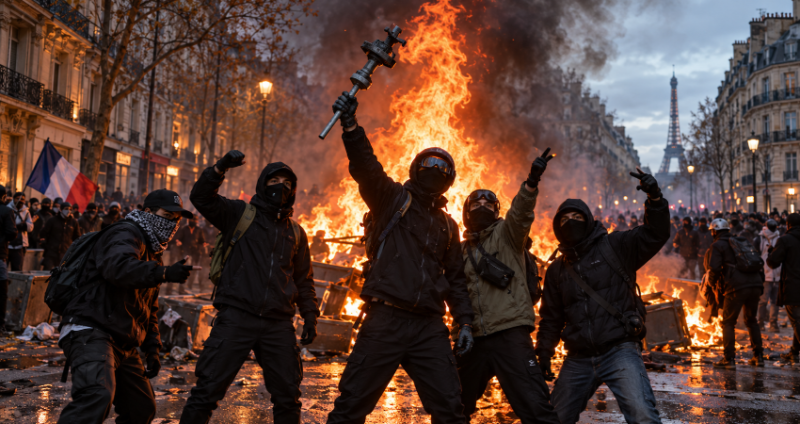
Elsewhere, luxury shop windows shattered, vehicles burned, police retreated under attacks and masked men moved through streets crowded with demonstrators. By the following day, France was confronting some of its worst civil disorder in decades.
But the most revealing part of this story began considerably earlier.
Before the broken windows, before the burning buildings, before hundreds of thousands of people appeared in the streets, there had been a date.
17 October 2026.
It travelled across TikTok, appeared on digitally generated posters and circulated through accounts whose operators were not always identifiable. The messages promised something resembling a nationwide uprising.
There was just one rather significant difficulty.
Nobody could establish who was actually organising it.
The first identifiable call appeared in September on a TikTok account belonging to a young man known as V2. His complaint was neither revolutionary nor particularly mysterious: fuel had become too expensive.
The video attracted approximately 1.5 million views.
V2 subsequently abandoned his plans to organise the demonstration. Yet the date continued travelling.
Others had apparently discovered a use for it.
An investigation published by Le Monde in September identified suspicious accounts created or renamed on 9 September. Many circulated similar messages and artificial intelligence-generated posters promoting 17 October as an apparently established day of national mobilisation.
The material created an impression of organisation without establishing the existence of an organiser.
Some accounts appeared interested in attracting followers, potentially for commercial purposes. French authorities found little evidence of significant foreign interference in the initial campaign.
These details complicate the familiar explanation of a revolution secretly designed by a single powerful institution.
But they reveal something arguably more important.
A political movement can now acquire its symbols, mythology and advertised starting date before it acquires a leadership structure.
And a campaign that begins without identifiable command can still become extraordinarily useful to those who know how to exploit it.
The revolution had not yet found its headquarters. It had already found its audience.
The Machinery of a Movement
For much of the twentieth century, large political demonstrations required an organisational infrastructure.
Someone printed the leaflets. Someone booked the buses. Someone contacted the unions, coordinated local committees and arranged for speakers.
These activities required money, time and identifiable institutions.
Digital mobilisation has changed the economics.
A single video can reach more people than thousands of printed leaflets. An AI-generated image can be reproduced, translated and modified almost without cost. Messaging platforms allow individuals who have never met to assemble around a shared date, symbol or grievance.
The barriers to participation have fallen dramatically.
So have the barriers to imitation.
By 16 October, the monitoring company Visibrain had counted approximately 460,000 social media posts concerning the proposed demonstrations since 27 September.
Videos mentioning 17 October had accumulated 132 million TikTok views and 18 million likes.
Those numbers require careful interpretation. Views are not individuals, engagement is not commitment, and the popularity of a video does not establish the existence of a functioning political organisation.
Nevertheless, attention changes expectations.
A person who believes hundreds of thousands of others intend to demonstrate may become more willing to participate. An established activist organisation may reconsider an event it initially dismissed as an internet fantasy.
That is precisely what happened.
Prominent figures associated with the Yellow Vest movement, initially sceptical about the proposed date, began treating it as an opportunity to revive public discussion of everyday economic hardship.
By early October, activists such as Maxime Nicolle and Jérôme Rodrigues were publicly reconsidering the mobilisation.
Meanwhile, existing Facebook groups reactivated, local demonstrations were discussed and student organisations began incorporating the date into their own plans.
No single piece of this process demonstrates central direction.
Together, however, the pieces explain how a date can become a political institution of sorts.
It begins as information.
It becomes expectation.
Eventually, enough people act upon that expectation to transform it into reality.
This is not necessarily manipulation. Social movements have always depended on the belief that other people will participate.
What technology changes is the speed at which that belief can be manufactured, amplified or mistaken for proof.
And that creates opportunities for actors whose motives may have little in common with those of the original protesters.
The Students Who Had Actual Grievances
To understand why the digital campaign mattered, one must examine what was already happening outside the internet.
On 17 September, students began blockading schools in Créteil, near Paris.
They complained of overcrowded classrooms, deteriorating buildings, staff shortages and inadequate educational resources.
These were not abstract demands.
The students attended the institutions they were criticising. Their teachers confronted the shortages. Parents worried about the consequences for their children's education.
The demonstrations spread through Parisian suburbs and eventually across France.
By early October, large numbers of students, teachers and parents were participating in protests over educational conditions.
Their movement developed its own language, humour and symbolism.
Young demonstrators used internet memes, theatrical costumes and familiar cultural references alongside traditional political slogans.
This was not simply frivolity. Shared humour helped newcomers participate in an activity that could otherwise appear intimidating.
A protest movement needs more than grievances. It needs people to feel that they belong.
The young demonstrators had discovered ways to create that belonging.
Then their movement began converging with the mobilisation planned for 17 October.
Visibrain estimated that approximately one-fifth of the social media content concerning the date was associated with student demands.
This figure does not demonstrate that the students were recruited into a carefully planned operation. It demonstrates that two previously distinguishable movements increasingly shared a political moment.
Fuel prices brought one audience.
Educational conditions brought another.
Trade union networks and veteran protesters supplied further organisational experience.
The convergence was powerful precisely because the grievances were different.
People did not need to agree on a complete political programme. They needed only to believe that the existing situation had become unacceptable.
Here lies an important distinction.
The digital networks did not have to invent French dissatisfaction.
They encountered a country already capable of producing it.
A manufactured invitation can attract genuinely angry guests. Their anger does not become artificial simply because someone else printed the invitation.
The Saturday That Changed the Argument
On 17 October, the internet's political experiment entered physical reality.
France's Interior Ministry estimated that approximately 550,000 people demonstrated nationwide. Organisers placed the number closer to 800,000.
Most participants protested peacefully.
Others attacked police, looted shops and damaged public buildings.
In Limoges, the town hall suffered devastating fire damage. In Marseille, people forced their way into municipal premises. Serious disorder also affected Paris, Lyon and other cities.
The violence continued into the following day.
Thousands were detained. Police officers, firefighters and demonstrators suffered injuries. Businesses faced damaged premises and lost income.
The immediate consequences were obvious.
The questions of responsibility were less straightforward.
A mass demonstration may contain peaceful citizens, experienced activists, opportunistic criminals and groups prepared to use violence. Sharing geographical space does not establish shared motives or common command.
The distinction is essential.
An organiser who advertises a peaceful march is not automatically responsible for every act committed by somebody nearby.
Equally, describing a violent group as merely spontaneous does not establish that its members acted without preparation.
Masks, equipment, coordinated movement and selected targets may provide grounds for investigating organisation. They do not, by themselves, reveal who supplied the equipment, issued instructions or financed the activity.
The attack on Limoges town hall has become especially significant.
French investigators have pursued suspects and examined evidence concerning the arson. The investigation raises legitimate questions about the actions of particular radical networks.
But criminal responsibility for a specific attack cannot simply be extended to an entire national protest movement.
Nor does it explain the origins of the original September digital campaign.
These are different evidential problems.
To combine them prematurely would produce a dramatic narrative at the expense of an accurate one.
Yet something else was already happening.
The public was beginning to encounter the violence not primarily through personal experience, but through competing digital representations.
And the struggle to define what had happened was becoming almost as important as the events themselves.
When Reality Became Optional
The days following 17 October produced an extraordinary quantity of manipulated information.
Some images were genuine. Others were misleadingly labelled. Some had been generated entirely by artificial intelligence.
A bizarre image of a demonstrator dressed as the Pink Panther confronting police water cannons travelled widely online.
It was not an authentic scene from the French demonstrations. The imagery was generated from material associated with an unrelated event in Kenya.
Yet it provided exactly the kind of visual symbolism that social media rewards: absurdity, defiance and instant emotional recognition.
Another widely circulated video supposedly showed French rioters launching fireworks at police.
The footage actually originated in Georgia in December 2024.
Other videos presented incidents in Belgium or earlier French disturbances as if they had occurred during the October protests.
These were not merely errors of geography.
They changed the emotional meaning of the events.
A supporter could receive a manufactured image of heroic resistance. An opponent could encounter an exaggerated depiction of indiscriminate violence.
Neither needed to invent the entire political crisis. Each required only a sufficiently persuasive illustration of what they already believed.
On 23 October, Le Monde documented the scale of the misinformation surrounding the unrest.
The French fact-checking service Vera received approximately 9,500 questions between 1 and 19 October. Nearly half concerned the authenticity of violence-related claims.
One widely reported story alleged that an elderly couple had been stripped and robbed. Prosecutors subsequently contradicted the account.
Another rumour claimed that a volunteer medic beaten by police had died. That was also false.
Both stories were powerful because they exploited existing fears.
They needed no sophisticated ideological manifesto.
The mechanism was emotional.
Present an event that confirms an audience's suspicions, and the audience may distribute it before the evidence catches up.
Political actors and foreign information networks also attempted to interpret the disorder for their own audiences.
Russian state-linked channels, international commentators and ideological influencers circulated selected images of the unrest. Some misleading accounts were translated and distributed internationally.
The claim that immigration alone explained the violence gained considerable visibility in certain political media.
But that claim was not substantiated by evidence establishing the origins or legal status of those responsible. Arrest data and individual criminal cases do not justify treating entire migrant communities as perpetrators.
The more revealing issue is why such narratives spread.
Different audiences were being offered different versions of France.
For some, it was a country collapsing under immigration.
For others, it was a population rebelling against economic injustice.
For still others, it was evidence of an authoritarian government suppressing dissent.
The images varied.
The commercial and political rewards for attention were remarkably consistent.
In the digital age, a riot has two locations: the street where it happens and the information system where its meaning is negotiated.
The Economy Beneath the Anger
The images of burning buildings explain why the protests dominated international headlines.
They do not explain why so many citizens were willing to demonstrate.
For that, one must return to economics.
France entered the autumn of 2026 confronting a difficult combination of public debt, fiscal deficits, rising living costs and pressure on essential services.
Government debt was approaching 120% of GDP.
The deficit remained substantially above the European Union's conventional 3% reference threshold.
The government's proposed 2027 budget required politically difficult decisions over taxation, spending and deficit reduction.
The problem is familiar across advanced economies.
Citizens expect functioning schools, healthcare, transport and social protection.
Governments must finance these services through taxation, borrowing or reductions elsewhere.
When debt and borrowing costs rise, those choices become increasingly constrained.
Yet public perceptions of fairness rarely follow Treasury accounting.
A student attending an overcrowded school does not experience the national deficit as a statistical argument.
A worker struggling to afford fuel does not interpret the government's borrowing requirements as a sufficient explanation for declining purchasing power.
And a household confronted with rising expenses may reasonably ask why years of economic growth and technological progress have failed to produce greater security.
These complaints have genuine foundations.
The fact that political movements may exploit them does not make the grievances imaginary.
But economic dissatisfaction becomes politically explosive when citizens disagree over who should bear the cost of adjustment.
Should public expenditure be reduced?
Should wealthy households contribute more through taxation?
Should companies accept higher costs?
Should pensions, salaries or subsidies be protected?
Every answer creates beneficiaries and opponents.
The distribution of those costs is where fiscal policy becomes a struggle over political power.
Macron's government entered this confrontation with limited room for manoeuvre.
The president is approaching the end of his second consecutive term and cannot seek immediate re-election.
The presidential contest scheduled for 2027 provides an additional incentive for political organisations to define the crisis in ways that support their competing programmes.
The government must restore public order while defending its economic strategy.
Left-wing parties seek to connect the protests with demands for social spending and redistribution.
The nationalist right emphasises public security, immigration and the authority of the state.
Trade unions defend workers and public services.
Student organisations pursue improvements in education.
These groups may simultaneously participate in, support or comment upon the same demonstrations without sharing a common objective.
This is one of the central difficulties of analysing mass movements.
A protest can be politically valuable to people who did not organise it.
And the actor who gains most from the consequences may have had little influence over the beginning.
That is why the familiar instruction to follow the money requires an additional discipline.
Follow the money, certainly. But do not mistake the beneficiary for the financier.
The Missing Financial Trail
If the unrest was organised, who paid for it?
It is a legitimate investigative question.
It is also one that must be asked with considerably more precision than is customary in political commentary.
What exactly requires financing?
A national trade union has staff, membership income, organisational experience and communications infrastructure.
An established political party possesses offices, employees and supporters.
A small student group may organise a demonstration using voluntary contributions and unpaid labour.
An anonymous social media account can distribute thousands of messages with almost no expenditure.
A violent group may require transport, equipment or other resources, but establishing how those were obtained requires evidence concerning that particular group.
There is no reason to assume these different activities share the same funding structure.
The original TikTok campaign presents an especially revealing example.
Some suspicious accounts apparently sought engagement and followers for commercial reasons. If so, their economic incentive may have been the attention generated by the supposed uprising rather than its political outcome.
This possibility is less cinematic than a secret international financing network.
It is also entirely consistent with the economics of digital platforms.
Attention has value.
Accounts with large audiences can generate revenue, promote products or be sold.
A controversial political date can therefore become an attractive commodity even to operators who care little about politics.
That does not exclude more deliberate political interference elsewhere.
But it means that similar online behaviour can emerge from very different motivations.
Political conviction, commercial opportunism, automated amplification and organised propaganda can produce overlapping digital footprints.
To distinguish them, investigators need more than unusual posting patterns.
They need financial records, verified administrative links, communications, contracts or reliable testimony establishing relationships between identifiable actors.
At present, publicly available evidence does not establish a single financial network linking the original September campaign, national student mobilisation and the violent incidents of 17 October.
That is not evidence that no such connections exist.
It is evidence that they have not been demonstrated.
For Prime Economist, this remains an open part of the investigation.
We are examining the organisational and economic incentives surrounding the movement. We cannot responsibly identify a financier or central command structure without material sufficient to support that conclusion.
A serious investigation must be capable of reaching a conclusion less dramatic than its original question.
Otherwise, it ceases to be an investigation.
It becomes a search for permission to believe.
The State and the Politics of Control
The French government's response added another dimension to the crisis.
After the disorder, Macron condemned attacks on public institutions and acknowledged failures in anticipating the scale and character of the violence.
Interior Minister Laurent Nuñez faced criticism over police preparedness but remained in office.
Authorities announced increased deployments, restrictions on certain demonstrations and tougher measures against violent groups ahead of another expected mobilisation on 24 October.
Approximately 70,000 police officers and gendarmes were to be deployed nationwide.
The official argument was straightforward: peaceful citizens and businesses needed protection from destruction.
But opposition parties and civil liberties advocates raised a different concern.
Restrictions intended to prevent violence can also limit lawful protest.
France's legal system distinguishes between the right to demonstrate and the state's responsibility to maintain public order.
Organisers ordinarily notify authorities in advance. Restrictions can be imposed on security grounds, but they remain subject to legal challenge.
The difficulty arises when large, loosely organised gatherings do not resemble the demonstrations for which these procedures were designed.
Who negotiates with the authorities when no universally recognised leadership exists?
Who has the authority to change a route, cancel an event or persuade participants to disperse?
And how should police distinguish peaceful participants from smaller groups preparing violence?
These are practical questions with political consequences.
A government that deploys too little force may allow serious destruction.
A government that responds indiscriminately may alienate peaceful demonstrators and reinforce grievances concerning policing.
Both failures can deepen instability.
The human consequences are substantial.
Police officers have reported exhaustion and injuries after prolonged deployments. Protesters have also sustained serious injuries, while complaints concerning police conduct have prompted investigations.
The competing experiences should not be collapsed into a single ideological narrative.
A police officer protecting a public building, a teenager protesting inadequate school facilities and a shopkeeper confronting the destruction of a livelihood may all be harmed by the same crisis.
None necessarily controls it.
Here, too, there is a question of incentives.
Political movements may benefit from images of excessive force.
Governments may cite serious violence to justify exceptional security measures.
Neither possibility establishes that either side deliberately created the events from which it later drew political arguments.
But both demonstrate how rapidly public disorder changes the balance between security and liberty.
And that balance may outlast the protests themselves.
The International Echo
France is not the only European country experiencing social tension.
During October, protests over energy costs, housing affordability, wages and public services also occurred in Italy, Belgium, Portugal and Spain.
The similarities are significant.
Across Europe, households are encountering economic pressures that governments struggle to relieve.
Political institutions face demands for greater spending while financial constraints encourage restraint.
Digital platforms help local grievances reach national or international audiences.
But similarity does not establish common direction.
Spain's housing demonstrations, for example, have often remained peaceful. Italian protests have involved different organisations and circumstances. Belgian and Portuguese movements reflect their own political histories and institutional arrangements.
A common European economic environment can generate similar political responses without requiring a coordinating headquarters.
That is an important alternative to the theory of a single international mechanism directing mass protests.
Yet international actors can still exploit events after they begin.
France's disorder quickly became material for political campaigns outside France.
American commentators used it to discuss immigration and European governance.
State-linked foreign information networks circulated material designed to portray French institutions as ineffective or divided.
Images were translated, repackaged and distributed to audiences with little direct knowledge of the events.
This is a form of influence that does not require organising the original demonstration.
The objective may be to change how foreign audiences interpret the country, weaken confidence in its institutions or strengthen ideological narratives.
It is entirely possible for a protest to begin domestically and later become part of an international information campaign.
Confusing those stages benefits nobody interested in discovering what happened.
One must ask separately who initiated an event, who amplified it, who organised particular actions and who subsequently exploited its political symbolism.
They may be four different sets of actors.
And if they are, the absence of a single mastermind does not mean the absence of manipulation.
Who Owns the Revolution?
The most revealing feature of France's October unrest may be the difficulty of identifying who has the authority to speak for it.
The original online mobilisation had no clearly established central leadership.
The students possessed legitimate grievances and their own organisations.
Trade unions and experienced activists supplied existing networks.
Violent groups pursued activities that cannot automatically be attributed to peaceful demonstrators.
Political parties competed to interpret the crisis.
Commercially motivated accounts discovered that revolutionary imagery attracted attention.
Foreign information networks turned the violence into material for their own audiences.
The government responded through the institutions of public security.
Each acquired some influence over a different part of the story.
None has been shown to control the whole.
This is not a comforting conclusion.
It describes a political environment in which collective action can expand faster than the institutions capable of representing, negotiating or containing it.
The initial participants may believe they are advancing specific demands.
Later participants may reinterpret those demands.
Radical groups may transform the imagery of a peaceful protest.
Political organisations may gain visibility from events they did not anticipate.
And algorithms may amplify whichever version generates the greatest emotional response.
The result is not necessarily a centrally organised revolution.
It may be something more difficult to govern: a movement whose direction emerges from competition among multiple actors with incompatible interests.
In this environment, control is temporary and ownership contested.
The organiser of yesterday's demonstration may be irrelevant to tomorrow's confrontation.
The author of a viral video may become famous without ever acquiring political authority.
And the people who suffer the consequences may have had no intention of participating.
That is the deeper problem exposed by France.
Technology has changed the speed and scale of political mobilisation without creating equally effective mechanisms of accountability.
Our investigation therefore returns to the question with which it began.
Who owns the revolution?
The existing evidence does not justify identifying a single owner.
It reveals instead a contest over ownership — between those who initiated calls for mobilisation, those who joined for genuine reasons, those who organised particular actions and those seeking to capture the consequences.
This distinction should not discourage investigation.
It tells us where to direct it.
Towards verifiable organisational links.
Towards documented financing.
Towards the decisions of political institutions.
Towards the mechanisms by which digital attention becomes physical mobilisation.
And towards the people whose interests are being invoked by organisations they may never have authorised to speak for them.
The Investigation Is Not Over
As France prepares for another weekend of demonstrations, important questions remain unresolved.
Can investigators establish direct links between the original digital campaign and organised protest structures?
What role did identifiable radical networks play in planning specific violent incidents?
Were particular activities supported by external funding, or were they organised through existing domestic networks?
How extensively did commercial engagement farming and deliberate political manipulation overlap?
And will the government's response address the grievances that brought peaceful citizens into the streets, or primarily the disorder that followed?
These are questions capable of being investigated through evidence.
They are not invitations to fill the gaps with certainty.
Prime Economist will continue examining developments as further information becomes available.
The investigation cannot be completed while relevant events are still unfolding and the relationships between participants remain only partly understood.
But one conclusion is already sufficiently clear.
The political power of a modern protest movement does not necessarily belong to the person who first calls for it.
It may not even belong to the people who form the crowd.
Power can shift towards those who organise, amplify, interpret, negotiate or exploit what happens next.
Whether that process amounts to democratic mobilisation, political manipulation or some unstable combination of the two depends on evidence that must be examined case by case.
That is where serious journalism has work to do.
France has provided the spectacle.
The task now is to understand the mechanism.
“The most dangerous illusion of modern politics is not that somebody controls everything. It is that nobody needs to take responsibility when everybody has learned how to influence the outcome.”